











From Vibe Code To Production: AI Coding Risks And Shipping Controls

Vibe coding can turn an idea into a working screen quickly. That speed is useful, especially when a team needs to explore a feature, test a workflow, or remove blank-page friction. Yet the path from vibe code to production is much more demanding than prompting an AI tool until the demo runs. Production software has to be readable, secure, testable, observable, maintainable, and aligned with real product goals.
The tension is visible across the software industry. Stack Overflow’s 2025 Developer Survey reported that 46 percent of developers do not trust the accuracy of AI tool outputs, while many still use AI tools in daily work. The practical lesson is not to reject AI coding. It is to treat AI-generated code as a fast draft that must pass normal engineering discipline before it ships.
This guide explains why vibe coding works so well early, why it often breaks down under production pressure, and what business, IT, and product teams need before AI-generated code becomes reliable software. Teams can start with low-risk features, then add review and delivery controls before wider release.
Why Vibe Coding Works Well At First
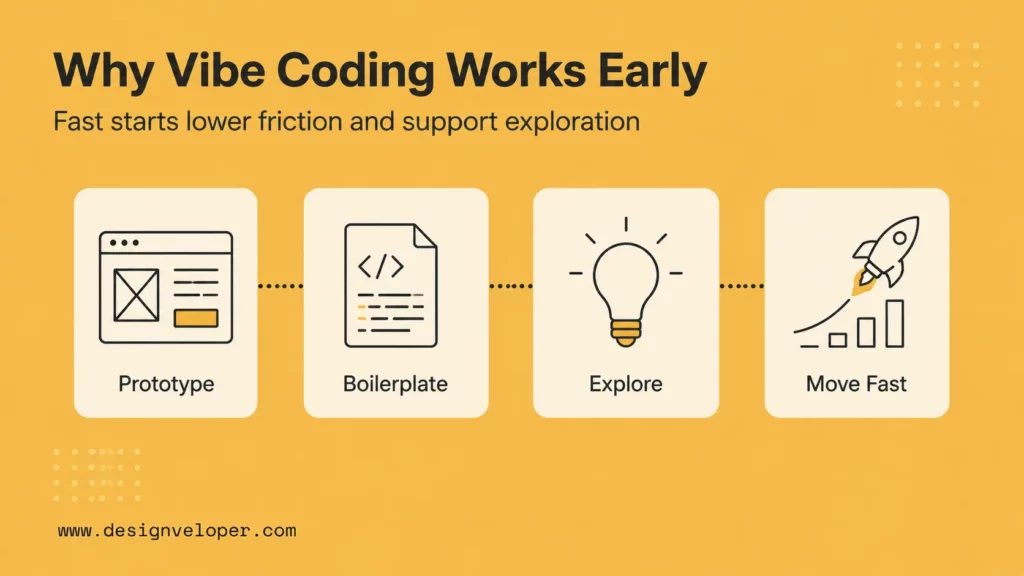
Vibe code works because it lowers the cost of starting for production. A product manager can describe a workflow. A developer can ask for a component, endpoint, database migration, or test scaffold. A founder can turn a rough concept into something that stakeholders can click. That immediacy is valuable because early product work is full of uncertainty.
AI coding tools are especially helpful when the goal is exploration. They can draft boilerplate, explain unfamiliar APIs, suggest patterns, and generate the first version of a simple feature. For teams under pressure, that can compress days of setup into hours. If you need the fundamentals first, Designveloper’s guide on what vibe coding really means explains why this workflow feels so fast at the start.
See more:
- 10 Best Practices For Prompt Engineering With Any AI Model
- Is Vibe Coding a Bad Idea or a Problem Misunderstood?
- Is Vibe Coding The Future Of Software Development or Just a Trend?
Fast Output Helps Teams Move Quickly
Speed creates momentum. A team can compare interface options, validate a user journey, or check whether a feature concept is technically plausible before investing in a full delivery cycle. AI can also help experienced engineers move through repetitive tasks faster, such as writing simple CRUD screens, converting data shapes, or producing test cases for known behavior.
The benefit is strongest when the human already understands the problem. AI can produce code quickly, but it cannot know the team’s architecture, customer contracts, operational constraints, or long-term roadmap unless that context is provided and checked.
It Works Best For Prototypes, Boilerplate, And Low-Risk Features
Vibe coding is most useful for low-risk work where the cost of being wrong is small. That includes prototypes, internal demos, disposable scripts, static screens, simple data transformations, and feature spikes. It also helps when the team needs examples of how an SDK or framework might be used.
For production systems, the same speed needs boundaries. A generated admin panel that only runs locally is different from an admin panel that can edit customer data. A generated payment flow, authentication layer, or data migration carries much higher risk because mistakes can affect privacy, revenue, and trust.
Early Momentum Can Hide Production Risks
A fast demo can feel complete before the hard work has started. The interface may look clean, the happy path may work, and the model may produce plausible code. However, the code may have weak error handling, missing authorization checks, unclear state management, poor accessibility, duplicated logic, or hidden assumptions about data shape.
This is why vibe coding should be treated as a starting point, not a delivery method by itself. The sooner the team names the risk, the easier it is to turn the momentum into a reliable product process.
Why Fast AI Code Breaks Down In Production
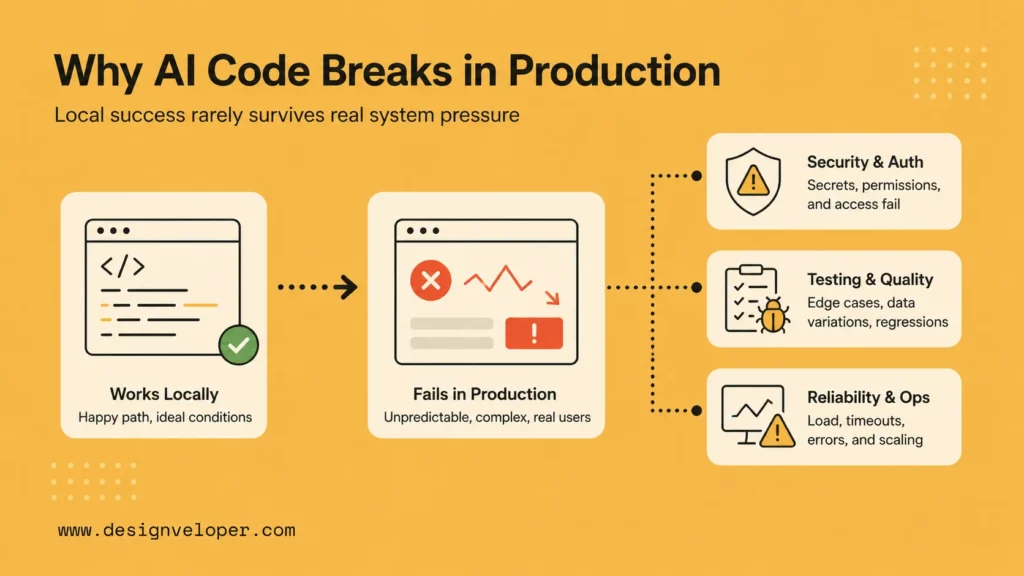
Fast AI code breaks down when local success is mistaken for system readiness. Production introduces users, permissions, integrations, traffic, support cases, monitoring, deployment pipelines, incident response, and long-term maintenance. Code that works in a prompt session may not be designed for any of those constraints.
The issue is not that AI-generated code is always bad. The issue is that generated code often arrives without the surrounding decisions that make software durable. Architecture, naming, boundaries, ownership, testing strategy, and security posture still need human judgment. This is also where discussions around AI pair programming become useful, because the strongest teams do not let AI work alone. They keep it inside a reviewable engineering loop.
Further reading:
- Vibe Coding Vs Traditional Coding: Where Fast AI Coding Helps And Where It Hurts
- 15 Best AI Coding Assistant Tools For Developers
- What Is The Model Context Protocol (MCP)? How Does It Work?
Weak Structure, Ownership, And Maintainability
Maintainability starts with structure. AI-generated code can solve the immediate request while spreading logic across the wrong files, duplicating behavior, or mixing UI, business rules, and data access. These problems may not matter in a small prototype, but they become expensive when the feature grows.
Ownership also matters. If no one understands why the code was written a certain way, the team cannot safely change it. Production code needs clear module boundaries, consistent style, readable naming, documented assumptions, and a reviewer who can explain the tradeoffs.
Security, Auth, And Data Integrity Gaps
Security gaps are common when code is generated around the happy path. A feature may work for the right user while failing to check whether that user is allowed to see, update, or delete the resource. It may trust client-side input, expose sensitive fields, store secrets incorrectly, or skip audit logging.
For AI-assisted development, the risk extends to the AI workflow itself. The OWASP Top 10 for Large Language Model Applications highlights risks such as prompt injection, insecure output handling, sensitive information disclosure, and supply-chain compromise. Teams using AI coding assistants should also check package choices, generated dependencies, and code paths that handle untrusted input.
Local Success Does Not Guarantee System Reliability
Local success proves only that a narrow setup worked once. Production reliability requires the code to behave under real data, network failures, expired tokens, concurrent users, partial outages, browser differences, and deployment changes. A generated feature may pass a manual click-through while still failing under load or breaking an integration contract.
Reliability must be designed into the delivery path. Google’s DORA research continues to frame delivery performance around practical measures such as deployment frequency, lead time for changes, change failure rate, and failed deployment recovery time in the 2024 Accelerate State of DevOps Report. Those measures matter because production software is not just code. It is code plus the ability to change it safely.
What Teams Need Before AI-Generated Code Can Ship
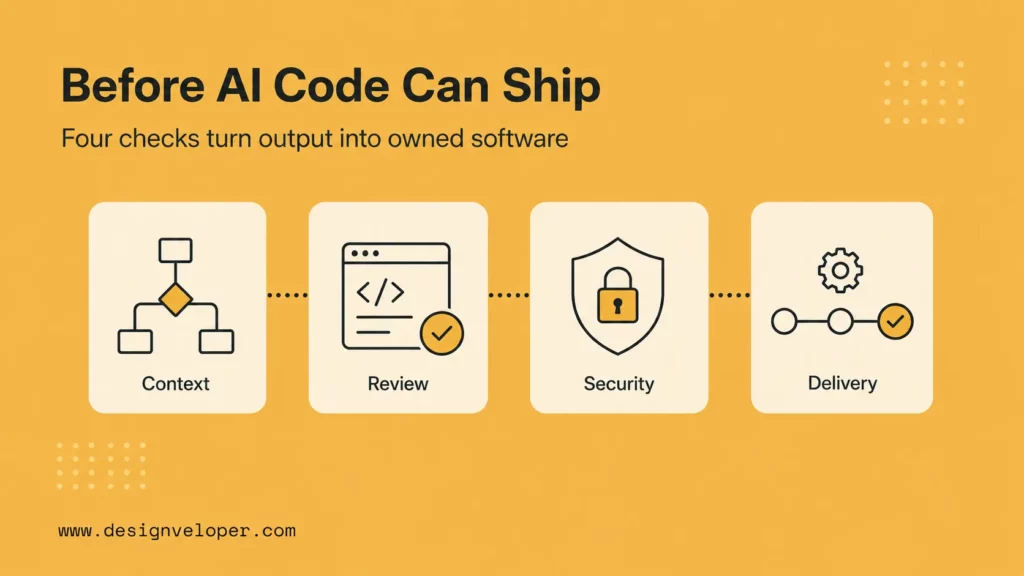
AI-generated code can ship when it has been converted from output into owned software. That means a human team has read it, shaped it to the architecture, reviewed security assumptions, tested critical paths, and placed it inside a safe deployment process. The goal is not to slow AI down. The goal is to keep speed from turning into hidden risk.
| Before shipping | What to verify | Why it matters |
|---|---|---|
| Context | The code matches the existing architecture, domain model, and user flow. | Prevents isolated snippets from becoming future debt. |
| Review | A responsible engineer can explain the code and its tradeoffs. | Creates ownership beyond the prompt session. |
| Security | Auth, permissions, validation, secrets, and dependency risks are checked. | Protects users, data, and business operations. |
| Delivery | Tests, CI/CD, monitoring, and rollback paths are ready. | Makes changes safer after launch. |
Deep Code Reading And Better Context Before Generation
Good AI coding starts before the first prompt. The team should read the existing codebase, understand the relevant modules, and identify the constraints that the generated code must follow. Without that context, AI may create a second pattern beside the established one, which increases complexity.
Better context includes architecture notes, coding standards, API contracts, design tokens, data models, permission rules, test conventions, and examples of similar features. The more precise the context, the easier it is for AI output to fit the product instead of fighting it.
Code Review, Small Commits, And Revertable Changes
AI-generated work should move through small, reviewable changes. A large prompt-generated patch is hard to reason about because reviewers must inspect many decisions at once. Smaller commits make it easier to isolate behavior, identify risky assumptions, and revert a change without removing unrelated work.
Review should ask specific questions: Does this follow existing patterns? Are permissions enforced server-side? Are errors handled? And, are dependencies necessary? Can another engineer maintain it next month? These questions turn AI speed into accountable engineering.
Testing, CI/CD, And Safer Deployments
Testing is where generated confidence becomes real confidence. Unit tests can protect business logic. Integration tests can verify API and database behavior. End-to-end tests can confirm that important workflows still work. Security checks and dependency scans add another layer for vulnerable packages and unsafe patterns.
Secure delivery should also follow recognized guidance. The NIST Secure Software Development Framework recommends practices for preparing the organization, protecting software, producing secure software, and responding to vulnerabilities. AI coding should fit inside that secure software development lifecycle, not sit outside it as a shortcut.
Continue reading:
- What Is DevOps? The DevOps Lifecycle And How It Works
- 13 Vibe Coding Tools: Best Picks to Build Faster
- Vibe Coding Workflow: From Product Requirements To Tested Code
What Production-Ready AI Coding Actually Looks Like
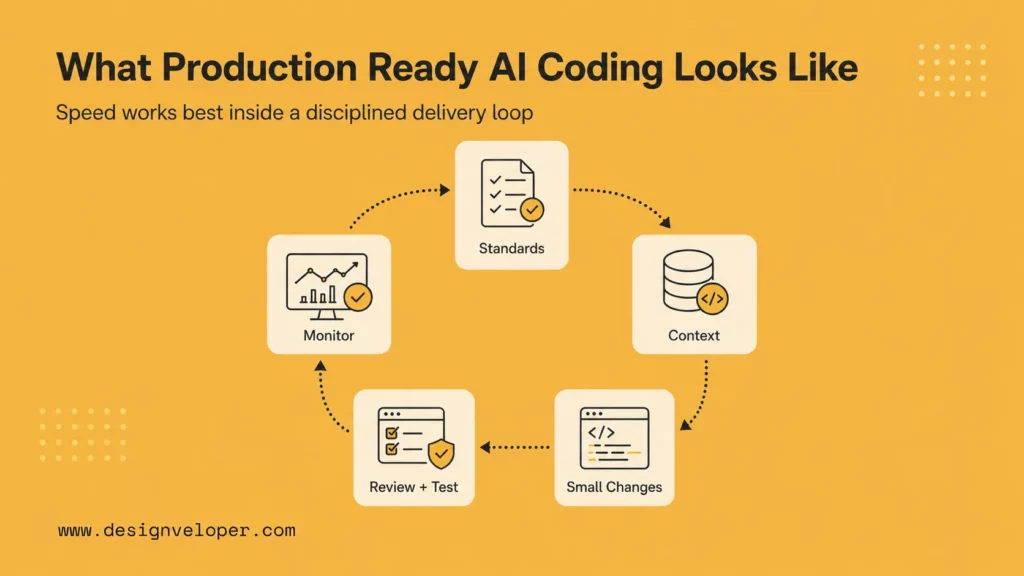
To AI vibe code for production, you will need to get used to the fact that instead of the whole process looking like a single magical prompt, it will look more like a disciplined delivery loop. The team defines standards, gives AI the right context, asks for small changes, reviews the result, tests the behavior, and monitors the outcome after release. AI accelerates parts of the process, but humans still own the product.
This approach lets teams keep the main advantage of vibe code for production: speed. It also adds the missing ingredients: consistency, security, reliability, and maintainability.
Explore more:
- How Will AI Affect Software Development? Complete Guide
- Prompt Engineering For Developers: A Guide To Practical Patterns
- AI In Software Development: Changing How Software Gets Built
Clear Standards Before The First Prompt
Clear standards reduce ambiguity. A team should define preferred frameworks, folder structure, naming conventions, error handling style, testing expectations, security rules, and accessibility requirements. These standards can be included in project instructions, templates, and code review checklists.
Standards also protect product coherence. If every AI-generated feature uses a different state pattern, validation library, or API style, the codebase becomes harder to understand. Consistency is a production feature of vibe coding because it lowers maintenance cost.
AI Speed With Human Control
Human control means engineers decide what AI should and should not do. AI can draft code, suggest tests, explain dependencies, summarize logs, and propose refactors. Humans should set boundaries around data access, security-sensitive code, production credentials, migration behavior, and user-facing policy decisions.
Control also means verifying outputs instead of accepting them because they compile. Stack Overflow’s 2025 survey finding about low trust in AI accuracy is a reminder that adoption and confidence are not the same thing. Teams can use AI heavily while still refusing to ship unreviewed AI output.
Reliable Delivery Instead Of One-Off Wins
A one-off win is a demo that works. Reliable delivery is a system that keeps working after repeated changes. That requires a backlog, architecture ownership, test coverage, release discipline, observability, and post-release learning.
For AI-generated code, reliable delivery also includes tracking which work was AI-assisted, where risk was reviewed, and what tests prove the behavior. The point is not to create bureaucracy. The point is to make the team confident that fast code can survive real product pressure.
Where Business And IT Teams Need To Step In
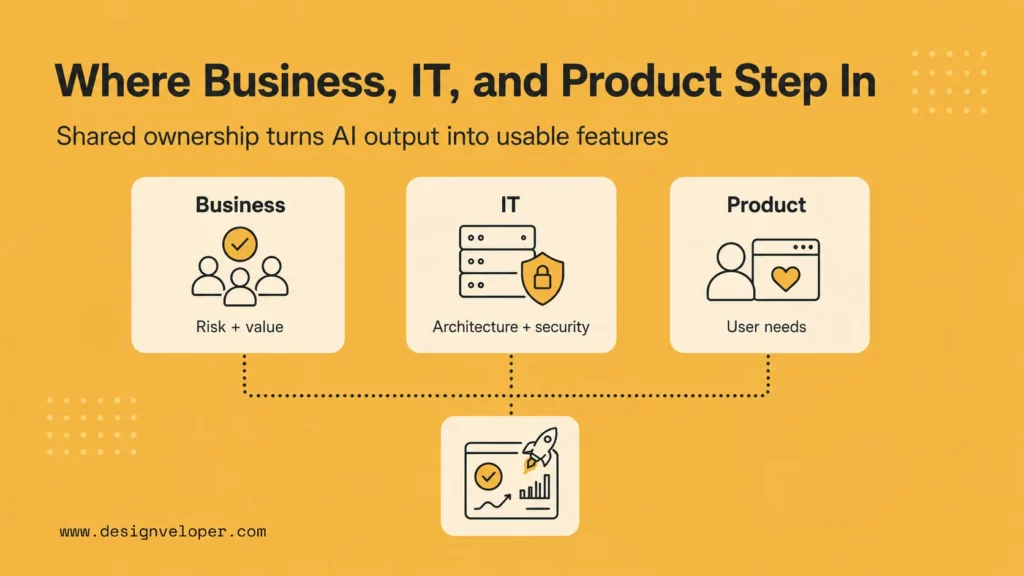
Vibe coding is not only an engineering topic. Business, IT, and product teams all shape whether AI-generated code becomes useful software. The business defines the value and acceptable risk. IT defines the architecture, security, and operational controls. Product turns the raw output into user-centered behavior.
When these roles are absent, AI coding can create impressive fragments that do not fit the organization. When they work together, AI becomes a multiplier for focused product development.
You might also like:
- Top 10 AI Code Review Tools & Best Practices For Implementation
- How to Start Vibe Coding: The Practical 7-Step Guide
- Is Vibe Coding Legal? Risks, Ownership, And Safe Use
Business Teams Define Risk, Value, And Operational Priorities
Business teams should clarify what the feature is meant to improve. Is the goal faster onboarding, lower support cost, higher conversion, fewer manual approvals, or a new revenue path? That answer changes how much risk is acceptable and what must be measured after launch.
They should also define operational constraints. A low-risk internal dashboard may tolerate a staged rollout with limited users. A feature that handles payments, health data, legal documents, or customer records needs stronger validation before release.
IT Teams Own Architecture, Security, And Delivery Controls
IT and engineering leaders own the guardrails that make AI coding safe. They decide which tools can access the codebase, how secrets are protected, how dependencies are approved, how code moves through CI/CD, and how incidents are handled.
They also decide how generated code fits the broader architecture. A feature that works in isolation may still be rejected if it bypasses observability, duplicates a service, weakens access control, or creates a maintenance burden.
Product Teams Turn AI Output Into Usable Features
Product teams make sure the generated feature solves the right problem. AI can build an interface that matches a prompt, but the prompt may not capture user behavior, edge cases, accessibility needs, or support workflows. Product judgment keeps the team focused on outcomes instead of output volume.
This role is especially important when AI creates several options quickly. Product teams should evaluate which option fits user needs, business goals, and operational reality before engineering hardens it for release.
When Vibe Coding Needs Real Product Engineering
Vibe coding needs real product engineering when the code affects users, data, revenue, compliance, or long-term roadmap quality. At that point, AI-generated code only becomes valuable when it fits a larger product system. The challenge is not just generating code faster, but turning that code into something secure, maintainable, and reliable at scale.
Designveloper approaches this transition as an AI-first software and automation partner. Our AI development services help teams build practical AI systems around real workflows, while our web application development services cover the engineering foundation needed to ship and maintain production applications.
For teams moving from vibe code to production, the most useful next step is a structured review. That review should identify which parts of the AI-generated code are worth keeping, which parts need refactoring, which risks must be closed before launch, and which delivery controls need to be added. From there, the team can keep the speed while building a product that survives real use.
FAQs About Taking Vibe Code To Production
Can Vibe-Coded Apps Go Into Production?
Yes, but not as raw prompt output. A vibe-coded app can go into production after engineers review the architecture, security, data handling, tests, dependencies, deployment process, and maintainability. The code must become owned software before it becomes customer-facing software.
What Usually Breaks First In AI-Generated Codebases?
The first weak points are often permissions, data validation, error handling, state management, dependency quality, and duplicated logic. As the product grows, weak architecture and missing tests become more expensive because every new change takes longer to verify.
How Should Teams Review AI-Generated Code Safely?
Teams should review AI-generated code in small commits, compare it with existing patterns, run automated tests, inspect security-sensitive paths, check dependencies, and ask whether another engineer can maintain the result. Reviewers should treat AI output as a draft, not as proof of correctness.
What Guardrails Matter Most Before Launch?
The most important guardrails are server-side authorization, input validation, secrets management, dependency scanning, logging, monitoring, rollback paths, and tests for critical workflows. For AI-enabled features, teams should also check prompt handling, output validation, data leakage risks, and human review paths.
How Do Teams Keep AI Speed Without Losing Engineering Quality?
Teams keep AI speed by narrowing prompts, giving better project context, generating smaller changes, enforcing code review, and automating tests and deployment checks. The best workflow is not unrestricted generation. It is fast AI assistance inside a disciplined product engineering process.
The move from vibe code to production is a maturity step. AI can help teams write faster, but production value comes from the system around the code: standards, review, security, tests, deployment, monitoring, and product judgment.
Also published on

Share post on










Related Articles


Prompt Engineering Best Practices: 10 Tips, Examples, And Evaluation
Prompt Engineering Best Practices: 10 Tips, Examples, And Evaluation Published October 07, 2026
AI Agent Architecture Diagrams: Components, Patterns, and Design Steps
AI Agent Architecture Diagrams: Components, Patterns, and Design Steps Published September 29, 2026
Best Open-Source Vector Database In 2026: 10 Options Compared
Best Open-Source Vector Database In 2026: 10 Options Compared Published September 29, 2026