
















AI Development Cost: What Businesses Should Budget In 2026

AI development cost in 2026 may be $50,000-$100,000 for a focused proof of concept and $500,000-$1 million+ for an enterprise platform with US or hybrid delivery. These are one consultancy’s planning ranges, not market averages or quotes. Estimates for other types of AI work use different sources and geographic assumptions. A realistic budget must also account for scope, excluded work, and costs after launch.
How Much Does AI Development Cost In 2026?
For US-based or hybrid delivery, TechAhead estimates $50,000-$100,000 for a focused proof of concept and $500,000-$1 million+ for an enterprise AI platform. Other consultancies give separate estimates for AI features, custom machine-learning (ML) systems, and computer vision. The table keeps their sources and geographic assumptions distinct. Our AI app development cost guide provides more app-specific budget and timeline context.
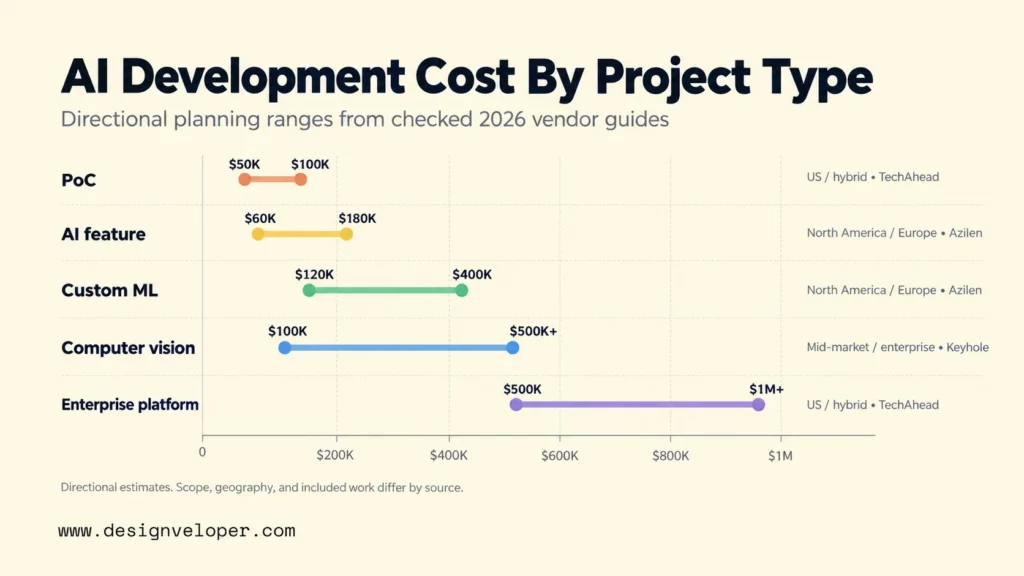
The AI-feature row describes a focused function inside an existing product. Retrieval-augmented generation (RAG) means giving a model relevant information from stored documents before it answers. A narrow RAG search feature may fit that row. A larger RAG or agent system may need its own estimate when it adds data pipelines, multiple integrations, tool actions, or ongoing governance.
| Project type | Indicative development cost (USD) | Typical scope | Key assumptions |
|---|---|---|---|
| Proof of concept | $50,000-$100,000 | One use case, isolated data, basic model evaluation, feasibility decision | TechAhead; US-based or hybrid team; no production infrastructure; 6-12 weeks |
| AI feature added to existing software | $60,000-$180,000 | A focused chatbot or automation feature within an existing product | Azilen detailed table; North America/Europe; engineering and initial deployment, not ongoing operations; 8-16 weeks |
| Custom machine-learning system | $120,000-$400,000 | Data engineering, custom model development, integration and evaluation | Azilen detailed table; North America/Europe; initial deployment included, ongoing costs excluded; 3-8 months |
| Computer-vision system | $100,000-$500,000+ | Image or video processing, model training and specialized infrastructure | Keyhole; mid-market/enterprise project scope; no comparable project-geography label given |
| Enterprise AI platform | $500,000-$1 million+ | Multiple enterprise workflows, organization-wide deployment, governance and model operations | TechAhead; US-based or hybrid team; organization-wide scope; 12-24 months |
The cost bands come from consultancy-published estimates, not a statistically representative market survey. TechAhead’s 2026 project table explicitly covers US or hybrid delivery. Azilen’s detailed 2026 table covers North America and Europe. It includes architecture, data engineering, integration, testing, and initial deployment, but excludes ongoing operations. Azilen’s executive summary uses different bands and exclusions, so the table above uses its detailed figures only. Keyhole’s computer-vision estimate targets mid-market and enterprise projects without a directly comparable geographic basis.
Timeline should be treated the same way. TechAhead lists 6-12 weeks for a proof of concept and 12-24 months for an enterprise platform. Axius Software’s 2026 guide lists 4-8 weeks and 9-18 months for those categories. A useful planning view is about 4-12 weeks for a PoC and 9-24 months for an enterprise platform. Data readiness, integration, compliance, evaluation, and rollout can move a project within or beyond those bands.
A low-cost prototype can still be the right choice when its job is only to test feasibility. It becomes misleading when stakeholders expect production security, live-system integration, monitoring, support, and predictable quality from the same budget. The estimate should say what is excluded as clearly as what is included.
Key Factors That Shape AI Development Costs
Two projects can use the same AI model and still have very different budgets because the surrounding data, application, integration, testing, and operations work can differ. The biggest differences usually come from scope, data readiness, integration depth, risk controls, testing, delivery needs, and the scale the system must support.
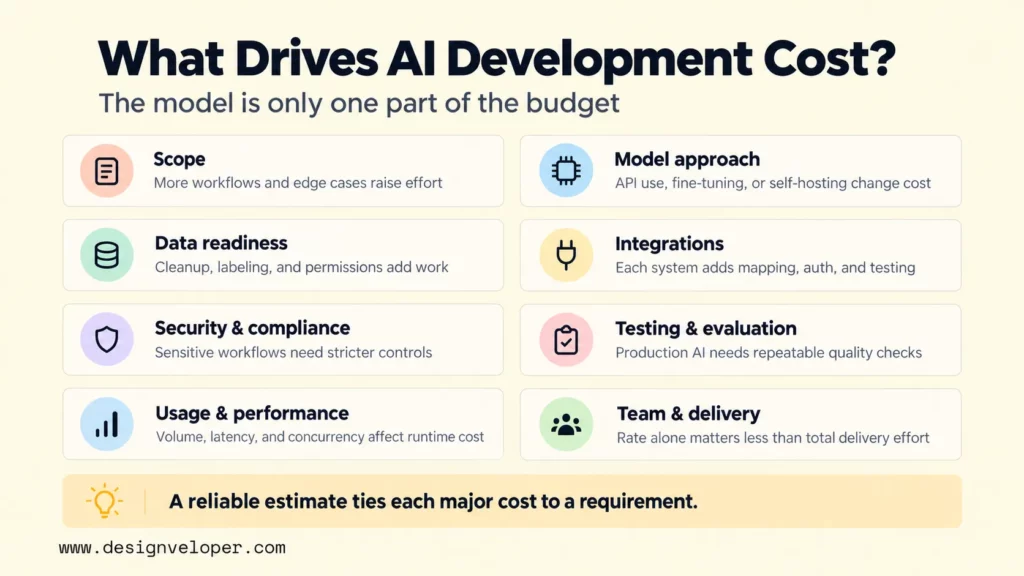
- Project scope. One narrow workflow is cheaper to define, build, and test than a product with many roles, channels, actions, or AI behaviors. Scope also determines how many edge cases the team must handle.
- Model approach. Calling a hosted model API usually reduces upfront model-engineering work. Fine-tuning, self-hosting, custom ML, or computer vision can add training, evaluation, and infrastructure work. Machine-learning operations (MLOps) means deploying, monitoring, and updating models after launch. Model choice can change usage cost, but it does not remove application engineering.
- Data quality and preparation. Clean, permitted, well-structured data reduces uncertainty. Messy files, missing labels, conflicting records, weak metadata, or unclear data rights create extra work before model quality can be judged.
- Integration complexity. Connecting one documented API is different from linking customer records, finance systems, document stores, and approval workflows. Each connection may have different data formats and permissions. Each system adds authentication, mapping, error handling, testing, and ownership questions.
- Security and compliance. Sensitive or regulated workflows may need stricter access control, audit logs, data residency, threat review, approval steps, and documentation. NIST’s AI Risk Management Framework treats risk management as part of AI design, development, use, and evaluation rather than a final launch check.
- Testing and evaluation. A demo can look convincing with a few examples. A production system needs a repeatable evaluation set, acceptance thresholds, regression testing, failure analysis, and monitoring. Our guide to AI in software development explains why human review, tests, security rules, and traceability still matter when AI is part of delivery.
- Usage and performance targets. Estimate monthly requests, average input and output tokens, peak concurrency, response-time targets, and required availability. Higher volume or stricter latency can change model, hosting, caching, and scaling costs even when the visible feature set stays the same.
- Team and delivery model. A small senior team may cost more per hour but need less coordination. A larger or distributed team can lower some labor rates while increasing management and handoff work. Compare total delivery effort and accountability, not hourly rate alone.
This is why “Which model will you use?” is rarely enough to judge a quote. A useful estimate connects each major cost to a requirement. It should name the data to prepare, the systems to connect, the quality target to test, the expected production load, and the operating controls needed after launch.
AI Development Estimate: What To Include
An AI project estimate should separate one-time build work from recurring operating expenses. This section is mainly a quote-scope checklist: it helps buyers compare whether two vendors have priced the same work, assumptions, and exclusions.
One-time build items usually start with discovery and solution design. The team defines the workflow, users, data sources, success criteria, risk limits, and technical architecture. That work reduces unknowns that would otherwise turn into change requests later.
- Data collection and preparation: access, cleaning, labeling, transformation, document parsing, permissions, and data-quality checks.
- Model or AI feature work: model selection, prompting, retrieval, fine-tuning when justified, classical ML training, computer-vision work, or agent orchestration.
- Application and system integration: user interface, backend logic, APIs, identity, permissions, databases, business rules, and existing systems.
- Testing and evaluation: functional tests, AI quality evaluation, security checks, latency tests, regression cases, and human review where needed.
- Deployment and monitoring setup: production environments, monitoring, logs, alerts, rollout controls, and support setup.
Recurring items should appear as separate line items instead of being buried in a build total. Ask vendors to state the assumptions behind model or API usage, cloud or specialized processing hardware, storage, monitoring, data refresh, maintenance, human review, and support. The operating-cost section below shows how to turn those assumptions into monthly scenarios.
Put assumptions beside each estimate line. An integration estimate should name the systems and environments included. A usage estimate should state expected request volume and the pricing date. A support estimate should define response times and what counts as maintenance versus a new feature. This makes two quotes much easier to compare.
Choosing Between An AI API, Existing Platform, And Custom Build
An AI API is a way to access a model, not a complete alternative to an existing platform or a custom application. A packaged platform provides a prebuilt product or workflow. A custom application may use a hosted API or a self-hosted model. Compare these as two decisions: solution ownership first, then model access and operation.
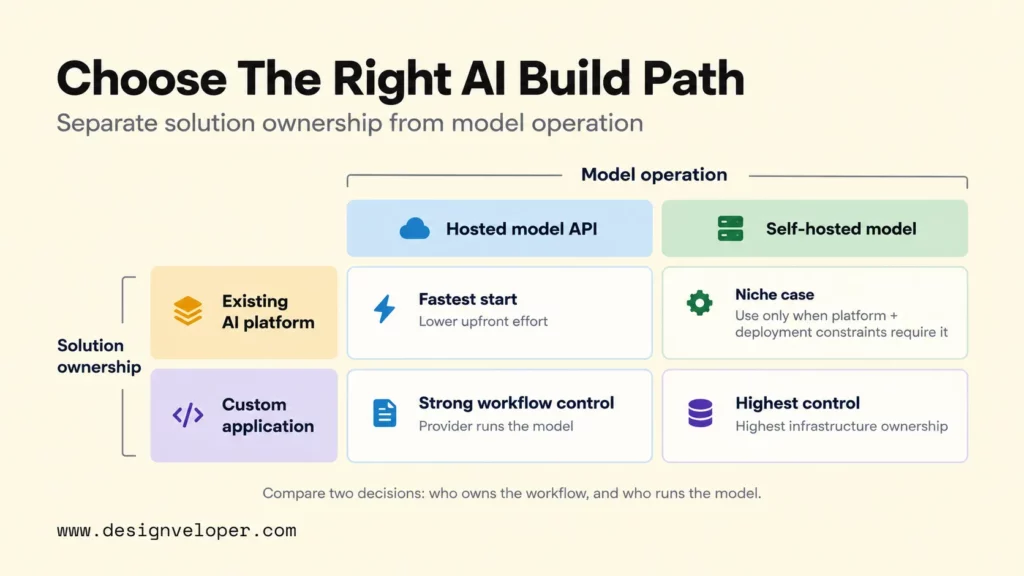
| Decision axis | Option | Upfront effort | Control | Integration work | Ongoing ownership |
|---|---|---|---|---|---|
| Solution ownership | Existing AI platform | Low to medium | Medium within platform limits | Low to high depending on connectors and customization | Vendor manages much of the product stack; your team manages configuration, data, adoption, and vendor risk |
| Solution ownership | Custom application | High | High over workflow, user experience, data boundaries, and integrations | High because the system is shaped around your processes | Your team or delivery partner owns application architecture, monitoring, updates, security, and support |
| Model access and operation | Hosted model API | Low to medium | Lower over the base model; high over your surrounding application | Medium; you still build workflow, data access, guardrails, and UX | Provider runs the model; you manage application quality, usage, and integration |
| Model access and operation | Self-hosted model | High | High over model deployment and infrastructure | High; hosting, scaling, monitoring, and updates become your responsibility | Your team owns capacity, deployment, monitoring, security, and model lifecycle |
The cheapest starting combination often reuses both a packaged workflow and hosted model access. Custom ownership becomes more useful when the workflow, data boundaries, integration depth, or governance needs do not fit the packaged product. Self-hosting is a separate decision and should be justified by requirements such as control, deployment constraints, or predictable capacity rather than by a vague desire to avoid API fees.
Provider pricing changes, so use current primary pricing pages when estimating usage. OpenAI API pricing lists token rates by model and processing mode. Amazon Bedrock pricing varies by modality, provider, model, and service tier. If the main question is model spend and API economics, our generative AI cost guide goes deeper into usage and infrastructure trade-offs.
A Practical Budget Example: An AI-Assisted Finance Workflow
A practical budget example can show where the money goes without inventing a project total. Our public Song Nhi project page describes a conversational virtual assistant that records personal-finance activity and answers finance-report questions. It does not publish the project’s cost, timeline, ROI, or document-processing architecture.
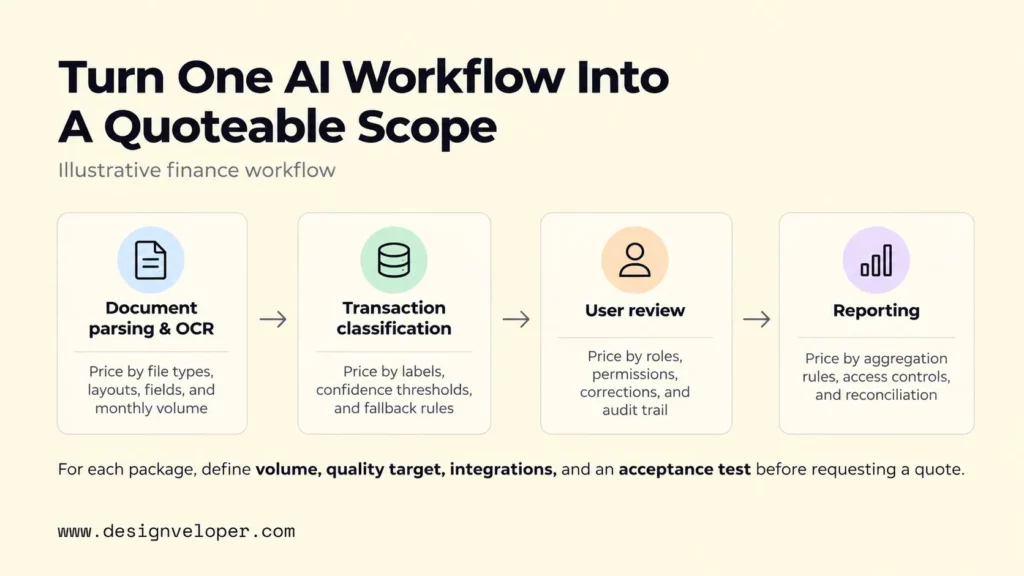
For an illustrative receipt-to-report workflow, ask vendors to price four work packages separately. The first uses optical character recognition (OCR) to turn text in scanned receipts into data the application can read. This example is not a description of Song Nhi’s implementation. It is a scope-to-estimate worksheet for a hypothetical workflow.
| Work package | Estimate drivers | Acceptance test | Vendor line item |
|---|---|---|---|
| Document parsing and OCR | File types, languages, layout variation, monthly document volume, privacy rules, extraction fields | Agreed field-level extraction quality on a representative document set | Data ingestion, OCR/parsing, preprocessing, exception handling |
| Transaction classification | Category rules, historical labels, confidence thresholds, fallback logic, model approach | Defined accuracy or acceptance threshold by category, including low-confidence cases | Classification logic or model work, evaluation set, fallback rules |
| User review | Roles, permissions, edit flows, duplicates, audit history, approval rules | Common corrections can be completed within the agreed workflow and are logged correctly | Review UI, permissions, audit trail, correction logic |
| Reporting | Aggregation rules, account access, reporting periods, data reconciliation, query types | Reports reconcile with stored transactions and respect account-level access | Reporting logic, queries, dashboards or answers, authorization tests |
For each package, record expected volume, quality threshold, integrations, and an acceptance test before requesting a vendor estimate. This prevents a vendor from pricing only the visible AI step while leaving review, permissions, exception handling, or reporting outside the quote. The result is not a market price, but it is a budget structure that can be compared across proposals.
Build Costs Vs. Ongoing AI Operating Costs
Build cost pays for creating and launching the system. Operating cost pays for keeping it useful, available, secure, and affordable after launch. The practical budgeting job in this section is to turn recurring categories into a monthly model rather than treat them as an unspecified maintenance percentage.
| Cost area | Main build costs | Main ongoing costs |
|---|---|---|
| AI/model layer | Model selection, prompting, retrieval, training or tuning, evaluation setup | API or inference usage, evaluation runs, model migration, retraining or re-tuning when needed |
| Data | Collection, cleanup, labeling, migration, indexing | Storage, sync, refresh, new labels, retention, and data-quality repair |
| Application and integration | UI, backend, APIs, identity, business rules, system connections | Bug fixes, dependency changes, connector updates, and new system versions |
| Operations | Deployment, logging and alert setup, security review, rollout tooling | Cloud or specialized compute, monitoring, logging, human review, support, incidents, and security maintenance |
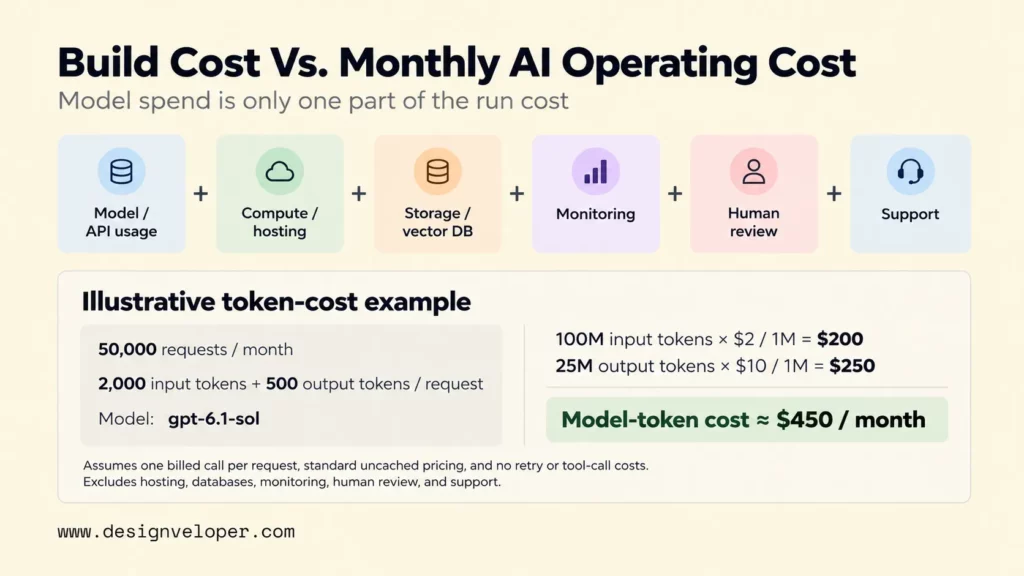
A simple monthly model is: model or API usage + compute or hosting + storage or vector database + monitoring + human review + support. Model usage should be calculated from request volume, average input and output tokens, tool calls, retries, and current provider rates. Infrastructure and people costs need their own measured assumptions.
For an illustrative API-only example, assume 50,000 user requests per month. Each request triggers exactly one model call on gpt-6.1-sol using Standard short-context pricing. Each call uses 2,000 uncached input tokens and 500 total billable output tokens, including any billed reasoning tokens. Assume no retries, cache discounts, cache-write charges, or paid tools. These are example assumptions, not measured usage.
That means 100 million input tokens and 25 million output tokens per month. OpenAI’s Standard API pricing, checked October 12, 2026, lists $2 per million input tokens and $10 per million output tokens. That is $200 for input and $250 for output. The model-token bill is $450 per month.
This $450 covers model tokens only. Hosting, databases, monitoring, human review, support, and paid tools are separate expenses. Extra model calls, more output tokens, long-context rates, or different processing modes can change the result. Check the provider’s current price before budgeting.
Build low, expected, and high cases around the formula. Include traffic growth, longer prompts, retrieved context, retries, tool calls, output length, peak concurrency, and higher service levels when they apply. If simple tasks can route to a cheaper model or deterministic code, estimate that architecture instead of pricing every request as if it uses the most expensive path.
Agentic systems can add another layer of variable cost because one user request may trigger several model calls and tools. Our AI agent pricing guide explains how workflow volume, token use, tool calls, integrations, monitoring, and human escalation combine into monthly operating cost.
Estimate And Control An AI Project Budget
The best way to control an AI budget is to reduce uncertainty before the most expensive work begins. That does not mean spending months in planning. It means turning a broad AI idea into one measurable workflow, then validating the riskiest assumptions in the cheapest credible stage.
- Define one use case and one success measure. Name the user, the task, the current baseline, and the improvement that would justify continuing. “Build an AI assistant” is not enough to estimate.
- Assess data and existing systems. Sample the real data early. Confirm who owns it, how it can be accessed, what must be cleaned, and which systems the product must read from or write to.
- Compare build approaches. Test whether an existing platform or hosted API can meet the quality, privacy, latency, and integration requirements before assuming a custom application or self-hosted model is necessary.
- Compare like-for-like quotes. Use the line-item scope above so each vendor prices the same boundaries, assumptions, exclusions, and recurring cost categories.
- Validate with a staged pilot. Test the hardest uncertainty, not just the easiest demo. Use representative data and users, measure quality and failure cases, and decide what must change before a wider rollout.
Before approving the next phase, set a spending limit and a clear go/no-go test. Use the pilot results to update the scope, expected monthly usage, and delivery plan. If the evidence does not meet the agreed threshold, revise the approach before committing the larger budget.
If you need help translating a workflow, data sources, integrations, and production requirements into a phased build plan, our AI development services can support the scoping and engineering work. We would still treat any early price as a range until the key data, integration, security, load, and evaluation assumptions are verified.
FAQs About AI Development Cost
How Much Does It Cost To Hire An AI Developer?
Upwork’s AI engineer rate page currently shows a $35-$60 per hour median, while expert-level AI engineers may list at $75 to well over $100 per hour. Upwork says these ranges reflect certain historical contracts worldwide and that negotiated rates vary. They are marketplace labor rates, not a universal salary benchmark or a full AI project estimate.
What Are The Hidden Costs Of Developing AI In-House?
Common hidden in-house costs include recruiting, data preparation, cloud or specialized computing, integration, evaluation, security, monitoring, and model updates. Teams also need people to investigate failures after launch. In-house ownership can be valuable when AI is strategically important, but the budget should include the full operating team rather than only one AI engineer’s salary.
How Long Does It Take To Develop An AI Solution?
A focused proof of concept can take about 4-12 weeks, while a production deployment often takes several months. Large enterprise platforms can take roughly 9-24 months. These are directional planning ranges, not commitments. Axius Software lists 4-8 weeks for a proof of concept and 9-18 months for an enterprise platform, while TechAhead lists 6-12 weeks and 12-24 months. Data readiness, integration work, compliance, evaluation, and rollout scope determine where a project lands inside those bands.
Also published on

Share post on










Related Articles


AI Development Cost: What Businesses Should Budget In 2026
AI Development Cost: What Businesses Should Budget In 2026 Published October 13, 2026
Enterprise AI Architecture: Layers, Patterns, And Use Cases
Enterprise AI Architecture: Layers, Patterns, And Use Cases Published October 13, 2026
Build An Enterprise RAG Architecture That Works In Production
Build An Enterprise RAG Architecture That Works In Production Published October 12, 2026


















