












MVP Development Cost: How Much Should You Budget in 2026?

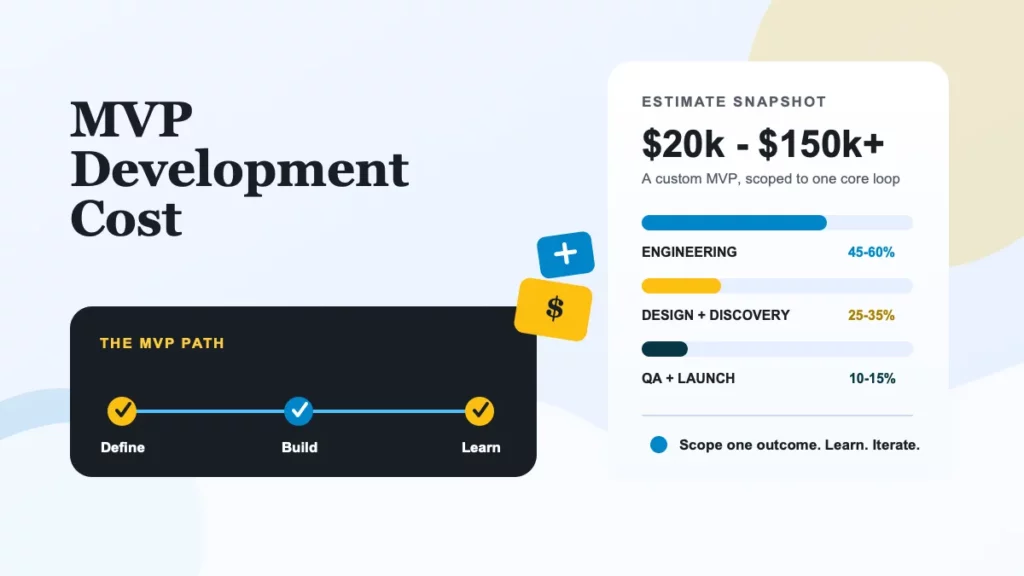
MVP development cost usually falls between $20,000 and $150,000+ for a custom software product. A lean web MVP that tests one core workflow may start around $20,000 to $60,000. A multi-platform product with complex integrations, AI features, or strict compliance requirements can require $100,000 or more.
The useful question is not simply, “What is the cheapest MVP?”. It is, “What is the smallest release that can give the business a reliable answer?”. A well-scoped MVP should test a specific customer, problem, and workflow before the team pays to scale features that users may not need.
This guide explains the cost to build an MVP, the factors that change the estimate, and a practical way to set a budget around the uncertainty the product needs to resolve. For a broader explanation of the product model, see what a minimum viable product is.
MVP Development Cost At A Glance
The table below gives planning ranges in US dollars. They assume a clearly defined scope, professional design and engineering work, QA, and a basic production launch. They do not represent fixed quotes; location, team seniority, product risk, and delivery model can change the result substantially.
| MVP approach | Typical budget | Typical timeline | What it can validate |
|---|---|---|---|
| Concierge, landing-page, or no-code test | $2,000-$12,000 | 2-6 weeks | Interest, positioning, and a manual service workflow |
| Prototype or technical proof of concept | $5,000-$25,000 | 2-8 weeks | User flow, desirability, or a difficult technical assumption |
| Lean custom web MVP | $20,000-$60,000 | 2-4 months | One end-to-end customer workflow with real users |
| Custom web or mobile MVP with integrations | $60,000-$150,000 | 4-7 months | A multi-role workflow, transactions, or a connected service |
| Complex, AI-enabled, or regulated MVP | $100,000-$250,000+ | 6-12+ months | A higher-risk product that needs security, evaluations, or complex operations |
A low-cost experiment can be the right first step when the team needs to test whether people care about the offer. It is not the same as a launch-ready software MVP. For example, a concierge test may prove that customers value weekly financial summaries, while a custom application is needed to test whether they will complete the task without staff support.
Teams comparing the first release with a broader product roadmap can also use this app development cost breakdown to see how scope affects a full application budget.
How To Budget An MVP: Pay For Learning, Not Feature Volume
Many cost estimates start with a long feature list. That approach often funds solutions before the team has agreed on the problem. A more useful MVP development budget starts with the riskiest assumption and then funds the smallest credible test.
For each proposed feature, ask three questions:
- What assumption does this feature test?
- Can a user complete the core task without it?
- Can the team handle this work manually until demand is clear?
This creates a cost-to-learning plan. It protects the budget from features that look complete but do not produce better evidence. A polished notification center, for instance, may be valuable later. It does not belong in the first release if the business still needs to learn whether users will complete the primary booking, ordering, or approval flow.
Match The Budget To The Risk
Product teams normally face three kinds of early uncertainty. Each one calls for a different level of spend.
| Main uncertainty | Lowest sensible investment | When custom development becomes worthwhile |
|---|---|---|
| Demand risk: Do target customers want this outcome? | Interviews, landing pages, concierge delivery, or a no-code test | Users show recurring intent, willingness to pay, or an urgent workflow problem |
| Workflow risk: Can users complete the task and get value? | Prototype or narrow web MVP | The workflow needs real data, permissions, or repeat use to evaluate it |
| Technical risk: Can the service work reliably? | Technical proof of concept | The product needs custom integrations, performance work, security controls, or a production architecture |
The cheapest appropriate test is not always a no-code product. If the core value depends on a secure integration with a client system, simulating that connection can create misleading feedback. In that case, spending on a focused proof of concept may avoid a much more expensive rebuild.
What Determines The Cost To Build An MVP?
The total cost is usually a combination of effort, team rate, direct services, and a contingency for assumptions that the discovery phase has not yet resolved.
MVP cost = delivery effort x blended team rate + direct product costs + risk contingency
The blended rate covers the combined cost of the people doing the work, such as product discovery, UX/UI design, front-end and back-end engineering, QA, delivery management, and DevOps. A lower hourly rate does not automatically produce a lower total cost. Rework, slow decisions, poor testing, and weak product ownership can add more hours than the initial rate saves.
Product Scope And Feature Depth
Scope is the largest cost driver because every feature has more work behind it than the screen a user sees. A booking flow, for example, may require availability rules, authentication, notifications, staff controls, error handling, analytics, and support processes.
An MVP should include the smallest complete loop that delivers value. For a marketplace, that may be listing, search, request, and confirmation. For an internal operations product, it may be request submission, approval, status tracking, and an audit trail. The first release rarely needs every user role, automation, report, or configuration option envisioned for the mature product.
Platforms And Product Surfaces
Building for web, iOS, Android, and an admin portal at the same time increases both build and testing work. If one audience or platform clearly dominates, launching there first can keep the MVP focused.
Cross-platform mobile development can reduce duplicated interface work when the product genuinely needs iOS and Android at launch. Native apps can be justified when the core experience needs platform-specific performance, device capabilities, or a highly polished interaction model. The decision should follow the target users and the workflow being tested, not a general rule that one approach is always cheaper.
Integrations, Data, And User Roles
Third-party services can accelerate an MVP, but every connection introduces work for authentication, data mapping, error handling, monitoring, and future change. Payments, maps, messaging, enterprise single sign-on, legacy systems, and data synchronization all increase the estimate.
Multiple user roles have a similar effect. A simple customer-facing flow may need only basic account controls. A product with customers, operators, managers, and administrators requires distinct permissions, dashboards, notifications, and edge-case testing. Define the first role that must succeed before adding the others.
AI Capabilities
An AI feature can be inexpensive to prototype and expensive to operate reliably. The budget should include more than model API usage. It may also need data preparation, prompt or workflow design, evaluation criteria, human review, rate limits, logging, privacy controls, and ongoing monitoring.
For an AI MVP, specify the job the system performs and how a user checks the result. A document assistant, for example, may need source citations, correction controls, and a clear policy for sensitive files. Designveloper’s guide to moving an MVP to production explains why these controls become more important after initial validation.
Security, Compliance, And Reliability
An MVP does not mean unsafe software. The required level of security depends on the data, transaction type, users, and industry. A health, finance, or enterprise product may need stronger access controls, auditability, data handling rules, security review, and recovery planning from the first release.
Teams can use the OWASP Application Security Verification Standard to discuss application security requirements in a structured way. The NIST Cybersecurity Framework 2.0 is also a useful reference when the MVP will operate within a broader organizational risk program. These needs should appear in the estimate as named work items, not as a vague buffer.
Where The MVP Budget Goes
The table below shows a practical allocation for a lean custom MVP. The proportions vary, but omitting discovery, QA, or release preparation usually moves cost into post-launch fixes instead of eliminating it.
| Delivery stage | Typical share of initial budget | Key output |
|---|---|---|
| Discovery and scope | 10-15% | User problem, assumptions, prioritized workflow, technical approach |
| UX/UI design | 15-20% | User flows, clickable designs, component rules, usability decisions |
| Engineering | 45-60% | Front end, back end, integrations, data model, deployment setup |
| QA and launch preparation | 10-15% | Test coverage, bug fixes, analytics checks, release readiness |
| Contingency | 5-10% | Controlled response to validated scope gaps or external dependencies |
Consider an illustrative $45,000 B2B scheduling MVP. The team might allocate $5,000 for discovery, $7,000 for UX/UI design, $24,000 for engineering, $5,000 for QA and launch preparation, and $4,000 for a controlled contingency. The release could include customer booking, staff availability, confirmation emails, a small operator dashboard, analytics, and one calendar integration. It would leave advanced reporting, native mobile apps, complex automation, and multi-location configuration for later evidence to justify.
This example is a planning model, not a quote. An estimate becomes credible only after the team defines the primary workflow, user roles, integrations, quality requirements, and decisions that remain open.
MVP Costs That Often Appear After The Initial Estimate
The initial build is only one part of the cost of an MVP. Teams should reserve operating budget for the services and work needed to learn from real users.
- Cloud infrastructure and storage: Costs change with traffic, data volume, uptime needs, and geography.
- Third-party services: Payment, messaging, mapping, analytics, identity, AI, and automation tools often charge by usage or account tier.
- Maintenance and updates: Dependencies, operating systems, browser behavior, security patches, and bug fixes require ongoing attention.
- Support and operations: A manual workaround may be acceptable during validation, but it still has a staffing cost that should be measured.
- Compliance and vendor review: Legal review, data-processing terms, accessibility work, penetration testing, and procurement can add material time for some buyers.
- Measurement: Analytics events, dashboards, user interviews, and experiment reviews are part of validating the MVP, not optional reporting extras.
The GOV.UK guidance on beta delivery similarly treats real-user testing, measurement, and iteration as active delivery work. A team that plans only for launch can run out of budget before it has learned enough to make the next product decision.
How To Control MVP Development Cost Without Weakening The Test
Cost control works best when it removes work that does not affect the learning goal. Cutting testing, security, or a necessary integration can make the result unreliable and force the team to repeat the experiment.
- Define One Core Outcome
Write the user outcome in one sentence before estimating. For example: “Independent retailers can submit a repeat order for local pickup without messaging staff.” This statement gives the team a clear test for every feature request. If a feature does not help users reach that outcome or help the business measure it, put it in the later backlog.
- Make Decisions During Discovery
Discovery is where the team resolves unclear flows, data needs, ownership, and technical constraints before engineering effort compounds them. A short discovery phase can reduce avoidable rework by turning broad ideas into a sequenced release plan.
- Use Existing Services Where They Do Not Change The Product Advantage
Authentication, payments, email, analytics, cloud hosting, and standard admin functions may be faster to adopt than to rebuild. Build custom software where it creates the value users are testing; use stable services where the function is not a differentiator.
- Launch One Platform Or Segment First
Choose the channel and audience that can provide the strongest evidence. A web application may be enough for an operations workflow. A product whose value depends on mobile, such as location-aware field work, may need a mobile-first release. The right choice comes from user behavior, not a preference for a particular stack.
- Budget For Iteration Before Scaling
Set aside a defined amount for the first two or three learning cycles. Early feedback may show that a feature needs refinement, that onboarding is unclear, or that the original assumption is wrong. A change budget lets the team respond to evidence without treating every adjustment as unplanned scope creep.
When Should A Startup Spend More On Its MVP?
Spend more when a cheaper test would produce weak or unsafe evidence. Examples include a product that handles sensitive data, depends on a difficult integration, requires reliable real-time behavior, or needs a strong first-use experience to prove its value.
For example, an invoice-processing product may need secure document upload, extraction quality checks, structured review, and role-based access before early users can trust it with real records. The scope can still be narrow: support one document type, one review workflow, and one user group. The budget rises because the core loop has real technical and operational requirements, not because the team added decorative features.
FAQ About MVP Development Cost
How Much Does It Cost To Build An MVP App?
A custom MVP app commonly costs $20,000 to $150,000+, depending on scope, platforms, team model, integrations, and quality requirements. A no-code or concierge experiment can cost much less, while a regulated or AI-enabled product may cost more because its core workflow needs additional controls.
Can You Build An MVP For Under $10,000?
Yes, if the goal is to test interest, a manual service, or a simple workflow with existing tools. Under $10,000 is less realistic for a custom, production-ready application with multiple roles, integrations, and ongoing support requirements.
How Long Does It Take To Develop An MVP?
Many lean custom MVPs take two to four months after the team has defined the scope. Projects with mobile apps, several integrations, complex user permissions, or compliance requirements often take longer. Read the app development timeline guide to plan the phases in more detail.
Is A Prototype Cheaper Than An MVP?
Usually, yes. A prototype tests a concept or user flow, while an MVP lets real users complete a narrow task and produces behavioral evidence. A proof of concept tests technical feasibility. The right first investment depends on whether the main uncertainty is desirability, usability, or technical viability. See the full comparison of POC vs. MVP vs. prototype for the decision framework.
How Much Should You Reserve After Launch?
Reserve enough to operate the product, support early users, fix issues, and run the next learning cycles. The amount depends on infrastructure, vendor usage, support needs, and the planned iteration scope. Agree on this budget before launch so the initial release can lead to a real decision instead of a stalled pilot.
Plan The MVP Around The Decision It Must Enable
The right MVP development cost is the amount required to test the most important product assumption with a usable, trustworthy experience. A focused $30,000 release can be more valuable than a $120,000 feature set if it gives the business a clear signal about demand, behavior, or feasibility.
Designveloper is an AI-first software and automation partner that helps teams turn product ideas into production-ready systems and measurable workflows. If you need to define the first release, estimate delivery effort, or plan an AI-enabled MVP, talk to the Designveloper team about the scope and outcome your MVP needs to prove.
Also published on

Share post on










Related Articles


Can ChatGPT Create an App? What It Can Build and What to Check
Can ChatGPT Create an App? What It Can Build and What to Check Published September 30, 2026
Best Open-Source Vector Database In 2026: 10 Options Compared
Best Open-Source Vector Database In 2026: 10 Options Compared Published September 29, 2026
Agile vs DevOps: Key Differences and How They Work Together
Agile vs DevOps: Key Differences and How They Work Together Published September 29, 2026