












Agile Web Development: Process, Benefits & Best Practices Guide

KEY TAKEAWAYS:
- Agile web development works best with short feedback loops: teams should release small, reviewable changes that users or stakeholders can assess.
- For an evolving product, Agile development best practices connect each increment to a clear user or business outcome.
- Agile describes values and principles; Scrum is one framework teams can use to organize work.
- Choose a delivery model based on how much requirements change, which approvals are fixed, and whether reviewers can take part.
- Track product outcomes and delivery flow separately; DORA metrics are not an Agile score.
A website redesign can begin with a clear page list, then encounter new content needs, user feedback, integrations, or approval rules halfway through. Agile web development gives a team a way to respond without turning each request into a reset: make the work visible, deliver a usable slice, review it with the right people, and decide what comes next. The approach can suit websites and web apps with uncertain requirements. It is less useful when no one can review the work or when every stage must follow a fixed approval sequence.
What Is Agile Web Development?
Agile web development applies the values and principles of Agile software development to websites and web applications. A team breaks a larger goal into prioritized work, delivers small usable increments, checks them with users or stakeholders, and adjusts its next plan based on what it learns.
Agile is an approach, not a required set of ceremonies or a promise to accept every request. Teams still plan architecture, document important decisions, define quality checks, and follow release controls. They keep the goal and safeguards clear while allowing the order or detail of future work to change when evidence supports it.
For example, an e-commerce team might first improve one mobile checkout step, then review the flow before deciding whether to change validation or payment options. The team is not committing to rebuild the entire store in one release; it is testing a bounded part of the customer journey.
Related reading:
- What Is An Agile Framework? Definition, Types And Examples
- Agile vs Waterfall vs Scrum vs Kanban: How to Choose a Method
- Agile Methodology Sample: A Practical Project Plan
Why Iterative Delivery Fits Many Web Projects
Web products often change as teams learn about user behavior, content needs, device support, business priorities, or external systems. A team building a campaign site may need to adjust its forms after marketing tests a message. A web app may need to change a workflow after support staff see where customers get stuck. Iterative delivery gives the team planned points to review those changes.
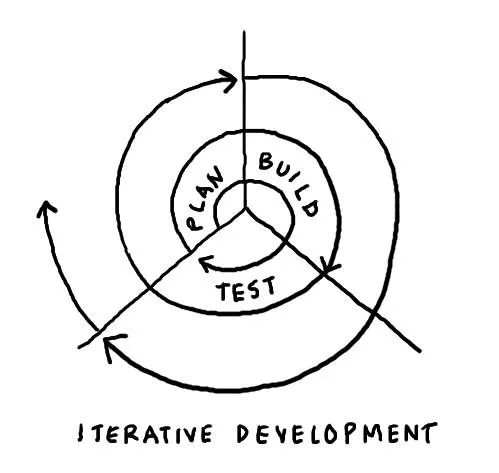
Small increments also make a large goal easier to inspect. Instead of waiting for every page and integration, a team can build one complete journey, check its design and behavior, and use the findings to refine later work. This can reduce the time an incorrect assumption remains hidden, but it does not guarantee an earlier launch or a better result.
Consider a fictional online store where the mobile checkout is difficult to use. The team could first simplify the cart summary and test it on common screen sizes. After review, it could choose whether clearer form errors or guest checkout is the more important next change. The team would compare checkout completion or form errors with an agreed baseline; it should not claim success before collecting that data.
Iteration is most useful when the team can learn and act on the feedback. If a project has stable requirements, little user access, and fixed acceptance gates, the extra review cycle may add work without changing decisions.
Principles Behind an Agile Web Workflow
The Agile principles and values in the Agile Manifesto guide how teams work; they do not prescribe one web-development calendar or toolset. A team can translate those ideas into a few practical behaviors:
- Deliver working slices: Make a small feature usable enough to review, rather than waiting for a large batch to be complete.
- Keep users and decision-makers involved: Ask for feedback while a change can still be adjusted, and make clear who resolves conflicting requests.
- Respond to evidence: Reorder the backlog when user needs or business conditions change, while still checking the effect on scope, risk, and dependencies.
- Protect technical quality: Keep testing, accessibility, performance, security, and useful documentation in the workflow instead of leaving them for a final cleanup.
These behaviors work together. Frequent delivery without a clear goal can create churn, while a detailed backlog without review can preserve assumptions that no longer fit. Teams should keep the product outcome visible and use each review to make a decision, not only to report activity.
Build a Web Team That Can Finish Useful Work
An Agile team needs enough skills, context, and decision access to move a user-facing change through design, development, testing, and review. The exact team shape depends on the product. A small site may use people with several responsibilities, while a larger web app may need dedicated design, quality, content, security, or platform support.
Before a cycle begins, make ownership clear:
- Who decides which user or business outcome takes priority?
- Who can approve the design, content, and acceptance criteria?
- Who checks technical quality and release readiness?
- Which dependencies or approvals sit outside the team, and how early must they be requested?
A team does not become cross-functional merely by putting several job titles in the same meeting. It needs a shared goal, a workable path to decisions, and timely access to reviewers. If approval takes longer than the build, the plan should show that dependency instead of treating it as a surprise.
Benefits and Trade-Offs of Agile Web Development
Agile can make web work easier to inspect and redirect, but the benefit depends on how the team works. Short cycles are not automatically faster, and stakeholder demos do not prove that a feature meets user needs.
- Earlier validation: A usable slice lets stakeholders test assumptions before the team commits to adjacent features. The trade-off is that each slice still needs clear acceptance and quality checks.
- More visible priorities: A ranked backlog helps the team explain why one request comes before another. The trade-off is that stakeholders must make choices when time or capacity is limited.
- Smaller decisions: Breaking a web project into increments can make design and technical choices easier to review. The trade-off is that teams need to protect architecture and integration work from being postponed repeatedly.
- Ongoing improvement: Reviews and retrospectives create regular chances to change the product or the team’s process. The trade-off is added coordination when feedback is late, inconsistent, or not tied to an owner.
Do not present these outcomes as guaranteed benefits. A team should state what it expects to learn, choose a measure that fits the goal, and review the evidence before deciding whether to continue, change, or stop an experiment.
Related reading:
- Agile And Lean: Differences, Similarities And When To Use Each
- Agile Innovation: Process, Benefits, Examples, And Best Practices
- Agile vs Traditional Project Management: Key Points in 2026

The Agile Web Development Process
A practical process connects a product goal to a tested increment and then uses the review to decide what the team should do next. Teams may use sprints or continuous flow, but the work still needs an owner, a quality bar, and a feedback path.
- Set the outcome and constraints. Name the user problem, the intended result, the technical or compliance limits, and the person who can make trade-off decisions. Record a baseline when the team plans to measure a change.
- Turn the goal into a prioritized backlog. Break the work into user-facing slices, then order them by value, risk, dependencies, and effort. Keep the next few items clear enough to start without pretending the full roadmap is fixed.
- Plan a realistic cycle. Choose a timebox or flow policy that fits the team’s work. In Scrum, the Sprint Goal gives the cycle a shared objective while leaving room to adjust the exact work needed to reach it. Connect planned increments to release planning when they need coordination.
- Design and build a complete slice. Let design, content, engineering, and quality checks progress together where practical. Define Agile acceptance criteria for user behavior and edge cases; a task is not complete simply because the code runs.
- Test and review the increment. Check the change against its acceptance criteria, supported devices, accessibility needs, performance expectations, and security controls. Use relevant Agile testing practices and invite the people who can judge the user outcome to review the working result.
- Release, observe, and reprioritize. Release when the change meets agreed controls. Compare the chosen product measure with its baseline, record issues, and decide whether the next increment should expand, correct, or replace the approach.
A team can start with one complete path through a site rather than trying to launch every page at once. For a demo-request flow, that might include the landing page, form validation, confirmation state, and analytics event. The team should still confirm privacy, accessibility, and integration requirements before release.
Related reading:
- Agile Release Planning: Steps, Benefits, And Best Practices In 2026
- User Stories In Agile: Examples, Template, And Practical Writing Tips
- Story Points in Agile and How to Estimate Them Effectively
Choose a Framework That Matches the Work
Agile is not a framework name that competes directly with Scrum or Kanban. Agile describes a set of values and principles; Scrum is a defined framework, while Kanban is commonly used to visualize and manage the flow of work. A team can also combine selected practices, but it should explain the working agreements rather than assume the label solves a process problem.
- Scrum: Consider it when a stable team can plan toward a shared Sprint Goal, inspect a usable increment, and make time for regular stakeholder review. Scrum’s events and accountabilities add structure, but they do not guarantee delivery quality.
- Kanban: Consider a flow-based approach when work arrives continuously, such as maintenance, content updates, or support fixes. Make work status and work-in-progress limits visible so the team can see where items wait.
- A hybrid: A team may keep a regular review cadence while managing incoming tasks on a visual board. Set rules for urgent work, planned capacity, and who can reprioritize the queue; otherwise, the hybrid can combine the overhead of two systems without their clarity.
Choose the lightest structure that makes priorities, ownership, and review points clear. A new product build and a mature site with frequent small changes may need different workflows, even when both teams follow Agile principles.
When to Use Agile, Sequential, or Hybrid Delivery
Choose a delivery model by looking at requirement uncertainty, release controls, and access to decision-makers. Agile is useful when learning may change priorities; sequential planning can fit stable scope or dependencies that must be approved in order. Many web projects can keep fixed approval gates while iterating within the approved boundaries.
| Decision factor | Agile delivery | Sequential or Waterfall-style delivery |
|---|---|---|
| Requirements | Priorities or user needs may change; the team reviews new requests and reprioritizes planned work. | Scope and acceptance criteria can be set early, and changes need a formal impact review. |
| Delivery | The team builds and reviews usable increments; production release still follows quality, security, and business controls. | Work is organized around planned phases or approval gates, with an integrated delivery at an agreed point. |
| Feedback | Reviewers can inspect work during development and influence later priorities. | Feedback is usually organized around planned milestones or phase reviews. |
| Fit check | Use it when learning and reprioritization matter and stakeholders can review the work. | Use it when scope is stable or formal approvals and dependencies require a more fixed sequence. |
These are planning patterns, not rules about which model is faster or safer. A hybrid can use a fixed discovery or compliance phase and iterative delivery afterward, provided the handoff, approval owner, and change rules are explicit.
Common Risks and Practical Controls
Agile web work can lose focus when teams treat flexibility as unlimited scope or assume that regular meetings will resolve unclear ownership. Pair each risk with a control that someone on the team can apply:
- Unplanned requests interrupt a cycle: Route requests through a backlog owner, assess their impact, and agree what existing work moves if an urgent item enters.
- Stakeholders do not review work: Name a reviewer and response window before planning. If the decision-maker is unavailable, reduce the amount of work that depends on their feedback or choose a more structured approval plan.
- Scope grows faster than capacity: Keep the sprint or release goal visible and make trade-offs explicit. Do not add a feature without identifying what it replaces or which constraint changes.
- Quality work is deferred: Include testing, accessibility, performance, security, and integration checks in the completion criteria. A separate final QA phase may still be required, but it should not be the first time the team checks its assumptions.
- External dependencies block delivery: Track approvals, content, data access, and third-party integrations as backlog items with owners and due points. Add a sequential or hybrid gate when the dependency cannot be changed safely.
For a regulated or contract-bound site, the team can keep required evidence and sign-offs while iterating on components that are safe to change. The method should fit the controls, not bypass them.
Measure Product Results and Delivery Flow Separately
Agile is not a metric, and no single delivery measure proves that a team is more Agile or that a product change caused a business result. Start with a baseline, name the metric owner, set a review period, and agree what result would lead the team to keep, change, or roll back the work.
For a user-facing web change, choose a product measure tied to the goal: task completion, checkout completion, form errors, page performance, or support requests. The right measure depends on the change. A team should also check guardrails such as accessibility, security, and error rates so that a local improvement does not hide a new problem.
DORA’s current software delivery model uses five measures: change lead time, deployment frequency, failed deployment recovery time, change fail rate, and deployment rework rate. DORA groups them around throughput and instability for an application or service. These metrics can help a team examine delivery flow, but they are not an Agile quality score and do not show that Agile itself caused a product outcome.
Start With One Small Web Release
A first Agile cycle should be small enough to inspect and complete, but meaningful enough to test a real assumption. A web team can prepare it with five decisions:
- Choose one user journey, such as account creation or a demo request, instead of committing to a full-site redesign.
- Write the user problem and the outcome the team wants to improve.
- Record a baseline or a simple observation method, then name the person who will review the result.
- Agree on the scope, acceptance criteria, technical checks, dependencies, and release controls.
- After the review, decide whether to expand the journey, revise it, or stop the experiment. Record why so the next cycle starts with shared context.
This setup gives a team a practical way to test its collaboration and delivery path before adopting more ceremonies. It also keeps the first release from becoming a promise to build every requested feature.

Conclusion
Agile web development helps teams make changing web work visible, deliver a small slice, and adjust based on review. Start with one user path, a decision owner, and a measure that fits the outcome. If you need project-specific support, contact us or explore web application development services.
Also published on

Share post on










Related Articles



What Is A MVP Examples? What Founders Can Learn From 10 Cases?
What Is A MVP Examples? What Founders Can Learn From 10 Cases? Published November 09, 2026
What Is a Vector Database? How It Works, Use Cases & Limits
What Is a Vector Database? How It Works, Use Cases & Limits Published October 28, 2026
How Will AI Affect Software Development? Complete Guide In 2026
How Will AI Affect Software Development? Complete Guide In 2026 Published October 21, 2026