














What Is an Agile Team? Structure, Roles, and How to Build One

KEY TAKEAWAYS:
- An Agile team shares an outcome and adapts its work through feedback; Agile does not prescribe one universal role chart.
- Agile and Scrum are not synonyms: Scrum is one framework with defined accountabilities and events.
- Choose team design on two axes: the skills people share and the product or service work the team owns.
- Set up a team around its user outcome, decision rights, dependencies, and a clear way to inspect results.
A product can have capable designers, engineers, and testers yet still stall when every feature waits on a different department. That delay may point to a team-boundary problem, not a lack of ceremonies. Team design affects who can make decisions, which skills work together, and how feedback changes priorities. This guide explains what an Agile team is, where Scrum-specific rules begin, which structure trade-offs matter, and how to test a practical setup without treating one model as right for every organization.
What Is an Agile Team?
An Agile team is a group of people who work toward a shared product or service outcome, deliver work in useful increments, and adjust their approach using feedback. The team needs the skills and access required to move its work forward, although it may still depend on specialists or approvals outside the group.
Agile is a set of values and principles, not a single organization chart. The Agile values and principles emphasize customer value, working software, collaboration, and responding to change, as described in the principles behind the Agile Manifesto. Teams apply those ideas through different methods. For example, Agile software development can use Scrum, Kanban, or another approach that fits the work.
This distinction matters because an Agile framework may define roles or practices that are not universal Agile rules. Scrum, for instance, has three accountabilities: Product Owner, Scrum Master, and Developers. A team using a different method may assign similar responsibilities under different titles or working agreements.
What Makes an Agile Team Effective?
Effective Agile teams share a few useful behaviors, but the exact practices depend on their product, risks, skills, and method. The Agile principles are a source for the ideas below; they are not a checklist that every organization must implement in the same way.
- Cross-functional capability: The team can complete a meaningful slice of work with the skills it has or can access. Cross-functional does not mean every person must perform every job.
- Shared ownership: Team members coordinate how work gets done and raise blockers early. A product or service owner can still set priorities without assigning every task.
- Customer and user focus: Priorities connect to a user need or business outcome. Feedback from users and stakeholders helps the team decide what to change next.
- Frequent collaboration: People make decisions together when work crosses disciplines. Written decisions, documentation, and asynchronous updates remain useful, especially for distributed teams.
- Inspection and improvement: The team reviews both the product and its way of working. It uses evidence such as user feedback, defects, blocked work, and delivery flow rather than relying only on meeting attendance.
These behaviors work together. A team can hold regular check-ins and still struggle if its members cannot access a decision-maker, wait days for a shared specialist, or cannot test a change with users. In those cases, adjust the work boundary or decision path before adding more meetings.
Related reading:
- Agile Software Development Life Cycle Guide
- Agile Web Development: How It Works, Process, and Benefits
- Agile And Lean: Differences, Similarities And When To Use Each

How Should You Structure an Agile Team?
Start with the work the team must finish, then decide how much expertise and decision-making authority should sit inside its boundary. Agile has no universal team-size rule. The 2020 Scrum Guide says a Scrum Team is typically 10 or fewer people; that guidance applies to Scrum, not every Agile team.
As a team grows, more people may add skills but also increase coordination needs. A smaller team may communicate more easily but lack a specialist for a critical task. Consider the work’s complexity, the cost of handoffs, access to specialists, and whether the group can finish work without repeatedly waiting on another team.
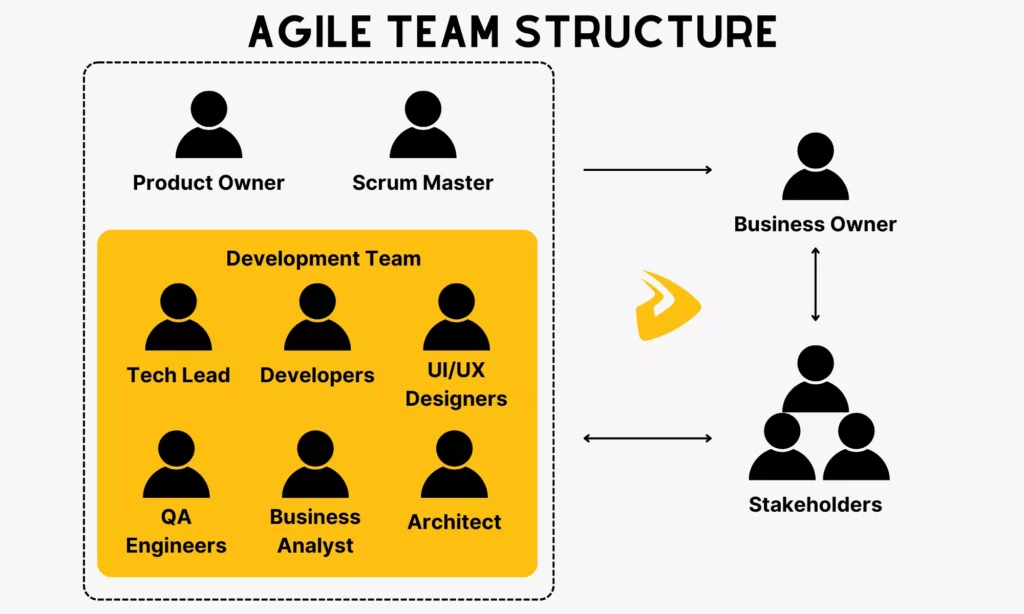
Think of a team structure as a practical map of who owns work and how the necessary skills come together. The diagram below shows a common arrangement, not a required Agile template.
Common Agile Team Structures
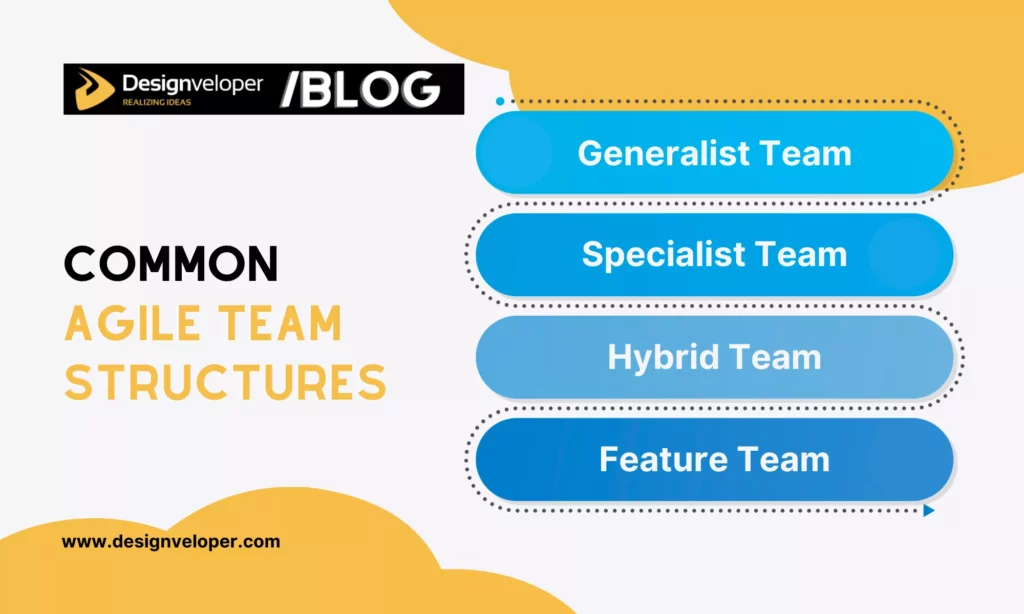
Agile team structures are easier to compare when skill mix and work ownership are treated as separate decisions. A team can, for example, have specialist skills and still own a customer feature end to end.
Choose a Skill Mix That Covers the Work
Skill mix describes how broad or deep people’s expertise is. It does not decide which product area the team owns.
| Skill mix | How it works | Useful when | Trade-off |
|---|---|---|---|
| Generalist | Members can contribute across several kinds of work. | The product is small and work does not need deep specialization at every step. | The team may lack depth for complex or regulated tasks. |
| Specialist | Members bring deeper expertise in distinct disciplines. | The work needs focused skills such as security, data engineering, or accessibility. | Work can queue behind an overloaded specialist. |
| Hybrid or T-shaped | Members have depth in one area and working knowledge of adjacent tasks. | The team needs specialist quality and enough overlap to share work. | Building and maintaining overlapping skills takes time. |
Choose What the Team Owns
Work ownership describes the slice of a product or service a team is responsible for delivering and supporting. These models can coexist across an organization.
| Ownership model | What the team owns | Main benefit | Watch for |
|---|---|---|---|
| Feature team | An end-to-end customer or user capability across relevant parts of the system. | Fewer handoffs for feature work and clearer ownership of user outcomes. | Shared components, architecture, or specialist skills may need coordination. |
| Component team | A technical component used by other teams. | Concentrated expertise and consistent maintenance of a complex component. | Customer features may wait for several component teams. |
| Platform team | Shared tools or services that help product teams deliver their work. | Common capabilities can be maintained once and offered to multiple teams. | Treat other teams as users; avoid creating a ticket queue for every interaction. |
Choose the boundary that reduces avoidable waiting while keeping necessary expertise available. A feature-oriented team is not automatically better: a shared security platform or data service may need a dedicated owner. The PMI overview of value-creation structures also describes several ways teams can be organized, rather than prescribing a single model.
Further reading:
- Scrum Software Development Turns Change Into Working Software
- Agile Project Management: Plan, Adapt, And Deliver Better In 2026
- 20 Software Project Management Methodologies for Software Development
Agile Team Roles and Responsibilities
Agile does not require every team to use the same job titles. In Scrum, the accountabilities are explicit: one Product Owner, one Scrum Master, and Developers. Outside Scrum, teams should name the responsibilities and decision rights their own method requires rather than treating similar titles as automatic equivalents.
Product Owner
In Scrum, the Product Owner is accountable for maximizing product value and managing the Product Backlog. This includes communicating the Product Goal, making backlog items understandable, and ordering the work. The role is one person, not a committee, though that person can delegate tasks and consult stakeholders.
Scrum Master
The Scrum Master is accountable for establishing Scrum and helping the Scrum Team improve its effectiveness. The role supports self-management, helps remove impediments, and makes Scrum events useful. It is not a task-assignment role or a synonym for every Agile coach, project manager, or delivery lead.
Developers
In Scrum, Developers are the people who create any part of a usable Increment. The term is broader than software programmers: the skills needed may include design, testing, analysis, operations, or other expertise. Developers plan their work, uphold the Definition of Done, and adapt their plan toward the Sprint Goal.
Specialists and Supporting Responsibilities
Teams may also need business analysis, UX, quality assurance, security, data, operations, or customer support skills. These are capabilities to cover, not mandatory standalone roles. A business analyst, for example, may help clarify a user or business need, but the team should still agree who owns the decision and how the requirement is validated.
For each responsibility, make three things visible: who decides, who contributes, and what evidence shows the work is complete. That clarity prevents role titles from hiding approval delays or leaving quality checks unowned.

How Do Agile Teams Work?
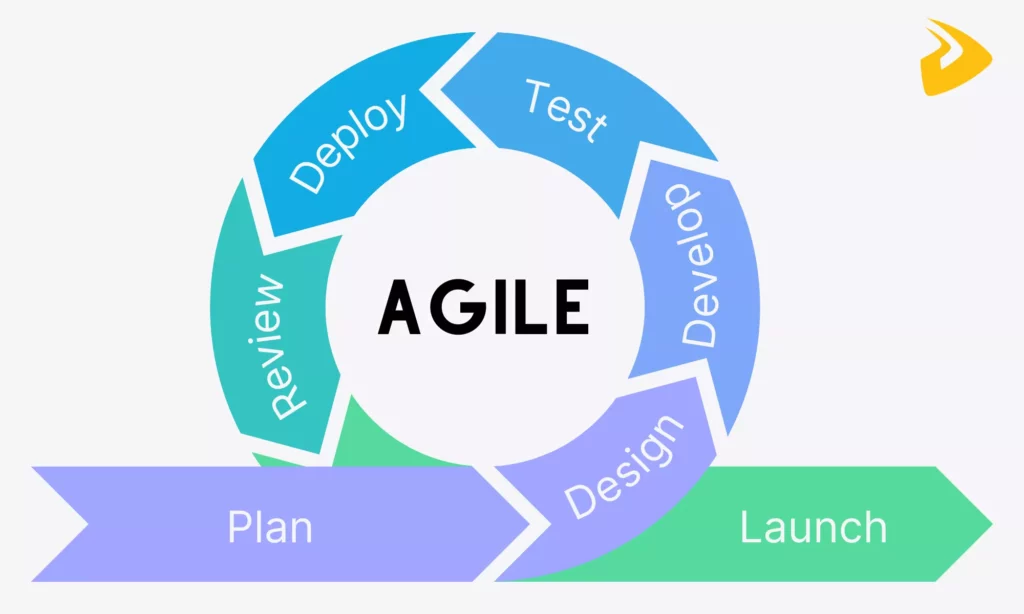
An Agile team moves from a user or business need to a usable result, checks what happened, and adapts the next piece of work. The exact cadence varies: Scrum uses Sprints and formal events, while a flow-based Kanban system does not require Scrum’s roles or Sprint events.
A Method-Neutral Delivery Loop
- Choose an outcome: Select a user or business problem that the team can make progress on and state what would count as useful evidence.
- Clarify and slice the work: Break the need into small items with understandable scope, dependencies, and completion conditions. Teams may use user stories in Agile when that format helps communicate the user need.
- Plan within capacity: Decide what to start based on priorities, available skills, active work, and unresolved dependencies. If the team uses Scrum, Sprint Planning establishes a Sprint Goal and the Developers forecast work they believe they can complete.
- Build and check quality: Integrate design, implementation, testing, and any required review as the work progresses. Agree on acceptance criteria that make the expected behavior testable.
- Inspect the result: Review working output with users or stakeholders where possible. In Scrum, the Daily Scrum is for Developers to inspect progress toward the Sprint Goal and adapt their plan, not a required round-robin status report.
- Adapt the next decision: Use feedback, quality signals, and blocked-work patterns to change priorities, clarify the workflow, or address a dependency.
What Scrum Adds to the Loop
Scrum defines a Sprint of one month or less, the Sprint Planning, Daily Scrum, Sprint Review, and Sprint Retrospective events, plus accountabilities and artifacts. Developers forecast work with the Sprint Goal in mind; they do not make an unconditional promise that scope can never change. The Sprint Review inspects the product outcome with stakeholders, while the Retrospective focuses on improving how the team works. These are Scrum rules, not a ceremony checklist for every Agile team.
Teams that estimate with story points should use them as a local planning aid, not as a measure of individual productivity or a promise of output. A team’s velocity in Agile is a historical planning signal within that team; it should not be compared as a universal performance score.
Explore more:
- Agile Sprint Planning: Definition and Generic Guides
- Story Points in Agile and How to Estimate Them Effectively
- Agile Methodology Testing: Lifecycle, Quadrants & Team Practices
Agile vs. Predictive Delivery: What Changes?
Agile-oriented and predictive approaches differ mainly in how teams plan, learn, and respond to change. These are common tendencies, not fixed traits of every project; many organizations combine adaptive delivery with formal approvals or milestone plans. For a broader comparison, see Agile vs. Traditional Project Management.
| Area | Agile-oriented delivery | Predictive or plan-driven delivery |
|---|---|---|
| Planning | Plans are revisited as the team learns, within agreed goals and constraints. | More scope and sequence may be set upfront, with changes handled through agreed controls. |
| Feedback | Teams seek feedback during delivery and use it to inform priorities. | Feedback may be organized around milestones or other review points. |
| Testing and risk | Quality checks can be integrated into each increment to reveal issues during delivery. | Checks may be staged or integrated, depending on the product and assurance model. |
| Documentation and approvals | The team keeps documentation and approvals that support decisions, quality, and compliance. | The plan may specify more documentation or approval gates before work proceeds. |
Neither approach removes the need for clear ownership, quality, or risk management. The right choice depends on how much uncertainty the team must learn through, what constraints it must satisfy, and how costly it would be to change the plan.
How to Build or Improve an Agile Team
Build the team around an outcome and test whether its boundaries help work reach users. A team can start with a small change to its responsibilities or workflow instead of reorganizing an entire department.
A Six-Step Setup Process
- Name the outcome and user: State which user or business need the team owns. Identify a result the team can observe, not just a list of tasks.
- Map the path from request to release: Note the skills, decisions, reviews, and other teams needed to finish work. Mark where items wait or change hands.
- Choose the team boundary: Decide whether work should be owned end to end or whether a component or platform needs a dedicated team. Record any dependency that remains.
- Cover the necessary skills: Identify missing product, design, engineering, testing, security, or operational capability. Pair, train, hire, or establish a clear service agreement for gaps.
- Set decision rights and working rules: Clarify who orders work, approves risk, checks quality, and handles stakeholder feedback. A useful set of Agile development best practices starts with observable working agreements, not a long list of ceremonies.
- Run a small pilot and review evidence: Choose one thin slice of work and agree how to assess it. Track a baseline such as blocked time, cycle time, escaped defects, or user feedback; name an owner, review cadence, and threshold for changing the setup. Do not claim improvement until the team has measured it.
Example: A Team Improving SaaS Sign-Up
Hypothetical example: A SaaS product team hears that users are abandoning a long sign-up process. It maps the flow and finds that product decisions, interface changes, validation, and release checks sit with different groups. The team proposes a feature boundary that brings product, UX, engineering, and test skills together for the sign-up experience.
The team breaks the work into smaller changes, writes acceptance conditions for each, and tests the flow before release. A shared security review remains outside the team, so the plan records that dependency and its owner rather than pretending the team is fully independent. The team compares sign-up completion, support feedback, and defects with its starting baseline at the agreed review point. The example describes a measurement plan, not a measured result.
If the team needs a practical starting artifact, it can use an Agile methodology sample as a reference and adapt it to its own decisions, constraints, and feedback loop.
When Should You Use an Agile Team?
An Agile team is a strong fit when the work has uncertainty, priorities may change, and users or stakeholders can provide feedback during delivery. It is also useful when a team can release or demonstrate increments often enough to learn from them.
Agile is not automatically unsuitable for regulated or high-assurance work. The team may need documented decisions, traceability, security review, testing evidence, or formal approvals inside its workflow. A predictive or hybrid plan may fit better when sequence and scope are tightly constrained by external dependencies or when iteration would add cost without useful learning.
- Consider Agile when a product team needs to test assumptions, respond to user feedback, or reprioritize within agreed goals.
- Add explicit guardrails when compliance, safety, privacy, or release approval must be demonstrated.
- Consider a more predictive or hybrid approach when requirements and sequence are stable, changes are costly, or external work fixes the delivery path.
- Use a lighter process for small, low-risk work if formal events do not add useful coordination or learning.
Compare the cost of waiting for feedback with the cost of changing the plan. Agile and Lean principles can inform that discussion, but the team’s actual constraints should drive the decision.

Frequently Asked Questions About Agile Teams
How Many People Should an Agile Team Have?
There is no universal Agile team-size rule. The Scrum Guide says a Scrum Team is typically 10 or fewer people; teams using other methods should size around the skills needed and the cost of coordination.
Can Agile Teams Work Remotely?
Yes. Remote teams can work with shared documentation, visible work, clear decision records, reliable access to stakeholders, and agreed overlap hours. Time zones and delayed feedback can add coordination cost, so asynchronous updates should not replace every conversation that needs a joint decision.
Can Agile Teams Have a Central Coordination Group?
Yes, when multiple teams need to manage shared goals, dependencies, or release decisions. Give the group a clear coordination purpose and keep day-to-day work decisions with the teams that own the work. A central group should reduce delays, not become another approval queue.
The best Agile team structure is the one that makes ownership visible, gives people access to the skills they need, and helps the organization learn from delivered work. Review the boundary when dependencies, user needs, or risk controls change.
Also published on

Share post on










Related Articles



How Will AI Affect Software Development? Complete Guide In 2026
How Will AI Affect Software Development? Complete Guide In 2026 Published October 21, 2026
How Gitignore Works: Rules, Patterns, Examples, And Debugging Tips
How Gitignore Works: Rules, Patterns, Examples, And Debugging Tips Published October 16, 2026
What Is Velocity In Agile? Formula, Examples, And Common
What Is Velocity In Agile? Formula, Examples, And Common Published October 15, 2026