













Top 15 Hardest Programming Languages (Ranked by Difficulty)

Many developers ask the same question: what is the hardest programming language to learn? The answer depends on how we define difficulty. Some languages are hard because they demand low-level precision, while others are difficult because they require a completely different way of thinking.
This guide ranks 15 of the hardest programming languages and explains why they are so challenging, where they are used, and which ones are difficult in practical software development rather than just in theory.
Related guide:
What Makes a Programming Language Hard?
Not all difficult programming languages are hard for the same reason. In most cases, a language becomes difficult because of one or more of the following factors:
- Syntax complexity: Some languages use dense notation, unusual symbols, or strict rules that make code harder to read and write.
- Memory management and debugging burden: Languages like C, C++, and Assembly give developers more control, but they also make bugs easier to introduce and harder to fix.
- Paradigm shift: Languages such as Haskell, Prolog, Erlang, and Rust can feel difficult because they require a very different way of thinking from procedural or object-oriented programming.
- Tooling and error feedback: A language with limited tooling, weaker documentation, or less helpful compiler feedback usually takes longer to learn.
- Real-world vs. theoretical difficulty: Some languages are hard because they solve serious engineering problems, while others are difficult mainly because they were designed to be obscure or experimental.
That is why the hardest programming language is not always the one with the strangest syntax. It is often the one that demands the most precision, abstraction, and problem-solving from the programmer.
Esoteric vs Practical Hard Languages
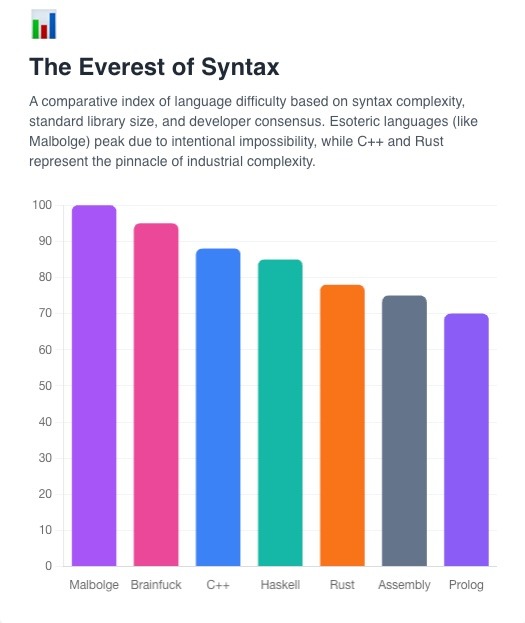
When people ask about the hardest programming language, they are often talking about two different categories:
- Esoteric hard languages: These include languages like Brainfuck and Malbolge. They were created to be unusual, experimental, or intentionally difficult, but they are rarely used to build real-world software.
- Practical hard languages: These include C++, Rust, Haskell, Assembly, and C. They are difficult because they solve demanding engineering problems and require deeper technical knowledge, precision, or abstract thinking.
This distinction matters because the answer depends on what the reader actually wants to know:
- If the goal is to identify the most extreme or most confusing language ever created, Malbolge is one of the strongest answers.
- If the goal is to understand which languages are hardest to learn and still useful in real jobs, C++, Rust, Haskell, and Assembly are much more relevant.
Keeping these two categories separate makes the ranking clearer and more practical for readers.
Quick Comparison of the Hardest Programming Languages
Before diving into the full list, it helps to compare these languages side by side. Some are difficult because they expose low-level machine details, while others are hard because they require new mental models or use intentionally obscure syntax. The table below gives a quick overview of why each language is challenging and where it is most relevant.
| Language | Difficulty Type | Why It’s Hard | Real-World Use | Best For |
|---|---|---|---|---|
| Assembly | Low-level / hardware | Manual register, memory, and instruction control | Embedded systems, drivers, optimization | Systems programmers |
| C++ | Complexity + manual control | Pointers, templates, undefined behavior, broad feature set | Game engines, finance, browsers, performance-critical systems | Advanced developers |
| Rust | Memory safety / strict rules | Ownership, borrowing, lifetimes, compiler restrictions | Infrastructure, backend systems, security tools | Developers who want safe performance |
| Haskell | Functional abstraction | Lazy evaluation, monads, and declarative thinking | Research, compilers, advanced data systems | Functional programming learners |
| Prolog | Logic programming | Rule-based thinking and backtracking | AI, symbolic reasoning, computational linguistics | Declarative problem-solvers |
| Lisp | Symbolic / recursive thinking | Parentheses-heavy syntax, recursion, macros | AI, academic work, language design | Developers interested in abstraction |
| Brainfuck | Esoteric minimalism | Extremely unreadable symbolic syntax | Experimental and educational use only | Puzzle-oriented programmers |
| Malbolge | Esoteric self-modifying design | Intentionally obscure and nearly impossible to write manually | No mainstream practical use | Curiosity and experimentation only |
| C | Low-level systems programming | Manual memory handling and limited safety features | Operating systems, embedded software, compilers | Systems and embedded developers |
| Scala | Hybrid paradigm | Combines OOP and functional programming with advanced syntax | JVM backend systems, data engineering | Developers working in Java ecosystems |
| Erlang | Concurrency model | Actor-based programming and immutable thinking | Telecom, distributed and fault-tolerant systems | Backend and distributed systems engineers |
| Forth | Stack-based model | Postfix notation and manual stack reasoning | Embedded systems, firmware | Low-level specialists |
| Objective-C | Legacy hybrid syntax | C mixed with message-passing syntax and older patterns | Legacy Apple development | Teams maintaining older iOS/macOS projects |
| Perl | Flexible but cryptic syntax | Context rules, regex-heavy style, readability issues | Scripting, automation, text processing | Scripting specialists |
| R | Statistical / domain-specific syntax | Specialized data structures and conventions | Analytics, statistics, research | Data analysts and researchers |
Top 15 Hardest Programming Languages to Learn
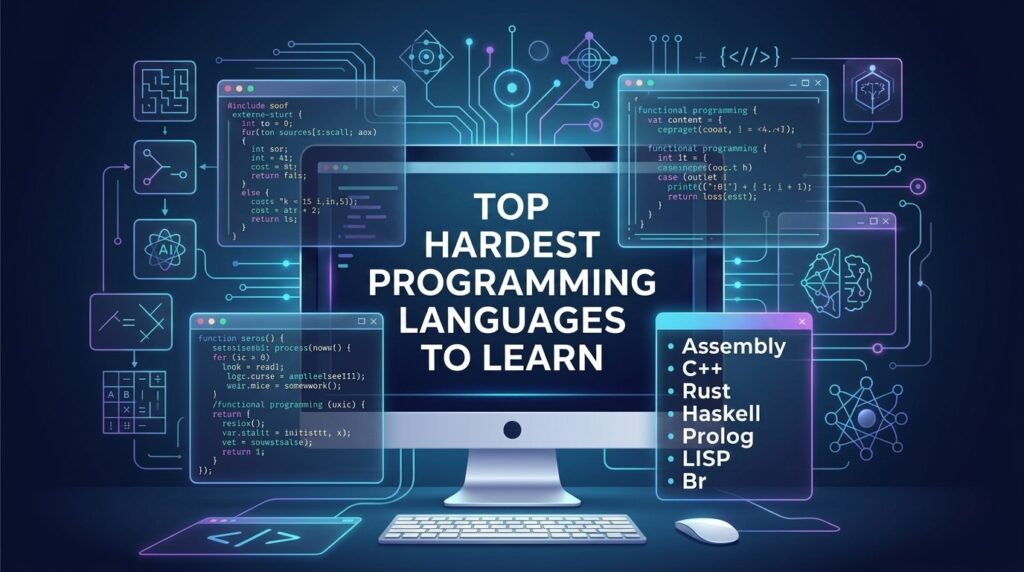
Assembly
Assembly is a hardware-level language. It uses mnemonic instructions that map almost one-to-one with machine code. Programmers must manage registers and memory addresses directly. This low-level detail makes it very challenging. For example, a few lines of x86-64 assembly are needed just to do simple arithmetic:
section .text global _start _start: mov rax, 1 ; Set register RAX to 1 add rax, 2 ; Add 2 to RAXEven this tiny example shows how verbose assembly is. There are no shortcuts or high-level operations. Errors in registers or memory can crash the program. Experts note that assembly’s “direct correspondence with machine code” demands a deep understanding of computer architecture. It is considered one of the hardest languages because every instruction and memory detail is manual.
Further reading: Key Differences Between WebAssembly vs JavaScript
C++
C++ is a powerful, high-performance language but also notoriously complex. It supports object-oriented, procedural, and template programming, which increases the learning curve. Programmers must manage memory manually using pointers and references. Even simple tasks often require understanding of low-level details. For example, printing a number via a pointer in C++ looks like:
#include <iostream> int main() { int x = 42; int *p = &x; // p points to x std::cout << *p << "\n"; return 0; }In this code, the line int *p = &x; declares a pointer to x. Using *p then prints the value of x. Misplacing a * or forgetting to delete dynamically allocated memory can cause crashes or leaks. As one source explains, missing a semicolon or mismanaging a pointer “can lead to memory leaks or pointer errors”. C++’s syntax is intricate and its features (like templates and operator overloading) are not easy for beginners. For these reasons, many call C++ one of the hardest mainstream languages to master.
Explore more: Comparing Rust vs C++ Performance
Rust
Rust is a modern systems language that emphasizes safety and speed. It introduces strict rules about ownership and borrowing to prevent memory bugs. While these rules avoid crashes, they also make Rust very hard to learn for beginners. For example, this Rust program uses mutable borrowing:
fn main() { let mut data = String::from("hello"); add_exclamation(&mut data); println!("{}", data); } fn add_exclamation(s: &mut String) { s.push_str("!"); }In this code, passing &mut data to add_exclamation demonstrates Rust’s borrowing. The compiler enforces that only one mutable reference exists at a time. Such rules force the programmer to think differently about memory. Sources note that Rust’s “strict compiler…will not allow code to compile unless it is entirely safe”. The language’s concepts like ownership and lifetimes can be “hard to master for new programmers”. Despite its popularity, Rust is widely regarded as one of the toughest languages because of this strict memory model and unique syntax.
To learn more about Rust, check out these articles:
Haskell
Haskell is a purely functional language that often ranks as extremely hard to learn. It uses a mathematical, declarative style unlike imperative languages. A beginner usually has not seen features like lazy evaluation or monads before. For example, a simple Haskell factorial function is:
factorial 0 = 1 factorial n = n * factorial (n - 1) main = print (factorial 5)Even this code looks different from C or Java. Haskell’s compiler and language rules are very abstract. As one source notes, Haskell’s “abstract syntax” and “functional approach” can be difficult for those used to imperative languages. Its lazy evaluation means expressions only compute when needed, which is a subtle concept. Because of its high level of abstraction and mathematical focus, Haskell is “considered one of the top 10 hardest languages to learn”. Many beginners find its syntax confusing and the functional mindset challenging.
Prolog
Prolog is a logic programming language used in AI and computational linguistics. It is very different from procedural languages. In Prolog, you declare facts and rules, and queries try to satisfy logical conditions. For example:
parent(alice, bob). parent(bob, carol). grandparent(X, Z) :- parent(X, Y), parent(Y, Z).A query like ?- grandparent(alice, carol). would return true because of the rule. This style requires thinking in logical relations instead of writing steps. Sources explain that Prolog’s “logic-based structure” forces a programmer to define “what” the solution is, not “how” to get it. Its syntax and backtracking mechanism are unfamiliar to most, making Prolog one of the hardest languages. In fact, it’s said to be “extremely challenging” and very different for programmers used to OOP. The mental shift to declarative coding is the main source of difficulty.
LISP
LISP is one of the oldest programming languages, famous for its heavy use of parentheses and symbolic expressions. It powers many AI and research projects. For example, a classic LISP function for factorial:
(defun factorial (n) (if (<= n 1) 1 (* n (factorial (- n 1)))))At first glance, the code is full of nested parentheses, which is hard for beginners. Every list or function call is written as (operator operands), which is very different from C-style syntax. Experts point out that LISP’s “unique syntax” and recursion-focused design make it complex to learn. Its powerful macrosystem also adds to the learning curve. In short, LISP forces you to think in terms of lists and recursive processing. Many find this so challenging that it’s often listed among the hardest languages to master.
Brainfuck
Brainfuck is an esoteric language intentionally designed to be extremely difficult. It has only eight commands (such as >, <, +, -, [, and ]) and everything else is ignored as a comment. Because of this minimalism, even trivial programs become very long and unreadable. For example, this small Brainfuck snippet increments a cell five times:
+++++ [Initialize cell #0 to 5] [ > + [Move to cell #1 and increment it] < - [Move back and decrement cell #0] ]Writing any non-trivial program in Brainfuck is extremely tricky. One source notes it is a “developer’s nightmare” precisely because of the eight one-character commands. Brainfuck has no words or descriptive syntax; loops and memory moves are all single symbols. Debugging or understanding Brainfuck code is like solving a puzzle. This is why it is widely considered one of the hardest programming languages to master.
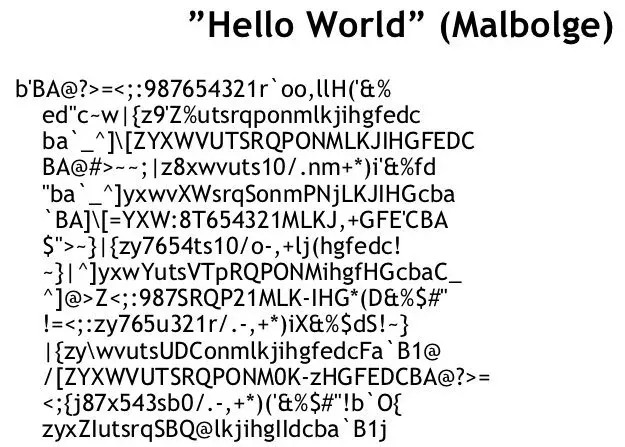
Malbolge
Malbolge is famously the hardest programming language ever created. It was deliberately designed to be nearly impossible to program. In fact, after it was invented in 1998, it took two years before anyone (using a beam search algorithm) wrote even a simple program. Malbolge’s code even self-alters at runtime. A language blog explains it is “engineered to be… unprogrammable”. No natural human example fits well here, but imagine code that modifies its own instructions as it runs. The combination of strange ternary-based operations and encryption makes Malbolge outrageously hard. Experts say these factors make it “one of the top 10 most difficult programming languages to learn”.
C
C is a low-level systems language that gives the programmer direct access to memory. It is older than C++ and is still the foundation of many operating systems. C requires strict syntax and manual memory management, which can trip up new learners. For example, C pointers allow powerful direct access but cause errors if misused:
#include <stdio.h> int main() { int a = 5; int *p = &a; printf("%d\n", *p); // prints the value of a via pointer return 0; }This code shows how a pointer p references a. In C, if a programmer forgets to manage dynamic memory or uses the wrong type, the program can crash. One source notes that C is “close-to-hardware” and requires very careful memory handling. Because there are few safety nets, C is considered powerful but very challenging for beginners. Its steep curve is why C remains on hardest-language lists.
Scala
Scala is a modern language that runs on the JVM. It blends object-oriented and functional programming in a single language. This hybrid nature leads to a very complex syntax and many advanced features. Beginners must learn both OOP concepts and functional ideas like immutability and higher-order functions. For example, Scala code for mapping a function over a list:
object Example { def main(args: Array[String]) { val result = List(1, 2, 3, 4, 5).map(_ * 2) println(result) // prints List(2, 4, 6, 8, 10) } }Even this example uses a lambda (_ * 2) and immutable lists. Scala’s approach can confuse new learners. One source notes that Scala’s “hybrid approach requires knowledge of both functional and object-oriented programming”, which adds complexity. It is widely used in big data and backend systems, but its steep learning curve is well-known. Many mention Scala on hardest-language lists simply because there are so many rules and shortcuts to master.
Erlang
Erlang is a functional language designed for highly concurrent, fault-tolerant systems (telecommunications, servers). It uses an actor model with lightweight processes. Although powerful, Erlang’s syntax and model differ greatly from mainstream languages. For example, defining a recursive factorial in Erlang:
-module(math). -export([fact/1]). fact(0) -> 1; fact(N) -> N * fact(N-1).Here the -> and semicolons are unique to Erlang. More challenging is thinking in terms of processes and message passing. Its concurrency model is very different from thread-based models in C++ or Java. A recent analysis notes that Erlang is “one of the hardest coding languages to learn” because it requires experience with its unusual concurrency model. Beginners often struggle with the mindset shift from imperative to functional concurrency. Therefore, Erlang is included among the harder languages to learn.
Forth
Forth is a stack-based language often used in embedded systems. It uses postfix (Reverse Polish) notation, which is unlike most languages. In Forth you define words (functions) that operate on a stack. This makes Forth code very terse but also very unusual. For example, a simple Forth definition might look like:
<code>: square ( n -- n^2 ) dup * ;</code>This defines a new word square that duplicates the top stack item and multiplies it. The ( n — n^2 ) is a stack comment. Because there are no variables or typical control structures, the programmer must manage the stack manually. Forth’s way of writing programs is so different that many find it hard at first. In practice, learning Forth involves understanding low-level operations and building up from very basic words. Although exact quotes are scarce, it’s well-known among programmers that Forth’s learning curve is steep due to its unconventional approach.
Objective-C
Objective-C is an object-oriented language used mainly for macOS and iOS development (before Swift). It mixes C syntax with Smalltalk-style messaging. This hybrid syntax can confuse learners. For example:
#import <Foundation/Foundation.h> int main() { @autoreleasepool { NSString *greeting = @"Hello, Objective-C!"; NSLog(@"%@", greeting); } return 0; }In this code, NSLog(@”%@”, greeting); is very different from C’s printf. Additionally, Objective-C requires understanding of memory management (ARC and retain-release). A source notes that Objective-C’s “syntax…can be confusing and hard to read”, and that its age means it “lacks some of the modern conveniences” of newer languages. Because of these factors, Objective-C is often described as one of the more difficult modern languages to learn.
Perl
Perl is a powerful scripting language known for its flexibility in text processing. It follows the philosophy “There’s more than one way to do it.” This extreme flexibility can lead to cryptic and hard-to-read code. For example:
my $s = 'hello'; $s =~ s/hello/world/; print "$s\n"; # prints "world"Even this simple example uses a regular-expression substitution, which might confuse new coders. As noted in a developer guide, “Perl’s syntax can be complex and hard to read”. Its variable naming and context rules also add confusion. Many inexperienced programmers find Perl’s constructs non-intuitive. Because of its “advanced syntax” and ability to generate unreadable code, Perl is often included among the challenging languages.
R Programming Language
R is a specialized language for statistics and data analysis. It has features for handling vectors and data frames, but its syntax is quite different from general-purpose languages. In R, many operations use vectorized functions, and even basic tasks may have unusual names. For instance:
data <- c(1, 2, 3) print(data + 1) # adds 1 to each elementThis seems simple, but beginners often find R’s syntax hard to read. One source notes that R “may be difficult for beginners to grasp as a first programming language”. Researchers find that R’s syntax and data operations (like selecting or renaming variables) are more complex than in other languages. In a built-in tech article, it is stated that R “can be considered difficult to learn due to its syntax being different from other popular languages, having a large number of commands and a complex variable naming system”. These features make R one of the harder languages for newcomers, especially those without prior coding background.

Continue with these:
- Everything About the Ruby Programming Language
- Everything About the Go (Golang) Programming Language
- Top Programming Courses Online to Start a Tech Career
Which Hard Programming Language Should You Learn?
Choosing the hardest programming language is not always the smartest goal. A better question is which difficult language is worth learning for the kind of work you want to do.
- For systems programming: C++, Rust, Assembly, and C are strong choices if you want to understand performance, memory, hardware, and low-level software behavior.
- For functional programming: Haskell and Scala are good options if you want to explore abstraction, immutability, and different programming models.
- For logic-based problem solving: Prolog is a strong fit for readers interested in symbolic reasoning and declarative programming.
- For experimentation and curiosity: Brainfuck and Malbolge are interesting to explore, but they are not practical choices for most software projects.
In most cases, the best hard language to learn is the one that gives you long-term value in the domain you care about. Difficulty alone is not the reward. The real value comes from what that difficulty helps you build, understand, or master over time.
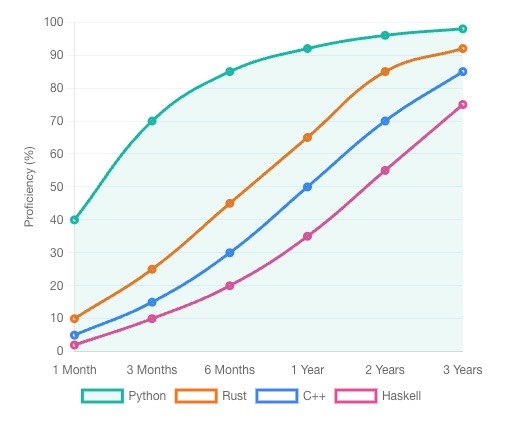
FAQs about Hardest Programming Languages
Is C++ the Hardest Programming Language to Learn?
C++ is certainly among the hardest general-purpose languages due to its complex syntax and manual memory control. However, it is not the single hardest. Lower-level languages like Assembly and esoteric ones like Malbolge and Brainfuck are often considered even more difficult. C++ has a steep learning curve, but most experts would say languages that work directly with hardware or use highly abstract paradigms are tougher.
Is C++ or Python Harder to Learn?
C++ is generally much harder to learn than Python. Python has a simple, readable syntax and automatic memory management, making it beginner-friendly. In contrast, C++ requires understanding pointers and manual memory management. According to experts, this extra complexity gives C++ a far steeper learning curve. Many sources call C++ “one of the toughest languages” to master, whereas Python is usually listed among the easiest.
Which is Hardest, C++ or Java?
Both C++ and Java are complex, but most agree C++ is harder than Java. Java was designed to be simpler: it removes pointers and adds garbage collection. C++ keeps low-level features that demand careful handling. As one source notes, C++’s manual memory management makes it very challenging. Java syntax and rules are more straightforward, so newcomers often find Java easier. In short, C++ is typically regarded as more difficult to learn than Java because of its closer-to-hardware nature.
Conclusion
At Designveloper, we’ve spent over a decade working with a wide range of programming languages—from the beginner-friendly to the most complex. Our team has tackled large-scale projects using C++, Rust, and Scala, and we’ve even explored languages like Prolog and Haskell in advanced AI and research-based solutions. With over 150 successful software projects delivered for clients across the US, Singapore, and Europe, we understand that choosing the right language—especially when it’s the hardest programing language—is not just about syntax, but about solving the right problems efficiently.
Whether you’re building a low-level system in C, a scalable backend in Erlang, or a high-performance web app in Rust, we’ve been there. Languages like Assembly and Objective-C may be tough to master, but our experience building mission-critical systems like LuminPDF (now with over 70M users) and Swell indicates our ability to handle even the most demanding technical challenges.
At Designveloper, we don’t just write code—we architect long-term solutions. If you’re unsure about which language to use for your next product, or if you’re facing complex technical requirements that demand senior expertise, our full-stack team can guide you through the process. From custom software development and web app creation to AI consulting and DevOps support, we combine deep technical mastery with a clear product vision.
Also published on

Share post on









Related Articles



Flutter vs React Native: Which Fits Your Mobile App?
Flutter vs React Native: Which Fits Your Mobile App? Published September 17, 2026
What Is TypeScript? JavaScript With Types, Explained
What Is TypeScript? JavaScript With Types, Explained Published September 16, 2026
Rust Vs Python: Performance, Safety, And Project Fit For Teams
Rust Vs Python: Performance, Safety, And Project Fit For Teams Published September 14, 2026