












Graph RAG Vs Traditional RAG: Choosing The Right AI Architecture

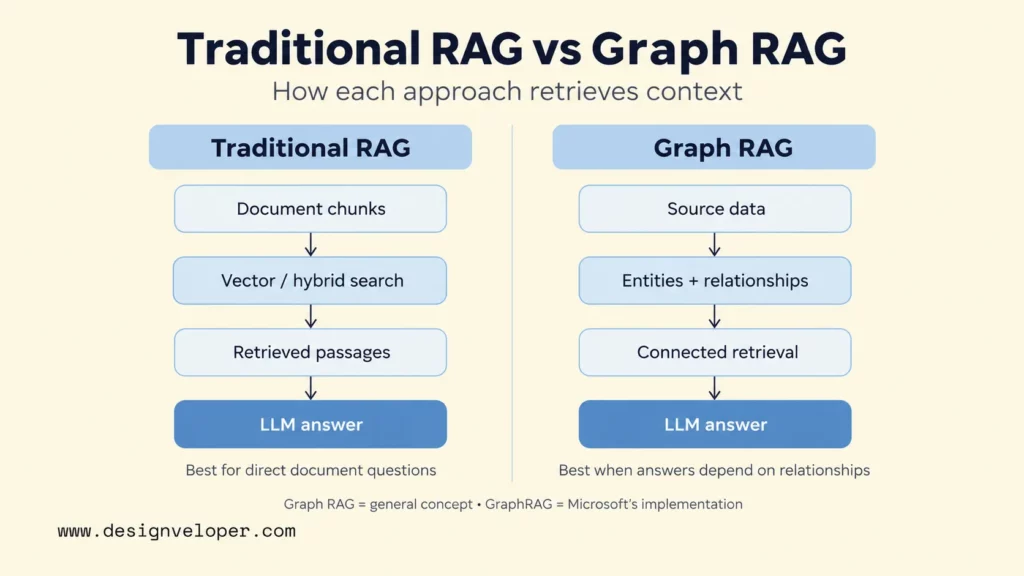
The Graph RAG vs Traditional RAG choice comes down to how each system retrieves context. Traditional RAG usually finds relevant passages through vector or hybrid search, while Graph RAG uses entities and relationships to retrieve connected evidence. Traditional RAG is often the simpler starting point for direct document questions. Graph RAG becomes more useful when answers depend on multi-hop relationships, and Hybrid RAG combines both when the workload needs them.
Throughout this article, Graph RAG is the general reader-facing term, while GraphRAG refers to Microsoft’s implementation. Traditional RAG means the common chunk-based baseline. In practice, non-graph RAG can also use keyword search, metadata filters, reranking, and hybrid retrieval. If you need the broader implementation pipeline first, our guide to building a RAG system covers ingestion, retrieval, evaluation, security, and production operations.
What Are Graph RAG And Traditional RAG?
Traditional RAG retrieves passages that are likely to contain the answer, while Graph RAG retrieves or expands through explicit connections between entities and facts. Both approaches give an LLM external context before generation. The main difference is the structure available to the retriever.
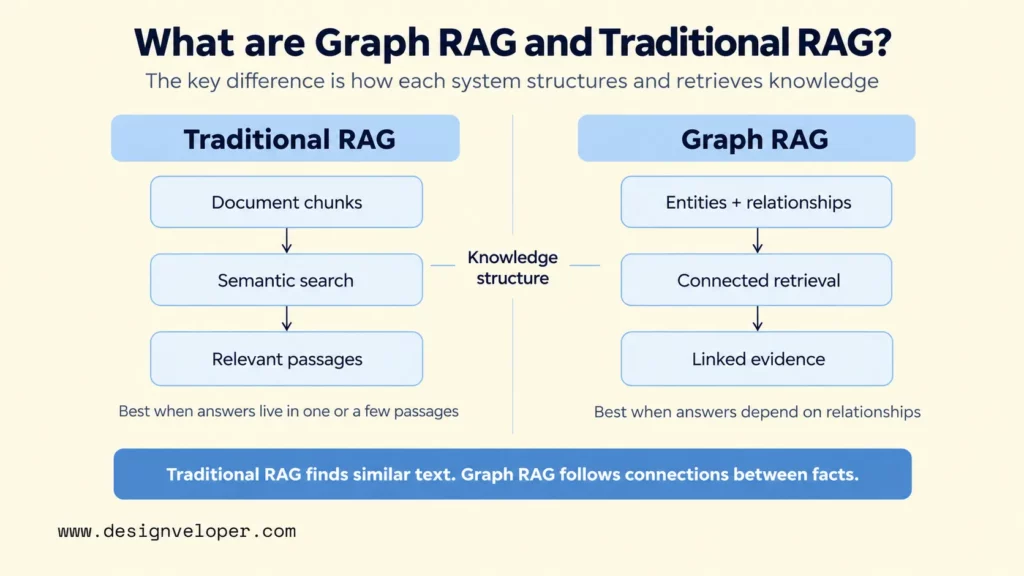
The original RAG paper combined a language model with a dense vector index, and that vector-retrieval pattern became a common baseline for document question answering. Current non-graph RAG can be broader than embeddings alone. Microsoft’s RAG solution design guide describes vector, full-text, hybrid, and multi-search options within a standard RAG architecture.
Graph RAG adds a graph-shaped representation of knowledge. Nodes can represent entities, concepts, events, or records, while edges represent relationships between them. Microsoft GraphRAG, for example, can extract entities and relationships from text, detect communities, create community reports, and store embeddings alongside graph-derived data. Its indexing documentation describes one implementation, not a universal workflow for every Graph RAG system.
The practical boundary is simple. Vector retrieval asks which passages are semantically close to the query. Graph retrieval can also ask how relevant items are connected. That extra structure matters when the relationship itself is part of the evidence needed for an answer.
How Traditional RAG Works
Traditional RAG usually turns a document collection into searchable chunks, finds the chunks most relevant to a question, and asks the LLM to answer from that retrieved context. A common vector-based workflow has four main steps.
- Ingest and chunk the sources. Break long documents into smaller passages that preserve enough local meaning to support retrieval.
- Create embeddings and index the chunks. An embedding represents each chunk as a vector so the system can compare semantic similarity.
- Retrieve passages for each query. Search the index and select a small set of relevant chunks. Metadata filters, keyword search, hybrid retrieval, or reranking can refine this stage.
- Generate the answer from retrieved context. Pass the selected evidence and the user’s question to the LLM with instructions about how to use that evidence.
This architecture fits questions whose answers already exist in one or a few passages. Product manuals, policy documents, support articles, and internal knowledge bases often have this shape. The main retrieval problem is finding the right text, not reconstructing a chain of relationships across many records.
The limitation appears when semantic similarity is not enough. A question may require facts from several chunks or an indirect dependency that no single passage states in full. The retriever may find useful pieces, but the LLM still has to connect them. Retrieval quality then becomes sensitive to chunk boundaries, query wording, ranking, and whether every required piece reaches the prompt.
Our Lumin project case study is a useful example of a document-centered product workflow. Lumin lets users view, edit, share, and collaborate on PDFs, with cloud-storage integration and digital signatures. A RAG assistant built for a comparable workflow could answer direct questions by retrieving passages from approved files. We do not claim that Lumin itself uses Traditional RAG, vector search, or Graph RAG. The example only shows why document-centric products often start naturally with passage retrieval.
How Graph RAG Works
Graph RAG adds relationship-aware indexing and retrieval to the RAG pipeline. Instead of treating every passage as an isolated retrieval unit, it creates or uses a graph that preserves how entities, facts, or concepts connect.
- Extract or import entities and relationships. A system may identify people, organizations, products, events, claims, dependencies, or other domain objects. Some projects start from an existing knowledge graph instead.
- Build graph structures and supporting indexes. The graph stores nodes and edges. An implementation may also create vector embeddings, text indexes, graph communities, summaries, or entity-to-passage mappings.
- Retrieve connected context. A query can start from a relevant entity or passage and expand through graph relationships. Other systems may use explicit graph queries, community search, vector search, or a combination.
- Generate from graph evidence and source text. The LLM receives selected entities, relationships, summaries, passages, or other provenance needed to answer the question.
Microsoft GraphRAG shows why there is no single Graph RAG query flow. Its query engine documentation describes Local Search for entity-focused questions, Global Search over community reports, DRIFT Search that combines local and broader context, and Basic Search for a vector-style baseline. Another Graph RAG system might use a graph database, a pre-existing ontology, or a different traversal strategy.
Graph construction also creates a new failure surface. Entity extraction can merge different entities, split one entity into several nodes, or create weak relationships. A graph can therefore make retrieval more structured without making it automatically correct. Teams still need source provenance, graph-quality checks, permissions, freshness controls, and answer evaluation.
Graph RAG Vs Traditional RAG: Key Differences
The decisive difference in Graph RAG vs Traditional RAG is whether retrieval needs explicit relationship structure. Traditional RAG is usually easier to launch because it can work directly from chunked documents. Graph RAG adds modeling and indexing work, but it can expose connected evidence that similarity search may not retrieve together.
| Factor | Traditional RAG | Graph RAG | Decision implication |
|---|---|---|---|
| Retrieval method | Finds relevant passages with vector, keyword, or hybrid search. | Retrieves graph entities, relationships, paths, communities, or linked passages. | Use graph retrieval when connections are part of the answer. |
| Data representation | Text chunks, embeddings, and metadata. | Entities or concepts plus explicit relationships, often linked to source text. | Graph RAG needs reliable entity and relationship modeling. |
| Query complexity | Strong for direct questions with evidence in a few passages. | Useful for relationship-heavy, multi-hop, or corpus-wide questions. | Classify real user questions before choosing an architecture. |
| Multi-hop reasoning | The LLM or retrieval logic must connect separate passages. | The retriever can follow explicit edges or graph-derived structures. | Graphs help when missing a relationship hop causes failure. |
| Explainability | Can cite retrieved passages and metadata. | Can also expose linked entities or paths as retrieval evidence. | Both still need provenance and source support. |
| Setup effort | Lower for a basic chunk, index, retrieve, and generate baseline. | Higher when teams must create, validate, and maintain graph structure. | Add graph complexity only for a measured retrieval need. |
| Cost, latency, and maintenance | Depends on corpus size, ranking, context length, and update frequency. | Adds graph construction and maintenance; query cost varies by method. | Measure both approaches on the same workload. |
| Best-fit use cases | Document Q&A, policy lookup, manuals, support, and early prototypes. | Dependency tracing, research synthesis, networks, and entity-rich analysis. | Use the simplest architecture that reliably answers target questions. |
Benchmark results are task- and implementation-dependent. Microsoft’s original Graph RAG paper reported better comprehensiveness and diversity than a naive RAG baseline for a class of global sensemaking questions over datasets around one million tokens. That result does not show that Graph RAG wins every retrieval task. A later GraphRAG benchmarking study examines several task types and notes that graph-based approaches can underperform vanilla RAG on some real-world tasks.
The same caution applies to cost. Microsoft’s current GraphRAG indexing methods documentation says Standard GraphRAG uses an LLM for entity extraction, relationship extraction, summaries, and community reports. The page estimates that graph extraction accounts for roughly 75% of indexing cost in that standard pipeline. FastGraphRAG replaces some LLM work with traditional NLP to reduce cost. The 75% estimate is specific to Microsoft’s documented implementation, not a universal Graph RAG cost ratio.
When To Use Traditional RAG
Use Traditional RAG when most questions can be answered from a small number of passages and you do not need an explicit relationship model to retrieve the evidence. It is usually the better baseline when the main task is to find the right part of a document collection and answer from it.
- Direct fact lookup from documents: policies, manuals, contracts, support material, research notes, and knowledge-base articles.
- Small or moderately complex knowledge bases: especially when semantic retrieval and metadata filters already recover the needed evidence.
- Early proofs of concept: a vector-based baseline is faster to build and gives the team a reference point for later architecture changes.
- Limited data-modeling resources: teams can postpone entity resolution, relationship extraction, graph schema decisions, and graph-maintenance work until those capabilities are justified.
Traditional RAG can also become more capable without becoming Graph RAG. Keyword search can recover exact terms that embeddings miss. Metadata filters can enforce tenant, date, product, or document constraints. Reranking can improve the order of retrieved passages, while hybrid search can combine lexical and vector retrieval. Our comparison of vector retrieval options explains how infrastructure choices affect filtering, deployment, scale, and operational ownership.
When To Use Graph RAG Or Hybrid RAG
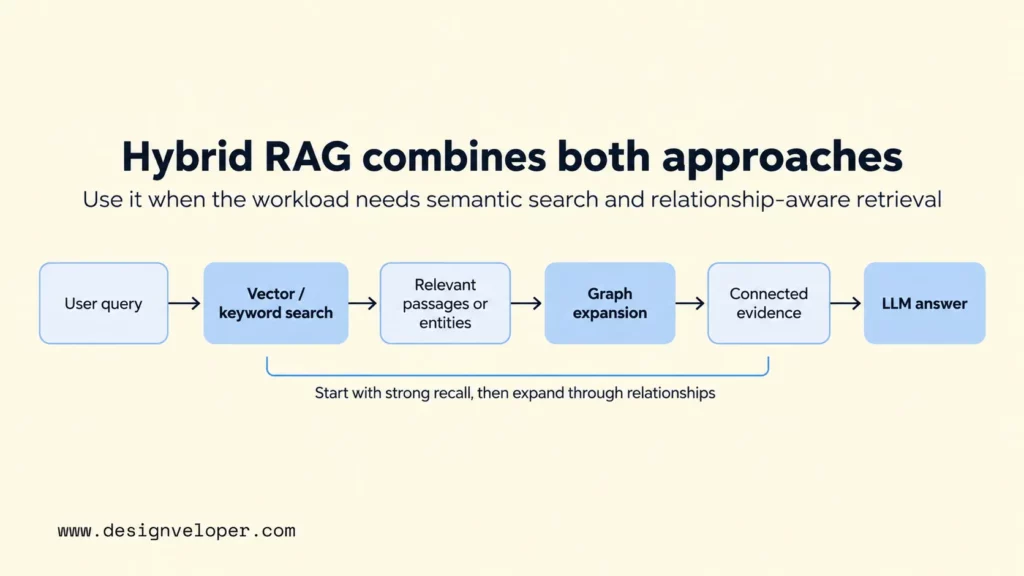
Use Graph RAG when important questions depend on explicit relationships that passage-similarity retrieval does not reliably bring together. Use Hybrid RAG when the workload needs both semantic or keyword retrieval and graph-aware expansion.
Multi-hop questions are a common signal. A supply-chain assistant may need to connect a delayed component to a supplier, a shipment, a product, and downstream orders. A compliance system may need to trace a rule to an entity, obligation, control, and affected process. Fraud analysis can involve accounts, devices, transactions, counterparties, and shared identifiers. Research and impact analysis can require connecting people, papers, events, dependencies, or claims across many sources.
Hybrid RAG is useful when neither structure nor semantic similarity is sufficient alone. A vector or keyword search can find good entry points in unstructured text, then graph retrieval can expand to related entities or records. Weaviate’s hybrid-search documentation describes a non-graph pattern that combines vector and keyword search. A graph-aware hybrid design adds relationship retrieval as another stage rather than replacing those search methods.
Our Song Nhi case study provides a useful structured-finance example without implying a specific RAG backend. Song Nhi is a personal-finance assistant that lets users record expenses through conversation and ask questions about their spending. For a similar future assistant, a graph could represent relationships among accounts, transactions, merchants, categories, dates, budgets, and goals. A query such as “Which subscriptions increased my dining-and-entertainment spending after my budget changed?” could require both relevant text and several connected records. We do not claim that Song Nhi uses Graph RAG.
Graph RAG is not justified merely because a corpus is large. A large document collection with mostly direct lookup questions may still work well with vector or hybrid retrieval. The stronger signal is a repeated retrieval failure where the missing evidence is relational: the system finds relevant pieces but does not connect the right ones.
How To Choose Between Graph RAG And Traditional RAG
Choose between Graph RAG and Traditional RAG by testing both against the questions, data relationships, freshness requirements, and operating constraints of your actual application. When the architecture is uncertain, start with a Traditional RAG baseline and add graph retrieval only if relationship-aware indexing fixes a measured gap.
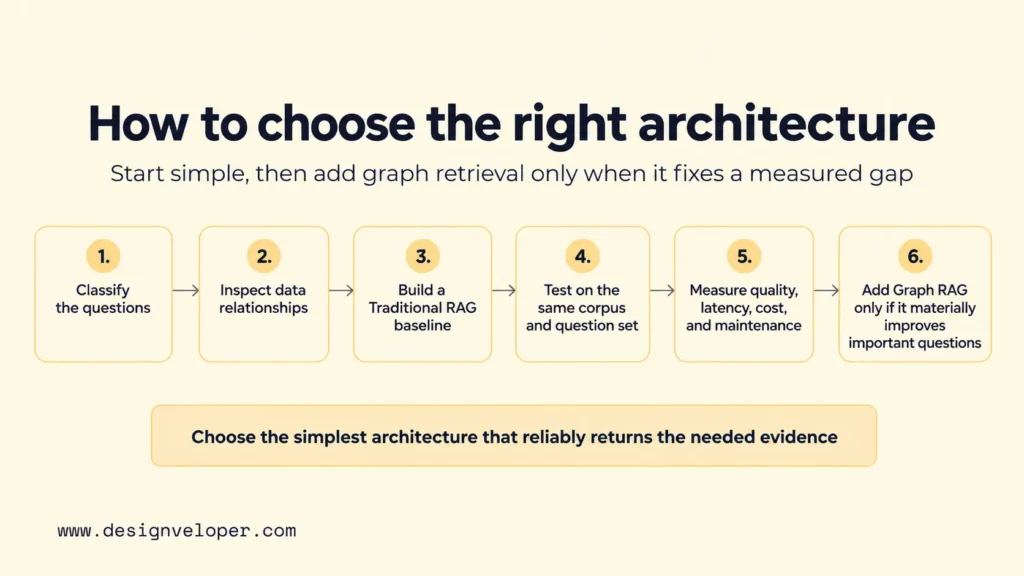
- Classify the questions. Separate direct fact lookup, broad synthesis, multi-hop questions, dependency questions, and queries that require exact filters or relationships. The architecture should follow the hardest important query class, not the most impressive demo.
- Inspect the data structure. Identify whether entities have stable identifiers, whether relationships are explicit or must be extracted, and how often those facts change. A graph is harder to trust when entity resolution is poor or relationships become stale quickly.
- Build the simplest credible baseline. Start with chunking, vector or hybrid retrieval, metadata filters, and reranking as needed. This establishes whether the problem is really missing relationships or simply weak baseline retrieval.
- Create an evaluation set from real questions. Use the same corpus and question set for each architecture. Include easy lookups and difficult relational questions so a gain in one slice does not hide a loss in another.
- Measure retrieval and answer behavior. Check whether the correct evidence is retrieved, whether the answer is grounded in that evidence, and whether important facts are omitted. Also measure latency, token use, index-build cost, update cost, and maintenance work.
- Add Graph RAG only where it earns its complexity. Keep graph retrieval when it materially improves important questions without unacceptable cost, latency, or governance trade-offs. Otherwise, keep the simpler baseline and improve it.
This evaluation-first approach also helps with governance. A graph adds derived data that must be refreshed, permissioned, and traceable back to sources. Traditional RAG has similar operating needs around document access, metadata quality, deletion handling, and citation provenance. Our RAG best practices guide expands on retrieval evaluation, source freshness, permissions, and regression checks when the system moves toward production.
A practical decision rule is to ask which retrieval design reliably returns the evidence the product needs. Compare answer quality, retrieval performance, latency, cost, and operational burden under the same conditions. Choose Graph RAG only when relationship-aware retrieval solves a real, measured problem that the simpler baseline does not.
FAQs About Graph RAG Vs Traditional RAG
Is Graph RAG Better Than Traditional RAG?
No architecture is better for every workload. Graph RAG can be more useful when questions depend on entity relationships, multi-hop retrieval, or broad structure across a corpus. Traditional RAG can be simpler and easier to maintain when a few relevant passages already contain the answer. Compare both on your own question set rather than relying on a generic accuracy claim.
Is Graph RAG More Expensive To Build?
Graph RAG often has higher setup and indexing effort because the system must create, import, or maintain graph structure in addition to ordinary retrieval components. The exact cost depends on how entities and relationships are produced, which database or index is used, how often data changes, and which query method runs at inference time. A pre-existing high-quality knowledge graph can change that cost profile substantially.
Can Graph RAG And Traditional RAG Work Together?
Yes. A hybrid system can use vector or keyword retrieval to find relevant passages and entities, then use graph traversal to add connected facts. It can also route direct questions to a simpler retriever and reserve graph search for relationship-heavy queries. This avoids using graph complexity for every request when only part of the workload needs it.
What Data Works Best For Graph RAG?
Graph RAG works best when the data contains meaningful, recoverable relationships and the application asks questions that use those relationships. Examples include dependencies, ownership, transactions, citations, supply chains, organizational structures, and research networks. Unstructured text can still be used, but entity extraction, relationship extraction, identity resolution, source provenance, and refresh logic then become part of the retrieval-quality problem.
Also published on

Share post on









Related Articles


Top Agentic AI Companies: 18 Vendors By Product Layer And Fit
Top Agentic AI Companies: 18 Vendors By Product Layer And Fit Published October 07, 2026
Agentic AI Architecture: Components, Patterns, And Workflows
Agentic AI Architecture: Components, Patterns, And Workflows Published October 07, 2026
AI Advantages and Disadvantages for Businesses: 5 of Each Explained
AI Advantages and Disadvantages for Businesses: 5 of Each Explained Published October 05, 2026