











8 LangChain Use Cases For AI Products That Need More Than Prompts

LangChain is most useful when an AI product must do more than send a single prompt to a model. The practical question behind langchain use cases is whether the product needs trusted data, tools, structured outputs, or multi-step execution. Common examples include support assistants, document Q&A, RAG, summarization, data extraction, controlled content drafting, tool-using copilots, and real-time operational assistants. This decision-and-delivery guide helps CTOs, product teams, and engineers choose a pattern, scope a pilot, and define production controls. Developers who want setup and implementation detail can use our LangChain overview.
LangChain As An Orchestration Layer For AI Applications
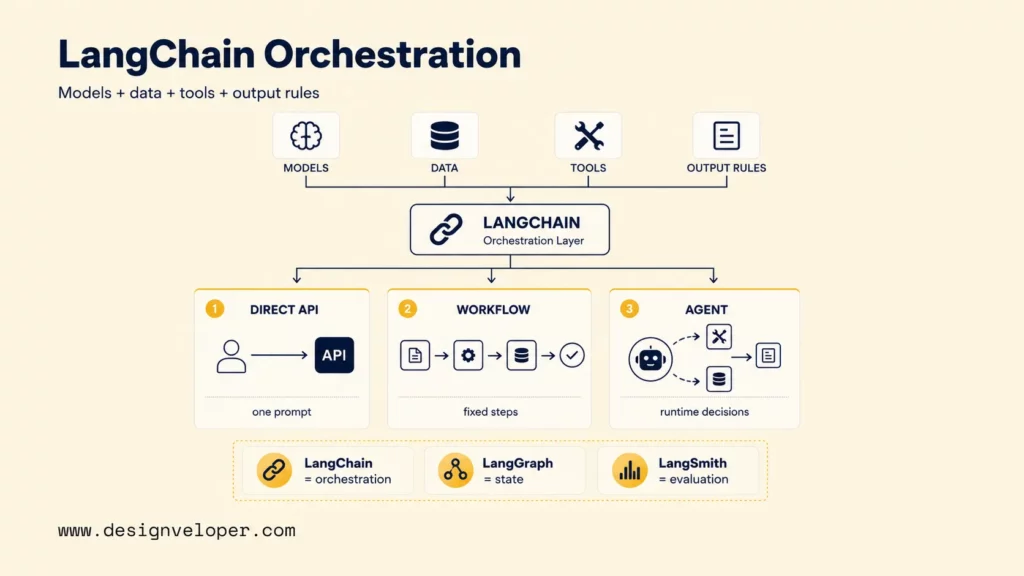
LangChain is not a large language model. It is an application layer for composing a model with tools, middleware, retrieval, state, and output controls. Use it when the application needs more than one bounded model call, and use an agent only when runtime decisions add value. The official LangChain overview of its agent harness and framework boundaries describes the model, prompt, tools, and middleware around the agent loop.
The labels below describe practical application patterns, not fixed LangChain product modules. A direct API handles a bounded call, a workflow adds fixed orchestration, and an agent adds runtime tool or step selection.
| Pattern | Best fit | Typical components | Main caution |
|---|---|---|---|
| Direct LLM API | One controlled input produces one controlled output | Prompt, model call, basic validation | Do not add orchestration that the task does not need |
| LangChain workflow | Retrieval, tools, structured output, or repeatable steps are required | Model interface, retriever or tools, schemas, application logic | Keep the flow observable so abstractions do not hide failures |
| Agent-based application | The task needs dynamic tool choice or multi-step decisions | Model, approved tools, state, policies, retries, approval points | Limit permissions and define stop, fallback, and escalation rules |
Use the path below as a boundary check, not as a full architecture decision. The detailed use-case trade-offs appear later in the architecture section.
- 1. One model call?Use a direct API when input, prompt, and output are controlled.
- 2. Fixed extra steps?Use a workflow for retrieval, schemas, or repeatable tool calls.
- 3. Runtime decisions?Use an agent when the model must choose a tool or next action.
- 4. Stateful execution?Consider LangGraph when execution state itself needs stronger control.
LangChain, LangGraph, and LangSmith sit at different layers. LangChain provides higher-level agent and integration building blocks, LangGraph provides lower-level orchestration control, and LangSmith supports tracing and evaluation. Our LangChain, LangGraph, Langflow, and LangSmith comparison explains those boundaries in more detail.
LangChain Use Cases For Knowledge And Workflow Products
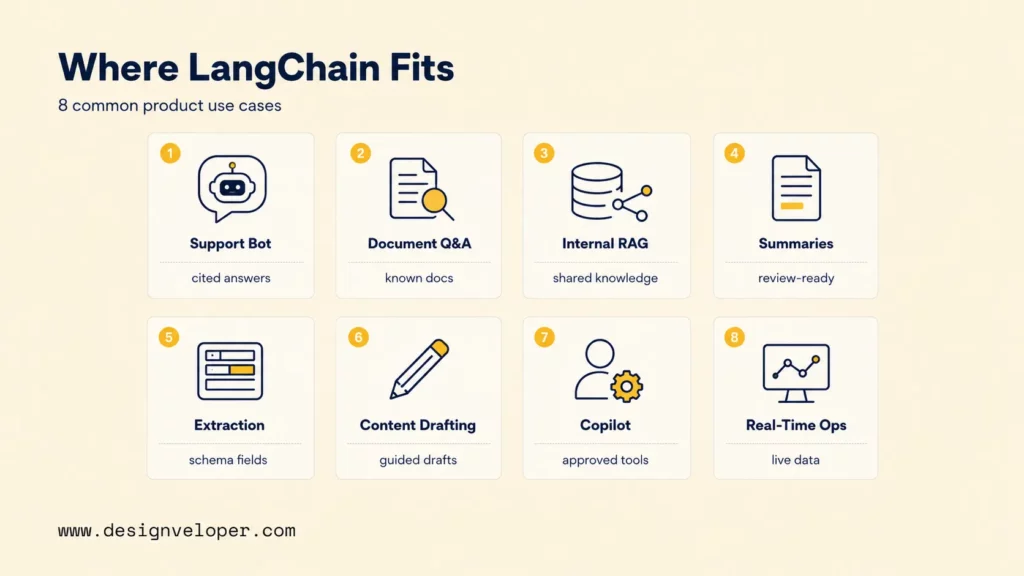
The strongest LangChain applications usually connect a clear user outcome to a capability the model cannot provide alone. The matrix below helps teams compare eight common product patterns before choosing an architecture.
| Use case | User outcome | Required capability | Main risk |
|---|---|---|---|
| AI-powered support chatbot | Fast answers with a clear handoff path | Intent routing, approved knowledge, response structure | Unsupported answers or missed escalation |
| Document question answering | Answers tied to known files | Loading, chunking, retrieval, citations, permissions | Wrong version or unauthorized content |
| Internal RAG assistant | Search across governed knowledge sources | Metadata, retrieval, refresh rules, evaluation | Stale or weakly governed knowledge |
| Document summarization | Review-ready summaries of long documents | Long-document handling, templates, source checks | Missing material facts |
| Data extraction | Validated fields for another system | Structured output, schema validation, exceptions | Invalid or silently wrong fields |
| Context-aware content | Controlled first drafts based on approved material | Retrieval, templates, versioning, editorial review | Fabricated or off-brand content |
| Tool-using copilot | Assistance across systems while users keep control | Tools, state, permissions, approvals, fallbacks | Unsafe or unintended actions |
| Real-time operational assistant | Advice based on current business data | Live queries, freshness checks, reconciliation | Stale data or integration failure |
AI-Powered Chatbots And Customer Support
Use LangChain for support when the workflow must answer from approved help content and hand complex cases to a person. LangChain can coordinate intent routing, retrieval, a response format, and a handoff decision without treating every conversation as an open-ended agent task.
The best fit is a support domain with defined source material and a known escalation path. A useful response can include the answer, the source used, and a confidence or escalation state. If the retrieved evidence is weak, the workflow should ask a clarifying question or create a handoff rather than improvise.
Avoid presenting this pattern as fully autonomous customer support. Refund approvals, account changes, or sensitive exceptions need explicit permissions and business rules. A deterministic support flow may also be safer when every intent maps to one fixed answer or action. For more agent-specific implementation detail, see our guide to building AI agents with LangChain.
Document Question Answering
Document Q&A is a good fit when users need answers from known manuals, policies, or agreements. The priority is not model creativity. The answer should trace back to the correct document version and remain limited to content the user is allowed to see.
LangChain can connect document loaders, text splitting, retrieval, source references, and output rules. The official LangChain retrieval documentation on knowledge bases and RAG workflows describes loaders, splitters, embeddings, vector stores, and retrievers as modular parts of the retrieval pipeline.
Permissions should come before model choice. Store metadata such as document owner, version, effective date, and access level. Apply those filters during retrieval where possible. A document Q&A product should also show the source passage or file reference so users can verify a high-impact answer.
LangChain RAG For Internal Knowledge Assistants
An internal knowledge assistant becomes useful when policy, process, and operational knowledge is spread across several governed systems. Unlike document Q&A, the challenge is not one file set. The team must decide which sources are authoritative, how often they refresh, and which employees can retrieve each source.
A RAG workflow built with LangChain can retrieve relevant chunks before generation or expose retrieval as a tool. Our RAG agent tutorial with LangChain covers loaders, chunking, metadata, retrievers, citations, evaluation, and production controls. The right design depends on how predictable the retrieval step needs to be.
Retrieval quality should be measured separately from final answer quality. If the system retrieves the wrong policy, a stronger model may only produce a more fluent wrong answer. Assign source owners, define refresh schedules, filter by permissions, and keep an evaluation set of representative questions with expected evidence.
Automated Document Summarization
Use automated summarization when reviewers need consistent first-pass summaries of long reports, contracts, or recurring submissions. LangChain can coordinate splitting, multiple model calls, summary templates, and final assembly when one controlled prompt is not enough.
A basic summary is suitable when missing one detail has low impact. A review-ready summary needs stronger controls. Require named sections, source references for material points, factual checks against the input, and a queue for human approval. The reviewer should be able to open the underlying passage behind a key statement.
This pattern fits teams that repeatedly review similar document types. It is less attractive when documents are short enough for one controlled model call, or when a deterministic parser already provides the needed fields. The workflow should solve a review problem, not add orchestration because the document happens to be long.
Data Extraction And Structured Outputs
Data extraction fits repeated invoices, forms, or contracts when the next system needs known fields rather than prose. The useful output is a valid schema. LangChain can connect a model’s structured output to validation and exception handling.
Define the schema before choosing the prompt. Then validate required fields, data types, allowed values, and cross-field rules. Low-confidence or invalid results should move to manual review instead of being silently saved. Store the source span when the downstream user may need to verify a field.
Deterministic extraction remains better when the source format is stable and machine-readable. A fixed CSV column, barcode, form field, or database value does not need an LLM. Use model-based extraction when language or layout varies enough that rigid rules become expensive to maintain.
Context-Aware Content Generation And Review
Context-aware drafting fits repeated content formats that must follow approved briefs, source material, and review rules. LangChain can retrieve context, apply a template, create a structured draft, and route it through factual and editorial checks before publication.
The fit is controlled drafting, not fully automatic publishing. Keep source material separate from tone instructions, and make the required output structure explicit. Version the prompt and source set so reviewers can explain why two drafts differ. For factual content, the workflow should mark claims that need verification rather than fill gaps with plausible text.
A simple model call may still be enough for low-risk copy with a stable brief. LangChain becomes more useful when the draft depends on several approved sources, must follow a schema, or moves through multiple review stages. Human editors should retain the final publishing decision.
Tool-Using Copilots And Workflow Automation
A tool-using copilot fits operations work that crosses systems but still leaves the final action with a person. It may read a customer record, check an order, draft an update, and wait for confirmation. LangChain agents fit when the model must choose an approved tool or next step.
Tool permissions are the main design boundary. Start with read-only tools and draft actions. Add write access only after tests show that the agent chooses the correct tool, sends valid arguments, handles tool errors, and stops when evidence is missing. State should record what the agent has already checked so retries do not repeat an unsafe action.
Standard automation is safer for a fully deterministic process. If an order with status X must always trigger message Y, normal code or a workflow engine is easier to test. Use an agent when language and context genuinely change the next action, then keep approval gates around consequential writes.
Real-Time Data Integration For Operational AI Assistants
Real-time operational assistants fit decisions that depend on current CRM records, ticket status, inventory, or event data. Static indexed knowledge is no longer enough. The application must know when data was fetched and what to do when a source is unavailable.
LangChain tools can query operational systems at runtime, while retrieval can still handle slower-changing reference material. Treat freshness as part of the response contract. Record timestamps, set stale-data rules, and reconcile conflicting sources before the model produces a recommendation. A cached result may be acceptable for a product FAQ but unsafe for available inventory or an open support incident.
This pattern fits decisions that depend on current operational information. It adds integration work, latency, failure modes, and permission concerns. The team should define which system is authoritative, how long a value remains valid, and whether the assistant may act or only recommend.
The model is only one part of a reliable AI product; data freshness, permissions, validation, and human decisions often define the real boundary.
Choose The Right LangChain Architecture For Each Use Case
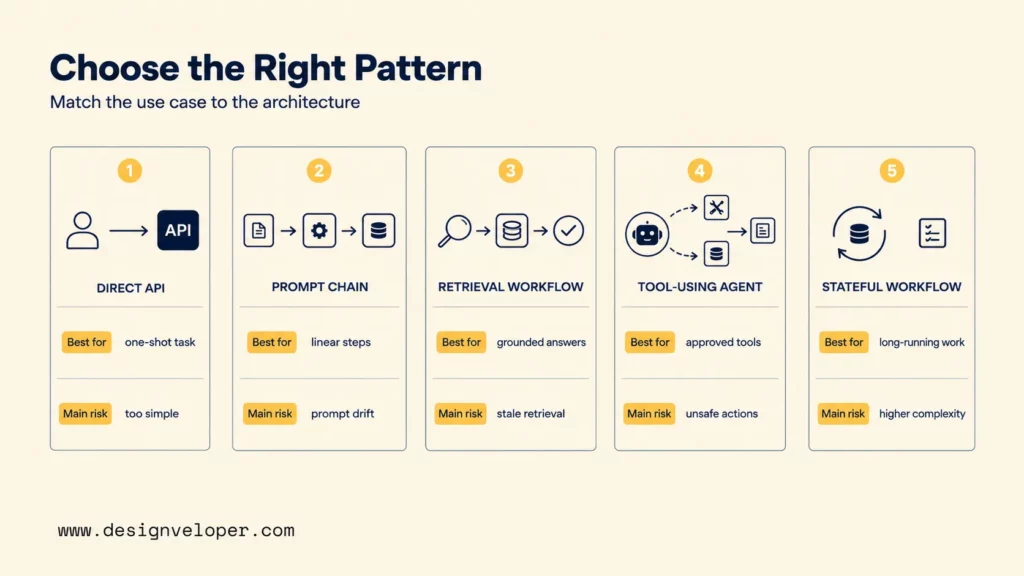
The right LangChain architecture is the simplest pattern that can meet the user outcome and control its main failure mode. The labels below are practical application patterns rather than fixed LangChain product modules. CTOs and PMs should choose among them after defining data and action boundaries.
| Use case | Suitable pattern | Data requirement | Delivery complexity | Main risk |
|---|---|---|---|---|
| Controlled drafting or classification | Prompt chain | Structured input and clear instructions | Low | Prompt drift or invalid output |
| Document Q&A or grounded support | Retrieval workflow | Trusted, indexed sources with metadata | Medium | Weak retrieval or stale content |
| Cross-system copilot | Tool-using agent | Approved APIs and permission-scoped tools | High | Incorrect tool choice or unsafe action |
| Long-running review or operations flow | Stateful workflow | Persistent state, checkpoints, event history | High | Duplicate actions or broken recovery |
| Simple one-shot task | Direct API integration | One bounded input and output | Lowest | Unnecessary framework complexity if LangChain is added |
The langchain usecases here vary. Use a prompt chain when the steps are known. Use retrieval when the answer must be grounded in trusted sources. Meanwhile, a tool-using agent can be suitable when runtime tool choice creates real value. And a stateful workflow is good for when execution must persist across longer tasks or approval points.
LangGraph becomes relevant when execution needs durable state, persistence, or human control across steps. The official LangGraph overview of durable execution and human-in-the-loop orchestration describes a low-level runtime for long-running, stateful agents that can mix deterministic and model-driven steps. That boundary, not the LangChain name alone, should drive the decision.
Budget and timeline follow the architecture rather than the framework name. A direct call needs little integration. Retrieval adds ingestion and quality testing. Tool use adds API contracts and permissions. Stateful execution adds persistence, retries, recovery, and approval logic. Those are the delivery items a product plan should estimate.
Scope A LangChain Pilot Before Building The Full Product
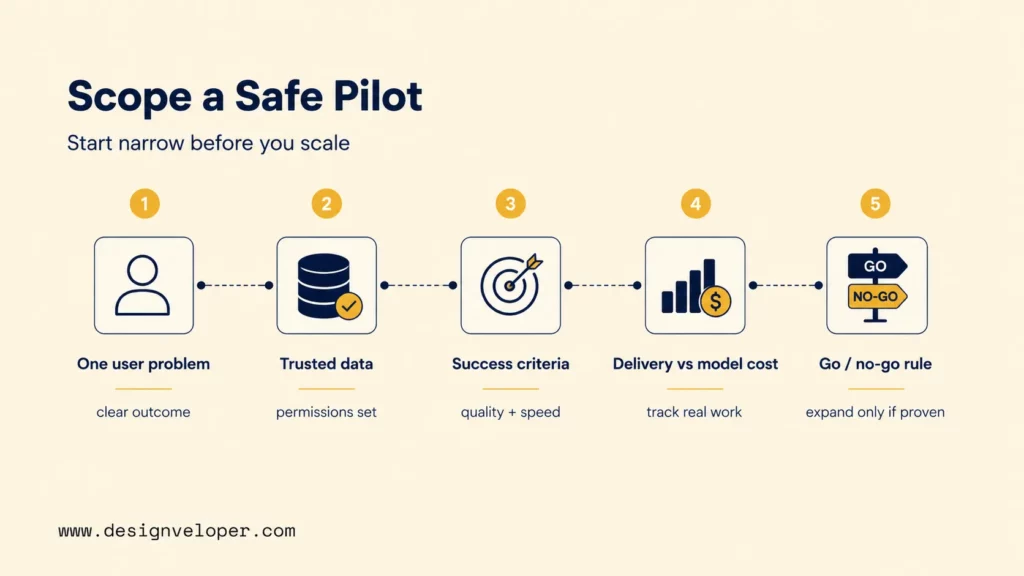
A LangChain pilot should prove one user outcome with one controlled data boundary. A useful example is an internal policy assistant that answers employee questions from approved HR documents, cites the source, and refuses questions outside that material. It starts read-only and does not update HR systems.
- Select one user problem with a clear business outcome. Define the user, the question they need answered, and the current pain. For the pilot, the outcome is faster policy lookup with a source citation.
- Define the trusted data source, permissions, and output boundary. Use a small approved policy set, attach document ownership and version metadata, and restrict retrieval by employee access.
- Set success criteria for quality, speed, adoption, and human-review load. Build representative questions and decide what counts as a correct source, a correct answer, an acceptable refusal, and a necessary escalation.
- Estimate delivery work separately from model and operating costs. Track ingestion, integration, evaluation, interface work, model usage, storage, observability, and support as different cost drivers.
- Decide the go or no-go criteria for production expansion. Expand only if the pilot meets its quality threshold, users understand its limits, and the team can operate failures without hidden manual work.
The checklist becomes more useful when each item has an explicit stop condition. The scorecard below helps a team see whether it is ready to build, ready to test, or still missing a basic control.
Build And Validate A Testable LangChain Workflow
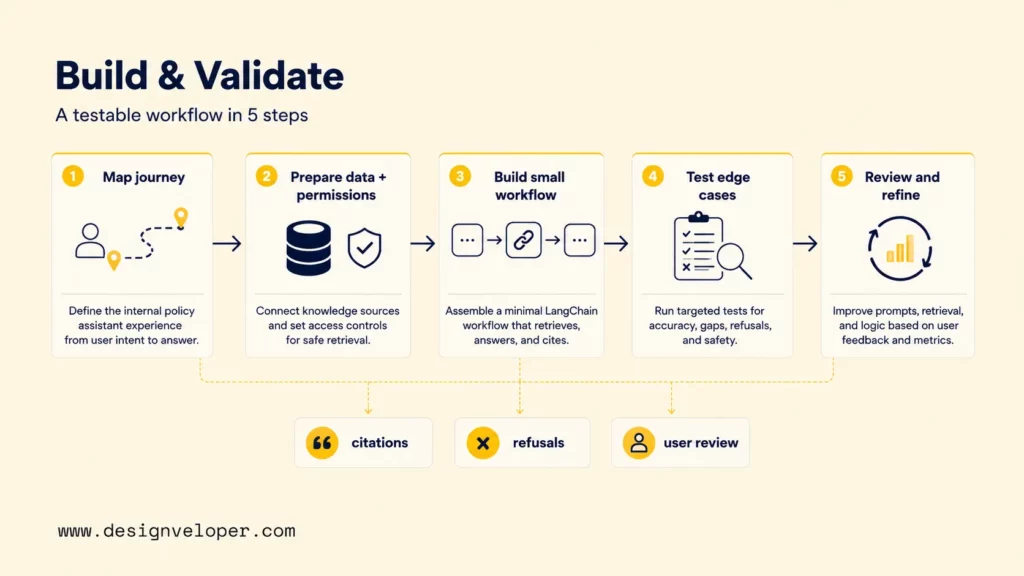
Build the smallest workflow that can pass the pilot’s acceptance tests. Keeping the same internal policy assistant example makes each technical decision easier to inspect. The first version only answers from approved HR documents, cites evidence, and refuses unsupported questions.
- Map the user journey and failure boundaries. Start with the employee question, retrieval, answer, citation, and refusal path. Define what happens when the question is ambiguous, the source is missing, or the user lacks permission.
- Prepare data, tools, permissions, and output schemas. Clean the policy set, attach metadata, define retrieval filters, and create a response schema with answer text, source references, and an escalation state.
- Build the smallest suitable chain, retrieval flow, or agent. For this pilot, use predictable retrieve-then-generate logic before adding agentic retrieval. The assistant does not need dynamic tool choice yet.
- Test representative queries, edge cases, and tool failures. Include known-answer questions, conflicting policies, outdated versions, unsupported requests, access-control cases, and empty retrieval results. Inspect both the retrieved evidence and the final answer.
- Review results with users and revise the workflow before expansion. Ask HR owners and employees where the answer was useful or confusing. Update sources, prompts, retrieval rules, or interface copy before adding more departments.
Evaluation should be tied to the failure modes the product can actually create. Retrieval tests ask whether the right source was found. Answer tests check whether the response stayed grounded. Permission tests verify that restricted content never reaches the model context. User tests show whether citations and refusals are understandable.
Do not use one average quality score to hide different failures. A pilot can look strong overall while failing a small set of high-risk questions. Keep those cases visible and require them to pass before expanding scope or adding write-enabled tools.
Production Requirements For LangChain Applications
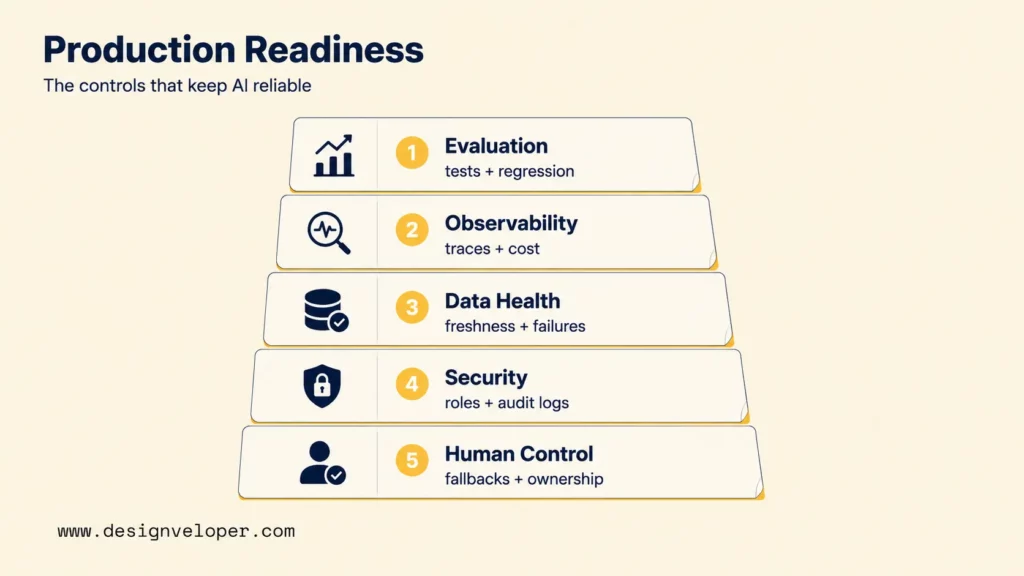
A production LangChain application needs the same disciplines as other software, plus controls for non-deterministic model behavior. Reliability, security, ownership, and ongoing cost should be designed before launch rather than added after the first incident.
- Evaluation and regression: maintain representative datasets, output checks, retrieval tests, tool-call tests, and regression cases for past failures.
- Tracing and monitoring: record latency, errors, tool calls, state transitions, and usage cost so operators can locate the failing step.
- Data and integration health: check source freshness, ingestion failures, API errors, schema changes, and stale caches before they affect answers.
- Security and access: protect secrets, apply role-based permissions, handle sensitive data deliberately, and keep audit logs for important actions.
- Human control and support: define escalation, fallback behavior, release ownership, incident response, and who can pause or roll back the AI workflow.
LangSmith can support both pre-release and production evaluation. The official LangSmith evaluation workflow for datasets, evaluators, and online monitoring describes offline experiments before deployment and online evaluators on production traces. Teams can use code checks, human review, or model-based evaluators depending on the metric.
The checklist above is the operating detail. The visual below compresses it into four control layers so teams can see where a failure should be detected, contained, or owned.
If a team needs outside engineering support, our AI development services can help turn a validated pilot into integrated, tested software with post-launch support. The product owner should still keep acceptance criteria and action boundaries explicit.
Production readiness means knowing who can detect a failure, limit an action, and stop the workflow.
FAQs About LangChain Use Cases
Can A LangChain Application Work Without An Agent?
Yes. A LangChain application can use models, retrieval, structured output, or fixed workflow logic without an agent. Use an agent only when runtime tool or step selection is part of the user need.
When Does A Team Need LangGraph Alongside LangChain?
Consider LangGraph when the workflow needs durable state, persistence, or human control across multiple steps. A short request-response agent may not need the extra orchestration layer.
How Do Teams Test A Tool-Using Workflow Before Enabling Write Access?
Start with read-only tools and simulated or draft actions. Test representative requests, invalid arguments, permission failures, timeouts, duplicate requests, and cases where the agent should refuse to act. Review traces to confirm the correct tool and arguments were chosen. Enable narrow write permissions only after those cases pass, then keep human approval for high-impact actions.
Can LangChain Connect To Multiple LLM Providers In One Application?
Yes. LangChain provides standard model interfaces across multiple providers, so one application can use different model integrations where the architecture needs them. The official LangChain models documentation on provider interfaces and model capabilities supports switching integrations with minimal application changes. Tool calling, structured output, parameters, and other behavior still vary by model, provider, and version, so test the exact deployment combination.
How Should Product And Engineering Teams Share Ownership After Launch?
Product should own the user outcome, acceptable failure boundaries, escalation policy, and expansion decisions. Engineering should own implementation quality, integrations, permissions, observability, recovery, and release safety. Both teams should review evaluation results and production failures together because a technically correct workflow can still fail the user decision it was meant to support. That shared model keeps LangChain use cases from becoming orphaned experiments after launch.
Also published on

Share post on









Related Articles


AI Agent Case Studies: 10 Real-World Examples Across Industries
AI Agent Case Studies: 10 Real-World Examples Across Industries Published October 21, 2026
How Will AI Affect Software Development? Complete Guide In 2026
How Will AI Affect Software Development? Complete Guide In 2026 Published October 21, 2026
How To Build A RAG System: Step-By-Step (New Guide)
How To Build A RAG System: Step-By-Step (New Guide) Published October 19, 2026