









Best AI Agent Frameworks For Building Smarter AI Systems

KEY TAKEWAYS:
- The best AI agent framework depends on workflow shape, not only model quality or developer popularity.
- Teams building long-running, stateful workflows usually need durable orchestration, observability, and approval control more than raw prompt flexibility.
- Retrieval-heavy systems, enterprise agent platforms, multi-agent collaboration, and typed Python or TypeScript services each favor different framework strengths.
- Off-the-shelf frameworks can accelerate delivery, but reliable products still need workflow design, integration planning, security controls, evaluation, and human review.
AI agents are moving from simple chat interfaces into real business systems that plan tasks, call tools, use data, and act across workflows. But building a reliable agent takes more than connecting a model to an API. Teams also need state management, observability, integrations, validation, security controls, and clear workflow logic.
That is where AI agent frameworks become important. The best AI agent frameworks help developers turn experimental prototypes into systems that can be tested, monitored, governed, and maintained. Some frameworks are better for stateful production workflows. Others fit multi-agent collaboration, enterprise integration, retrieval-heavy systems, structured Python services, or TypeScript-native products.
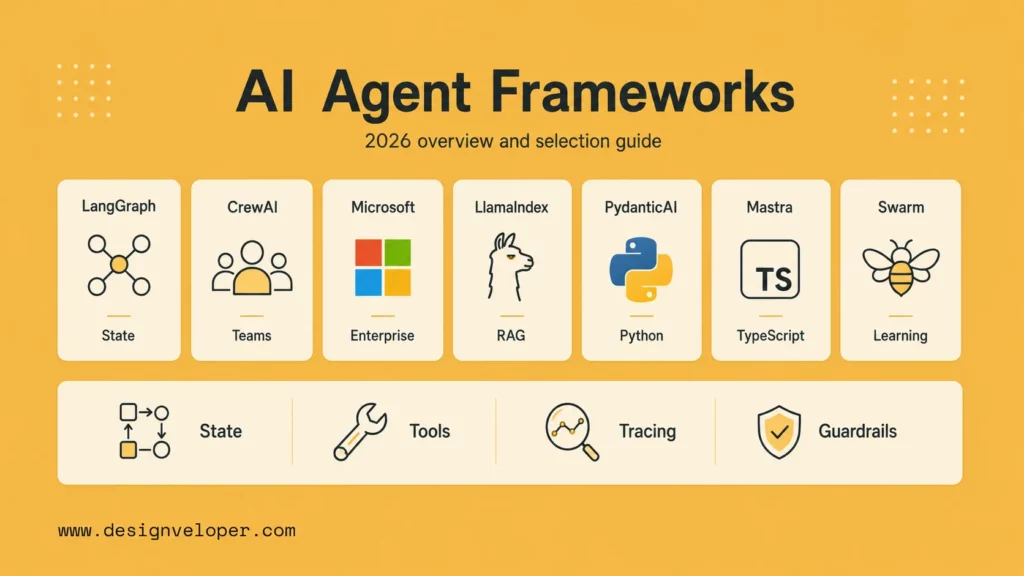
In this article, we compare the leading AI agent frameworks in 2026, including LangGraph, CrewAI, Microsoft Agent Framework, LlamaIndex, PydanticAI, Mastra, and OpenAI Swarm. We also explain how to choose the right one based on workflow complexity, team stack, production needs, and long-term scalability.
See more:
- What Is Agentic AI? Benefits, Architecture And How It Works
- Types of AI Agents: Key Categories and When to Use Each
- Best Agentic AI Tools for Practical Workflow Automation
What Is An AI Agent Framework?
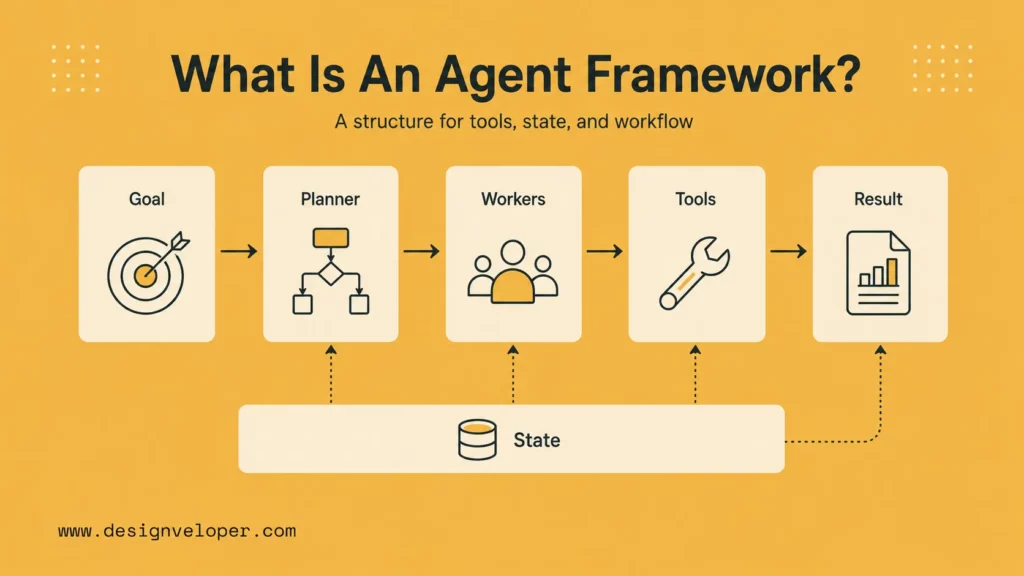
An AI agent framework is a development layer for building software agents that can understand a goal, plan the next step, call tools, use data, keep state, and return a result inside a product or business workflow. It gives developers a repeatable structure for work that would otherwise become a fragile mix of prompts, API calls, memory stores, and custom routing logic.
This matters because AI agents are no longer limited to simple chat. A support agent may need to read a ticket, check an order, search a policy document, draft a response, ask a supervisor for approval, and update a CRM. A finance agent may need to extract invoice data, validate fields, flag exceptions, and send the result into an accounting system. Those workflows need more than a model call. They need orchestration, state, permissions, logging, and recovery.
In 2026, the best AI agent frameworks are the ones that help teams move from impressive demos to reliable systems. LangGraph, Microsoft Agent Framework, LlamaIndex, and the OpenAI Agents SDK all point in the same direction: serious agents need tools, workflow control, memory or state, observability, and guardrails.
Recent enterprise data explains why framework choice now matters. McKinsey’s 2025 State of AI survey found that 23% of respondents were scaling an agentic AI system somewhere in the enterprise, while another 39% had begun experimenting with AI agents. That means many teams have moved past curiosity. They now need workflows that can be tested, observed, and governed.
See more:
- What Is An AI Harness and How To Build a Minimal One
- What Is Model Context Protocol? A Beginner’s Guide
- Top AI Agent Companies to Watch
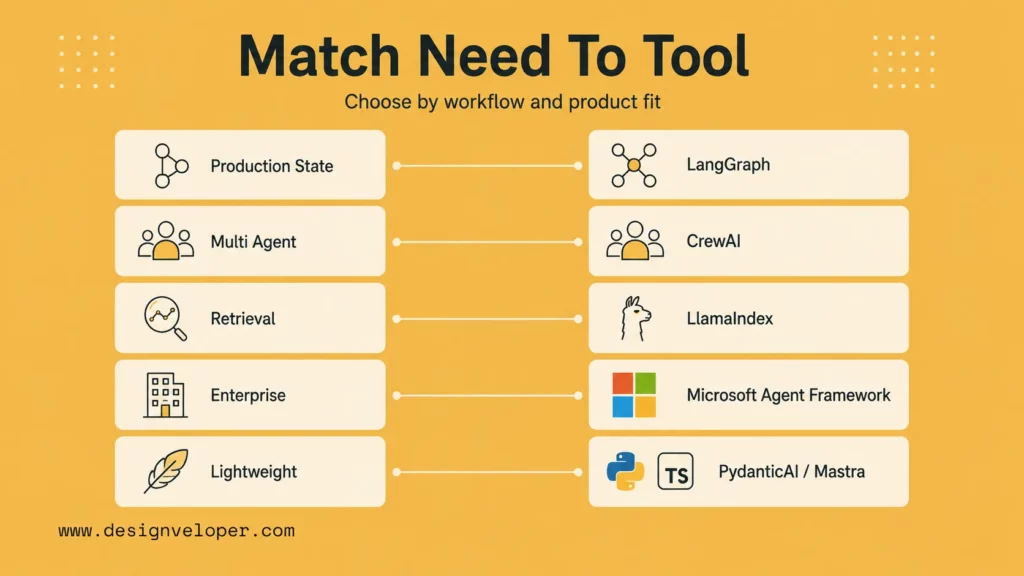
Quick summary: choose LangGraph for stateful production workflows, CrewAI for role-based multi-agent collaboration, Microsoft Agent Framework for enterprise systems, LlamaIndex for retrieval-heavy agents, PydanticAI for structured Python agents, Mastra for TypeScript-native workflows, and OpenAI Swarm only for lightweight learning or experiments.
Core Components Of Agent Frameworks
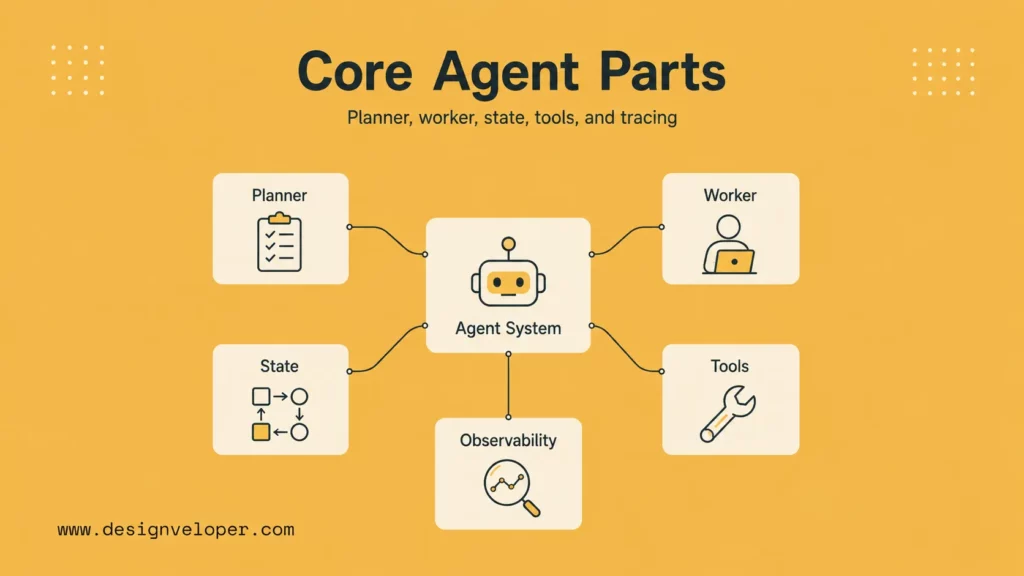
Different frameworks use different names, but most agent systems share a few core components.
- Planner: The planner decides what the agent should do next. It may decompose a goal, choose a tool, route work to another agent, or stop when the task is complete.
- Worker: A worker performs a specific job. In multi-agent systems, workers may handle research, retrieval, coding, analysis, writing, validation, or operations tasks.
- Session State: State stores the information needed during the run. It may include user messages, retrieved documents, tool outputs, approvals, errors, retries, and checkpoints.
- Tools/Integrations: Tools connect the agent to systems such as databases, CRMs, calendars, file storage, messaging apps, ticketing systems, search indexes, and internal APIs.
These parts should be explicit. When the planner, state, tools, and workers are hidden inside one long prompt, the system becomes hard to test and debug. When they are defined through a framework, developers can inspect tool calls, validate outputs, resume interrupted runs, and improve one part of the workflow without rewriting everything.
Further reading:
- LangChain Vs LangGraph Vs Langflow Vs LangSmith: How To Compare AI Workflow Tools
- LangChain Vs MCP: How They Compare For AI Agent Workflows
Further reading:
- Enterprise AI Agents: What Matters Before Scaling
- AI Agent vs AI Assistant: Which Is the Better Fit?
- Agentic AI Impact on Workforce: What Changes as Automation Grows
Why Use Agent Frameworks?
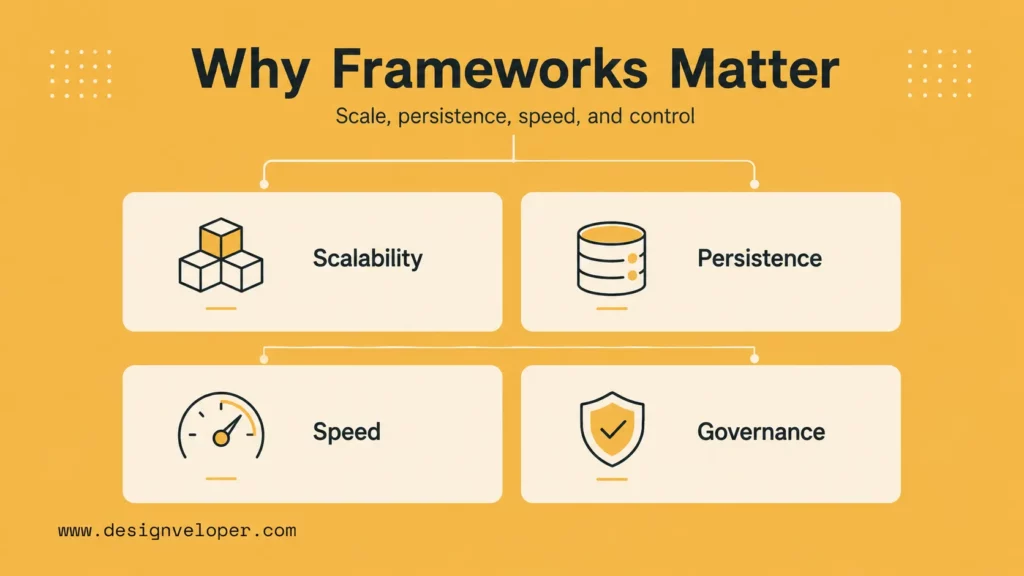
Teams use agent frameworks to reduce avoidable engineering work and improve control. A framework can provide tool schemas, state management, tracing, multi-agent handoffs, memory, evaluations, and deployment patterns. That saves time, but the deeper value is reliability.
- Scalability: A framework makes it easier to split a workflow into agents, states, tools, and services that can grow with the product.
- Persistence: Business workflows often last longer than one response. Frameworks with checkpoints or memory can pause, resume, and preserve useful context.
- Reduced Development Time: Developers can spend less time rebuilding tool routing and retry logic, and more time designing the workflow that creates value.
Security and governance are also part of the decision. The NIST AI Risk Management Framework emphasizes trustworthy AI design, development, evaluation, and use. The OWASP Top 10 for LLM Applications covers risks that become more serious when agents can use tools and access data. A good framework should make those risks easier to manage, not easier to ignore.
Explore more:
- AI Agent Pricing: What Cost Models Start to Matter in Production
- AI Agent Orchestration: Coordinating Systems Safely
What To Consider Before Choosing An AI Agent Framework
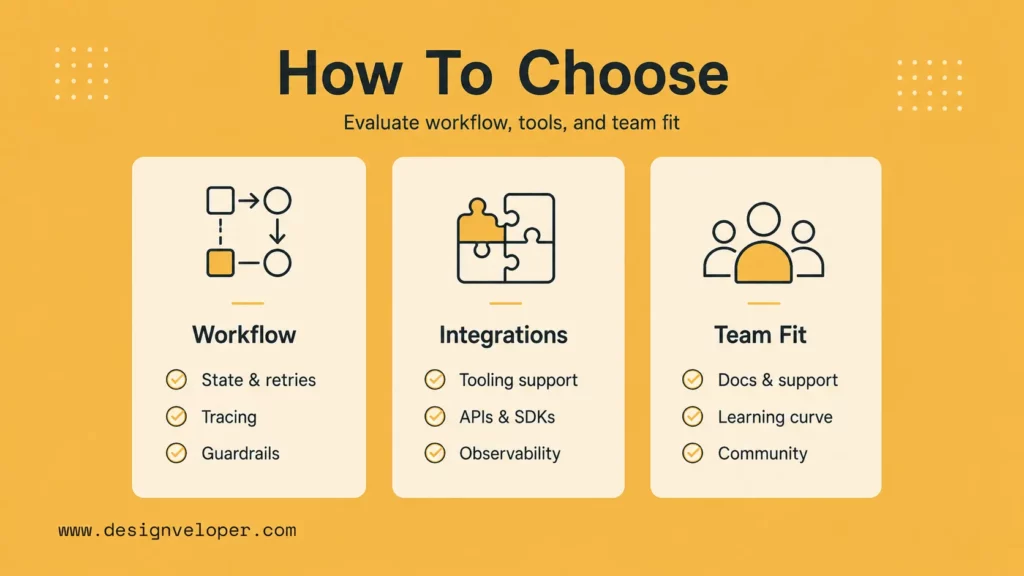
Choosing an AI agent framework is not the same as choosing a model. The model affects reasoning quality, latency, cost, and modality support. The framework affects how the agent behaves as software: how it uses tools, stores context, recovers from failure, logs actions, and fits into the product architecture.
Start with the job the agent must do. A research assistant, a document intelligence tool, a coding agent, and an enterprise operations agent have different requirements. Some need retrieval quality. Some need strict output validation. Others need human approval before tool execution. Many also need to run inside Azure or a TypeScript application. The best AI agent framework is the one that makes the real workflow easier to build, observe, and maintain.
Continue reading:
- Agentic AI Architecture and Workflow Patterns
- How To Build Agentic AI Around Real Workflow Logic
- What AI Integration Means in Real Business Systems
Workflow Complexity And State Management
Workflow shape is the first filter. If the agent only needs to answer a question and call one search tool, a lightweight SDK may be enough. If it needs branching logic, retries, approvals, queues, memory, or long-running execution, state management becomes central.
LangGraph is strong here because its durable execution, streaming, human-in-the-loop workflows, and stateful orchestration fit complex delivery paths well. Microsoft Agent Framework also treats workflows, conversations, memory, persistence, tools, and hosting as first-class concepts. These features matter when an agent must pause for human input, recover after an error, or show a user where a process stands.
Without state, teams often rebuild the same workaround repeatedly: save partial results in a database, rehydrate the prompt, hope the next model call remembers the right context, and patch edge cases later. A framework with clear state primitives makes that work more disciplined.
Tool Calling, Integrations, And Observability
Tool calling is where an agent becomes operational. The agent may read a customer profile, search a vector database, update a ticket, create a document, schedule a meeting, or trigger an automation. A framework should make tools easy to define, restrict, inspect, and test.
Observability is equally important. When an agent fails, the team needs to know why. Was the retrieved context weak? Did a tool return malformed data? Did the model choose the wrong action? Did a permission rule block execution? And did state drift between steps? Frameworks with tracing, logs, run histories, evaluations, and replay support reduce the time needed to find the answer.
This is also a security issue. OWASP’s LLM guidance highlights risks such as prompt injection, sensitive information disclosure, excessive agency, and insecure output handling. Agent frameworks do not eliminate those risks, but strong tool boundaries and traces make them easier to control.
Team Skill, Scalability, And Production Readiness
The team’s stack matters. Python-heavy teams may prefer LangGraph, CrewAI, LlamaIndex, PydanticAI, or the OpenAI Agents SDK. TypeScript teams may prefer Mastra or a JavaScript-native implementation. Microsoft-centered organizations may favor Microsoft Agent Framework because it matches enterprise tooling, identity, hosting, and governance expectations.
Production readiness should include testing, typed outputs, evaluation, monitoring, secrets handling, deployment options, human review, versioning, provider flexibility, and long-term community health. Agent frameworks change quickly, so teams should prefer a clear fit over a trendy name.
A useful decision rule is simple: if the agent can affect data, money, customer communication, legal obligations, or internal operations, choose a framework that supports inspection and control. If the project is only a small prototype, choose the lightest framework that helps the team learn quickly.
Best AI Agent Frameworks In 2026
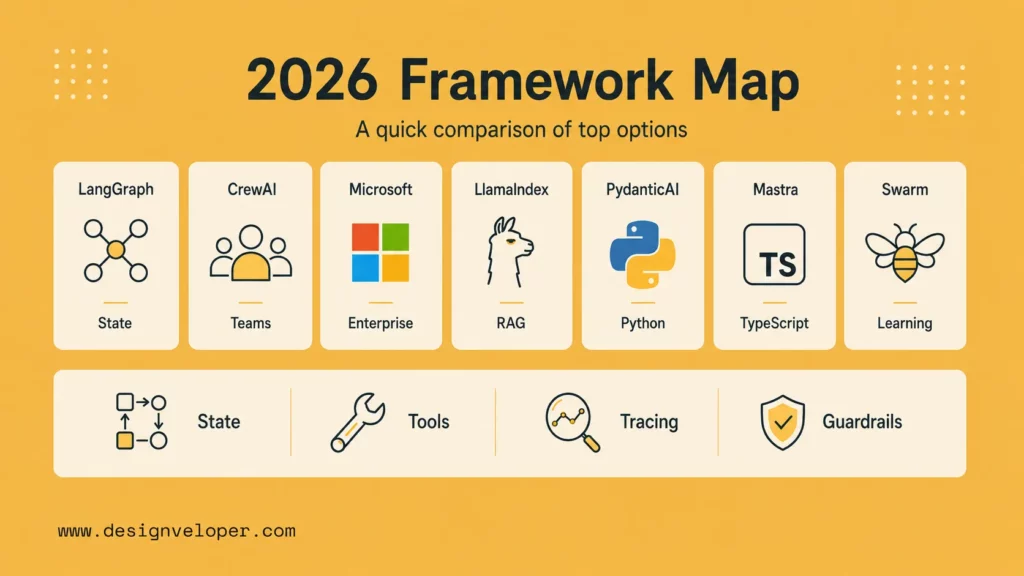
The frameworks below are not interchangeable. Each one is strongest in a slightly different product shape, engineering stack, and workflow style.
| Framework | Best fit | Main strength | Watch out for |
|---|---|---|---|
| LangGraph | Stateful production workflows | Durable graph orchestration and human-in-the-loop control | Requires careful workflow design |
| CrewAI | Role-based multi-agent collaboration | Clear crews, agents, tasks, and flows | Complex production systems may need extra architecture |
| Microsoft Agent Framework | Enterprise agent systems | Workflows, memory, persistence, tools, and hosting | Best fit for Microsoft-oriented teams |
| LlamaIndex | Retrieval-heavy agent workflows | Data ingestion, indexing, retrieval, and agent workflows | May need another orchestration layer for complex operations |
| PydanticAI | Structured Python agents | Typed outputs, validation, and Python ergonomics | Not a full enterprise workflow platform by itself |
| Mastra | TypeScript-native agent workflows | Agents, workflows, memory, and observability in a TS stack | Evaluate ecosystem fit for long-term projects |
| OpenAI Swarm | Learning and lightweight experiments | Simple handoff concepts | Experimental and replaced by newer OpenAI agent tooling |
Explore more:
- Building AI Agents with LangChain: The Complete Guideline
- LangGraph vs LangChain: A Detailed Comparison of Features
- Comparison of AutoGen vs LangChain: Which Is Better?
1. LangGraph – Best Overall For Stateful Production Workflows
LangGraph is the strongest general choice for teams that need stateful, long-running, or human-in-the-loop workflows. Its graph-based design lets developers model an agent process as nodes and transitions instead of hiding the whole process inside one prompt loop.
This is useful for workflows that need predictable stages: classify a request, retrieve context, call a tool, validate output, request approval, update a system, and return a final answer. LangGraph’s documentation highlights durable execution and persistence, which are essential when a workflow may be interrupted or require review before continuing.
Choose LangGraph when the problem is not just “make the model smarter” but “make the process controllable.” The tradeoff is design effort. Teams need to think clearly about states, transitions, failure paths, and evaluation.
2. CrewAI – Best For Role-Based Multi-Agent Collaboration
CrewAI is attractive because it makes multi-agent collaboration easy to understand. Developers can define agents, assign roles, create tasks, and organize work through crews and flows. This maps well to business processes where different people or functions already have distinct responsibilities.
A content workflow might use researcher, strategist, writer, and editor agents. A sales workflow might use account research, qualification, outreach, and CRM update agents. A software workflow might use planning, implementation, review, and documentation agents. The role-based model makes the workflow easier to explain to stakeholders.
CrewAI is a strong option for prototypes, internal workflows, and role-driven automation. For high-risk production systems, teams should still plan surrounding concerns such as authentication, monitoring, deployment, permissions, data retention, and exception handling.
3. Microsoft Agent Framework – Best For Enterprise Agent Systems
Microsoft Agent Framework is a strong fit for enterprises that already use Microsoft tooling. Its core concepts cover agents, tools, workflows, conversations, memory, persistence, integrations, and hosting. It also includes migration guidance from AutoGen, which matters for teams that experimented with earlier Microsoft agent frameworks.
The main value is ecosystem fit. Organizations using Azure, Microsoft identity, enterprise governance, C#, Python, and managed infrastructure may prefer a framework that aligns with existing policies and engineering standards. This is especially useful when agents need to connect to internal enterprise systems.
Choose Microsoft Agent Framework when governance, hosting, enterprise integration, and organizational fit matter as much as rapid prototyping. Smaller teams may find it heavier than necessary, but enterprise teams often need that structure.
4. LlamaIndex – Best For Retrieval-Heavy Agent Workflows
LlamaIndex is a leading option when the agent’s value depends on private or domain-specific data. Its platform focus includes building LLM-powered agents over data, with ingestion, indexing, retrieval, parsing, extraction, and workflow capabilities.
Use LlamaIndex for document assistants, enterprise search, RAG applications, support knowledge copilots, legal or financial review support, and internal analytics assistants. In these systems, the hardest part is often not the model response. It is finding the right source material, ranking it correctly, and preserving citations or provenance.
LlamaIndex may not be the only orchestration layer in a complex system. Many teams use it for data and retrieval while using LangGraph, Microsoft Agent Framework, or another workflow layer for broader business process control.
5. PydanticAI – Best For Structured Python Agent Development
PydanticAI is a strong option for Python teams that care about typed outputs and validation. Because it comes from the Pydantic ecosystem, it fits developers who already define application contracts with type hints and schemas.
This is valuable when an agent must return predictable objects, call tools with validated arguments, or integrate with APIs that cannot accept vague text. PydanticAI’s output documentation explains that structured data can be validated and retried when validation fails, which is useful for practical application development.
Choose PydanticAI when the main need is clean Python ergonomics, structured outputs, and validation. It is not a complete enterprise agent platform by itself, but it can be a reliable foundation for focused agent services.
6. Mastra – Best For TypeScript-Native Agent Workflows
Mastra is an open-source TypeScript framework for building AI-powered applications and agents. It is a natural fit for teams whose products already use TypeScript across the front end, back end, or full-stack application layer.
Mastra’s materials emphasize agents, workflows, memory, evaluation, observability, and deployment. Its project guidance also highlights human-in-the-loop workflows, where an agent or workflow can suspend and wait for user input or approval before resuming.
Choose Mastra when the agent belongs inside a TypeScript product and the team wants to avoid running a separate Python orchestration service. As with any fast-moving framework, validate the integrations, hosting model, community activity, and long-term fit before committing to it for critical systems.
7. OpenAI Swarm – Best For Lightweight Research And Experiments
OpenAI Swarm is best treated as an educational and experimental framework for learning multi-agent handoffs. Its original positioning was as a lightweight framework for exploring ergonomic multi-agent orchestration. That made it useful for understanding routines and handoffs.
For new production work, teams should look at the OpenAI Agents SDK instead. Its newer updates cover agents, tools, handoffs, sessions, guardrails, tracing, long-running agent infrastructure, sandbox execution, snapshotting, and rehydration.
Swarm is still useful as a learning reference. It is not the best foundation for production systems in 2026 when maintained SDKs and more complete frameworks are available.
Which AI Agent Framework Fits Different Needs Best?
The best AI agent framework depends on the use case. The table below gives a practical shortcut, but teams should still validate the framework with a small proof of concept using real data, real tools, and real failure cases.
| Need | Best starting point | Why |
|---|---|---|
| Durable production workflow | LangGraph | Strong stateful graph model and persistence patterns |
| Enterprise integration | Microsoft Agent Framework | Fits Microsoft ecosystem, workflows, memory, tools, and hosting |
| Role-based multi-agent work | CrewAI | Clear agent roles, tasks, crews, and flows |
| RAG or document intelligence | LlamaIndex | Strong ingestion, indexing, retrieval, and data-agent capabilities |
| Typed Python service | PydanticAI | Structured outputs and validation with Python ergonomics |
| TypeScript product | Mastra | Agent workflows in a modern TypeScript stack |
| Learning handoffs | OpenAI Swarm | Simple educational reference for multi-agent handoff patterns |
You might also like:
- AI Agent vs Chatbot: Product Tradeoffs and Use Cases
- Conversational AI vs Chatbot: What Actually Changes in Business Use
For Production-Grade Stateful Workflows
Choose LangGraph when the workflow has meaningful state, multiple stages, approvals, retries, or long-running execution. It is especially useful when the team wants to see the workflow as a graph and reason about each transition.
Microsoft Agent Framework can also fit production workflows, especially in enterprise environments. If the team is already invested in Microsoft infrastructure, its governance and hosting fit may outweigh the flexibility of a more general framework.
For Multi-Agent Collaboration
CrewAI is a strong starting point for role-based multi-agent collaboration. Its concepts are easy to map to real business responsibilities, which helps teams design and explain the workflow.
For more controlled multi-agent systems, LangGraph or the OpenAI Agents SDK may fit better. LangGraph gives explicit state and routing control. The OpenAI Agents SDK offers handoffs, tools, guardrails, sessions, and tracing for teams building around OpenAI’s ecosystem.
For Retrieval And Knowledge Workflows
LlamaIndex is the best starting point when retrieval quality is the main challenge. It helps teams connect documents, databases, and knowledge sources to agents in a structured way.
For example, a document review assistant needs parsing, chunking, indexing, retrieval, citations, and answer synthesis. A customer support knowledge agent needs source freshness and relevance. In both cases, retrieval architecture can matter more than the agent planner.
For Enterprise Governance And Integration
Enterprise agent systems should be judged by more than model quality. They need access control, logging, auditability, security review, privacy controls, policy enforcement, incident response, and lifecycle management.
NIST’s AI RMF is useful here because it frames trustworthy AI as a risk management discipline. OWASP’s LLM security guidance is also relevant because agents expand the attack surface through tools, memory, retrieval, and autonomous actions. Microsoft Agent Framework, LangGraph, and carefully designed OpenAI Agents SDK implementations can all support enterprise patterns when the surrounding architecture is built well.
For Lightweight Python Or TypeScript Builds
PydanticAI is a good fit for lightweight Python agents that need typed outputs and validation. It gives teams a clean way to make agent responses behave more like application data.
Mastra is the better fit for TypeScript-native teams. It keeps agent logic closer to existing application code and can reduce the overhead of a separate orchestration stack. The OpenAI Agents SDK can also work for lightweight builds when teams want a model-native agent framework with handoffs, tools, guardrails, and tracing.
When Off-The-Shelf Frameworks Are Not Enough
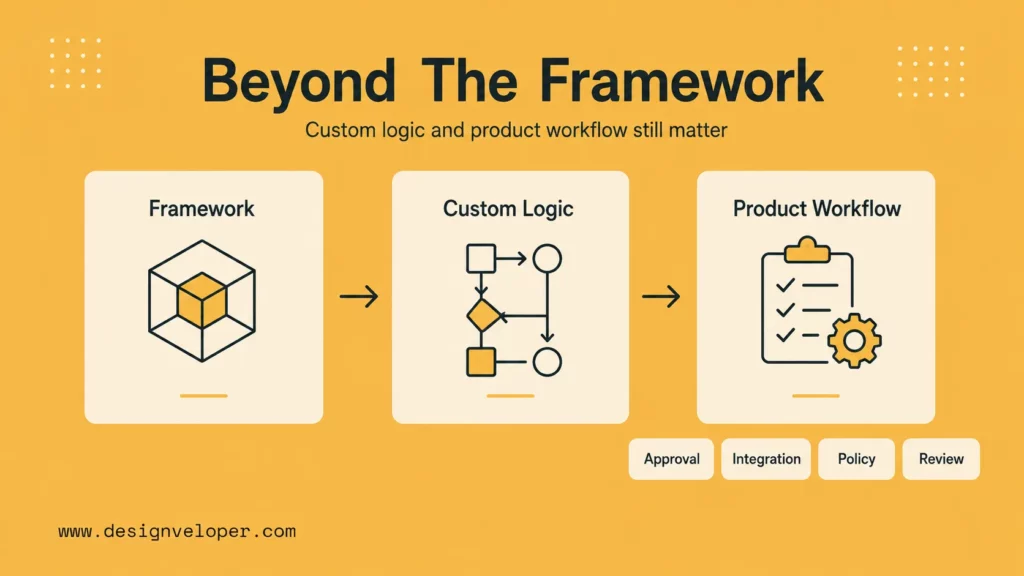
AI agent frameworks can speed up development, but they do not replace product engineering. A framework helps with orchestration. The business still needs the right workflow, data access, interface, permission model, monitoring plan, and support process.
This is where many agent projects get stuck. The prototype works in a controlled demo, but the production version has to connect to messy systems, handle incomplete data, ask for approval, protect sensitive information, and recover from tool failures. Off-the-shelf frameworks help, but they rarely solve the whole product problem alone.
Related articles:
- AI Business Process Automation: What It Really Changes
- AI Chatbot Development: When a Custom Build Makes More Sense
- AI Chatbot Integration: What Successful Rollouts Usually Need
When Generic Orchestration Stops Being Enough
Generic orchestration is enough when the agent returns low-risk information. It stops being enough when the agent can change business records, send messages, approve actions, move money, or affect customers and employees.
At that point, teams need policy-aware workflows. The agent should know what it can do, what it cannot do, what requires human approval, and what must be logged. This is also where “least agency” becomes a useful design principle: give the agent only the autonomy it needs for the task, then add more authority only when the workflow has proven reliable.
When Workflow Logic And Integrations Get More Complex
Real business agents usually connect to several systems. A sales agent may use CRM data, email, calendar, lead enrichment, and analytics. A document agent may use cloud storage, OCR, indexing, approval, and e-signature systems. An HR agent may use policies, calendars, leave balances, chat tools, and manager approvals.
Each integration introduces failure modes. Data may be stale. Permissions may be wrong. APIs may return partial results. A tool may time out after completing the action. A user may ask for something outside policy. A framework can help organize the workflow, but the engineering team still needs idempotency, retries, validation, audit logs, and fallback paths.
How Designveloper Approaches AI Agent Product Workflows
At Designveloper, we approach AI agent projects as production software, not only prompt design. As an AI-first software and automation partner, we focus first on the workflow: who uses the agent, what systems it can access, what data it can see, what actions require approval, and how the product will be maintained after launch.
That approach is important for agent systems that combine LLM integration, RAG, workflow automation, document intelligence, internal operations, or customer-facing software. The framework choice matters, but it is only one layer. Teams also need UX design, backend architecture, integration planning, security controls, monitoring, evaluation, and support.
For companies exploring agent products, a safer path is to start narrow. Pick one workflow, define success criteria, connect tools carefully, keep humans in the loop for risky actions, evaluate outputs, and expand only after the system behaves reliably. That is how agent frameworks become real business systems instead of isolated experiments. Teams that need help moving from framework evaluation to delivery can also extend that work through practical AI development services.
FAQs About AI Agent Frameworks
What Is The General Framework Of AI Agents?
The general framework of AI agents includes a model, instructions, memory or state, tools, planning logic, execution rules, feedback, and monitoring. In a simple system, these parts may live in one loop. In a production system, they are usually separated into workflow states, tool services, evaluation layers, approval steps, and logs.
A strong agent framework also defines boundaries. The agent should have limited permissions, clear tool schemas, structured outputs when needed, and an escalation path when risk or uncertainty is high.
Which Framework Is Best For Multi-Agent Systems?
CrewAI is often the easiest starting point for role-based multi-agent systems. LangGraph is better when the multi-agent workflow needs explicit state, routing, and graph control. The OpenAI Agents SDK is useful for teams that want handoffs, tools, sessions, guardrails, and tracing in the OpenAI ecosystem.
The best choice depends on whether the team values quick collaboration patterns, production control, or ecosystem fit most.
Which Framework Is Best For Enterprise Use?
Microsoft Agent Framework is a strong enterprise option for teams already using Microsoft infrastructure. LangGraph can also fit enterprise-grade systems when teams want stateful control and are ready to design the architecture carefully.
For enterprise use, evaluate identity, access control, audit logs, monitoring, data governance, security review, deployment model, and support. A good framework should fit the company’s operating model, not only the development team’s preference.
Do You Need A Framework To Build AI Agents?
No. Developers can build a simple agent with model calls, a tool registry, memory, and a loop. For a small experiment, that may be enough.
A framework becomes useful when the agent needs multiple tools, persistent state, retries, handoffs, evaluations, tracing, human approvals, or production deployment. In other words, teams need a framework when the agent becomes part of a real product or operational workflow.
How Should Teams Choose Between These Frameworks?
Teams should choose by use case first. Use LangGraph for stateful workflows, CrewAI for role-based collaboration, Microsoft Agent Framework for enterprise integration, LlamaIndex for retrieval-heavy agents, PydanticAI for structured Python agents, Mastra for TypeScript-native workflows, and OpenAI Swarm mainly for learning handoff concepts.
Then validate the choice with a small but realistic proof of concept. Use real data, real tools, real permission rules, and real failure cases. The best AI agent frameworks are not simply the ones with the most features. They are the ones that help teams build AI systems that are useful, observable, secure, and maintainable.
Also published on

Share post on










Related Articles


Enterprise AI Agents: Use Cases, Tools, And Implementation Guide
Enterprise AI Agents: Use Cases, Tools, And Implementation Guide Published July 27, 2026
How Much Does It Cost To Develop An AI App In 2026?
How Much Does It Cost To Develop An AI App In 2026? Published July 27, 2026
How AI Will Affect Software Development: What Teams Should Prepare For
How AI Will Affect Software Development: What Teams Should Prepare For Published July 27, 2026