
















Agile Vs Scrum: Key Differences And When To Use Each Approach

KEY TAKEAWAYS:
- Agile sets broad values and principles; Scrum is a lightweight framework. The Agile principles and values do not prescribe one team calendar.
- Scrum names three accountabilities—Developers, Product Owner, and Scrum Master—not a “Development Team” role.
- Sprints last one month or less, but teams may release earlier; the timebox is not a release deadline.
- Use flow for unpredictable intake; choose Scrum when a stable team can protect a Sprint Goal and inspect increments.
The Agile vs Scrum comparison often treats them as competing methods, but they are different kinds of choices. Agile sets values and principles for adapting work; Scrum is a defined framework for complex product work. Choosing a cadence also depends on work patterns, stakeholder access, and how much structure the team needs. This guide compares accountabilities and delivery rhythms, then applies them to cases so PMs and product owners can decide without assuming either model guarantees speed or quality.
What Is Agile?
Agile is an approach to software development guided by values and principles for delivering useful work, learning from feedback, and adapting as needs change. The Agile Manifesto favors individuals and interactions, working software, customer collaboration, and responding to change while still recognizing the value of the items on the other side of each comparison.
Agile does not prescribe one required workflow, role chart, meeting schedule, or release cadence. A team may use iterations, continuous flow, or a mix, provided it makes progress visible, collaborates with customers, and changes course based on what it learns. That is why Agile principles can guide different forms of Agile software development rather than a single method.
Agile is not a checklist: teams still need ownership, quality controls, and priorities, but they choose practices that fit the product and its constraints.
What Is Scrum?
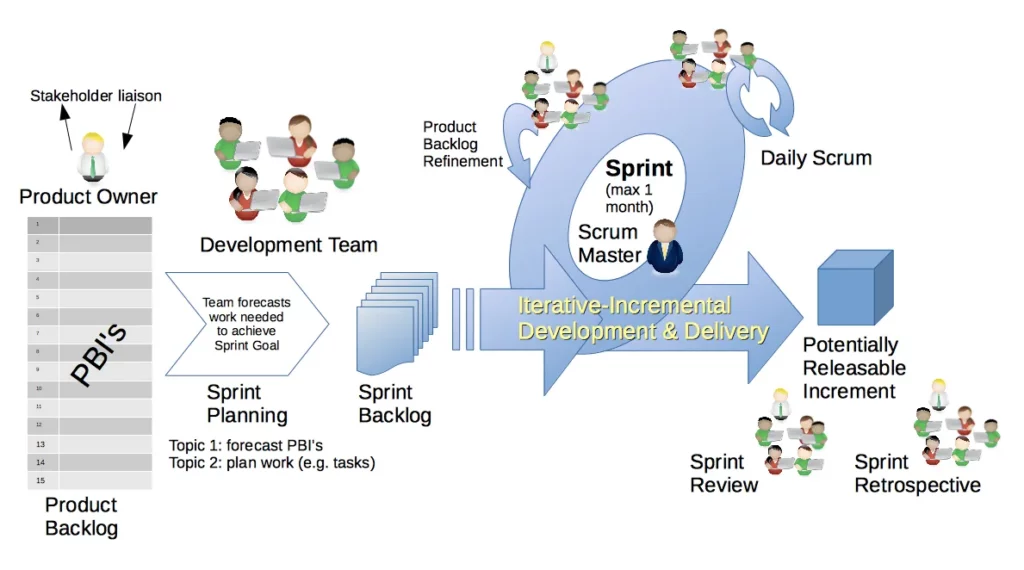
Scrum is a lightweight framework for helping people, teams, and organizations generate value through adaptive solutions for complex problems. The Scrum Guide defines the framework around a Scrum Team, accountabilities, events, artifacts, and commitments; it does not prescribe every engineering practice or every task a team must perform.
A Scrum Team has three accountabilities: the Product Owner, the Scrum Master, and Developers. The Product Owner is accountable for maximizing product value and effective Product Backlog management. The Scrum Master is accountable for establishing Scrum and improving the team’s effectiveness. Developers create a usable Increment and adapt the Sprint Backlog toward the Sprint Goal. These are accountabilities, not mandatory job titles.
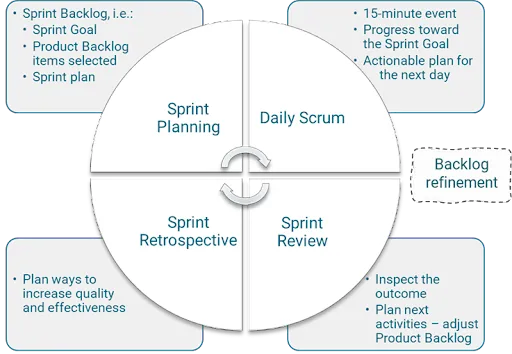
Scrum organizes work into Sprints: fixed-length events of one month or less. Within a Sprint, the team uses Sprint Planning, Daily Scrums, the Sprint Review, and the Sprint Retrospective to plan, inspect the Increment and progress, and adapt. The team can release value during a Sprint; a Sprint is a planning and inspection timebox, not a rule that software ships only at its end. For a deeper product-delivery context, see Scrum software development.
Scrum can support Agile values, but using the framework’s events alone does not make a team adaptive. The team must inspect real outcomes, respond to evidence, and improve how it works.
Related reading:
- Agile vs Waterfall vs Scrum vs Kanban: How to Choose a Method
- Agile Methodology Sample: Real Examples & Success Stories
- What Is An Agile Framework? Definition, Types And Examples
Agile vs Scrum: Key Differences
Agile and Scrum differ mainly in scope: Agile guides how teams respond to change, while Scrum defines a repeatable framework for doing that work. The table summarizes the distinction; the notes below explain where the boundaries matter in day-to-day delivery.
| Aspect | Agile | Scrum |
|---|---|---|
| What it is | A set of values and principles for iterative, adaptive product work. | A lightweight framework for complex work, with defined accountabilities, events, artifacts, and commitments. |
| Structure | Teams select practices that fit their context; Agile does not mandate one workflow. | The framework sets boundaries, while the team adapts its plan and practices within them. |
| Cadence | May use continuous flow, iterations, or a combination. | Uses fixed-length Sprints of one month or less. |
| Accountability | No universal role model is prescribed. | Defines the Product Owner, Scrum Master, and Developers as accountabilities. |
| Best fit | Work patterns or teams need different cadences and a tailored operating model. | A stable cross-functional team benefits from a shared Sprint Goal and regular inspection. |
Agile Sets Principles; Scrum Sets Framework Boundaries
Agile describes the values behind a team’s decisions; Scrum makes several operating expectations explicit. A Scrum team plans a Sprint, works toward a Sprint Goal, creates an Increment, and inspects its progress through the framework’s events. The rules provide a common structure, but they do not turn every planning choice into a fixed script.
This distinction matters when comparing Agile project management with Scrum. Agile can be expressed through different practices and workflows. Scrum is one framework within that broader space, so the comparison is not between two equal-sized methods.
Agile Allows Different Workflows; Scrum Requires a Sprint Rhythm
An Agile team may organize work as a continuous queue, short iterations, or a combination. Scrum requires a Sprint timebox, but the team can adapt its plan as it learns as long as the Sprint Goal is not endangered. A change in backlog detail is not the same as abandoning the outcome the team agreed to pursue.
Continuous delivery is an engineering and release practice, not the opposite of Scrum or a synonym for Agile. A Scrum team can release during a Sprint if the Increment meets its quality standards. A flow-based Agile team may release whenever work is ready. The useful question is whether release planning and work intake fit the team’s real dependencies and feedback needs.
Scrum Names Accountabilities; Agile Does Not Mandate Job Titles
Scrum’s accountabilities make product value, framework effectiveness, and Increment creation explicit. They do not require three separate departments or fixed job titles. In a small organization, one person may hold another job title while still being accountable for a defined Scrum responsibility; Developers collectively own creating the Increment.
Agile teams can organize ownership differently, but that flexibility should not leave product priority, delivery quality, or decisions about customer feedback unowned. A team can choose its structure; it still needs to make responsibility visible.
What Agile and Scrum Have in Common
Scrum and other Agile approaches share an emphasis on learning through delivery rather than relying only on a large upfront plan. In both, teams can work in small increments, seek customer feedback, and adjust based on what they observe. An iterative Agile software development life cycle helps make that learning part of the work instead of a final-stage review.
They also depend on communication and transparency. Scrum formalizes some inspection points; other Agile approaches may use regular demos, workflow reviews, or customer sessions. The practice only helps when it informs a real decision: what to change, what to continue, or what risk to address.
Potential Benefits and Trade-Offs
Agile and Scrum can improve visibility and shorten the time between a decision and useful feedback, but neither guarantees faster delivery or higher quality. Outcomes depend on the team’s ability to finish work, involve the right stakeholders, and act on what inspection reveals.
| Potential value | When it can help | Trade-off to manage |
|---|---|---|
| Earlier learning | Small increments let teams test assumptions before investing in a larger release. | Frequent feedback takes stakeholder time; feedback that arrives late or lacks decision authority may not change the plan. |
| More visible work | A backlog, board, or Sprint Goal can expose priorities, blockers, and unfinished work. | Tracking becomes overhead if teams maintain artifacts that do not support decisions. |
| Clearer coordination | Shared ownership and regular inspection can reduce handoffs between product, design, and engineering. | Events and coordination do not replace technical quality practices or resolve cross-team dependencies on their own. |
For example, smaller batches may surface a usability problem sooner, but the team still needs time and authority to change direction. Scrum events create scheduled opportunities to inspect work; they do not force useful conversations if participants arrive without context or decisions. Treat process benefits as outcomes to check, not promises attached to a method name.
When to Choose Agile or Scrum
Choose based on the work pattern, the team’s ability to inspect outcomes, and the amount of structure needed—not on whether the organization is “mature” enough. Both approaches require discipline; they differ in how much of the operating model is prescribed.
Use a Broader Agile Approach When Work Needs Flexible Flow
A broader Agile approach can fit when requests arrive continuously, priorities shift often, or several teams need different cadences under shared product goals. A flow-based board may be more useful than fixed Sprint commitments for support, maintenance, or platform work with frequent interruptions. The team still needs clear ownership, visible work-in-progress limits, and a way to review outcomes.
Agile does not mean “no process.” Teams may combine flow with planning, customer discovery, and practices from Agile and Lean to limit waste while keeping decisions close to the work.
Choose Scrum When a Stable Team Can Work Toward a Sprint Goal
Scrum can fit a stable, cross-functional product team that can create a usable Increment, work toward a Product Goal, and review results with stakeholders regularly. A Sprint Goal gives the team a short-term outcome to coordinate around; Sprint Planning, the Daily Scrum, the Sprint Review, and the Retrospective support planning and inspection.
Before adopting Scrum, check that the team can protect focus while still responding to urgent work, and that a Product Owner can make timely backlog decisions. The team should also agree on a quality bar and clear completion conditions; useful Agile acceptance criteria can help clarify what a backlog item must demonstrate without turning every task into a rigid specification.
Combine Agile Principles and Scrum Where Each Fits
An organization can use Agile values across product planning while selecting Scrum for teams that benefit from Sprint Goals and recurring inspection. Another team may use continuous flow because its incoming work is less predictable. The combination is useful only when the handoffs, dependencies, and decision rights between those teams are explicit; labeling the whole company “Agile” does not solve coordination by itself.
Related reading:
- Agile Development Best Practices: 10 Tips And Templates In 2026
- Agile vs Traditional Project Management: Key Points in 2026
- What Is Software Development and the Software Development Process?

Agile vs Scrum Examples
Examples help show why the choice depends on the level of work and its cadence. The cases below illustrate different contexts; they do not prove that one method produces a universal performance result.
Public-service lifecycle: GOV.UK’s Agile delivery guidance describes service phases such as discovery, alpha, beta, live, and retirement. This is an example of organizing a service around its lifecycle; it does not establish that every GOV.UK team avoids Scrum or uses one identical delivery framework.
Scrum across teams: Scrum.org’s Vodafone New Zealand case study describes an 18-month operating-model change involving ten tribes and 55 squads, alongside roles such as Product Owners, Scrum Masters, Tribe Leads, Chapter Leads, and Agile Coaches. The case shows one organization’s structure, not a universal scaling template.
Scrum at enterprise scale: Scrum.org’s direct Akbank case study documents a transformation involving more than 100 Scrum teams. It supports the reported scale of adoption; the case page alone does not establish a measured performance gain caused by Scrum.
Illustrative product and platform teams: Imagine a SaaS product team building a new billing workflow. If it has stable cross-functional membership, a clear Product Goal, and regular stakeholder access, it can use a Sprint Goal to deliver a small Increment and inspect it at the Sprint Review. By contrast, a platform team receiving unpredictable support and infrastructure requests may use a flow-based queue with explicit work-in-progress limits so urgent issues do not repeatedly derail a Sprint. The first choice favors a regular planning and review rhythm; the second accepts less batch-level predictability in exchange for handling variable intake. A team building a customer-facing site may also have a distinct Agile web development cadence based on discovery and release risk.

FAQs About Agile vs Scrum
Is Scrum the Same as Agile?
No. Agile is a broader set of values and principles, while Scrum is a specific framework. Scrum can help a team apply Agile ideas, but the terms are not interchangeable.
Can a Team Be Agile Without Scrum?
Yes. A team can use another framework or a tailored workflow and still work according to Agile values. The test is whether it delivers useful work, collaborates with customers, inspects results, and adapts—not whether it holds Scrum events.
Can a Scrum Team Fail to Be Agile in Practice?
Yes. A team can hold every event and maintain every artifact while ignoring feedback or refusing to adapt. Scrum.org’s Intralinks case study describes an initially mechanical Scrum implementation and a later “Scrum Reboot” that emphasized inspection, adaptation, and Scrum Values. The case illustrates why ceremonies alone are not enough; it does not guarantee that a particular change will work for every team.
Conclusion
Agile is the broader guide for adapting product work; Scrum is one framework for applying that intent through accountabilities, events, and Sprints. Use continuous flow when intake is unpredictable and a stable Sprint Goal would be disrupted. Use Scrum when a cross-functional team can focus on an outcome, create an Increment, and inspect it with stakeholders. If you need help defining a delivery model before a product build, contact Designveloper’s software development team to discuss the work and its delivery needs.
Also published on

Share post on










Related Articles



What Is Velocity In Agile? Formula, Examples, And Common
What Is Velocity In Agile? Formula, Examples, And Common Published October 15, 2026
User Stories In Agile: Examples, Template, And Practical Writing Tips
User Stories In Agile: Examples, Template, And Practical Writing Tips Published October 14, 2026
What Is The Scaled Agile Framework (SAFe)? How It Works At Scale
What Is The Scaled Agile Framework (SAFe)? How It Works At Scale Published October 14, 2026


















