















30 SaaS Ideas To Build In 2026: Choose A Niche Worth Testing

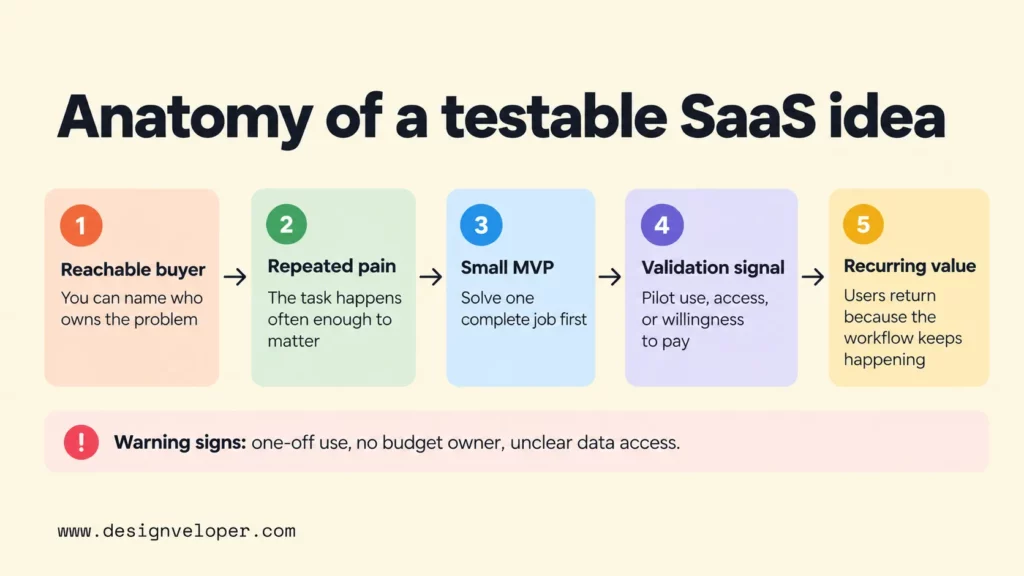
Good SaaS ideas to test in 2026 start with a recurring problem, a reachable buyer, and a small product that can prove value before a full build. A support team sorting the same ecommerce tickets or an IT lead tracking unused licenses offers a possible starting point. Whether either is worth building depends on the current workaround, the cost of the problem, and the buyer’s willingness to test a solution. The 30 ideas below cover five categories. Each includes a likely buyer, a focused minimum viable product (MVP), a validation signal, a revenue-model hypothesis, and a main risk. They are opportunities to investigate, not proof of demand or guaranteed profit.
AI And Data Workflow SaaS Ideas
AI products are easiest to evaluate when they improve a task that someone already performs. For the underlying product decisions, our SaaS application development guide explains why subscription access, customer data separation, and operating costs matter alongside features.
1. AI Customer Support Platform
Support managers at small ecommerce stores repeatedly sort order-status tickets and rewrite answers to familiar questions. A focused product could use approved store policies to draft replies and route uncertain cases to an agent. The MVP needs one help-desk connection, a review queue, and a clear handoff, not a fully autonomous agent.
Ask a support lead to run real, anonymized tickets through a pilot and measure accepted drafts and handling time. A per-agent subscription is one revenue hypothesis. The main risk is an incorrect reply that sounds confident; our guide to customer service chatbots explains why grounded answers and escalation are essential.
2. Voice Biometrics Security SaaS
Call-center fraud teams need help identifying suspicious callers without making account access depend on a voice match. A service could flag unusual voice patterns and suspected synthetic speech for human review. Start with call scoring, reason codes, and an investigation log inside one existing contact-center system.
Test the review process on authorized, labeled calls and measure both false alerts and missed cases. Charge per analyzed call or test an enterprise subscription. Spoofing, consent, privacy, and false confidence are major risks. NIST SP 800-63B says voice-based biometric comparison must not be used for authentication under its digital identity guidance. That requirement concerns authentication. Describe this idea as a fraud-review signal, not proof of identity or a blanket promise of compliance.
3. Legal Contract Analysis SaaS
Legal operations teams spend time locating unusual terms across supplier contracts. This software could extract clauses, compare them with a company-approved playbook, and flag items for a lawyer. Begin with one contract type, searchable documents, and source-linked findings rather than automated legal decisions.
A useful validation test is whether counsel catches real exceptions faster on a sample they have permission to share. Per-reviewer or document-volume pricing could be tested. The main risk is a missed clause or fabricated interpretation, so each finding needs a traceable passage and human sign-off.
4. Video Localization And Lip-Sync Tool
Training publishers and video agencies often rebuild the same material for different languages. A niche tool could create translated subtitles and draft voice tracks, with optional lip synchronization. Start with one language pair and training-video format. Give editors control over timing, pronunciation, and speaker consent before release.
Show a producer a sample clip and ask whether they would pay to finish several real assets. Charging per processed minute is a possible model. Translation errors, likeness rights, and compute costs are the main risks; a convincing demo is not enough if revisions consume the savings.
5. Competitive Intelligence Platform
Product marketers at mid-sized software companies regularly check competitor websites, release notes, and pricing pages. A monitoring service could track specified public pages, highlight changes, and attach source links. An MVP needs reliable change detection and a weekly digest for one industry.
Recruit teams that already maintain competitor spreadsheets and check whether they act on the alerts. A subscription priced by tracked companies is plausible. The biggest risk is noisy or misleading summaries; avoid scraping restricted information and distinguish an observed change from an interpretation.
6. Content Repurposing SaaS
B2B marketing teams often turn a webinar into LinkedIn posts and an email summary by hand. A focused tool could draft those formats from an approved transcript. Start with one webinar upload, editable templates, and a review step before anything is published.
Offer a manual-assisted pilot to teams that already produce weekly content and track which drafts they actually use. Monthly plans based on source hours may fit. The risk is generic output that takes longer to edit than to create, especially when brand claims need careful checking.
7. AI Governance And TRiSM Control Center
Organizations using several AI systems need an inventory of models, owners, approved uses, and review events. A narrow trust, risk, and security management tool could record evaluations, policy exceptions, and incidents for one AI workflow. It should begin with evidence collection rather than promises of automatic compliance.
Ask an AI platform owner to use the pilot during a real model review, then check whether it reduces missing records. Team or managed-model subscriptions are hypotheses. Integrations and changing rules create risk; the voluntary NIST AI Risk Management Framework offers a useful risk-management reference, not a product certification.
Finance, Billing, And Compliance Ideas
Finance and compliance buyers are often paying to avoid errors and missed deadlines. These ideas need a clear record of what the product can check and what still requires professional judgment.
8. AI Bookkeeping For Freelancers
Freelancers lose time copying receipts and categorizing transactions before tax season. A service could collect invoices, suggest expense categories, and export records to an accountant. Start with one freelancer segment and one local accounting workflow. The MVP should accept corrections rather than post irreversible entries automatically.
Ask freelancers and bookkeepers to process a month of real records and record correction rates. A low-cost monthly plan is one hypothesis. The main risks are incorrect classification, country-specific tax rules, and the cost of acquiring users with small budgets.
9. Subscription Management Tool
Finance teams at small businesses often miss their own software and service renewals. This buyer-side subscription tracker could read approved invoices, show upcoming charges, and assign owners before renewal dates. Start with email forwarding, a contract list, and reminders; leave cancellation automation for later.
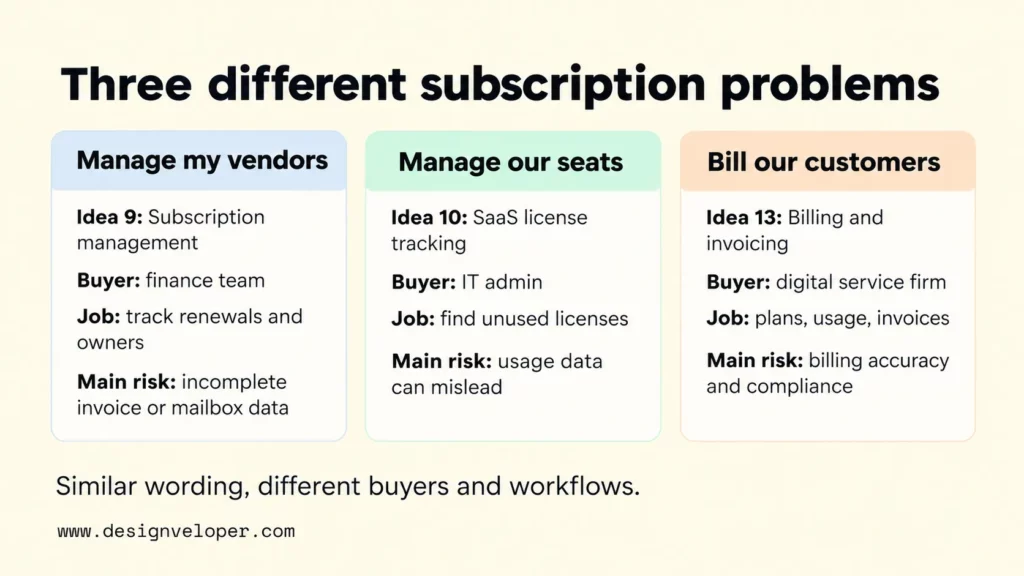
Check whether a finance manager can find commitments missing from an existing spreadsheet and act before renewal. A company subscription could scale with tracked vendors. Invoice detection errors and sensitive mailbox access are the largest risks, so permissions and manual verification matter.
10. SaaS License Tracking Platform
IT administrators need to know who owns paid software seats and which accounts are unused. A license tracking product could combine one identity-provider integration with employee and renewal records. An MVP might flag inactive seats and produce a review list rather than revoke access automatically.
Invite an IT lead to audit one application’s seats with the tool and check the accuracy of suggested changes. A per-managed-seat fee could be tested. The main risk is incomplete activity data: a rarely used license may still be essential for a critical task.
11. ESG Compliance SaaS
Sustainability teams may struggle to collect evidence for environmental, social, and governance reporting from different departments. A focused service could request documents, record data owners, and track approvals for one reporting obligation. Build the first version around one jurisdiction and one customer segment.
Validate by observing an actual reporting cycle and securing a pilot from the responsible team. An annual organization subscription is possible. Regulation is the key risk: the European Commission’s sustainability simplification updates show why scope must be checked for each buyer before claiming mandatory compliance.
12. Contract Lifecycle Management Software
Procurement teams often lose time finding agreements and checking renewal terms. A specialized contract system could store signed documents, assign owners, and alert staff before key dates. The MVP should focus on one type of agreement, access permissions, and dependable search.
Ask a procurement lead to migrate a small live contract set and verify whether users can find dates without chasing colleagues. Pricing by workspace or contract volume is plausible. The main risk is poor migration quality; a missing date or permission error can undermine trust quickly.
13. Subscription Billing And Invoicing Platform
Small digital-service firms with unusual billing rules may struggle to reconcile subscriptions and invoices. A targeted product could connect plan changes, metered usage, and customer-visible bills for one business model. Start with a single payment integration and clearly defined retry and cancellation behavior.
Validate with merchants willing to run test billing cycles and review edge cases, not only a checkout demo. A base fee plus transaction or usage charges is a hypothesis. Billing accuracy and regulatory duties are major risks; Stripe’s Billing feature documentation also helps founders check which functions they could buy instead of rebuild.
14. Business Intelligence And Reporting SaaS
Owners of multi-location repair businesses may combine job records and invoices to prepare weekly performance reports. A focused reporting service could connect those two sources and show completed jobs, unpaid invoices, and service delays by location. Start with definitions the owner can verify, not an open-ended analytics platform.
Compare the pilot with the owner’s existing weekly report and ask which staffing or collection decision changes. A subscription per connected location is a possible model. Inconsistent metric definitions are the main risk: the numbers must reconcile before anyone acts on them.
Sales, Marketing, And Creator Ideas
Marketing software has to fit the buyer’s existing distribution channel. These ideas work best when a narrow niche provides access to both useful data and reachable customers.
15. Newsletter Sponsorship Marketplace
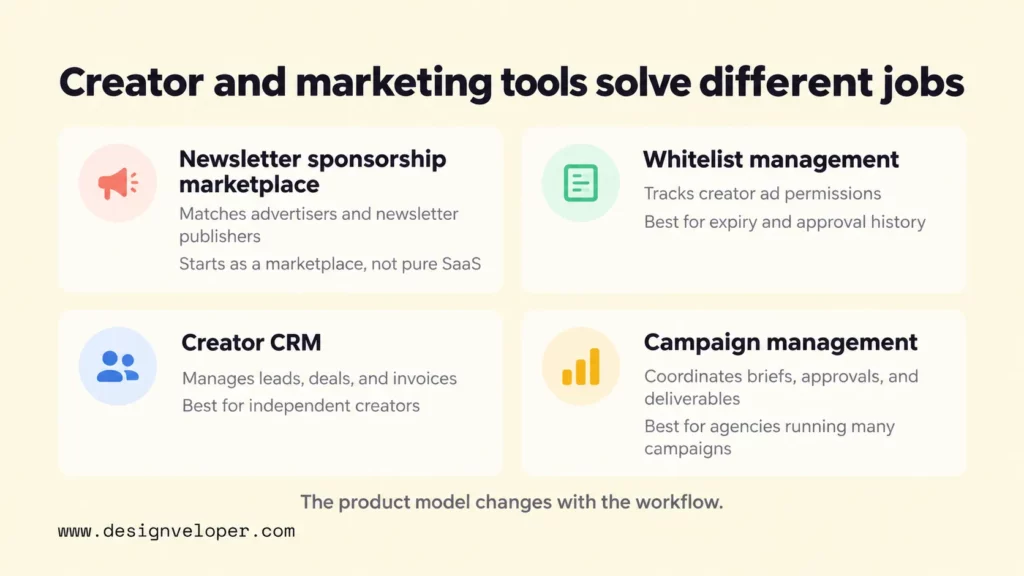
Specialist newsletter publishers need sponsors, while small advertisers struggle to assess relevant audiences. A newsletter sponsorship marketplace could list placements, verify audience evidence, and manage bookings for one subject area. Begin with curated profiles and manual approvals, not an automated matching engine.
Test both sides by manually arranging real placements and asking advertisers and publishers whether they would transact again. Commission per placement is a possible model. This begins as a two-sided marketplace, not necessarily subscription SaaS; recurring publisher workflow features could make it a SaaS-marketplace hybrid. Without enough active buyers and sellers, the marketplace will feel empty.
16. Influencer Whitelist Management Tool
Brand agencies that run creator-authorized ads must track which advertising permissions are active and when they expire. A tool could maintain consent records, access owners, and expiration reminders for supported platforms. The first release should manage one platform and keep a clear approval history.
Ask an agency to run a live campaign through the workflow and count manual follow-ups avoided. Pricing by active creator may work. API changes and consent disputes are the risks; an authorization tracker is not a substitute for contracts or proper advertising disclosures.
17. Programmatic SEO Platform For Local Services
Franchises and multi-location repair providers need accurate service pages for each branch. Software could combine approved templates with unique local staff, service-area, and availability details. Begin with a few real locations and require editorial review before publication. The output must be useful to local customers, not just easy to multiply.
Test whether branch managers maintain the pages and whether customers find accurate information. A fee per live location is one revenue hypothesis. The risk is mass-produced, low-value pages; generating more URLs is not proof of useful search visibility.
18. Creator CRM And Monetization Platform
Independent creators often manage sponsorship leads and invoices across email and spreadsheets. A small CRM could store brand contacts, track deal stages, and remind creators when deliverables are due. Begin with a simple pipeline, calendar, and payment-status view for one creator category.
Invite creators with several current partnerships to use it for a month and watch whether they return without reminders. Monthly creator plans could fund the service. The challenge is retention when deal volume is seasonal or existing tools already cover the workflow.
19. Influencer Campaign Management Software
Agencies managing many creators need a shared view of briefs, approvals, deliverables, and results. A campaign platform could assign tasks and collect evidence before client reporting. Its first release should support one channel and a repeatable agency approval process.
Validate with one agency campaign and check late deliverables and revision cycles. Agency-seat or campaign pricing could be tested. The main risks are unreliable platform data and disclosure failures; the FTC’s influencer endorsement guidance explains U.S. disclosure expectations that software should help users address, not promise to satisfy automatically.
Industry-Specific SaaS Ideas
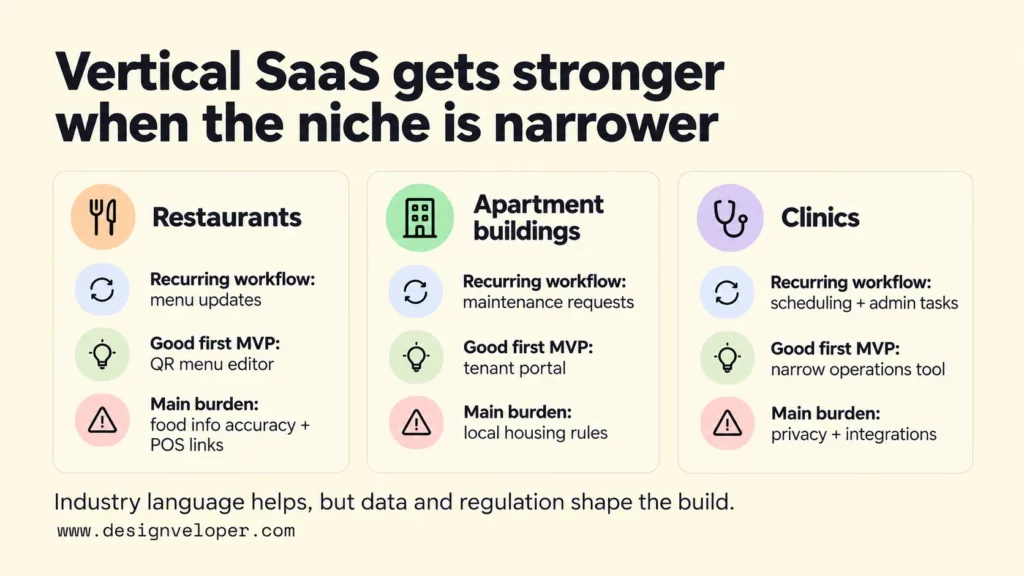
Industry-specific software can earn attention by matching everyday language and tasks. It also carries a higher integration and regulatory burden when the niche handles sensitive records or business-critical operations.
Our Wave solar-industry project describes a business-management platform built around one sector’s workflows. Its evolving data and feature requirements illustrate why industry knowledge matters during design. It does not prove demand for any of the new ideas listed here.
20. Dynamic QR Code Platform For Restaurant Menus
Restaurant groups update prices, availability, and allergen information across locations while printed menus become outdated. A QR menu product could give staff one approved place to update each location’s mobile menu. Start with version history, permissions, and visible update times, not QR-code generation alone.
Pilot through repeated menu changes and verify that staff keep updates accurate. Monthly pricing per location is plausible only if the editing workflow earns repeated use. Food information errors, accessibility, and existing point-of-sale integrations are major risks.
21. Healthcare Operations Management SaaS
Small clinics may spend hours coordinating appointment changes, forms, and follow-up tasks. A narrow operations tool could handle one administrative workflow without making clinical recommendations. An MVP might synchronize scheduling and staff task status while limiting access to necessary records.
Secure a clinic-led pilot and measure completed scheduling tasks and exceptions. Charging per location is one hypothesis. Privacy and integration risk can dominate the build. In the U.S., HHS guidance on HIPAA and cloud services explains when covered entities and cloud vendors need business associate agreements.
22. PropTech Tenant Management Platform
Managers of small residential apartment buildings may lose maintenance requests across calls, messages, and spreadsheets. A tenant portal could collect repair reports, assign them to staff, and show progress to residents. Start with maintenance tickets and notifications for one property type before adding rent or deposits.
Test with a manager who handles several buildings and measure whether requests stop disappearing between channels. A per-unit subscription is a possible model. Local housing rules and tenant data privacy require careful scoping, especially if the product later handles deposits or notices.
23. CRM For Niche Industries
Heating and air-conditioning repair shops need customer records tied to installed units, site visits, and maintenance contracts rather than a generic sales pipeline. A niche CRM could show each customer’s equipment history and the next scheduled visit. An MVP should replace one spreadsheet-based service follow-up workflow.
Have one repair shop migrate active customers and upcoming visits. Check whether dispatchers and technicians return to update each job without prompting. Per-user pricing is a hypothesis. The main risk is over-customization: the first shop’s process may not represent other repair businesses.
24. Vendor And Procurement Management Tool
Procurement teams need to know whether new suppliers have completed required onboarding and approvals. A tool could join vendor records with document requests and a review queue. Begin with one supplier category and its approval handoff rather than an all-purpose procurement platform.
Ask a procurement manager to run several real onboarding requests and track missing documents and approval delays. An organization subscription is possible. Supplier access, security reviews, ERP integrations, and long purchasing cycles can make this difficult for a solo founder.
Team Productivity, HR, And Learning Ideas
Productivity software should make a decision or repeated task easier, not just measure more activity. HR and employee-related products also need clear consent, access controls, and limits on what managers may infer from the data.
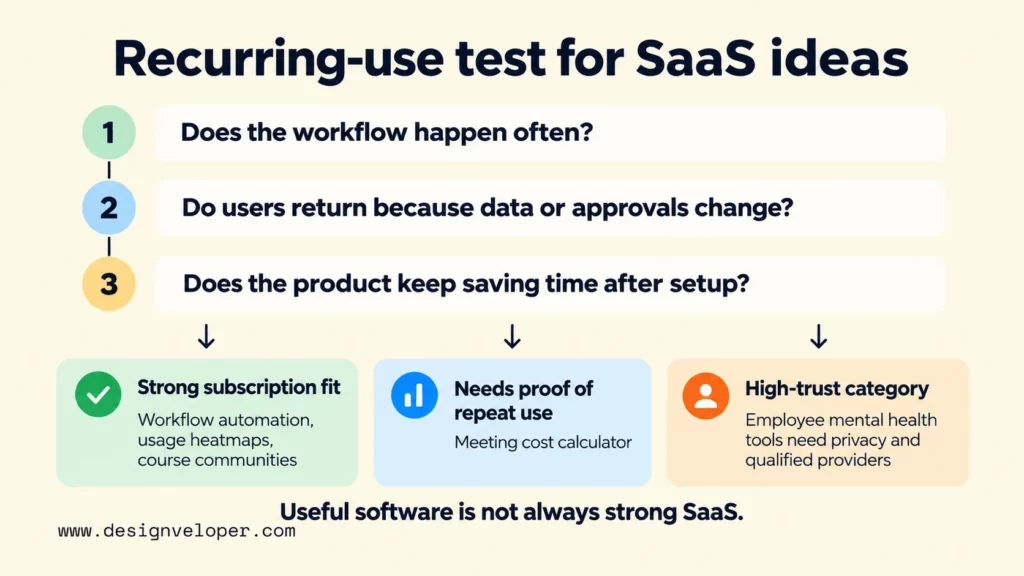
25. Team Meeting Cost Calculator
Department heads may not know whether recurring meetings still justify their cost. A tool could estimate labor time using calendars and role-based salary bands, then support a monthly review of meetings to shorten or cancel. Start with one calendar connection and aggregate team data, not individual performance scores.
Ask a department lead to repeat the review over several months and record which scheduling decisions they make. A per-team subscription is plausible only if ongoing reviews create continuing value. If users need one calculation and never return, offer a one-time tool instead. Salary privacy remains a major risk.
26. Workflow Automation For Non-Technical Teams
Office managers at small nonprofits often copy purchase requests into spreadsheets and chase approvals by email. A narrow automation service could route each request to the right budget owner and record decisions. Start with one form, one approval workflow, and the office tools the pilot team already uses.
Test whether managers can launch and maintain a workflow without developer support. Plans based on active workflows could work. The largest risk is competition from established workflow automation tools; a niche template is valuable only when it removes setup and maintenance work those tools leave behind.
27. SaaS Usage Heatmap Tool
SaaS product managers often see usage totals but cannot tell where new customers abandon a key task. A product analytics tool could capture consented events and show step-by-step adoption by account. Start with one event-tracking connection and a few core journeys instead of recording everything.
Pilot with a product team that already has a retention question and see whether the data changes a roadmap decision. Charge by monthly tracked events or accounts. Privacy rules, data quality, and misreading correlation as causation are the main risks.
28. Personalized Corporate Reskilling Platform
Customer support training managers need to teach new service workflows and confirm staff can perform them. A focused platform could assign approved practice tasks to one support role and record manager-reviewed demonstrations. Begin with employee-selected goals rather than opaque predictions about career potential.
Run a cohort pilot and check skill demonstrations, not just course clicks. Per-learner or company subscriptions could be tested. Weak content relevance and unfair employee profiling are the major risks; our guide to HR workflow automation also shows why people must own sensitive workforce decisions.
29. Employee Mental Health Platform
Employers may want to sponsor employee wellbeing resources, but staff need privacy and choice. A non-clinical service could provide voluntary resource check-ins and confidential routes to qualified support. The MVP should avoid diagnosis and never expose identifiable mental-health responses to managers. Crisis referrals must be handled by suitable qualified providers.
Validate through confidential employee feedback and an employer’s willingness to sponsor access, not through collection of personal disclosures. Per-eligible-employee pricing is a hypothesis. Trust, clinical claims, crisis handling, and sensitive data are major risks; qualified providers must own any clinical service.
30. Online Course And Community SaaS
Independent professional educators running repeat certification cohorts may manage lessons, Q&A, and renewals across several services. A niche platform could combine enrollment with moderated cohort discussions and alumni access. Start with one teaching format and member workflow, rather than another general-purpose course-hosting tool.
Ask an educator with an existing paying audience to migrate one cohort and track completion and renewal intent. Plans based on active members could work. The biggest risks are costly media hosting, moderation, and weak differentiation from established course platforms.
How To Choose And Validate A SaaS Idea Before Building
Choose the idea whose buyer already experiences the problem often, controls a budget, and can test a small solution with you. An attractive feature list is not evidence of demand. For SaaS ideas that require integrations or regulated data, test access to the necessary systems before committing to a build. A frequent and costly workaround is a stronger starting point, especially when you can reach the people who own it.
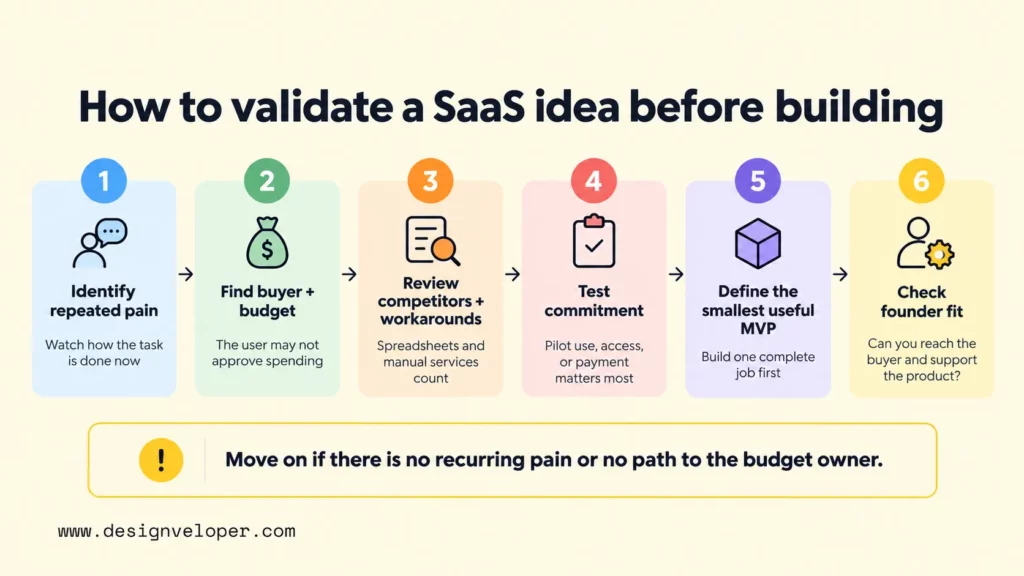
- Identify the repeated pain. Ask prospective users to show a recent task, how they complete it now, and what delay or mistake it causes. Separate a minor inconvenience from a problem worth paying to remove.
- Find the buyer and budget. The daily user may not approve spending. Interview both roles and learn what event would trigger a purchase, who approves data access, and what current solution is already funded.
- Review competitors and workarounds. Try the tools buyers use, including spreadsheets and manual services. Look for one unmet need you can verify, such as an awkward handoff or poor integration, rather than assuming competition is weak.
- Test commitment before building widely. Use a landing page to test messaging, a prototype to watch actual tasks, or a manual pilot to deliver the outcome. Stronger signals include customer time, permitted data access, a signed pilot, and payment. Forum complaints and Reddit threads are leads for interviews, not demand proof.
- Define the smallest useful MVP and success signal. Build one complete task with clear permissions, support, and error handling. Before launching, choose a measurable result: repeated use, tasks completed correctly, renewal, or willingness to pay after the trial.
Before choosing a pilot, check your own founder fit. Can you reach the buyer, understand their work, and maintain the service after launch? Decide whether you want a small side business or a company that will need a larger sales team. A creator CRM may be testable with a few creators you already know. Voice-security and healthcare ideas usually require deeper expertise, permission to use sensitive data, and longer sales work. For example, access to one clinic manager could make a narrow scheduling pilot realistic; without that access, the same idea remains a guess.
Compare the business model with the cost to serve each customer. An AI video tool can have high processing charges; a healthcare tool may need expensive security and integration work; a meeting calculator may lack a reason for monthly payment. Our SaaS operating cost breakdown explains why infrastructure, vendors, support, and maintenance belong in that calculation. These are cost categories, not proof that any idea will make money.
For founders choosing a next step, we recommend documenting the buyer, current workaround, MVP boundary, and evidence needed to continue. Our guide to minimum viable product planning explains how to turn those assumptions into a testable release. If interviews reveal no recurring pain or no path to a budget owner, change the niche before writing more code.
Also published on

Share post on










Related Articles


30 SaaS Ideas To Build In 2026: Choose A Niche Worth Testing
30 SaaS Ideas To Build In 2026: Choose A Niche Worth Testing Published October 19, 2026