
















RAG Cost: What It Takes To Build And Run A RAG System

RAG cost consists of a one-time build and the recurring expense of answering queries, updating documents, and maintaining the system. There is no universal price: build effort depends on the scope, while monthly spending depends on traffic, retrieved context, infrastructure, and operations. Estimate those parts separately before calculating the cost per query or useful, grounded answer.
How Much Does A RAG System Cost?
There is no verified fixed price for building a RAG system. A prototype, production application, and enterprise deployment need different amounts of engineering work. To calculate the one-time cost, estimate the hours for each workstream and multiply them by the delivery team’s actual hourly cost. Then budget monthly infrastructure, usage, document updates, and maintenance separately. Without a scoped work estimate, a generic build-price range would make assumptions look like a quote.
For a concrete running-cost example, the internal assistant calculated later has about $82.04 in monthly provider charges at 20,000 queries. Adding hypothetical support labor brings that example to about $882.04. Neither figure represents a general RAG price or a validated production quote.
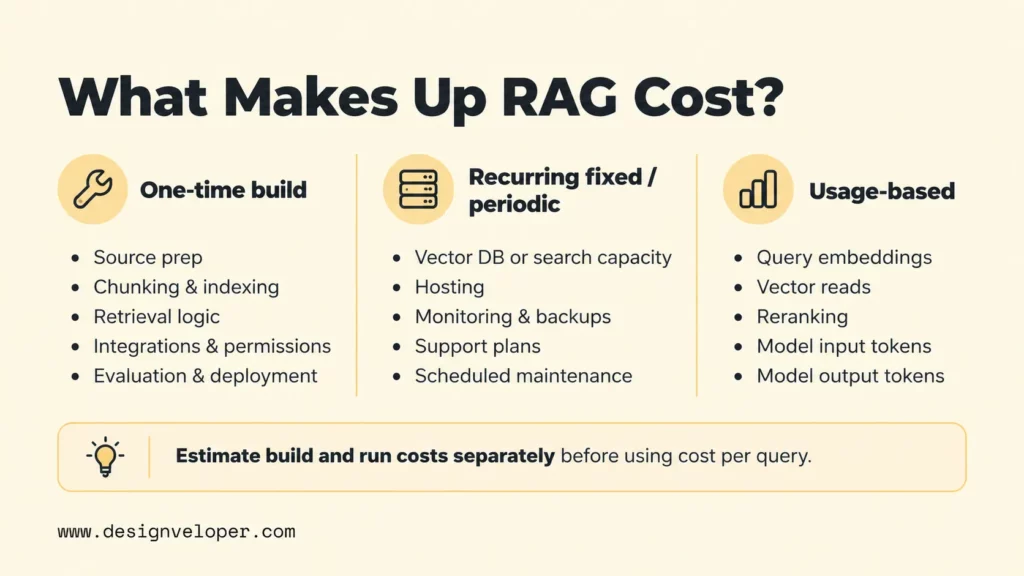
- One-time development: source discovery, data cleaning, chunking, embedding and indexing setup, retrieval logic, integrations, permissions, evaluation, deployment, and production hardening.
- Recurring fixed or periodic costs: vector database minimums or provisioned search capacity, application hosting, monitoring, backups, support plans, security work, and scheduled engineering maintenance.
- Usage-based costs: query embeddings, vector reads, reranking, model input and output tokens, and any metered search or inference service.
For the delivery work behind those budget lines, our guide to building a RAG system maps the production pipeline from source preparation through monitoring and fallbacks. It also covers indexing, retrieval, generation, evaluation, and access control. That sequence is useful for costing because every production requirement adds either build effort, recurring service spend, or both.
Do not use a single “cost per query” number until the architecture and workload are defined. A 10,000-query internal assistant with a small corpus has a different cost shape from a customer-facing service with high concurrency, strict latency targets, large retrieved contexts, or complex access rules. Geography also changes labor and cloud prices. The estimates below therefore state their assumptions instead of pretending there is one market price.
Upfront RAG Development Costs By Project Scope
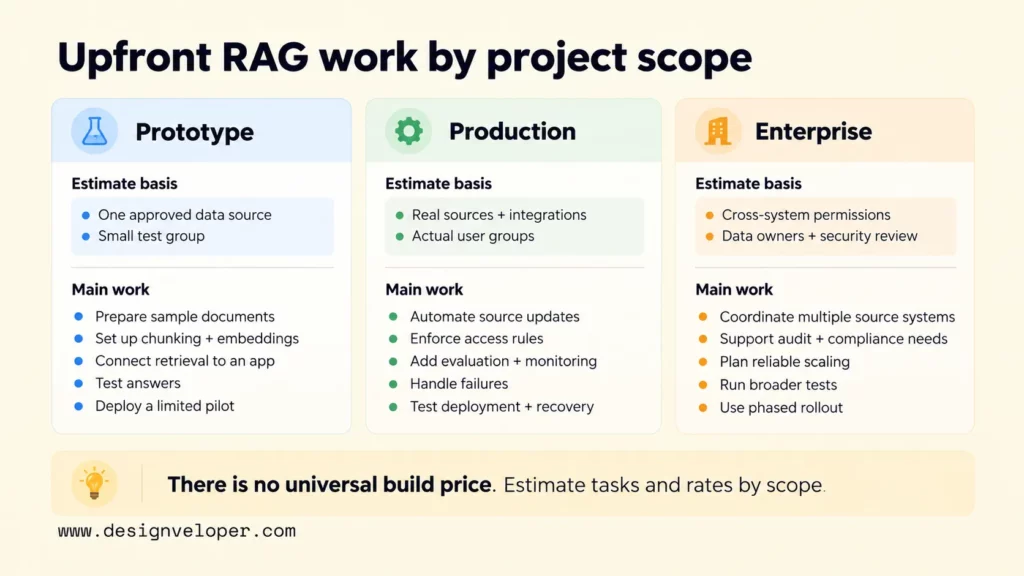
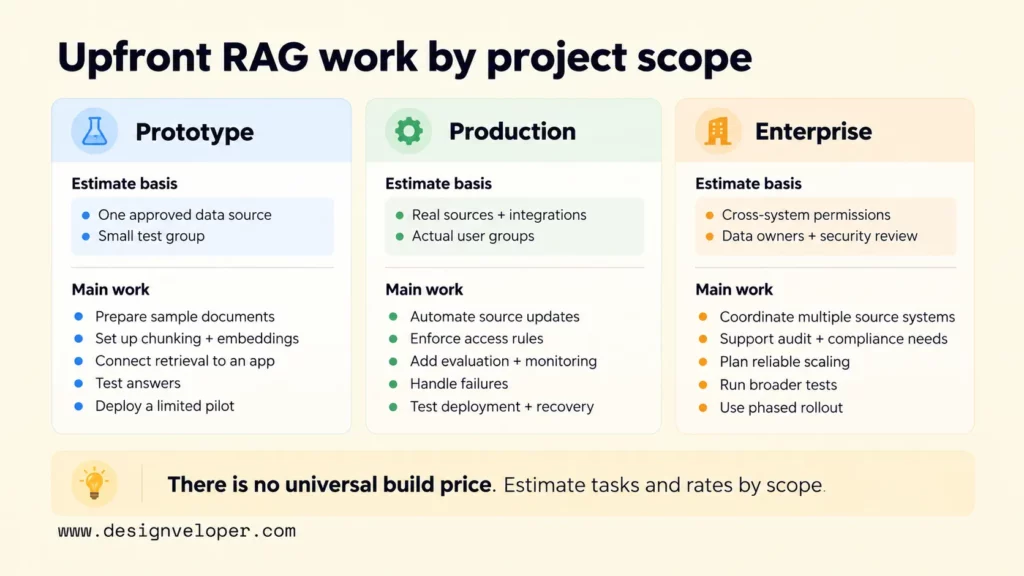
Upfront RAG development costs depend on the work needed to make retrieval accurate, secure, and dependable. A demo may answer questions from one document set, while production must cope with changing sources and real users. The table compares the work to estimate at three scopes. It deliberately gives no dollar or hour range because no independently supported estimate for those scopes is available.
| Project scope | Effort basis to estimate | One-time cost method | Workstreams and scope limits |
|---|---|---|---|
| Prototype | Estimate a bounded pilot with one approved data source and a small test group. | Scoped hours by role × the team’s loaded hourly rate; obtain an actual estimate. | Prepare sample documents, set up chunking and embeddings, connect retrieval to an app, test representative answers, and deploy a limited pilot. Keep permissions and integrations within the pilot boundary. |
| Production | Estimate each real source, integration, user group, and service requirement. | Sum workstream labor estimates; add any setup fees, licenses, and specialist review. | Automate source updates, enforce access rules during retrieval, add evaluation and monitoring, handle failures, and test deployment and recovery. |
| Enterprise | Estimate cross-system permissions, data owners, security review, availability, and rollout separately. | Sum role-level labor and external setup costs for the approved enterprise scope. | Coordinate multiple source systems, changing permissions, audit and compliance needs, broader tests, reliable scaling, and phased rollout. Avoid assuming every enterprise needs the same architecture. |
Build the estimate from tasks rather than choosing a project tier first. Ask the delivery team to list the documents and connectors it must support. Next, scope the retrieval application and its access controls. Then specify the evaluation set, deployment environment, and operating handover. For each workstream, record the responsible roles, hours, exclusions, and estimation date. This makes the result reviewable when a source or security requirement changes.
Use a loaded hourly rate for labor. That is the hourly cost of the people doing the work, including relevant employer expenses; a supplier’s quoted rate may also include its margin. For context, the U.S. Bureau of Labor Statistics’ June 2026 employer-compensation table reports $73.69 per hour for the broad group of private-industry professional and related occupations. It is not a RAG engineer’s rate or a vendor quote. Do not multiply that general statistic by invented project hours to set a customer budget.
Keep the build estimate separate from cloud bills and ongoing operations. Include one-time setup charges or licenses only when the scope requires them. Confirm whether data owners, security specialists, and internal reviewers are providing time outside the engineering quote. Without those boundaries, two proposals that look similar can cover different work.
Architecture changes the tasks being estimated. A straightforward vector-retrieval system normally has fewer moving parts than a graph-based design that extracts entities and searches their relationships. If the questions do not need that relationship-based search, compare Graph RAG versus traditional RAG before adding the more complex work to the budget.
RAG Operating Costs Beyond Model Tokens
Monthly RAG cost is the sum of fixed infrastructure, metered usage, periodic data work, and operations labor. Model input and output tokens can dominate at high query volume, but they should not be the only numbers in the budget.
- Model calls: price the input tokens sent with each request and the output tokens generated. Retrieved passages increase input size, so context length becomes a cost lever on every query.
- Embeddings and re-indexing: include the initial corpus separately, then budget new or changed documents and query embeddings. Incremental updates can avoid paying to reprocess unchanged content.
- Vector search and storage: managed services may have minimum monthly charges, read/write usage, storage, or provisioned capacity. Pinecone, for example, currently lists a $50 monthly minimum for its Standard plan.
- Reranking: a second scoring stage reorders the passages returned by the initial search. It may improve which evidence reaches the model, but adds another service call. Test the quality gain against its added cost and delay.
- Hosting and monitoring: the application still needs compute, logs, metrics, alerts, and often backups. A small DigitalOcean Basic Droplet with 2 vCPUs and 4 GiB of memory is $24 per month as of October 2026, but production capacity may be higher.
- Maintenance: someone must review failed queries, refresh evaluation sets, fix ingestion problems, update dependencies, and investigate quality or latency regressions. This is labor, not a provider invoice.
Search pricing can follow fixed-capacity or consumption models. Azure AI Search Dedicated charges for provisioned Search Units. Its Serverless Developer preview instead measures compute usage and indexed storage. Microsoft’s current Azure AI Search service documentation states that Serverless Developer billing began on September 13, 2026. The tier remains in public preview, has no service-level agreement, and is not recommended for production. That distinction matters: a metered preview is not automatically an appropriate production replacement for dedicated capacity.
The same ownership question applies to vector databases. Self-hosting open-source software can remove a managed-service subscription while adding infrastructure and operations responsibility. Our current comparison of open-source vector database options recommends judging total ownership cost alongside retrieval quality, filtering, workload shape, and the operations your team can support.
Keep provider bills and labor on separate lines. Maintenance requires someone to investigate failed answers, fix data connections, and check quality after updates. Its cost is the monthly hours spent on that work multiplied by the team’s loaded rate. Those hours may cost more than the cloud services for a low-traffic assistant. An API-only RAG cost per month therefore understates the budget when it leaves people out.
Calculate Monthly RAG Costs And Cost Per Query
Calculate the monthly run rate as fixed platform and infrastructure costs + monthly queries × average variable cost per query + document update and indexing costs + operations. Keep the one-time build cost outside that formula unless you deliberately amortize it over a stated period.
Then calculate two unit costs. Cost per query equals the monthly run rate divided by total queries. Cost per useful, grounded answer uses only answers that meet the task’s quality test and are supported by retrieved sources. Divide the same monthly cost by that smaller accepted-answer count. This exposes false savings when cheaper settings cause retries or more human correction.
RAG Cost Calculator Inputs
A useful RAG cost calculator needs workload inputs, not just a model price. Record the following assumptions before multiplying anything:
- Monthly query volume and expected peak traffic.
- Average input tokens, including instructions, conversation history, and retrieved context.
- Average output tokens per answer.
- Generation-model rates, including any long-context, regional, batch, or caching rules that apply.
- Query-embedding rate and the tokens embedded per query.
- Corpus size, initial embedding volume, monthly data growth, and the share of documents that change.
- Vector storage, read/write usage, managed-plan minimums, or self-hosted infrastructure.
- Reranking requests and candidate-set size when a reranker is enabled.
- Application hosting, observability, backups, support, and service-level requirements.
- Monthly engineering and operations time.
Use pilot or production logs where possible. Otherwise, calculate low, expected, and high traffic scenarios. Keep the share of documents updated each month, sometimes called corpus churn, separate from total corpus size. Also test longer retrieved contexts and traffic bursts: either may increase metered use or require greater infrastructure capacity.
To turn the calculator into a budget, first request dated workstream estimates and hourly rates from the delivery team. Use pilot logs to replace the sample traffic, token counts, and document-update assumptions. Next, ask each provider to confirm the selected region, plan, storage, read/write usage, and likely peak capacity. Report the one-time build, monthly provider charges, monthly operations labor, cost per query, and cost per accepted grounded answer separately. That makes both the price and its exclusions visible.
Worked Example: An Internal Knowledge Assistant
Consider an illustrative assistant that answers employee questions from company policies and support documents. Its searchable corpus contains 25 million tokens, and 5% of those tokens change each month. It handles 20,000 queries per month. Each query sends 40 tokens to the embedding model and 2,500 billed input tokens to the generation model. Those 2,500 tokens include system instructions, the user question, conversation history, and retrieved document chunks. Each answer uses 300 billed output tokens, including any reasoning tokens. These assumptions are not production measurements.
For this U.S.-region illustration, use OpenAI’s GPT-6 Luna Standard short-context rates of $0.10 per million uncached input tokens and $0.50 per million output tokens. Use text-embedding-3-small at $0.02 per million embedding tokens. The published prices were checked on October 14, 2026. The example assumes no caching, batch discount, retries, or extra model/tool calls. It also assumes Pinecone Standard reads, writes, and storage stay within the $50 monthly minimum. A $24 DigitalOcean 2-vCPU, 4-GiB Basic Droplet is assumed to host only the application, not the model or vector database. Reranking is disabled.
| Line item | Calculation | Cost |
|---|---|---|
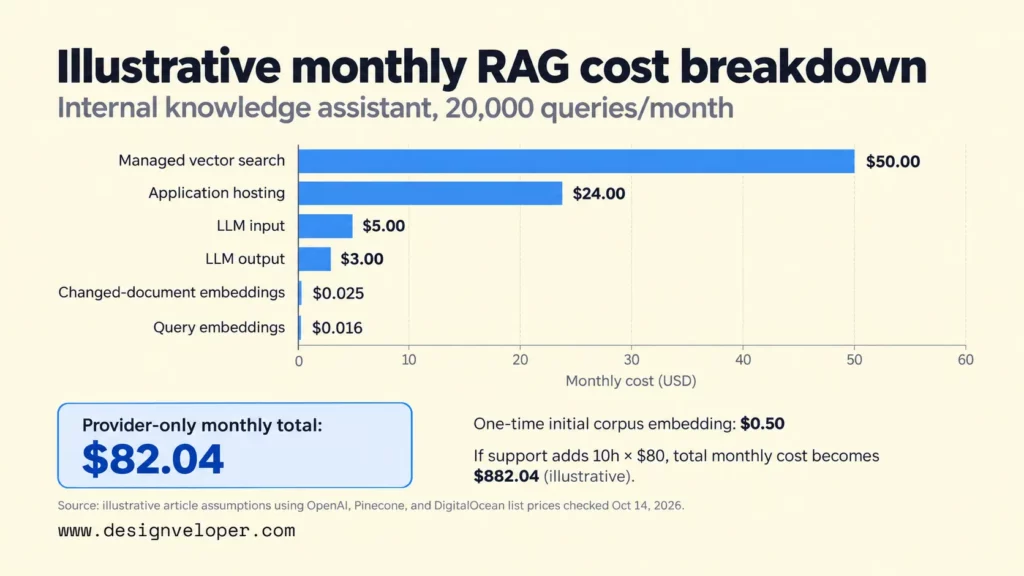
| Initial corpus embedding | 25M tokens × $0.02/M | $0.50 one-time |
| Monthly changed-document embedding | 1.25M tokens × $0.02/M | $0.025/month |
| Monthly query embeddings | 20,000 × 40 tokens × $0.02/M | $0.016/month |
| LLM input | 20,000 × 2,500 tokens × $0.10/M | $5.00/month |
| LLM output | 20,000 × 300 tokens × $0.50/M | $3.00/month |
| Managed vector search | Pinecone Standard minimum | $50.00/month |
| Application hosting | DigitalOcean 2 vCPU, 4 GiB Basic Droplet | $24.00/month |
Under those assumptions, the provider-only run rate is about $82.04 per month, or $0.0041 per query. If 95% of the 20,000 answers passed a defined grounding and usefulness test, that same provider bill would equal about $0.0043 per accepted answer. The 95% result is a hypothetical pass rate, not a tested performance claim. At this volume, $82.04 is also about $4.10 per 1,000 queries, including the assumed database minimum and server. Generation and query embeddings alone cost about $0.40 per 1,000 queries. These figures describe different cost boundaries and should not be compared as if they included the same expenses.
The $50 vector minimum and $24 server are capacity assumptions, not validated production sizing. Before using them in a budget, estimate the number and dimensions of stored embeddings, metadata size, search and indexing read/write units, and peak concurrent requests. Check the vector service’s metering against those inputs, then load-test the application server for response time and memory use. A 25-million-token corpus and 20,000 monthly questions alone cannot establish those costs.
Query volume offers a simple sensitivity test. At 5,000, 20,000, and 80,000 monthly queries, generation plus query-embedding charges would be about $2.00, $8.02, and $32.06, respectively, if token sizes and model rates stay unchanged. These are variable AI charges, not three complete monthly budgets. Recalculate Pinecone read units and storage, hosting capacity, peak traffic, and operations for each scenario. Do not carry the $50 vector minimum or $24 server assumption into a larger workload without checking its usage limits.
Operations change the picture. Suppose, only for this worked example, that the team spends 10 hours a month on support at an assumed loaded rate of $80 per hour. That adds $800 in labor. The resulting monthly cost would be about $882.04, rather than the $82.04 provider-only bill, before taxes and unmodeled services. The 10 hours and $80 rate are hypothetical calculator inputs, not staffing benchmarks. Replace both with measured support time and an actual team rate.
DigitalOcean lists a production RAG cost breakdown from August 2026. Treat any figures from that benchmark as workload-specific rather than copying them into this estimate. A useful comparison must match indexing volume, retrieval usage, generation tokens, and infrastructure assumptions. The worked example above instead uses its own disclosed inputs and current provider list prices.
Control RAG Costs Without Weakening Answer Quality
Reduce RAG cost by removing waste from the retrieval and generation path, not by blindly shrinking the system. Every change should be tested on representative queries so you can see whether the saving also changes groundedness, usefulness, latency, or failure rates.
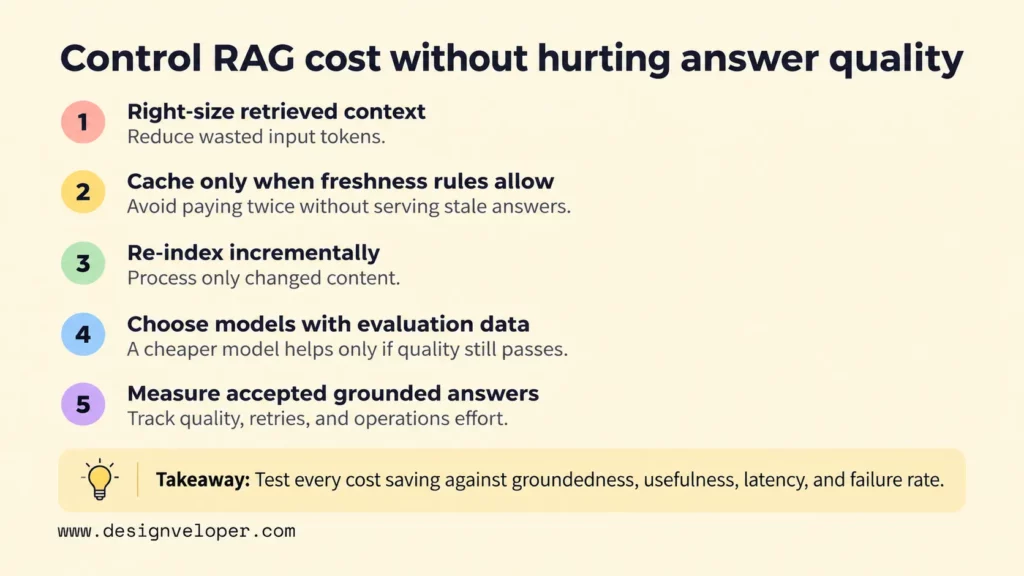
- Right-size retrieved context. Test how many document chunks the search should return (often called top-k) and how large each chunk should be. Send enough evidence to answer the test questions, but exclude irrelevant text that adds input-token cost.
- Cache only where freshness rules allow it. Repeated stable questions can avoid repeated generation, but cached answers need invalidation rules when source documents change.
- Re-index incrementally. Detect new or changed content instead of embedding the entire corpus on every refresh. Keep deletion and permission changes in the same process so stale content does not remain searchable.
- Select models with evaluation data. A lower-priced generation model is valuable only if it still meets the required answer-quality threshold. Route harder queries to a stronger model when a mixed strategy performs better than using the expensive model for every request.
- Measure accepted answers, not just requests. Track provider spend, operations effort, retry rate, and the share of answers that pass your groundedness and usefulness criteria.
Evaluation is the guardrail for these savings. Our RAG best-practices guide covers retrieval accuracy, groundedness, faithfulness, latency, and user trust as parts of an evaluation framework. For cost control, use the subset that matches your risk and define a pass rule before changing chunking, retrieval depth, reranking, or the generation model.
Scale only after the representative workload passes that quality test. Otherwise, higher traffic magnifies both the bill and the cost of bad answers. A small pilot with measured token counts, retrieval behavior, update volume, latency, and acceptance rate gives you better budgeting inputs than a generic RAG cost calculator default.
FAQs About RAG Cost
How Much Do 1,000 Tokens Cost In A RAG System?
There is no single cost for 1,000 RAG tokens because generation input, generation output, and embeddings are priced separately. At GPT-6 Luna’s Standard short-context rates checked October 14, 2026, 1,000 uncached input tokens cost $0.0001 and 1,000 billed output tokens cost $0.0005. At text-embedding-3-small’s rate, 1,000 embedding tokens cost $0.00002. The generation examples exclude caching discounts, long-context premiums, region-specific surcharges, and the rest of the RAG pipeline.
How Do Document Updates Change RAG Operating Costs?
Document updates add parsing, chunking, embedding, index writes, and validation work. If the pipeline supports incremental indexing, only new or changed content needs those steps. The monthly cost therefore depends on corpus churn, not just total corpus size. Permission changes and deletions also need to reach the index so old or unauthorized content is not retrieved.
When Does Self-Hosting A Model Lower RAG Costs?
Self-hosting can lower inference costs when a steady workload uses enough of the paid hardware to offset serving and maintenance effort. Low or bursty utilization makes that harder because idle GPU capacity still costs money. In DigitalOcean’s illustrative dedicated-inference analysis, an H100 was priced at $4.41 per GPU-hour as of August 25, 2026. The analysis compares cost per successful task at different utilization levels. That rate is provider-specific, not a general GPU price. Compare actual cost per accepted answer, including operations and reliability, before choosing dedicated inference.
Also published on

Share post on










Related Articles


AI Voice Agent Platforms: Best Options For Business In 2026
AI Voice Agent Platforms: Best Options For Business In 2026 Published October 15, 2026
Generative AI Vs. Discriminative AI: Key Differences and Use Cases
Generative AI Vs. Discriminative AI: Key Differences and Use Cases Published October 15, 2026
RAG Cost: What It Takes To Build And Run A RAG System
RAG Cost: What It Takes To Build And Run A RAG System Published October 15, 2026


















