
















Generative AI Vs. Discriminative AI: Key Differences and Use Cases

Generative AI models learn patterns in data to create new samples, while discriminative AI models learn how to map inputs to labels, scores, or predictions. The choice between generative AI vs discriminative AI depends on whether a workflow must generate content, make a bounded decision, or do both. Neither approach is always cheaper or more accurate; the result depends on the model and task.
What Is The Difference Between Generative And Discriminative AI?
Generative models try to represent how data itself is distributed, while discriminative models focus on the relationship needed to predict a target from an input. Google for Developers’ explanation of generative models describes how generative models capture p(x) when examples have no labels, or the joint distribution p(x,y) when labels are included. Discriminative models instead often learn p(y|x), the probability of a label given an input. Some discriminative methods learn a decision boundary directly.
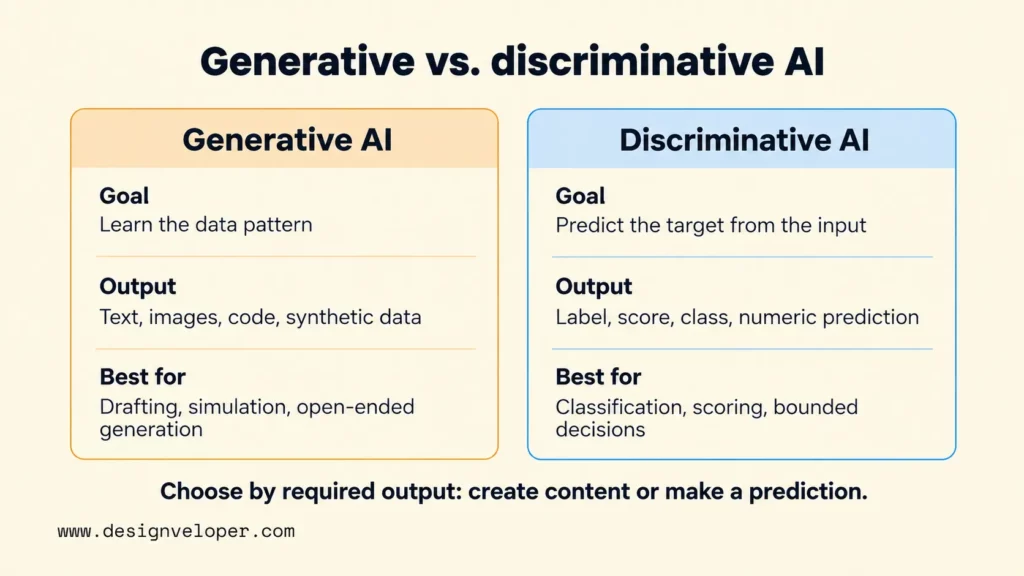
That notation becomes easier with one example. Suppose a system learns from cat and dog images. A generative model can learn patterns that make those images plausible and then produce a new animal image. A discriminative model can learn the boundary that separates cats from dogs and return a label or score for a new image. MIT’s machine learning notes use the same probability distinction when comparing generative classification with discriminative classification.
This is a model-level distinction. It is not simply a choice between creative AI and traditional AI. A generative model can still be used for classification, and a discriminative model can be part of a larger generative system. For more context on content generation, our guide to generative AI explains how those models support products and business workflows.
Generative Vs. Discriminative AI: Key Differences
The decisive difference is the learning objective. Generative approaches spend modeling capacity on the structure of the data or on a process that can produce samples. Discriminative approaches focus on the target relationship needed for a prediction. That difference changes the output, the evaluation method, and the kinds of errors a product team should watch.
| Aspect | Generative AI | Discriminative AI |
|---|---|---|
| Objective | Model or approximate a data-generating process and produce plausible new samples. | Predict a label, class, score, value, or decision from an input. |
| Learned relationship | Often models p(x), p(x,y), or an equivalent generative process. | Often models p(y|x) or learns a decision boundary directly. |
| Typical output | Text, images, audio, code, synthetic records, or other generated samples. | A class label, probability, risk score, ranking score, or numeric prediction. |
| Example models | Autoregressive language models, diffusion models, GANs, and VAEs. | Logistic regression, support vector machines, decision trees, and task-specific classifiers. |
| Suitable tasks | Drafting, simulation, synthetic data, image generation, conversational response, and open-ended transformation. | Spam detection, fraud scoring, image classification, risk prediction, screening, and other bounded decisions. |
| Evaluation focus | Task success, factual or semantic quality, faithfulness, diversity, human preference, and domain-specific quality measures. | Metrics tied to the prediction task, such as precision, recall, F1, calibration, ranking quality, or error on a numeric target. |
The table does not imply a fixed cost hierarchy. A small generative model can be cheaper than a large classifier, while a high-throughput discriminative system can still require substantial infrastructure. Data requirements also depend on the training setup. Some generative models learn from large unlabeled or self-supervised corpora, while many discriminative systems depend on labeled examples. Compare the actual data volume, serving load, response-time target, and quality threshold for your task.
Evaluation is another important split. A binary fraud classifier can be measured against known outcomes, but a generated summary may have several acceptable phrasings. That does not make generative output impossible to evaluate; it means the team must define criteria that match the job. For background on the wider field, our machine learning vs. AI comparison explains how learned models fit inside AI systems.
Examples Of Generative And Discriminative Models
Model names can be confusing because an architecture and an application are not the same thing. The safest way to classify an example is to ask what the model is trained to represent and what output it produces for the task.
Generative Models For Creating Or Simulating Data
GPT models are generative language models. They produce text by predicting the next token from the preceding context. ChatGPT is an AI assistant powered by generative AI models, not a single model architecture; GPT is a model family, while ChatGPT is a product. OpenAI documents this language-model lineage in its GPT-2 technical report and describes the assistant in its ChatGPT product FAQ. A generative language model can draft an email, suggest code, or write a structured response rather than return only a class label.
Diffusion models generate samples by learning how to reverse a process that adds noise to data. The 2020 Denoising Diffusion Probabilistic Models paper demonstrated image synthesis with this approach. In product terms, diffusion is a useful example when the desired output is a new image or another sample drawn from a learned distribution.
Generative adversarial networks, or GANs, use two components during training. The generator produces candidate samples, and the discriminator judges whether an example looks real or generated. Google describes this generator-discriminator structure in its GAN structure documentation. The final product may use the trained generator by itself even though a discriminative component helped train it.
Variational autoencoders, or VAEs, are latent-variable generative models. They learn a compact latent representation and a decoder that can produce samples from that space. The original Auto-Encoding Variational Bayes paper introduced the training approach that became central to VAEs. A common use is generating or reconstructing variations of data rather than assigning one fixed label.
Discriminative Models For Classification And Prediction
Logistic regression is a classic discriminative classifier. It estimates the probability of a label from input features and can then assign a class using a decision rule. In an email system, the features may represent properties of a message and the output may be a spam probability. In a finance workflow, the same model family could estimate the probability that a transaction belongs to a risk class.
Support vector machines, or SVMs, learn a separating boundary between classes. Decision trees split data through a series of feature-based rules until they reach a prediction. These models do not need to create a plausible new email, transaction, or image. Their job is to return the label or score that the workflow needs.
The business use case often matters more than the model name. A fraud system may use a discriminative model to score incoming transactions, then route only high-risk cases for review. Our guide to fraud detection with machine learning explains how defining the problem, preparing data, testing, and monitoring shape that kind of workflow.
Where Generative And Discriminative Models Work Together
Outside GAN training, product workflows can place the two model families in separate stages. One model can score an input before another generates a response. A separate model or rule can then check that response before anyone relies on it.
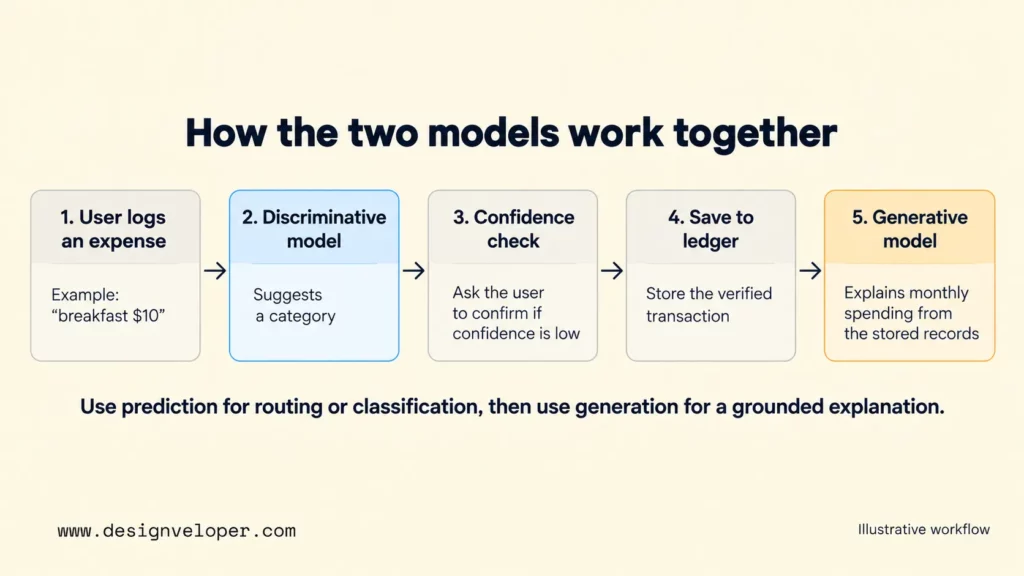
Consider our Song Nhi virtual financial assistant project. Its public page describes logging an expense such as “breakfast $10” through a conversation, then asking questions about spending. A hypothetical Song Nhi-style design could use a discriminative classifier to suggest a category for the expense. If confidence is low, the assistant would ask the user to confirm the category before saving it.
After the expense is stored, a generative model could explain dining spending for the month using the recorded transactions. The product should calculate totals from the ledger, show which records support them, and say when records are missing. It should not invent transactions to fill a gap. The classifier’s category accuracy and the generated summary’s faithfulness need separate tests; the complete workflow also needs a user check before any financial action.
This architecture is an illustrative design, not a documented description of Song Nhi’s implementation. Its value is the separation of responsibilities. Categorizing an expense is a bounded prediction, while explaining spending in natural language is a generation task grounded in verified records. The same division can help support, search, and document workflows, where classification or rules can route an input and check an answer.
How To Choose The Right Model For Your AI Workflow
For generative AI vs discriminative AI, start with the required output. If the workflow must create new text, code, images, summaries, or synthetic samples, evaluate a generative approach. If it must return a label, score, rank, or bounded prediction, start with a discriminative approach. If it needs both, split the workflow into stages and evaluate each stage separately.
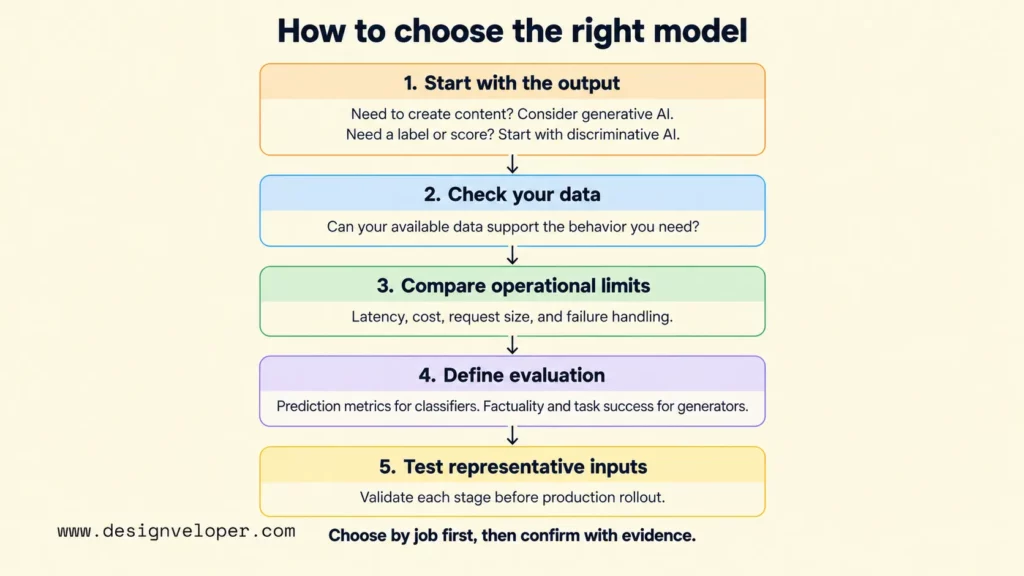
Next, inspect the data you can actually use. A discriminative classifier often needs representative labeled examples for the target decision. A generative system may use pretrained models, domain context, retrieval, fine-tuning, or a combination of these. The relevant question is not which family needs more data in the abstract. It is whether your available data can support the behavior you need and whether you can legally and safely use that data.
Then compare operational constraints. Measure latency at the expected request size and traffic level. Estimate compute or API cost from realistic inputs and outputs. Decide what happens when the model is uncertain or wrong. A low-latency classifier may be ideal for a high-volume routing step, while a slower generative model may be acceptable for an analyst-facing summary. The reverse can also be true for different architectures and deployment choices.
Choose evaluation metrics before production rollout. Classification tasks may need precision, recall, F1, calibration, or cost-sensitive error measures. Generative tasks may need factuality checks, task-completion criteria, human review, or domain-specific quality measures. If a workflow mixes the two model families, a strong average score can still hide a weak stage. Test the classifier and generator separately as well as end to end.
Finally, test representative inputs before committing to the architecture. Our guide to training an AI model recommends defining the task and success evidence before choosing a training path. Our AI integration guide covers goals, data readiness, and performance tracking. Use these checkpoints to validate the model choice inside the real product workflow, measure the failure cases that matter, and only then plan a production rollout.
Also published on

Share post on










Related Articles



AI Voice Agent Platforms: Best Options For Business In 2026
AI Voice Agent Platforms: Best Options For Business In 2026 Published October 15, 2026
Generative AI Vs. Discriminative AI: Key Differences and Use Cases
Generative AI Vs. Discriminative AI: Key Differences and Use Cases Published October 15, 2026
RAG Cost: What It Takes To Build And Run A RAG System
RAG Cost: What It Takes To Build And Run A RAG System Published October 15, 2026


















