













How To Create A Free App And Make Money: 8 Monetization Models

KEY TAKEWAYS:
- You can create an app for free with no-code tools, open-source frameworks, and free tiers, but publishing, testing, payments, analytics, support, and user acquisition still create real costs.
- Revenue depends less on downloads and more on retention, trust, audience fit, and monetization design across ads, subscriptions, in-app purchases, sponsorships, affiliate revenue, commissions, or data insights.
- Start with a narrow problem and a testable MVP before adding monetization. A free app should prove that users return, complete the core action, and accept the value exchange.
- The best monetization model depends on usage frequency, user intent, transaction value, privacy sensitivity, and operating cost, not on which model looks most profitable in isolation.
- Move beyond free tools when the app needs payments, roles, integrations, security, analytics, scalability, or custom UX that no-code builders cannot support reliably.
How to create an app for free and make money starts with a narrow app idea, a free or low-cost prototype path, real-user validation, and a revenue model that matches how users receive value. Free builders can help create an early version, but publishing, payments, integrations, storage, analytics, support, compliance, and scale often introduce costs.
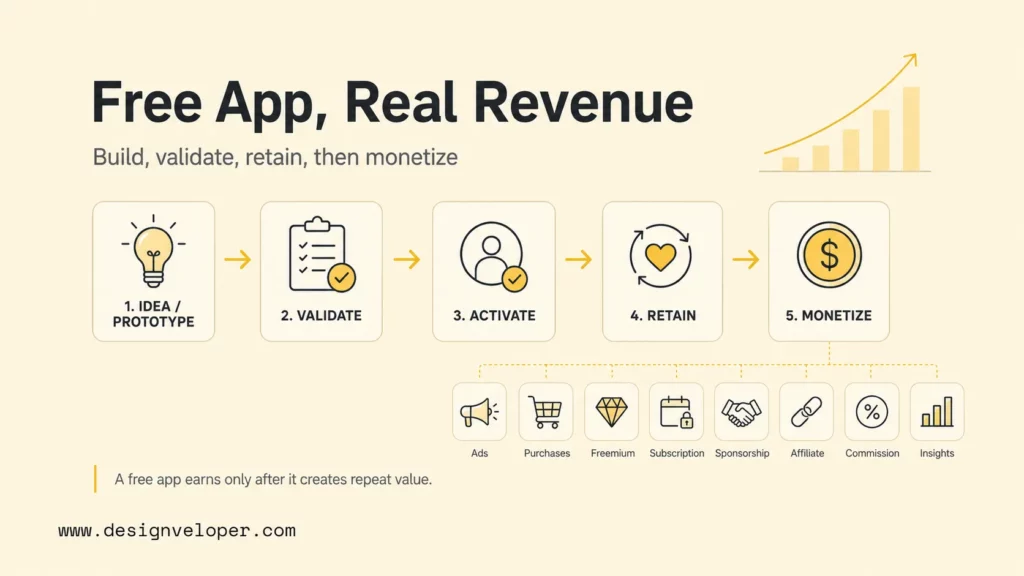
A free app does not earn money simply because it is downloaded. Revenue comes from repeated attention, useful digital goods, premium capability, recurring value, commercial partnerships, qualified referrals, completed transactions, or carefully governed aggregate insights. Retention and trust usually matter before monetization optimization.
Quick decision guide: Use ads when sessions and audience scale can support them without damaging the task. Use purchases for optional digital items, freemium for a clear upgrade path, subscriptions for ongoing value, commissions for transactions, and partnerships or referrals when recommendations naturally fit. Validate demand and retention before adding several revenue models.
| App behavior | Likely model | First proof to collect |
|---|---|---|
| Frequent content, entertainment, or utility sessions | Advertising, freemium, or subscription | Retention, session depth, ad tolerance, and premium intent |
| Optional items or one-time capability | In-app purchases | Item demand, purchase conversion, refund, and fairness |
| Ongoing service or evolving content | Subscription | Repeated value, renewal, churn, and support cost |
| Buyer and seller complete an exchange | Transaction fee or commission | Liquidity, completion, take rate, disputes, and payment cost |
| Trusted niche audience considers external offers | Sponsorship or affiliate referral | Relevance, disclosure, qualified action, and user trust |
Recommended for you:
- Mobile App Ideas: Practical Concepts For Startups And Businesses
- How To Build An App For Your Business: A Practical Guide
- How Much Does It Cost To Make An App?
Can You Create An App For Free And Make Money?
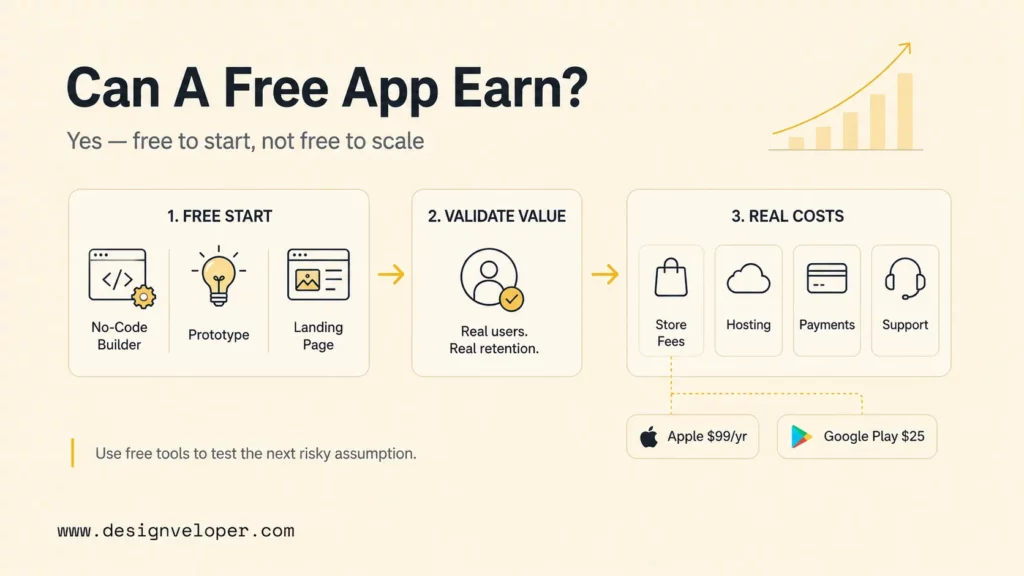
Yes, a person can prototype and validate an app at little or no software cost, then earn revenue if the app solves a real problem and retains users. “Free” normally describes the starting tool tier, not the complete product lifecycle. Domain, developer accounts, publishing, database, email, media, maps, AI models, payment processing, legal work, customer support, and marketing can all create expenses.
No-code builders, spreadsheets, forms, automation tools, website builders, and AI app builders work well for prototypes, internal workflows, directories, simple databases, landing pages, and controlled MVPs. Limits often appear around custom logic, background jobs, offline use, performance, permissions, native-device features, complex payments, integrations, export, source ownership, and vendor quotas.
Store distribution also has direct requirements. Apple lists the Apple Developer Program at $99 per membership year or local currency, while Google Play currently lists a $25 one-time Play Console registration fee. Fees, store policies, testing requirements, service charges, and regional rules can change, so verify them during release planning.
The realistic goal is not “zero cost forever.” The goal is to spend as little as necessary to test the next risky assumption. A landing page can test audience interest; a clickable prototype can test the flow; a no-code MVP can test repeated use; custom development becomes sensible when traction or requirements exceed the temporary platform.
How To Create A Free App Before Monetizing It
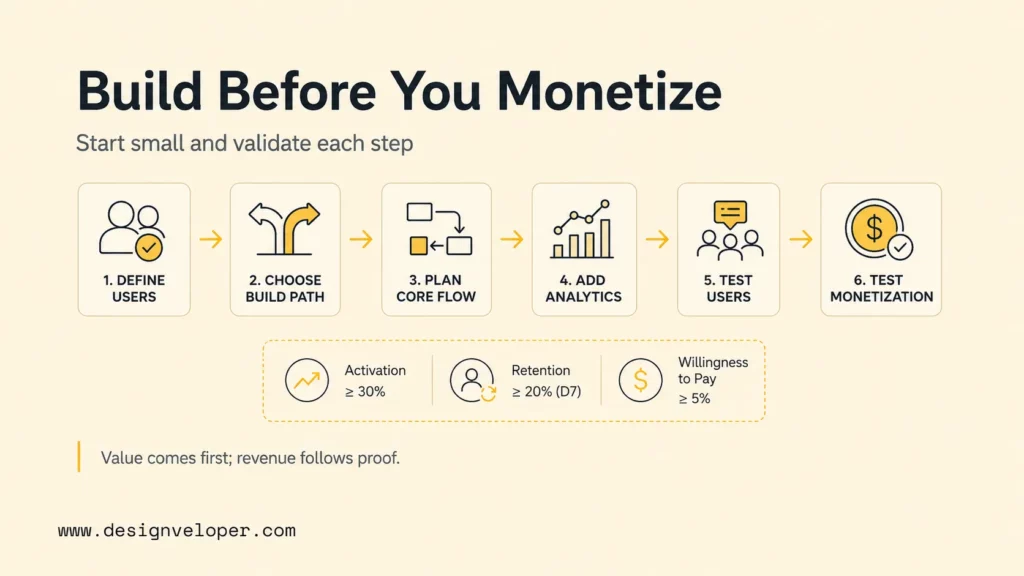
Create the smallest useful app around one target user and one measurable outcome. Monetization should be considered during product design, but revenue features should not dominate before users receive value.
- Define the idea and target users. Describe the problem, current alternative, trigger, desired outcome, and why the app is better enough to try. Interview real users about recent behavior.
- Choose a build path. Use a landing page, clickable prototype, no-code database, low-code workflow, AI builder, or custom MVP according to the hardest assumption. Check export, data ownership, vendor limits, and upgrade paths.
- Plan the core flow. Map discovery, onboarding, first value, repeat use, account or privacy choices, support, and exit. Include failure states and accessibility.
- Instrument analytics before launch. Track acquisition source, activation, core value event, repeat use, retention, errors, support, and cost. Collect only necessary data and obtain required consent.
- Test with representative users. Watch people use the app in a realistic context. Measure behavior and outcomes, then decide whether to iterate, pivot, scale, or stop.
- Test one monetization hypothesis. Show a price, sponsorship concept, purchase, or fee at the point of value. Measure conversion and any damage to retention or trust.
Set a validation threshold before building. For example: at least 40% of invited target users complete the core task, 25% return within two weeks, and ten agree to a stated premium price. The specific numbers must fit the app and cohort; their purpose is to force a decision, not to imitate an industry benchmark.
The value-to-revenue loop below shows why monetization cannot be isolated from product quality.
Reader asset: weak activation or retention cannot be permanently repaired by inserting more ads or a stricter paywall.
A free app earns sustainable revenue only after it creates repeat value strong enough to support a fair exchange.
Further reading:
- How To Develop A Low Code MVP: A Step-By-Step Guide
- POC Vs MVP Vs Prototype: Key Differences And When To Use Each
- Custom Mobile App Development Process: Steps, Cost, And Best Practices
8 Free App Monetization Models That Generate Revenue
Related reading:
- Mobile App Development Tools: Best Options For Building Apps
- Small Business Applications: Practical Software Ideas And Use Cases
- Software Development Costs: Key Factors, Ranges, And Planning Tips
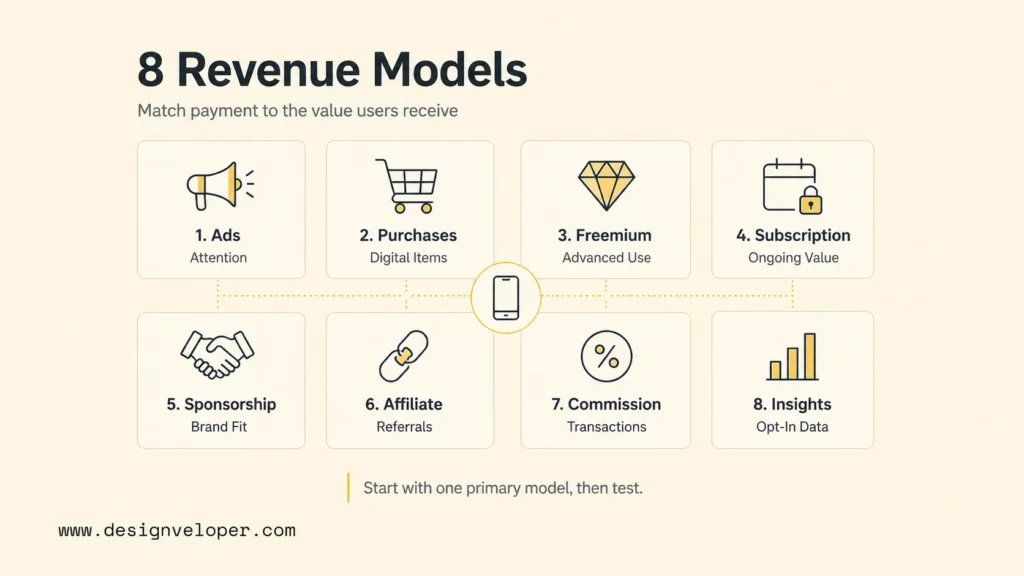
The eight models below can work individually or in carefully chosen combinations. Each changes product design, analytics, policy, support, and unit economics, so begin with the model closest to the app’s value mechanism.
1. In-App Advertising For Free Mobile Apps
Advertising monetizes user attention through banner, native, interstitial, rewarded, video, or app-open formats. Revenue depends on eligible impressions, geography, format, advertiser demand, engagement, fill, and policy-compliant traffic. High-frequency entertainment, content, casual game, and utility apps are usually better fits than infrequent sensitive tasks.
Ads should appear at natural pauses and never disguise themselves as navigation or block urgent actions. Test ad load against retention, task completion, session quality, complaints, and accidental clicks. Google AdMob warns that invalid activity can remove earnings or suspend accounts, and its Policy Center guidance explains how violations, regulatory issues, and unintended-click treatments can restrict serving.
2. In-App Purchases For Digital Goods And Premium Features
In-app purchases sell optional digital goods, credits, content, themes, tools, levels, or permanent feature unlocks. The model fits games, creative tools, education, and utilities where users can understand a discrete item and retain value after purchase. Design the free experience so it remains useful without making paid items misleading or coercive.
Model price, store fees, tax, refunds, fraud, restore-purchase behavior, family or device access, virtual currency, and customer support. Apple’s current App Review Guidelines require in-app purchase for many digital feature unlocks and require app metadata to indicate when featured items need additional payment. Google Play also requires its billing system for many in-app digital goods and features, subject to regional programs and exceptions.
3. Freemium App Monetization With Paid Upgrades
Freemium provides durable free value and charges for advanced capability, higher limits, professional use, convenience, collaboration, export, or removal of ads. It works when users can experience the core outcome before paying and a meaningful segment grows into a premium need.
Define the upgrade boundary through user value, not arbitrary frustration. Measure free activation, free retention, paywall views, upgrade conversion, time to upgrade, downgrade, support, and cost to serve free users. A generous free tier can accelerate distribution but become expensive; a restrictive tier can prevent users from discovering value.
4. Subscription Model For Recurring App Revenue
Subscriptions exchange recurring payment for recurring value such as evolving content, coaching, productivity, cloud storage, collaboration, data services, or ongoing feature access. The model can improve revenue predictability, but it creates obligations around renewal, entitlement, failed payment, cancellation, restoration, support, and continuous value.
Offer a clear plan, billing period, renewal terms, trial, price, and cancellation path. Google Play’s subscription policy requires transparent terms and sustained or recurring value rather than a one-time benefit disguised as a subscription. Track trial conversion, renewal, voluntary and involuntary churn, refund, lifetime value, and support cost.
5. Sponsorships And Brand Partnerships In Mobile Apps
Sponsorships provide payment for association with a relevant audience, feature, event, content series, reward, or community. A fitness app might host a clearly labeled challenge with an appropriate brand; an education app might sponsor a learning collection. The partnership must fit the user’s reason for opening the app.
Define placement, duration, exclusivity, creative control, data access, disclosure, measurement, brand safety, termination, and user complaints. Do not let a sponsor influence rankings or recommendations without disclosure. Protect user data: audience value can be demonstrated through aggregated metrics without sharing identifiable behavior.
6. Affiliate Marketing And Referral Fees From App Users
Affiliate monetization earns a fee when a user takes a qualifying action with an external provider, such as purchasing, booking, applying, or subscribing. The model works when the app already helps users discover or compare relevant products and services. Referral value should improve the decision rather than turn every screen into a promotion.
Disclose commercial relationships clearly, verify offer accuracy, avoid manipulative ranking, and measure qualified actions, approval, returns, reversals, and complaints. Build link and partner monitoring because offers, terms, eligibility, and destination quality change. Do not claim independence if payment affects inclusion or ordering.
7. Transaction Fees And Marketplace Commissions
A marketplace takes a fixed fee, percentage, spread, or service charge when buyers and sellers complete a transaction. The model aligns revenue with completed value and works for bookings, services, commerce, delivery, ticketing, creator products, and other exchanges.
The product must support discovery, trust, availability, checkout, payment, identity, communication, cancellation, refund, dispute, payout, reconciliation, tax, fraud, and support. Calculate contribution after processor fees, incentives, chargebacks, service operations, and seller acquisition. A high take rate can push transactions off-platform unless the app provides sufficient convenience, protection, demand, or workflow value.
8. Privacy-Safe Data Insights And Market Research
An app can sell or use aggregated insights when users understand the data practice, the processing is lawful, and outputs cannot reasonably expose an individual. Examples include broad demand trends, benchmark reports, or opt-in research panels. Selling personal data or quietly expanding data use is not a responsible monetization shortcut.
Apply purpose limitation, minimization, consent or another valid basis, access controls, aggregation thresholds, de-identification risk review, retention limits, vendor controls, and user rights. Apple’s guidelines require third parties receiving app data, including analytics and ad networks, to provide protections consistent with the app’s privacy commitments. Privacy-safe insights need governance and legal review, not only removal of names.
How Much Money Can A Free App Make?
A free app can make nothing, modest side income, or a large business. Downloads alone do not determine revenue. Audience geography, activation, retention, session frequency, purchase conversion, pricing, renewal, transaction volume, take rate, advertiser demand, acquisition cost, store fees, infrastructure, refunds, fraud, and support determine the result.
| Revenue Model | Main Revenue Driver | Best-Fit App Type |
|---|---|---|
| Advertising | Eligible impressions x effective revenue per thousand impressions | High-engagement content, games, utilities, or community |
| In-app purchases | Active users x purchase conversion x average purchase value | Games, creative tools, education, or utilities |
| Freemium | Active free users x upgrade conversion x net premium revenue | Productivity, storage, collaboration, and professional tools |
| Subscription | Paying subscribers x net recurring price x retention | Ongoing content, service, SaaS, coaching, or data |
| Sponsorship | Contract value based on audience, placement, and campaign outcome | Niche media, community, education, fitness, or events |
| Affiliate referral | Qualified actions x approved commission | Discovery, comparison, travel, shopping, or finance content |
| Transaction fee | Completed gross transaction value x take rate | Marketplace, booking, commerce, delivery, or creator platforms |
| Aggregate insights | Research contracts, subscriptions, or reports | Opt-in panels or apps with lawful, valuable aggregate patterns |
Build a unit-economics model. For subscriptions: monthly active users x paid conversion x net price, minus store or payment fees, refunds, variable infrastructure, support, and acquisition. For a marketplace: transaction volume x take rate, minus payment processing, incentives, refunds, disputes, and operations. Use conservative, base, and optimistic scenarios.
Avoid universal “revenue per download” estimates. One download may never open, while a retained business user can pay for years. Cohort metrics are more useful: activation, day- or week-based retention, payer conversion, average revenue per active user, renewal, lifetime contribution, and acquisition payback.
How To Choose The Right App Monetization Model
Choose the model that matches user value, engagement, willingness to pay, privacy expectations, and distribution rules. The map below routes common product behavior to a sensible first test.
Reader asset: monetize the behavior that signals value; do not force a model because it is common in another app category.
Score each candidate model on value alignment, audience scale, engagement frequency, conversion potential, retention impact, privacy, platform policy, operational effort, gross margin, predictability, and reversibility. Test a lightweight version: a price screen before building premium features, a sponsor concept with users, or a commission model in a concierge marketplace.
Hybrid monetization can work when models serve different segments without creating confusion. A free app may include light ads and an ad-free purchase; a freemium product may offer subscriptions plus optional transaction fees. Avoid combining every model. Each extra model adds states, analytics, policy, support, and user-experience complexity.
Run pricing experiments with complete context. Show the exact benefit, price, billing period, renewal or one-time nature, eligibility, and cancellation path to the intended cohort. Compare behavior before and after the offer, including activation, retention, support, refunds, and reviews. A higher conversion rate can still be a poor result if the paywall reduces long-term use or attracts customers whose support cost exceeds their contribution.
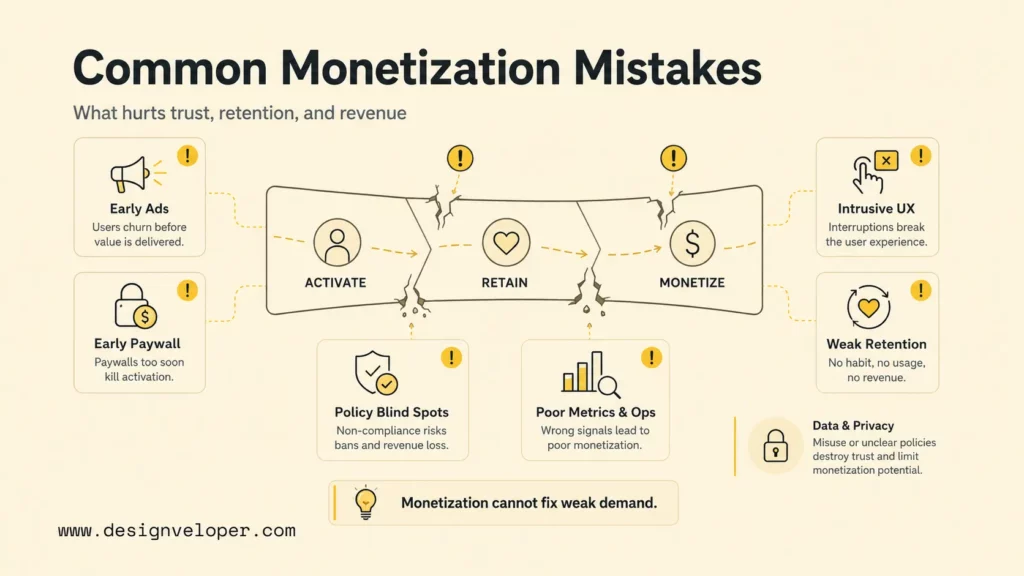
Common Mistakes When Building A Free App To Make Money
- Adding ads before users see value: Early interruptions can prevent activation and make retention data look worse than the product opportunity.
- Choosing monetization before validating demand: A perfect paywall cannot create a reason to return.
- Blocking core value too early: Users need enough experience to understand the paid promise. Paywall the advanced or recurring benefit, not the explanation.
- Ignoring retention and onboarding: Revenue optimization on a leaking user base produces short-term wins and weak lifetime value.
- Using intrusive ads: Accidental clicks, deceptive placement, or ads in sensitive moments harm trust and can violate network policies.
- Tracking revenue without product analytics: Revenue totals do not explain which cohort, feature, channel, or behavior produced durable value.
- Ignoring store and payment rules: Digital goods, subscriptions, external links, alternative billing, and service fees vary by store, category, region, and date.
- Underestimating operations: Refunds, chargebacks, payout, tax, fraud, disputes, moderation, privacy requests, and customer support consume margin.
- Treating user data as a product: Unexpected sharing can damage users, trigger enforcement, and destroy the trust required for every other model.
- Scaling on vanity metrics: Downloads, registrations, and ad impressions matter only when connected to active use, revenue quality, and cost.
Monetization should amplify a healthy product loop; it should not hide weak demand, poor onboarding, or fading retention.
Preparing A Free App Idea For Monetization And Scale
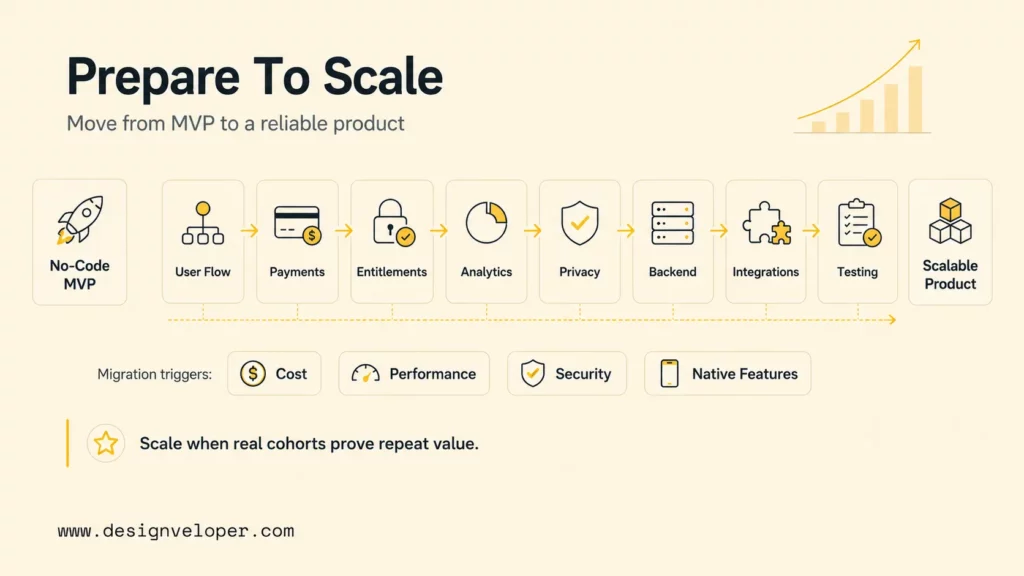
Prepare for scale when real cohorts show repeat value and the monetization test supports positive unit economics. The next architecture should follow measured bottlenecks, policy obligations, and product direction rather than rewriting everything because the first version used no-code.
Document users, core flows, data, integrations, entitlements, purchases, subscriptions, analytics, privacy, support, and export. Move critical commercial logic out of fragile UI rules. Verify purchases on the server, process store or payment notifications idempotently, maintain an entitlement ledger, support restore and refund states, reconcile revenue, and keep catalog configuration separate from code.
Define the signals for moving from no-code to custom development: unacceptable platform cost, missing functionality, poor performance, complex permissions, sensitive data, background processing, native-device needs, difficult integrations, source-control limitations, unreliable testing, or vendor lock-in that blocks the roadmap. Migration can be incremental, beginning with the backend or highest-risk workflow.
At Designveloper, we can help teams move from a free app idea or no-code MVP into a monetizable product. Our app and software development services can connect the core user flow, UX/UI, analytics, payment model, privacy controls, scalable backend, integrations, AI features, testing, deployment, and a custom-feature roadmap when traction grows.
We recommend a monetization-readiness review before a large build. The outputs should include a target cohort, value event, retention evidence, primary revenue model, unit-economics scenarios, platform-policy check, entitlement model, data and privacy map, analytics plan, architecture limits, and phased investment decision.
Explore more:
- Ecommerce Business: Models, Benefits, And How To Start
- B2C Ecommerce Model: Definition, Examples, And How It Works
- Healthcare App Ideas For Startup: Practical Concepts And Opportunities
FAQs About Creating A Free App And Making Money
Can I Create An App For Free Without Coding?
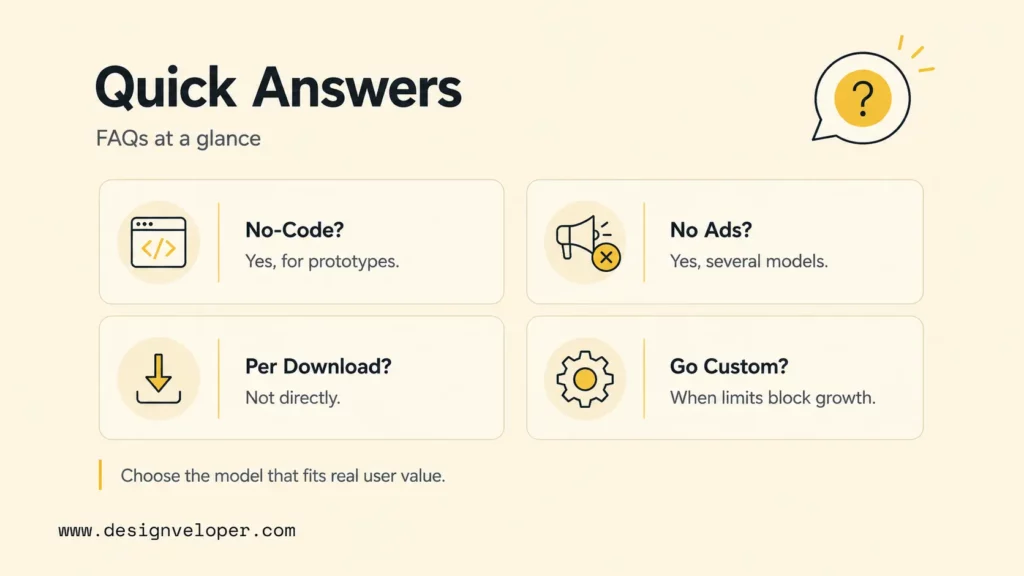
Yes. Free-tier no-code, low-code, website, database, automation, and AI app builders can create prototypes and simple MVPs. Check feature limits, export, data ownership, branding, integrations, privacy, and usage charges. Store accounts, publishing, infrastructure, payment, email, AI, and support may still cost money.
Can Free Apps Make Money Without Ads?
Yes. In-app purchases, freemium upgrades, subscriptions, sponsorships, affiliate referrals, transaction fees, and privacy-safe research can earn revenue without display ads. The best option depends on what users value, how often they return, whether they will pay, and which commercial relationships fit their expectations.
Do Free Apps Make Money Per Download?
Usually not directly. A free download produces revenue only when the user later views eligible ads, buys an item, upgrades, subscribes, follows a compensated referral, completes a transaction, or contributes to another lawful model. Track revenue per active or retained user rather than assuming every installation has the same value.
What Is The Best Monetization Model For A Free App?
The best model aligns payment with the app’s recurring value and user expectations. Subscriptions fit ongoing outcomes, purchases fit optional digital items, freemium fits growing power users, commissions fit completed exchanges, and ads fit frequent attention at scale. Test one model against conversion, retention, trust, policy, and contribution margin.
When Should A Free App Move From No-Code To Custom Development?
Move when validated demand exists and platform limits block reliability, differentiation, integration, security, cost, permissions, performance, testing, native capability, or product ownership. Do not rewrite only for prestige. Create a staged migration with data export, acceptance tests, parallel validation, rollback, and a clear economic reason.
Also published on

Share post on










Related Articles


iOS & Android App Development Is More Than Building The Same App Twice
iOS & Android App Development Is More Than Building The Same App Twice Published August 19, 2026
How To Build An Android App: From MVP To Google Play
How To Build An Android App: From MVP To Google Play Published August 19, 2026
Financial App Development: Features, Security, And Cost
Financial App Development: Features, Security, And Cost Published August 13, 2026