















Financial App Development: Features, Security, And Cost

Financial application development means building software that handles money-related tasks safely, clearly, and reliably. The work is not only about screens and features. Teams also need to plan sensitive data flows, financial APIs, security controls, compliance needs, testing, and long-term monitoring.
This guide explains the main app types, must-have features, development process, security choices, integrations, cost drivers, and real product examples. It also shows where AI can add value without weakening trust or control.
What Is Financial App Development?
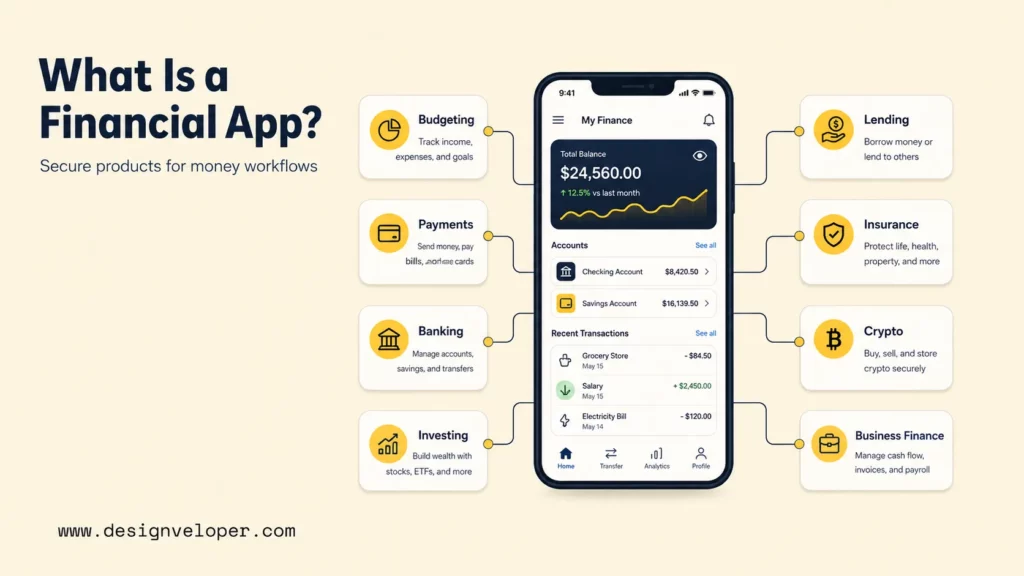
Financial app development is the process of building digital products for budgeting, payments, banking, investing, lending, insurance, crypto, or business finance. The product may be a mobile app, web app, or both.
The main difference from ordinary app development is the risk around money and sensitive data. A broken social feature may annoy a user. A failed payment, exposed balance, or incorrect transaction record can damage trust immediately.
Teams therefore need to define the app type before choosing features or technology. That decision affects identity checks, account linking, payment flows, security, regulatory review, and cost. The rest of the build should follow from that scope.
Common Types Of Financial Apps
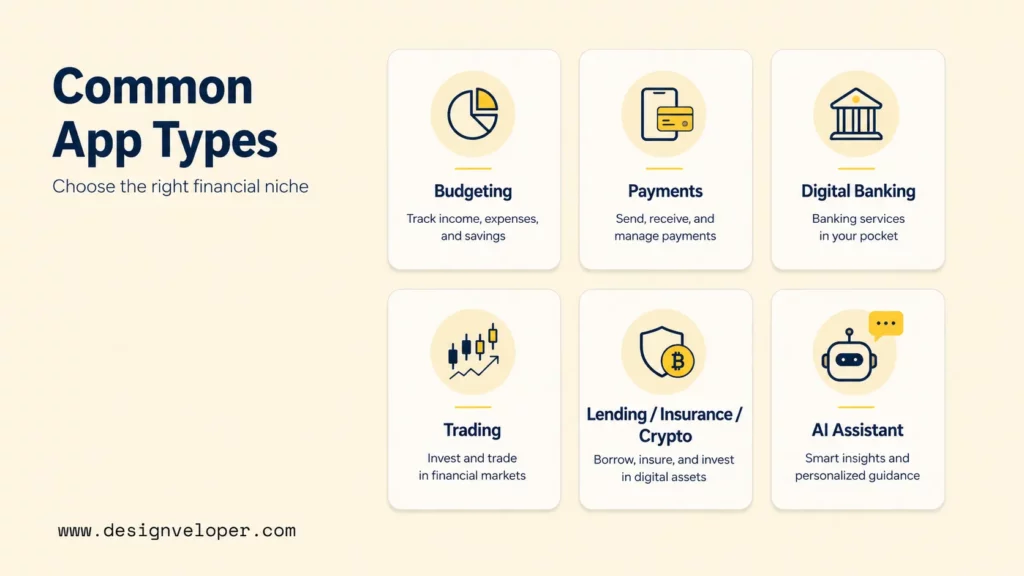
The right product type determines what data the app handles and which risks matter most. These are the most common starting points for a fintech app development project.
- Personal finance and budgeting apps. These apps track income, expenses, goals, and spending patterns. They may use bank sync, manual entries, or both.
- Payment and transfer apps. These products move money between people, merchants, cards, or bank accounts. Payment reliability and fraud controls become central requirements.
- Digital banking apps. These apps may combine account balances, cards, transfers, statements, support, and identity verification. The product usually depends on regulated banking infrastructure.
- Investment and trading apps. These products show portfolios, prices, orders, performance, and disclosures. Data accuracy and clear risk communication matter as much as interface speed.
- Lending, insurance, or crypto apps. Each category has distinct identity, transaction, custody, underwriting, or claims risks. Teams should map those obligations before development.
- AI-powered financial assistants. AI can classify transactions, answer questions, summarize spending, or support forecasting. Higher-impact uses need stronger evaluation and human oversight.
A budgeting tool and a lending app can look similar on a phone, yet their backend and compliance burden may differ sharply. Choose the niche first, then design the build around its real financial risk.
Must-Have Financial App Features
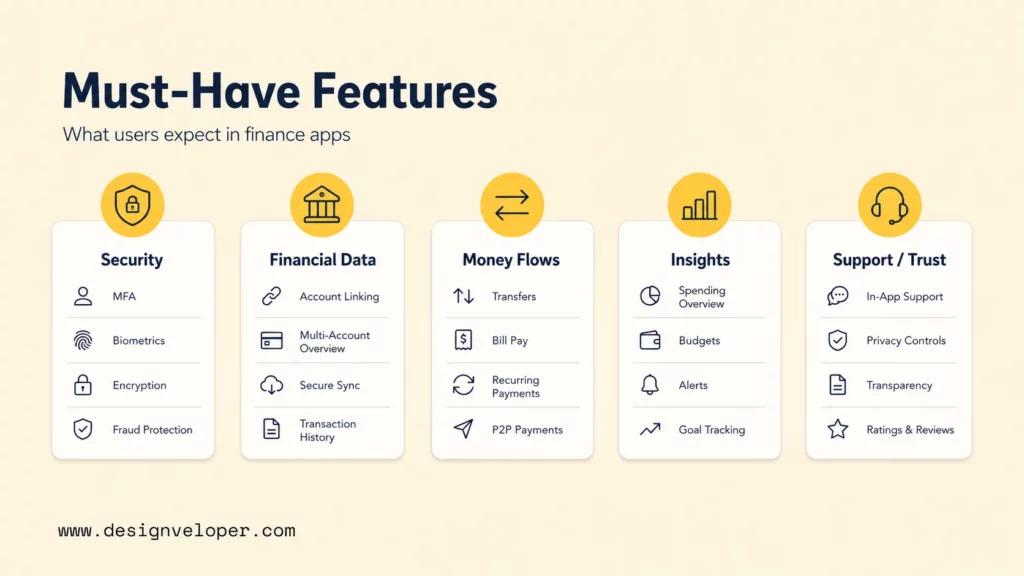
Useful financial app features should protect trust, preserve accurate records, or help users act on their money. A long feature list is less valuable than a small set that supports the core financial job.
- Security: secure login, multi-factor authentication, biometrics, session controls, device checks, and safe account recovery. These controls reduce the chance that one stolen password exposes financial data.
- Financial data: account linking, transaction tracking, categorization, balances, and reports. Each screen should make the source and status of the data clear.
- Money workflows: payments, transfers, bill reminders, receipts, and payment history. The user should always know whether a transaction is pending, completed, reversed, or failed.
- User value: budgets, saving goals, insights, alerts, and useful explanations. These features should help users make a decision, not just create more charts.
- Operations: an admin dashboard, support tools, notifications, and issue review. Operations staff need a safe way to investigate problems without receiving unnecessary access.
- Trust layer: consent settings, privacy controls, audit logs, and clear compliance messages. Users should understand what data is collected and why.
Account linking is a good example of a feature that affects both convenience and risk. Plaid Link documentation describes Link as the user-facing component for connecting financial accounts to Plaid. Its flow also shapes consent, error handling, and institution coverage.
A financial feature earns its place when it makes money safer to manage, easier to understand, or harder to misuse.
Financial App Development Process
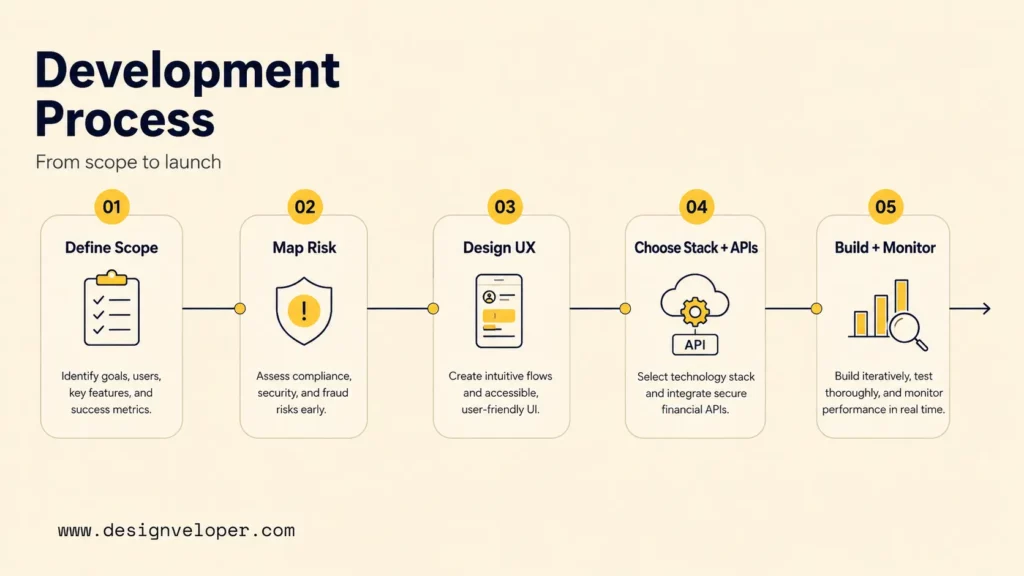
A strong finance app development process moves from scope to risk, then design, technology, and controlled release. Skipping that order often creates rework because security or integration limits appear after the interface is already designed.
Define user, niche, and MVP.
Map data, compliance, and fraud exposure.
Design clear money and consent flows.
Choose stack and integrations.
Test, launch, monitor, and patch.
The workflow keeps product decisions ahead of implementation decisions. Each step should produce something the next step can test or use.
Step 1. Define The Niche, Users, And MVP Scope
Start with one financial problem and one main user group. A first release might focus on budgeting, payments, investment tracking, crypto, lending, or an AI finance assistant.
Keep the MVP narrow enough to test the product idea. Payments, account aggregation, compliance work, analytics, and AI can each add new backend and testing requirements. Adding all of them at once makes the first release harder to validate.
Step 2. Map Security, Compliance, And Data Requirements
List every sensitive data type the product will receive, store, generate, or share. Then identify who can access it and why. The map should include users, administrators, support staff, vendors, and automated services.
Card workflows may bring PCI DSS v4.0.1 into scope. EU personal data may trigger GDPR requirements. KYC or AML duties may also apply to regulated financial activities, depending on the product and jurisdiction. The FATF Recommendations provide the global policy framework for anti-money-laundering controls.
This stage should also define consent, retention, encryption, audit logs, fraud signals, incident response, and deletion rules. Legal and compliance specialists should confirm which obligations actually apply.
Step 3. Design Trust-Focused UX And Financial Data Flows
Financial UX should reduce uncertainty. Users need to know what will happen before they connect an account, move money, or accept an AI suggestion.
Design onboarding, consent screens, balance views, transaction categories, charts, reports, empty states, and error states together. Use plain labels for financial status. A pending payment should not look completed, and an estimated balance should not look final.
Prototype the risky flows before polishing the rest. Test account recovery, failed transfers, stale account data, duplicate transactions, disputed charges, and permission changes. Those moments often determine whether a user trusts the product.
Step 4. Choose The Tech Stack And Financial APIs
Choose technology around product needs, team skill, and integration support. React Native and Flutter are current cross-platform options for mobile development. Backend choices can include Node.js or Django, with PostgreSQL or MongoDB where they fit the data model.
Financial APIs require the same scrutiny as the app code. Plaid and Yodlee account aggregation support financial account connections. Stripe in-app payments and PayPal Checkout support payment flows.
Do not choose an API only because its demo works. Check country coverage, supported institutions, consent flow, authentication, webhooks, error states, pricing, support, data retention, and failure behavior. An integration becomes part of the product’s reliability.
Step 5. Build, Test, Launch, And Monitor
Build secure backend rules before relying on the interface to prevent bad actions. The server should validate permissions, transaction state, limits, account ownership, and external API responses.
Testing should cover normal flows and failure conditions. Include API outages, delayed webhooks, duplicate requests, expired sessions, incorrect permissions, and interrupted payments. Penetration testing should be added when the risk level justifies it.
Launch is the start of operations, not the end of development. Monitor crashes, fraud signals, failed integrations, suspicious access, support cases, and third-party API changes. Patch security issues and review access as the product grows.
Security, Compliance, And Financial API Integrations
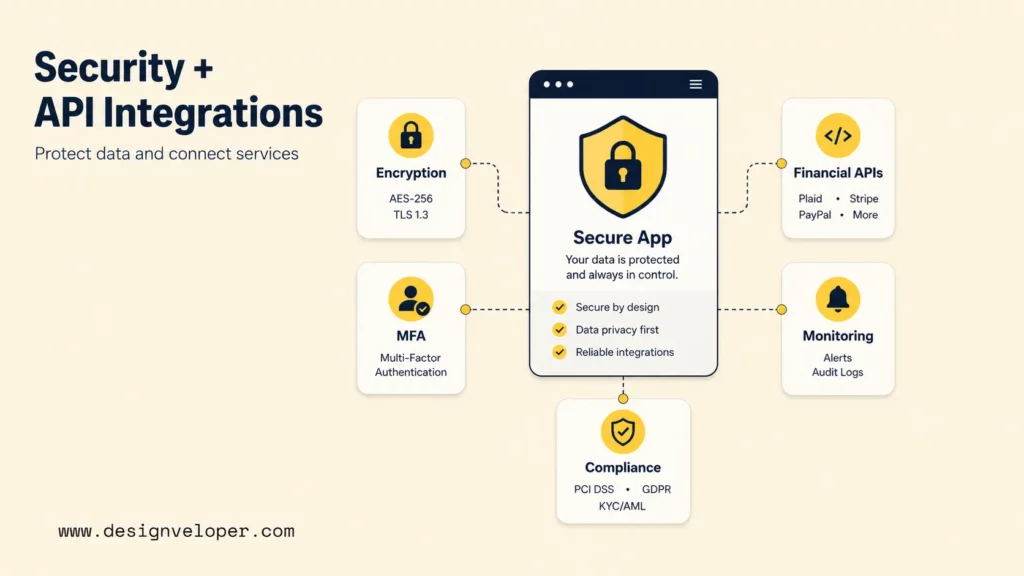
For fintech app security, the full data path matters. A secure login cannot compensate for exposed API secrets, unsafe storage, weak permissions, or an unreliable payment integration.
Balances, permissions, transaction state, limits, and reconciliation.
Encryption, key handling, secure storage, retention, and audit trails.
MFA, biometrics, recovery, device checks, and session expiry.
Bank links, payment APIs, webhooks, consent, outages, and retries.
Fraud alerts, logging, incident response, access reviews, and patches.
The stack shows why teams should not treat security as one feature. A failure in any layer can create a financial or privacy incident.
For data at rest, AES is a common cryptographic building block. NIST FIPS 197 defines AES-128, AES-192, and AES-256. Encryption still needs sound key management, access controls, and secure implementation.
For data in transit, use secure transport and validated API communication. Plaid states that its API is served over HTTPS with TLS 1.2. Payment SDKs should also keep sensitive secrets away from client-side code.
Authentication should use more than a password when risk is high. MFA, biometrics, passkeys, device checks, and session controls can reduce account takeover risk. The OWASP Mobile Top 10 2024 includes credential misuse, insecure authentication, insecure communication, privacy problems, insecure storage, and weak cryptography among major mobile risks.
Compliance scope depends on the market, product, and data handled. PCI DSS applies to environments that store, process, or transmit cardholder data. Privacy rules can add consent, access, deletion, and accountability duties. KYC and AML controls may be required for regulated services that identify customers or move funds.
Integrations deserve ongoing monitoring. An institution connection can degrade, a payment can require extra authentication, or a webhook can arrive late. The app should show a clear state instead of guessing what happened.
Security is not a login screen. It is the behavior of every data flow before, during, and after a financial action.
Financial App Development Cost And Timeline
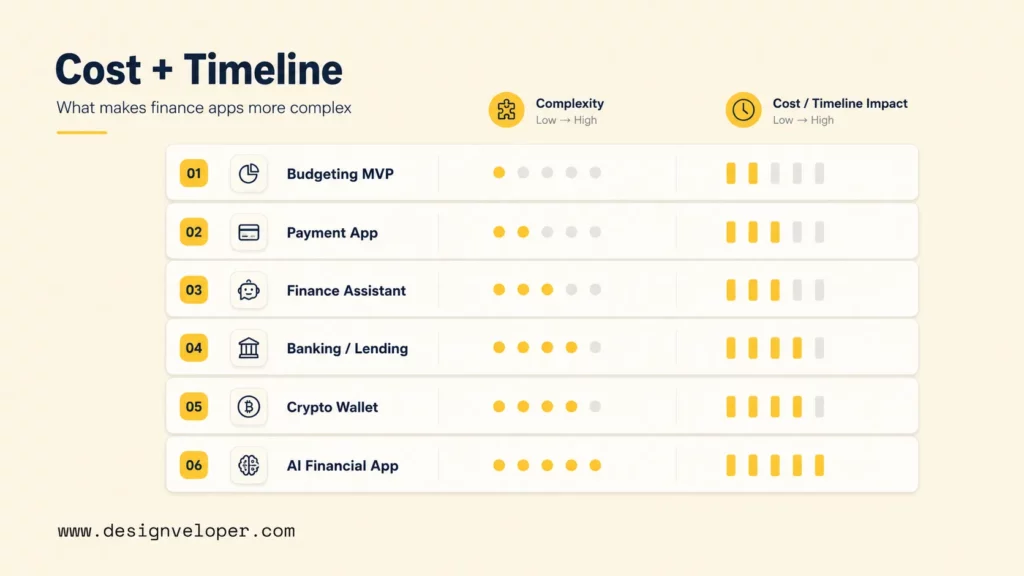
There is no reliable universal price or build time for a financial app. The largest cost drivers are feature scope, security depth, compliance review, financial APIs, AI features, platform choice, backend complexity, QA, and maintenance.
The useful question is not “What does an app cost?” but “Which parts make this app expensive or slow?” The table below helps teams classify those drivers before asking vendors for estimates.
| App Type | Typical Complexity | Cost/Timeline Impact |
|---|---|---|
| Budgeting MVP | Low to medium | Lower when users enter data manually. Bank sync, automation, and advanced reports add integration and QA work. |
| Payment app | Medium to high | Payment states, fraud controls, PCI scope, webhooks, dispute flows, and provider testing increase effort. |
| Personal finance assistant | Medium | Cost rises with account aggregation, transaction categorization, conversational AI, and personalized insights. |
| Banking/lending app | High | Identity, regulated workflows, credit logic, auditability, security review, and complex integrations extend delivery. |
| Crypto wallet | High | Wallet security, transaction signing, chain integrations, monitoring, recovery, and custody choices add technical risk. |
| AI-powered financial app | Medium to high | Model integration, evaluation, privacy, guardrails, monitoring, and human review add work beyond normal app features. |
A focused MVP should be planned as a multi-month software project until a detailed delivery plan proves otherwise. A payment, lending, or banking product needs more time when identity checks, compliance review, and external integrations expand the scope.
For estimating, separate the product into modules. Price the core user flow first, then account linking, payments, admin tools, AI, analytics, and compliance work. Also budget for post-launch monitoring and third-party changes.
Real products show how these cost drivers appear in practice.
Real Financial App Examples And DSV Project Angles
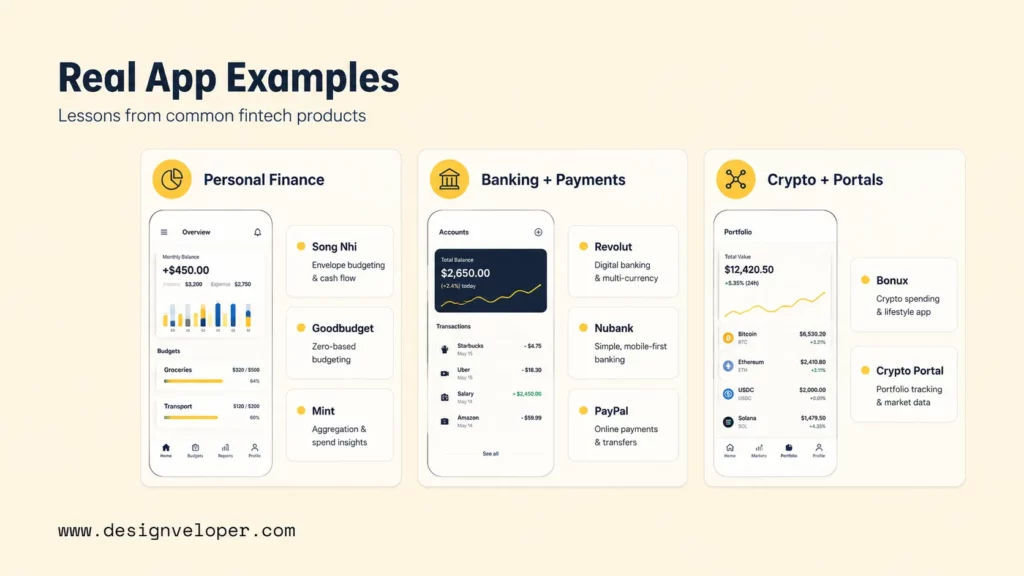
How useful real products are will depend a lot on how they show one financial decision shapes the rest of the experience. The examples below focus on product lessons rather than feature counts.
Personal Finance And Budgeting Apps
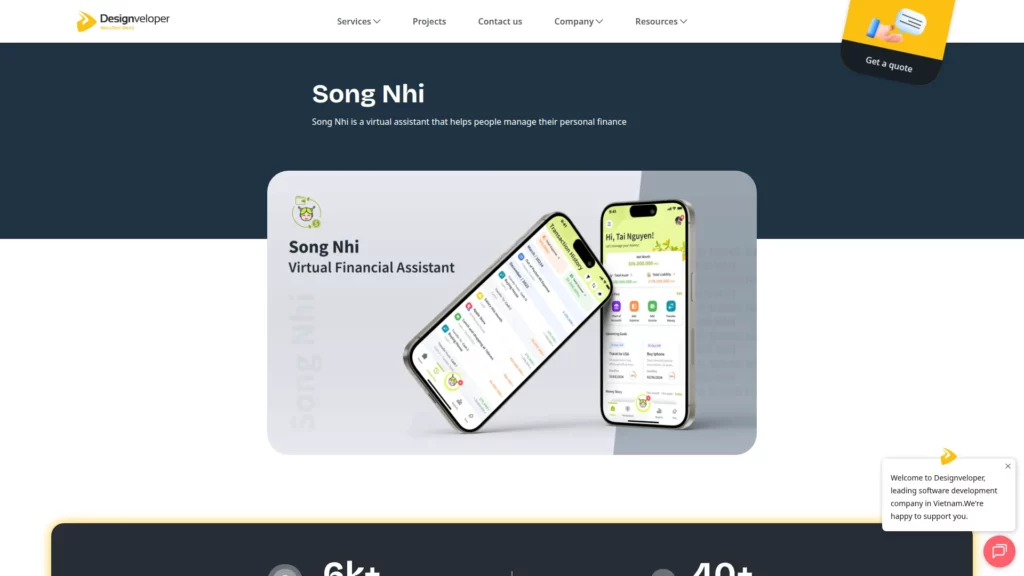
A personal finance app needs to make repeated money tracking easier, not create another chore. Goodbudget uses the envelope budgeting method across web, Android, and iPhone. Its bank-sync flow imports transactions so users can categorize and confirm them.
Our Song Nhi project focused on a specific friction: traditional tools such as spreadsheets can make personal finance tracking feel cumbersome. When recording spending takes too much effort, users have less reason to keep the habit going.
Song Nhi reduced that friction through a conversational interface. Users could record an expense by chatting or speaking to the assistant, then ask questions about recent spending or financial reports. The product decision was to simplify data capture before adding more analysis around it.
For product owners, the case highlights an important financial UX lesson. A useful insight depends on reliable input first. A budgeting product should therefore decide how users record financial events, how unclear inputs are handled, and when the app should ask for confirmation.
For a new budgeting MVP, the key choice is how transactions enter the system. Manual entry is simpler. Bank sync reduces effort but adds consent, mapping, categorization, and connection failures that the UX must explain.
Banking, Payment, And Account-Linking Apps
Banking and payment products show why trust must be visible during every action. Revolut’s mobile banking pages highlight transfers, budgeting tools, and account controls. Its support guidance also recommends transaction notifications so users can spot suspicious activity quickly.
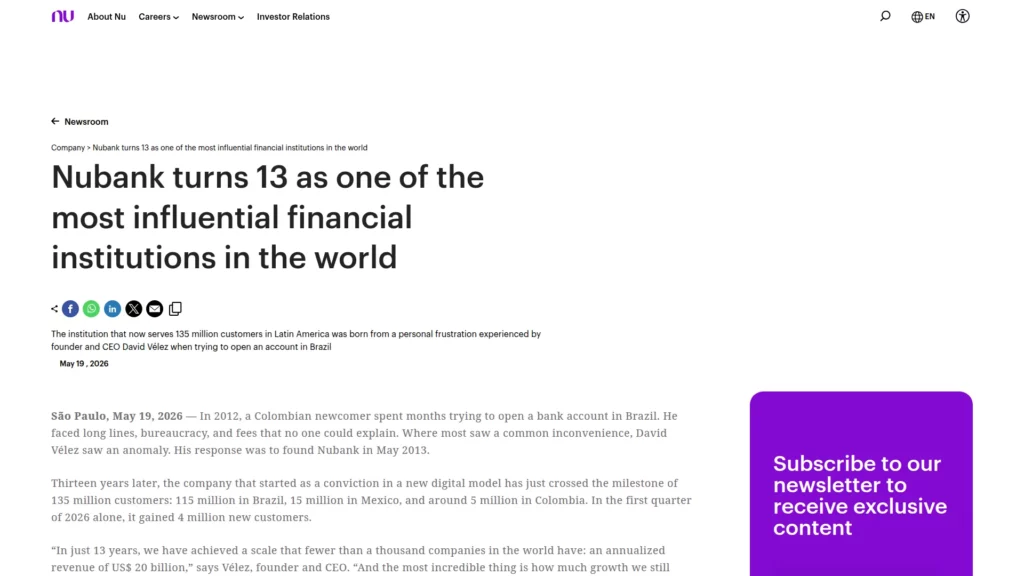
Nubank grew from an app-managed credit card into a broader digital financial platform. The product lesson is not to copy its feature set. It is to keep complex financial products understandable through a consistent app experience.
PayPal’s passkey support shows how authentication can become easier while improving resistance to phishing. Plaid-connected apps provide another lesson: account linking is a journey with consent, institution choice, connection health, and recovery states.
Our work on Song Nhi and Bonux also gives us practical reference points for finance-related product flows. Song Nhi centers on low-friction financial input, while Bonux connects mobile, web, backend, and transaction-oriented crypto workflows. Payment-specific reconciliation, fraud rules, and provider behavior still need to be designed for the target product and market.
Crypto Wallet And Fintech Web Portals
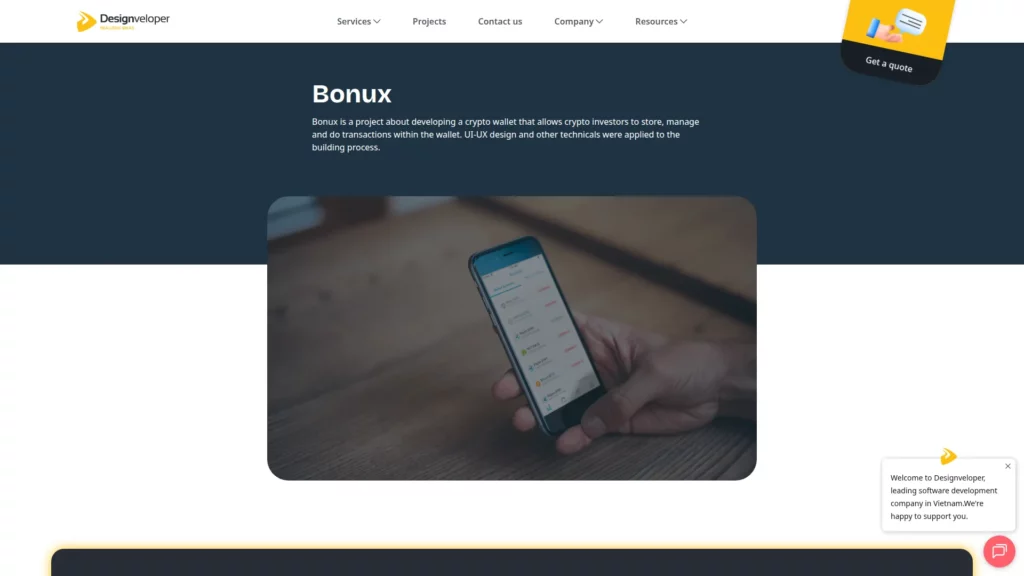
Crypto products place more responsibility on wallet state, transaction clarity, identity choices, and recovery. Users need to understand what asset they are moving, where it is going, and whether the action can be reversed.
Our Bonux project addressed a different financial product challenge. The public case describes a scalable, integration-focused crypto wallet where investors can store, manage, and transact crypto assets.
The solution used Node.js and MongoDB for the backend, ReactJS for the web portal, React Native for mobile, and AWS for scalable deployment. This split matters because a wallet is not only a mobile screen. The backend, web portal, mobile client, integrations, and deployment environment all affect the same transaction experience.
For a new crypto wallet, the architecture decision should therefore come before framework preference. Teams need to decide where transaction rules live, how each client receives reliable state, and which security responsibilities belong to the wallet, backend, or external provider. Key custody, signing, recovery, and chain-specific testing should also be scoped explicitly when they apply.
A fintech web portal adds another surface to secure and monitor. Shared backend rules can help keep mobile and web behavior consistent. Still, each client needs its own session, storage, and release controls.
Building A Financial App Users Can Trust
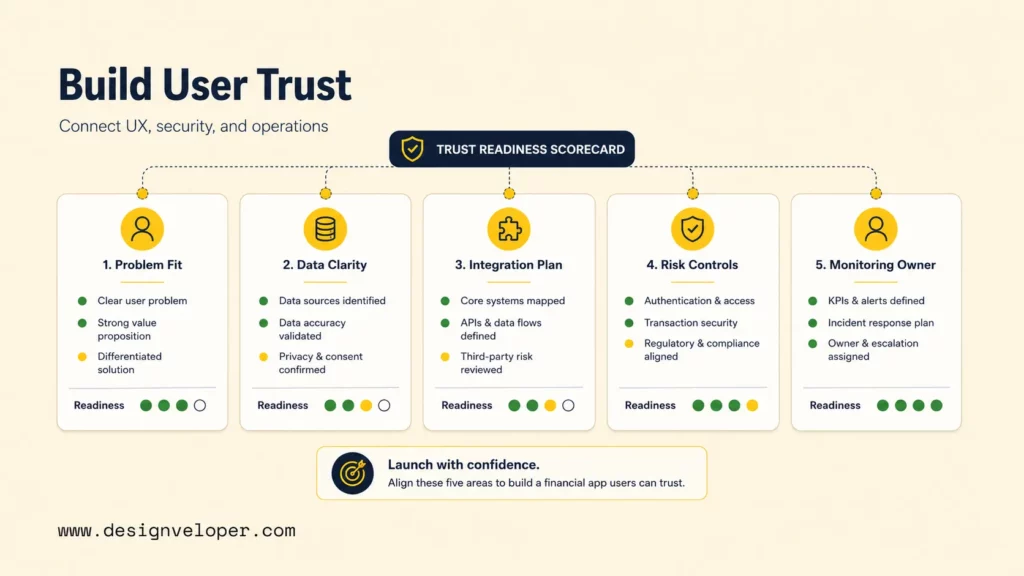
When a product combines money movement, linked accounts, or AI advice, the hardest part is keeping the experience understandable while the data flow stays secure. A practical roadmap should connect product scope, UX, integrations, security, compliance planning, testing, monitoring, and maintenance.
Teams can use the scorecard below before committing to a full build. A weak answer in one area does not always stop the project. It does show where discovery work is still needed.
Can the team name one user and one financial job for the MVP?
Is every sensitive data source, owner, and access path mapped?
Are account, payment, identity, and failure flows understood?
Has the team identified fraud, privacy, and compliance review needs?
Who responds when a transaction, API, or security control fails after launch?
The last question is easy to miss. A finance product needs someone to investigate failed integrations, suspicious activity, access problems, and inaccurate data after release.
If your team is planning a financial app, we can help scope the MVP, map security and compliance needs, choose integrations, and turn those decisions into a first release. Our software development services cover the product and engineering work needed to move from requirements into implementation.
Our Song Nhi work gives us a reference point for conversational personal finance and low-friction expense capture. Bonux adds experience with crypto wallet, mobile, web portal, backend, integration, and scalable deployment decisions. Together, those projects help us ask more useful questions about transaction UX, sensitive data, financial integrations, and the systems that must keep working after launch.
The build is ready to scale only when the team knows what happens after a payment fails, an API goes down, or a user disputes the data.
FAQs About Financial App Development
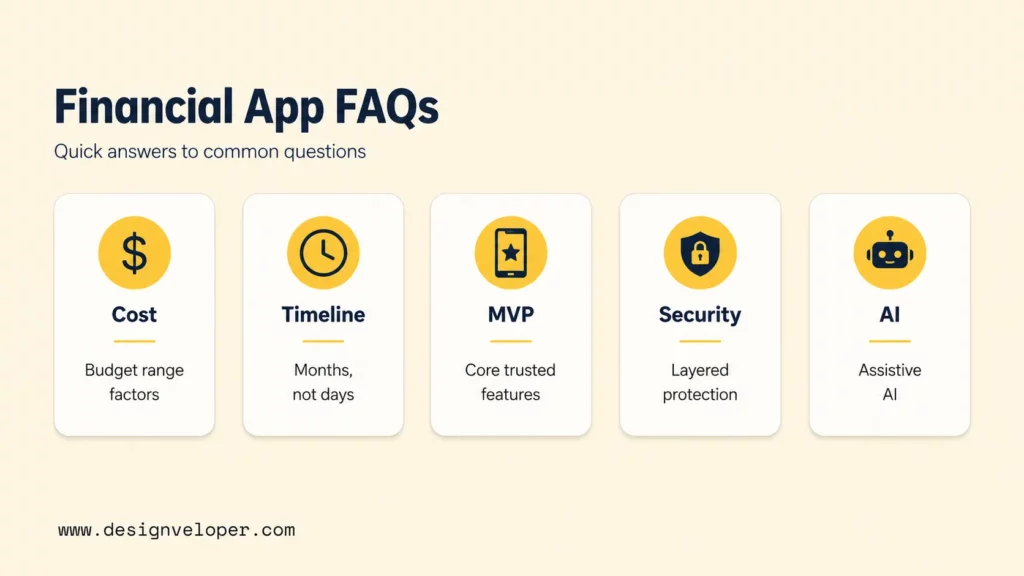
How Much Does Financial App Development Cost?
There is no defensible single price for financial app development without a defined scope. A budgeting MVP can be cheaper to estimate than a payment, lending, banking, or crypto product when it avoids regulated and transaction-heavy workflows.
Ask for an estimate by module instead of one headline number. Separate core UX, backend, account linking, payments, admin tools, security review, AI, QA, and maintenance. That makes exclusions visible and reduces surprise later.
How Long Does It Take To Build A Financial App?
A focused MVP should be planned in months rather than days. The exact duration depends on product scope, external APIs, security testing, compliance review, and release requirements.
The fastest useful schedule starts with the riskiest dependency. Test the account-linking, payment, identity, or AI flow early. A polished interface cannot recover time lost to an integration that fails late.
What Features Should A Financial App MVP Include?
A financial app MVP should include only the features needed to complete one trusted money workflow. Most products still need secure authentication, clear transaction or account states, basic support, logging, and privacy controls.
Add account linking, payments, AI, or advanced analytics only when they are part of the core test. Each new dependency adds failure states that the product must handle.
How Do You Secure A Financial App?
Secure a financial app in layers: identity, authorization, encryption, API security, logging, monitoring, and incident response. Use established standards and test the failure paths, not only the happy path.
For payment data, determine whether PCI DSS applies and reduce unnecessary card-data exposure. For mobile apps, use the OWASP Mobile Top 10 as one risk checklist. Add penetration testing and independent review when the threat level warrants them.
Can AI Be Used In Financial App Development?
Yes. AI can support transaction categorization, chat assistance, document extraction, fraud analysis, spending summaries, and forecasting. The right control level depends on how much the output can affect a person’s money or access to financial services.
High-impact AI needs evaluation, monitoring, clear user communication, and human review where appropriate. The NIST AI Risk Management Framework offers a voluntary structure for managing AI risk. In the EU, AI used to assess personal creditworthiness can fall into the AI Act’s high-risk category, subject to the Act’s conditions and exceptions.
The safest starting point is an assistive use case with measurable output quality and a clear fallback. That keeps AI financial app features useful without letting uncertain output silently control critical decisions.
Also published on

Share post on










Related Articles


Financial App Development: Features, Security, And Cost
Financial App Development: Features, Security, And Cost Published August 13, 2026
25 Fintech App Ideas for New Business to Consider in 2026
25 Fintech App Ideas for New Business to Consider in 2026 Published November 24, 2025
How to Build a Debt Management Software
How to Build a Debt Management Software Published April 16, 2025