
















Low Code vs Traditional Development: Key Differences, Pros & Cons
October 23, 2025


Today, we’re not limited to traditional software development; we can use various approaches to create software. From using prebuilt templates and components to having AI to generate code, software development is more accessible than ever before. However, between low code vs traditional development, which one is better? Let’s find the answer in this blog post with Designveloper!
In today’s post, we’ll dive deep into the definition of each development approach, along with its pros, cons, and key differences. Understanding these factors, you’ll weigh these two options to find out which one suits your project. Let’s get started!
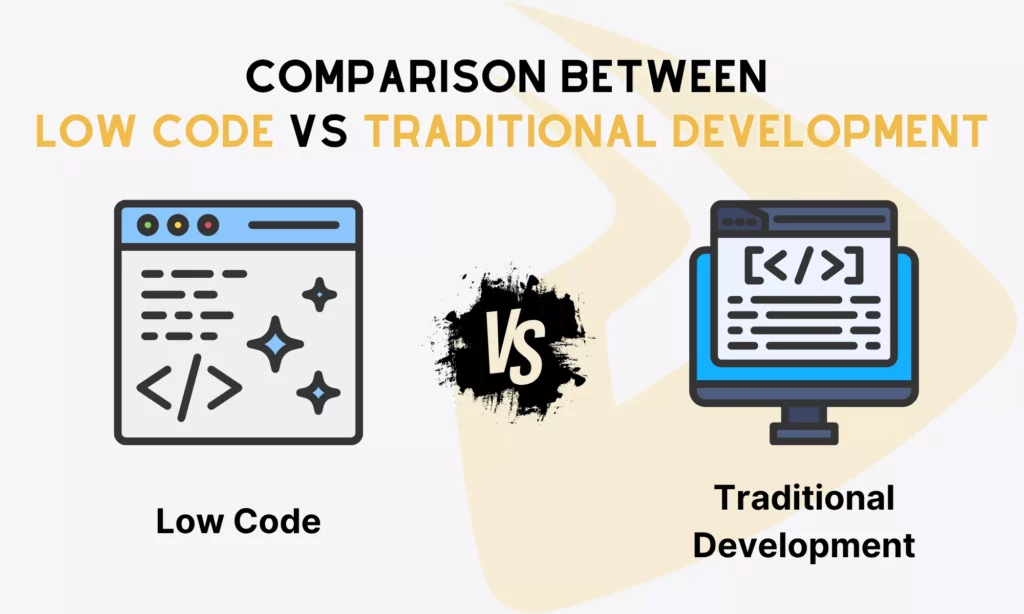
What Is Low Code Development?
The definition of low code development lies right in its name: developing apps or software without writing extensive code.
Low code platforms often come with a visual editor, prebuilt templates, and customizable UI components for users to create an app easily. Like playing with Legos, you only need to choose, modify, and plug modules to build an engaging frontend of your app.
They also allow you to connect with countless databases, API services, and other systems to automatically share data. Many major players in this realm, like OutSystems, SAP, or Microsoft, also integrate AI and GenAI capabilities that analyze your natural language descriptions and assemble reusable components to build apps. Convenient, right?
However, these low code platforms don’t completely remove coding from the development process. They allow professional developers to write highly specialized or unique features to make their apps different and outstanding.
With low code development, IT teams can speed up their development time and increase productivity.
They don’t need to waste time coding repetitive features or doing boring tasks. Instead, the platforms cover such stuff and give them more time to focus on higher-level tasks and accelerate time-to-market while ensuring the quality of final deliverables.
Low code development also helps those with limited coding knowledge develop their web or mobile apps without hassle by removing much of the technical complexity.
With its transformative benefits, it’s no wonder that low code development platforms are expected to increase their global value fourfold to over $82 billion in 2034.
What Is Traditional Software Development?
Traditional software development requires developers to manually plan, design, develop, deploy, and maintain software or apps.
Before low code development, this was a very common approach to building software, mobile apps, and websites. In traditional software development, developers have to follow best practices, write custom code, and own specialized tech skills to meet specific or complex business requirements.
Key Differences Between Low Code and Traditional Development
Low code and traditional software development differ in the following factors:
| Aspects | Low Code Development | Traditional Development |
| Coding Knowledge | Limited coding skills, due to drag-and-drop components | Skilled IT teams, even in specialized technologies |
| Development Speed | Fast development, because you can use prebuilt UI components and AI to assemble apps | Slower, because developers have to manually write code from scratch |
| Cost | Lower costs, because you mostly rely on low code platforms | Higher, due to highly specialized talents for software development |
| Customization | Limited customization because low code platforms handle much of the source code | High customization, as developers can freely write code to build highly specialized or unique features using any programming language |
| Security & Compliance | Lower, because the underlying code is built under low code abstractions and hard to audit or configure | Higher, as developers often follow secure practices throughout the development process to ensure security and compliance with industry standards |
| Flexibility | Lower, as programming languages and tools used in low code development platforms are limited and you may face vendor lock-in | Higher, as traditional developers handle the source code, technologies, and other tools themselves |
| Quality | Depends on low code platforms | Depends on the expertise of development teams |
| Best for | – Rapid prototyping- Simple software that requires little customization or integration to common services- Automated business workflows | – Complex, enterprise-grade software that needs full customization, robust security, and complex integrations to unique systems- Long-term control over your codebase |
Pros and Cons of Low Code Development
Low code development brings various transformative benefits but also comes with unexpected challenges. Understanding its pros and cons helps you identify whether this approach suits your project:
Pros
- Low code platforms simplify and accelerate development. Their prebuilt modules and a drag-and-drop interface allow you to assemble a web/mobile app visually without worrying about the underlying code. This makes development simpler and speeds up time-to-market.
- Low code development reduces IT workloads. Instead of coding the entire app from scratch, you can leave monotonous, repetitive tasks to low code platforms and focus more on highly specialized features or custom projects.
- It lowers the barrier to entry. With configurable visual components, low code platforms allow those with modest coding skills to develop their dream apps.
- Low code development saves development costs. Not only time but also costs can be significantly reduced thanks to low code platforms. For simple internal apps that don’t prioritize high customization, these platforms can get you covered without hiring costly professional developers.
- It makes app management and maintenance simpler. Many low code platforms offer a centralized management hub for you to manage and track all your app components, data connectors, and workflows. You can easily modify reusable components or integrate your own to keep your apps always updated.
Cons
- Low code development comes with lower customization and scalability than traditional approaches. Many low code platforms let you write custom code, but just to some extent. This may hinder your app from scaling efficiently when your user base gets larger and business needs become more complex.
- It has limited integrations with other systems. Low code platforms let you integrate with common systems and services. But if your business is using legacy or specialized systems they don’t support, you can hardly connect your app seamlessly with your existing infrastructure.
- It may lack security and compliance features for enterprise-grade apps. Major low code platforms integrate various strong mechanisms to keep your apps secure and compliant, but once again, just to some extent. If you want to build complex, large-scale enterprise apps that require robust security measures, you should carefully consider using low code platforms.
Pros and Cons of Traditional Coding

Compared with low code development, traditional software development still benefits your business in many aspects, especially when it comes to customization and scalability. However, it’s crucial to consider some inherent limitations of this approach. This helps you weigh both low code and traditional options better:
Pros
- Traditional software development offers expansive customization options. Low code development often relies on prebuilt components, hence coming with limited customization. However, traditional software developers can use any programming language to code any specialized features. This helps them meet specific, complex business requirements effectively.
- It facilitates scalability and adaptability. Developers can leverage their familiar technologies to add, remove, or modify features. This allows their apps and software to scale up when needed and adapt well to evolving business needs and requirements.
- It ensures seamless integrations with other systems. In traditional software development, developers can build custom APIs, write custom scripts, or use middleware solutions (e.g., Apache Camel or WSO2) to connect with unique or complex systems that low-code platforms don’t support.
- Traditional software development ensures security and regulatory compliance better than low code development. While low-code platforms have limited built-in security and compliance tools, traditional developers have more freedom to work with advanced security protocols and adjust performance to keep software always secure and compliant.
- Traditional developers have greater control over software and apps. They can decide how to write code and structure these digital solutions to meet specific business needs instead of depending completely or partially on low-code platforms.
Cons
- Due to greater customization, traditional software development requires higher costs and longer development time. Unlike low code platforms using available components, traditional developers have to manually write code, generate tests, deploy, and maintain software.
- It requires specialized skills with certain programming languages, frameworks, libraries, and other tools (e.g., LangChain or CrewAI). Skill requirements vary depending on project types and goals.
When to Choose Low Code vs Traditional Development
Given several inherent traits of low code and traditional software development, you may now wonder when to use which. Before choosing the best development approach, you should evaluate your project requirements first, from essential features to budget and delivery time. Then, consider the following common use cases to determine the right approach:

Choose Low Code If
- You want to build simple software
Low code platforms are sufficient to build simple software, websites, or mobile apps that don’t require highly customized features or significant modifications of the underlying code. For example, if you just want a simple website whose content is mainly static, using low code platforms will remove the hassle of writing HTML/CSS code manually.
- You want fast prototyping or MVP development
With a visual editor and prebuilt UI components, low code platforms allow you to prototype or build minimum viable products (MVPs) quickly to test ideas. These products often require enough features to validate your concepts, and low code development can meet this requirement well.
- You want to automate business processes
Do departments in your company (e.g., accounting, HR, or marketing) want to automate simple workflows, like email sending, employee onboarding, or inventory management? If so, use low code platforms. These tools provide essential tools to make these processes automated, removing manual work.
Choose Traditional Coding If
- You want complex, enterprise-grade software
Large-scale or enterprise-grade software often involves precise code, unique business logic, optimized software layers, robust security measures, and more.
Low code platforms can provide prebuilt UI components and several security or governance tools to build simple, internal apps. However, they don’t suffice to meet complex business requirements. That’s why traditional software development wins in this case.
- You prioritize security, compliance, and top performance
In some regulated industries, like healthcare or law, strict security and compliance standards are crucial for software and apps.
Low code platforms inherently integrate some security tools. But it’s hard to determine whether low code apps stay compliant with stringent security regulations. Not to mention that auditing security settings is tricky, as the underlying code lies under the low code abstractions.
- You want long-term control, full customization, and complex integrations
If you want full customization and smooth integrations with unique or complex systems, low code platforms may not meet these needs well.
They only enable you to tailor your app to some extent or connect with common services. Therefore, traditional software development is still needed to make your apps highly customized or work seamlessly with your specific existing infrastructure.
Besides, there are use cases in which low code platforms are discontinued or supported by their providers. This makes long-term maintenance challenging.
Further, if your apps are locked into a specific low code tool and its ecosystem, it’s hard to move them to another platform when needed.
So, to avoid lock-in or ensure long-term control over your codebase, traditional software development is still a decent option.
Starting Software Development with Designveloper
Low-code development is cool if you just wanna create something together fast and don’t care much about custom stuff.
But when you need software that actually fits your business? You still need the real deal: actual developers who know their way around code, security, and the mountain of integrations that come with serious projects. That’s where we roll in.
We’re not just another dev shop, but basically the go-to crew in Vietnam for companies that want things done right.
We’re talking over 200 projects in everything from healthcare to finance. Our successful projects prove our excellent technical expertise and hands-on experience, from ODC for remote health monitoring, to Swell & Switchboard, which totally level up business management for our clients.
Our work’s not just about flashy features, but it fits whatever custom setup you’ve already got. Clients actually say we make their lives easier: smoother user experiences, teams working more productively, and organic traffic increasing fast. Not to brag, but, you know, we’re kind of proud.
Whether you’re looking to add something extra to what you’ve already got, or you want to build your dream app from the ground up, we’ve got the skills and the tech chops. Just hit us up. Let’s make your idea happen.
Also published on

Share post on










Read more topics











You may also like



Low-Code Development Cost: Does It Really Save Money?
Low-Code Development Cost: Does It Really Save Money? Published October 30, 2025
Build Your MVP with Low-Code: 5 Step Rapid Development Guide
Build Your MVP with Low-Code: 5 Step Rapid Development Guide Published October 29, 2025
Future of Low-Code Development: Trends & Predictions
Future of Low-Code Development: Trends & Predictions Published October 28, 2025