











How Much Does It Cost to Make an App? A Budget Breakdown

KEY TAKEAWAYS:
- A booking MVP can be modeled at $63,000 in delivery labor: 1,400 hours at an assumed $45 hourly rate. This is an illustration, not a market average or quote.
- Add setup costs and a stated reserve to the build budget. Budget hosting, support, usage fees, and improvements separately after launch.
- Define the smallest useful release before comparing vendors. A minimum viable product should test a real user need without dropping essential quality checks.
A founder can receive very different quotes for the same app idea because each supplier fills in the missing details differently. One includes a working admin dashboard, testing, and store submission. Another prices only the screens customers see. To understand how much it costs to make an app, you need a shared scope and a budget you can recalculate. The examples below separate delivery work, setup, uncertainty, and running costs. They also show how platform choice, team structure, and advanced features change the work behind the number. Use them to prepare a brief and compare proposals on equal terms.
How Much Does It Cost to Make an App?
There is no single reliable price for an unspecified app. For the illustrative booking MVP below, delivery labor is $63,000 and the initial project budget is $71,500. A separate first-year operating allowance brings the planning total to $95,699, before tax and excluded costs.
These are USD planning assumptions for a hypothetical outsourced team delivering an English-language, cross-platform iOS and Android app. The assumed $45 blended hourly rate is an input you must replace with a supplier quote. It is neither a surveyed regional rate nor a Designveloper offer.
| Budget Layer | Illustrative Amount | What It Covers |
|---|---|---|
| Delivery labor | $63,000 | 1,400 role-hours × $45 blended hourly rate |
| Non-labor setup | $2,000 | A chosen allowance for setup, test resources, and initial service configuration |
| Risk reserve | $6,500 | 10% of labor plus setup; an explicit planning choice |
| Initial project budget | $71,500 | $63,000 + $2,000 + $6,500 |
| First-year operating allowance | $24,199 | Maintenance labor, cloud/services, and store registration, detailed below |
| Build plus first-year operating allowance | $95,699 | Initial project budget plus 12 months after launch; not a fixed-price promise |
The scope includes account access, service listings, availability, bookings, email confirmations, and a basic web admin dashboard. It assumes managed authentication and one existing scheduling integration. It excludes payments, chat, offline sync, migration, multiple languages, regulated health data, and acquisition marketing.
A web-only release may avoid store work. Separate native apps can add platform-specific engineering and testing. Compare the required types of app before treating an app category as a price tag.
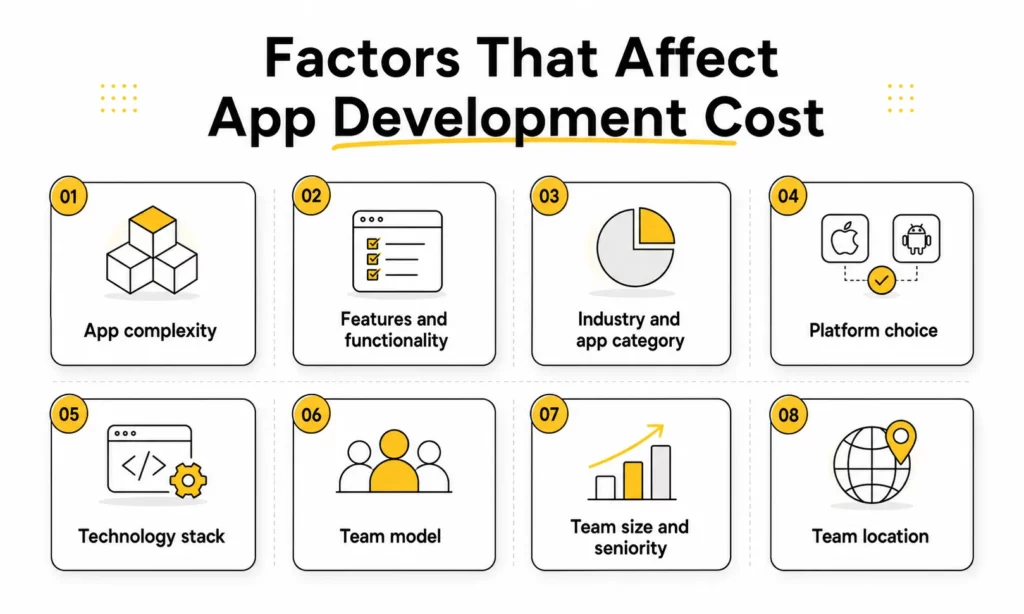
What Changes App Development Cost?
Cost changes when a requirement adds design, engineering, testing, or operating work. A feature count alone misses the hard parts: access rules, exceptions, integrations, data quality, and release support.
- Complexity: booking one appointment is simpler than coordinating staff, locations, cancellations, refunds, and conflicting calendars.
- Platforms: sharing code can reduce duplicated work, but each platform still needs device checks, permissions, and release validation.
- Industry requirements: sensitive records, financial actions, accessibility, and contractual controls add work that must be scoped individually.
- Design: a proven interaction pattern needs less exploration than a new workflow that users have never tried.
- Integrations: a stable documented API is easier to estimate than a legacy system without a test environment.
- Team: role coverage, senior review, availability, and handover affect delivered effort. Location alone does not establish quality or total cost.
For each requirement, write an acceptance condition. “Users receive a confirmation” should define the trigger, contents, delivery service, retry behavior, and what happens if sending fails. This makes effort visible before a proposal becomes a contract.
Choose mobile app development frameworks around needed device features, maintainability, and team skills. A lower hourly rate will not offset large amounts of avoidable rework.
Xem thêm:
- Web Development Cost: How Much to Build a Website?
- How Much Does eCommerce App Development Cost?
- Which Programming Language Is Best for App Development?
A Worked Booking MVP Estimate
The delivery estimate assigns hours to work packages before applying a rate. The role-hours below include collaboration within each package; they do not imply one person can complete all tasks or a fixed calendar duration.
| Work Package | Role Coverage | Assumed Hours | Labor at $45/Hour |
|---|---|---|---|
| Discovery and planning | Product analyst, project lead, technical lead | 120 | $5,400 |
| User flows and interface design | UX/UI designer, product review | 180 | $8,100 |
| Frontend and backend build | Mobile and backend engineers, technical review | 900 | $40,500 |
| QA and deployment | QA engineer, engineers for fixes, release support | 200 | $9,000 |
| Total | Blended role mix | 1,400 | $63,000 |
Delivery labor = sum of each role’s hours × that role’s rate. A blended rate is a shortcut that works only when the role mix is agreed. Ask for separate rates when specialist or senior time changes the budget materially.
For this illustration, the 1,400 hours already include the listed planning, review, testing, and launch tasks. Do not add another phase percentage for that same work. Add a new line only when it covers a genuinely excluded requirement.
Test sensitivity before accepting the total. With the same 1,400 hours, an assumed $35 rate gives $49,000 labor and $60 gives $84,000. Keeping $45 per hour but adding 200 hours adds $9,000. These are arithmetic scenarios, not a market rate range.
Calendar time also depends on dependencies and staff availability. Use an app development timeline to check whether design approval, API access, and release work can happen when the quote assumes.
How a Project Budget Can Be Split Across Stages
An illustrative $100,000 delivery allocation can split work across five stages. This is a separate example of a fixed total, not a second calculation for the booking MVP and not an industry benchmark.
| Stage | Share | Allocation |
|---|---|---|
| Discovery and planning | 10% | $10,000 |
| Design | 15% | $15,000 |
| Development | 55% | $55,000 |
| QA | 15% | $15,000 |
| Launch | 5% | $5,000 |
| Total | 100% | $100,000 |
Discovery confirms users, scope, data, and constraints. Design turns that scope into tested flows. Development builds the app and services. QA checks behavior, security requirements, and supported devices. Launch covers release configuration and submission support.
Stages overlap in iterative delivery. A percentage allocation can help discuss coverage, but it should not replace work estimates or imply that testing starts only after coding. Contracts should identify acceptance, revision limits, and who handles rejected store submissions.
Agency, Freelancer, In-House, or No-Code?
Compare delivery options against the same backlog and acceptance criteria. Their cost structures differ, so a freelancer’s engineering rate and an agency’s blended team rate are not equivalent products.
| Route | What to Include in the Comparison | Main Trade-Off |
|---|---|---|
| Agency | Design, management, development, QA, review, handover, support terms | Broader role coverage; confirm which roles are actually allocated |
| Freelancer | Engineering plus separately funded product, design, QA, backup and handover | Direct communication; availability and missing roles need an owner |
| In-house | Loaded employment cost, recruitment, tools, management and ongoing team needs | Direct control; hiring and unused capacity affect total cost |
| No-code or low-code | Subscriptions, usage, plugins, integration work, export and migration | Useful for supported workflows; custom device or data needs may outgrow the platform |
Request deliverables, source access, ownership terms, test evidence, documentation, and support responsibility in every proposal. Fixed-price work needs a clear change process. Time-based work needs visible progress, budget reporting, and a way to stop or reprioritize.
If location is part of your search, compare overlap hours, communication, specialist availability, and operational continuity. The Vietnam app outsourcing option still needs the same scope and acceptance checks as any other delivery market.
Xem thêm:
- 15 Best Countries to Outsource Software Development
- 120+ Best Mobile App Ideas to Make Money
- 20 Best Small Business Applications
First-Year App Costs After Launch
Running costs depend on workload and service commitments. Estimate maintenance from planned hours and expected tasks, rather than applying a universal annual percentage to the build price.
| Item | Assumption for 12 Months After Launch | Illustrative USD |
|---|---|---|
| Maintenance labor | 30 hours/month × $45/hour × 12; fixes, dependency and OS checks | $16,200 |
| Cloud and managed services | $500/month × 12; replace with a workload estimate | $6,000 |
| Messaging and monitoring | $150/month × 12; excludes paid acquisition | $1,800 |
| Apple Developer Program | Standard annual membership; eligibility and local pricing can differ | $99 |
| Google Play registration | Standard one-time registration, if a new account is needed | $25 |
| Domain and certificate allowance | Chosen annual allowance; certificate costs may already be bundled | $75 |
| Total | No separate feature roadmap or emergency coverage | $24,199 |
The cloud allowance is not sized to a validated traffic forecast. Estimate storage, requests, bandwidth, background jobs, backups, and peak concurrency before procurement. Changes in volume, retention, or availability targets can change that line substantially.
Apple lists standard membership at $99 USD per year on its enrollment page. Google lists a $25 USD one-time fee for Play Console registration. These standard fees were applicable on November 23, 2026; local currency, taxes, eligibility, and waivers can affect payment.
Registration fees are separate from transaction charges. Google Play service fees depend on the program, product, transaction, billing arrangement, and market. Payment processing, refunds, and taxes also need their own assumptions.
Define the support window and response terms. Thirty planned hours do not buy round-the-clock incident coverage. New product features, major migrations, and a second launch campaign belong in a separate roadmap budget.
How AI Features Change the Estimate
An AI feature adds integration, evaluation, and operating work to an existing app. A full AI product may also need document processing, data access controls, workflow tools, and monitoring. Those are different estimation jobs.
For example, adding a support-answer feature requires approved source content, retrieval or prompts, failure handling, and tests for incorrect answers. A voice assistant adds audio handling and call costs. An image feature adds image capture, data preparation, and task-specific validation.
Model costs should follow expected requests, input and output size, retries, caching, and the chosen service. Include a spending limit and a fallback when a provider fails. Compare the wider scope in AI app development cost before borrowing a small feature allowance for a whole product.
How to Reduce Cost Without Cutting Essential Work
Reduce uncertain scope first. Preserve the checks needed to release a usable product, then remove features that do not test the first business goal.
- Choose one primary workflow and postpone optional roles, languages, and integrations.
- Prototype the hardest interaction before building all screens.
- Use managed services where ownership, limits, and exit options fit the product.
- Get access to APIs and representative data before committing to an integration estimate.
- Request a small discovery deliverable when key requirements are still unknown.
- Keep a decision log so new requests include their hours, operating impact, and priority.
A useful request for quotation includes user roles, priority journeys, platforms, integrations, data migration, quality requirements, acceptance conditions, and the desired support period. Ask suppliers to list assumptions and exclusions beside each estimate.
Frequently Asked Questions
Can I Build the First Version Myself?
Yes, if the workflow fits your skills or a supported app builder. Include your own time, subscriptions, testing, and maintenance. A prototype does not prove that payment, privacy, or reliability requirements are ready for production.
Does Publishing to Both Stores Double the Cost?
Not automatically. Shared code can reduce duplicated implementation, while permissions, device testing, store assets, and release checks remain platform-specific. Ask the team to separate shared work from iOS and Android work.
When Should I Ask for a Fixed Quote?
Ask after the key journeys, integrations, acceptance conditions, and exclusions are clear. If important unknowns remain, fund discovery or a bounded technical trial first. Otherwise, a fixed quote may rely on assumptions that later become change requests.
A useful app budget can be traced back to scope, effort, rates, and operating assumptions. Bring those inputs to Designveloper for a scoped discussion about delivery options, estimate uncertainty, and the work required for a first release.
Also published on

Share post on










Related Articles


How Much Does It Cost to Make an App? A Budget Breakdown
How Much Does It Cost to Make an App? A Budget Breakdown Published November 23, 2026
20 Best Small Business Applications In 2026
20 Best Small Business Applications In 2026 Published November 23, 2026
7 B2B Apps Compared: Categories, Costs, and Build vs. Buy
7 B2B Apps Compared: Categories, Costs, and Build vs. Buy Published November 23, 2026