
















Generative AI Vs. Traditional AI: Key Differences and Use Cases

Generative AI creates new content or responses, while traditional AI is commonly used to classify, forecast, detect, recommend, or automate a defined task. When comparing generative AI vs traditional AI, focus on the output a workflow needs, not which approach is newer or universally better. Choose based on the task, acceptable errors, available data, cost, privacy, and review requirements.
What Is Traditional AI?
Traditional AI, as used in this article, means task-specific, non-generative AI that classifies, forecasts, detects, recommends, scores, or automates a defined decision. It is a practical umbrella term rather than one formal model family.
That distinction matters because “traditional AI” is used inconsistently. It can describe rules-based expert systems, statistical models, machine-learning classifiers, forecasting models, recommendation systems, computer-vision models, and other approaches that do not primarily generate new content. Some systems follow explicit rules. Others learn patterns from data. So it is inaccurate to say that traditional AI always relies on fixed rules or only on structured, labeled data.
A spam filter illustrates the pattern. The useful output is not a new email. It is a category such as “spam” or “not spam,” often with a probability score. A demand model produces a forecast. A defect detector produces a class or alert. A recommendation engine ranks existing options. In each case, the system is judged mainly by whether its decision or prediction is useful for the defined task.
For a broader view of how forecasts, rankings, alerts, and recommendations support business choices, our guide to AI-driven decision making explains how these outputs fit into human-reviewed workflows. The useful lesson is to define the decision and its measurable outcome before choosing a model.
What Is Generative AI?
Generative AI creates new outputs such as text, images, audio, video, code, summaries, or structured content from learned patterns and the context supplied at generation time. The prompt may come from a person, an application, retrieved documents, or another software component. Our guide to generative AI explains the main model families and the controls needed to use their outputs in business software.
Generative systems use different model families for different content. Large language models can produce text or code, while diffusion models are often used for images. These models learn statistical patterns during training and produce outputs shaped by the input and instructions. That does not mean every response is factually correct or original in a legal or creative sense. The important distinction is that the system generates a response rather than only a category or score.
ChatGPT is a generative AI application powered by large language models. OpenAI describes ChatGPT as a conversational AI assistant that understands natural language and generates responses, and states that it is built on large language models. LLMs are one family of generative AI models focused on language, although generative AI also includes systems for images, audio, video, and other modalities.
Generative AI is also broader than “writing from a blank page.” It can transform or summarize existing content and answer questions from retrieved knowledge. It can also explain data, generate code, or produce a first draft for a person to review.
Generative AI Vs. Traditional AI: Core Differences
The decisive difference is the job each approach is built to do. Traditional AI usually returns a prediction, score, category, recommendation, or action. Generative AI creates a response or another form of content. Teams then need to check whether it follows instructions, uses the supplied facts, and meets the task’s safety and quality requirements.
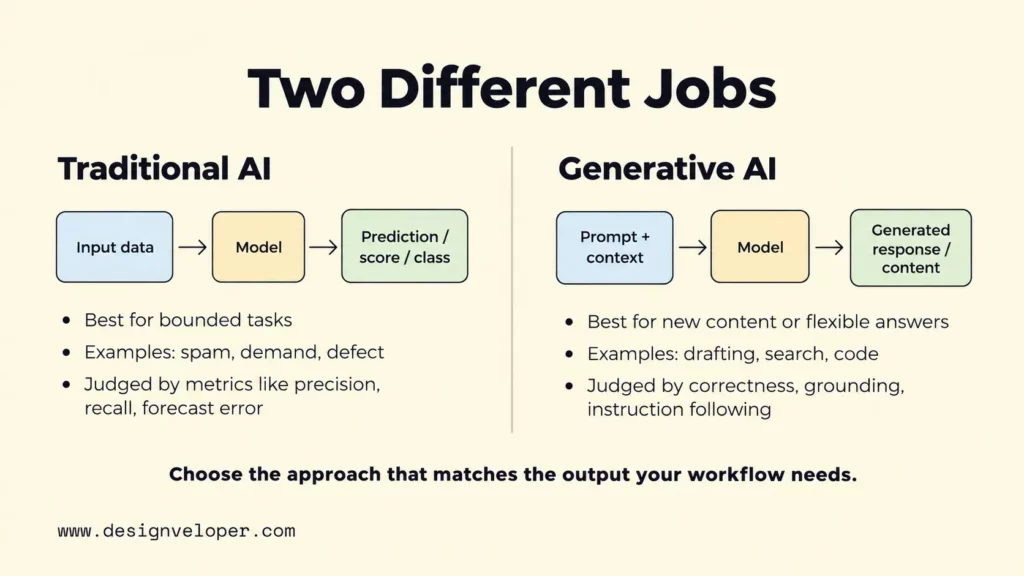
| Comparison | Traditional AI | Generative AI |
|---|---|---|
| Goal | Predict, classify, detect, rank, recommend, optimize, or automate a defined decision. | Create, transform, summarize, or explain content in response to prompts and context. |
| Typical output | A label, probability, numeric forecast, risk score, ranked list, alert, or predefined action. | New text, code, image, audio, video, summary, answer, or other generated content. |
| Example tasks | Spam filtering, defect detection, demand forecasting, customer segmentation, fraud or churn scoring. | Drafting content, summarizing documents, conversational search, knowledge assistance, code generation. |
| Evaluation | Task metrics such as precision, recall, error rates, forecast error, ranking quality, or business outcome metrics. | Task success plus criteria such as correctness, groundedness, relevance, instruction following, safety, and human review. |
| Key limitations | Narrow task scope, dependence on representative data or rules, drift, and errors when conditions differ from training or design assumptions. | Hallucinations, variable outputs, difficult-to-bound behavior, privacy and safety risks, and higher review needs for consequential uses. |
These are task categories, not hard capability walls. A large language model can classify sentiment or extract fields, and a traditional classifier can process text or images. The practical question is which approach produces the needed output with acceptable accuracy, control, cost, and review effort.
Data requirements do not divide neatly into “structured for traditional AI” and “unstructured for generative AI.” A traditional computer-vision classifier can learn from images. A generative model can use tables, labels, examples, retrieved documents, or multimodal inputs. The right data depends on the task, the model, and whether you are training, tuning, retrieving context, or simply calling a pretrained model.
The underlying model technology is not a clean boundary either. Traditional systems may use rules, linear models, decision trees, or neural networks. Generative systems may use different neural-network designs to create language, images, or other content. Microsoft’s comparison of generative and other AI types is useful for the high-level taxonomy, but in production the task and output matter more than the label attached to the model.
The two approaches also use different evaluation styles because their outputs differ. For a binary classifier, metrics such as precision and recall can show different kinds of mistakes; Google’s classification metrics guidance explains why accuracy alone can mislead on imbalanced data. For generative systems, teams can check whether an answer follows the supplied facts (grounding) and instructions. They may also assess its clarity and safety. Google Cloud documents such checks in its guidance on generative AI evaluation.
Cost and latency need the same qualification. Large generative models can be expensive or slow for high-volume workloads, but that does not mean generative AI is always more resource-intensive. A hosted model used for a small workflow may cost less to adopt than training a custom predictive model. Conversely, a compact classifier running at high scale can be efficient. Compare the actual architecture, traffic, response-time target, and review process rather than assuming one category is cheaper.
Most importantly, the categories can overlap inside one product. A system can use a predictive model to score risk and business rules to enforce policy. Retrieval can fetch approved knowledge. A generative model can then explain the result in natural language. Treating traditional AI and generative AI as mutually exclusive options can hide the better architecture: use each component for the job it handles best.
Where Each AI Approach Works Best
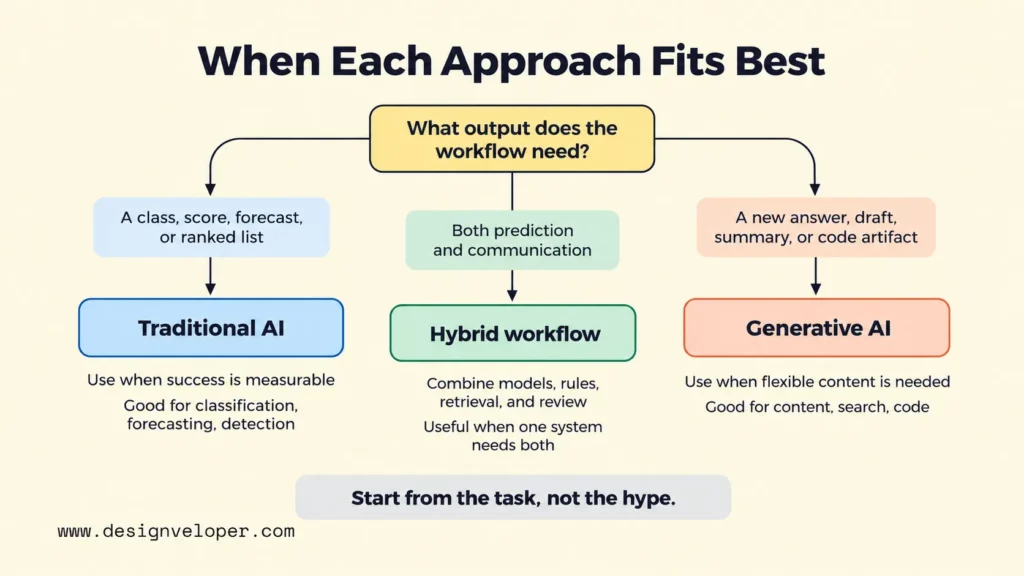
Traditional AI works best when the required answer can be defined and measured clearly. Generative AI works best when the required output is new content or a flexible natural-language or multimodal response. That rule is not absolute, but it is a strong starting point for choosing a solution.
Traditional AI For Classification, Forecasting, And Detection
Use traditional AI when the business needs a stable prediction, class, score, ranking, or anomaly signal. These tasks usually have a target that can be compared with known outcomes, which makes it easier to define success before deployment.
Spam classification is a simple example: the system predicts whether a message belongs to a category. Manufacturing defect detection asks whether an image or sensor pattern shows an acceptable or defective item. Demand forecasting estimates a future quantity. Customer segmentation groups similar records. Risk or churn scoring estimates the likelihood of an event.
The advantage is not that the model is automatically simple or explainable. The advantage is that the task boundary is clearer. A team can decide which errors matter, select suitable metrics, and test performance on representative data. For example, a fraud screen may value recall because missing a real fraud case is expensive. Another workflow may put more weight on precision to avoid overwhelming reviewers with false alarms.
Traditional AI can also be the better choice when a generated explanation would add little value. If a warehouse system only needs to predict tomorrow’s unit demand, a numeric forecast may be enough. Adding a language model could increase complexity without improving the decision.
Generative AI For Content, Search, And Code
Use generative AI when the workflow needs a new draft, transformation, explanation, synthesis, conversational answer, or code artifact. These tasks have many acceptable outputs, so success often depends on whether the response is useful in context rather than whether it matches one exact answer.
Common generative AI use cases include drafting or rewriting content, summarizing meetings and documents, and answering questions over a knowledge base. They also include support-response suggestions, translation, content transformation, code generation, and technical explanations. Our collection of generative AI applications shows how these patterns change across industries and why review requirements depend on the risk of the workflow.
Conversational search is a good example of what generation adds. A conventional retrieval system can return matching documents or ranked passages. A generative layer can turn those retrieved sources into a concise answer, compare points across documents, or adapt the explanation to the user’s question. The generative layer still needs grounding and validation because fluent wording does not guarantee factual accuracy.
Developer support is similar. Generative models can propose code, tests, documentation, or explanations, but those outputs still need engineering review and automated checks before production use. Our guide to AI in software development explains why the useful workflow keeps tests, code review, security checks, and human ownership around generated code.
How To Choose Or Combine Both Approaches
Choose between traditional AI, generative AI, or a hybrid by starting with the required outcome and failure cost, not with which technology sounds newer. If the task is a defined prediction or classification, test a traditional or predictive approach first. If the task needs new content or natural-language interaction, test a generative approach. And if the workflow needs both prediction and communication, consider combining them. Google Cloud’s guidance on choosing generative or traditional AI also describes task-dependent and hybrid options.
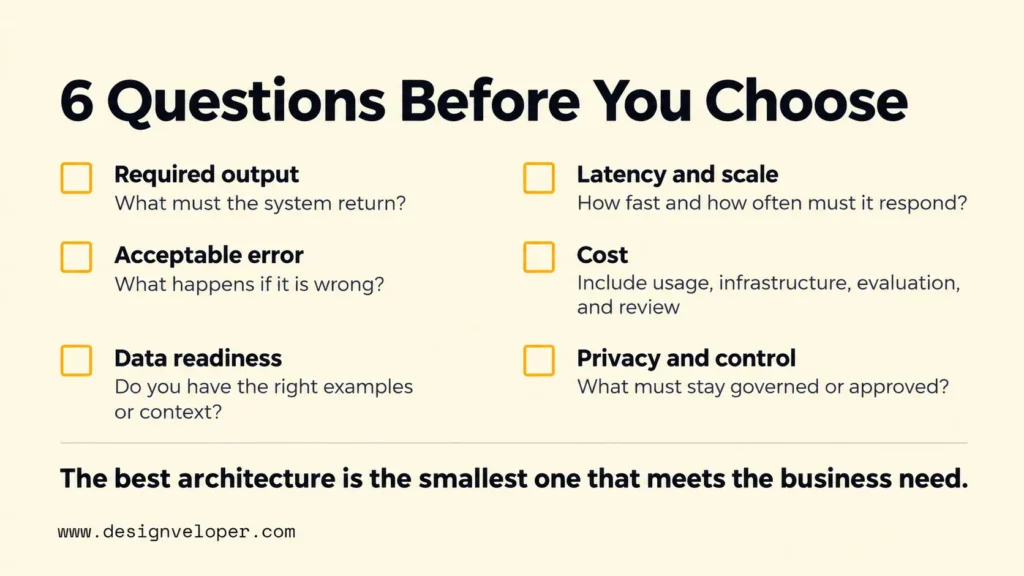
- Required output: Is the system expected to return a class, score, number, ranking, or decision, or must it create a new response, explanation, or artifact?
- Acceptable error: What happens when the system is wrong? A low-risk draft can tolerate more variation than a credit, safety, medical, or compliance decision.
- Data readiness: Do you have representative historical examples for a predictive model, or reliable documents and context that a generative system can use? If training is being considered, our guide to training an AI model explains why the task and evidence for success should be defined before choosing the training method.
- Latency and scale: How quickly must the system respond, and how many requests will it handle? Measure the actual model and infrastructure instead of assuming one AI category is always faster.
- Cost: Include data preparation, model or API usage, infrastructure, evaluation, monitoring, and human review. A cheaper model can become expensive if its error rate creates heavy manual work.
- Privacy and control: Decide what data may leave your environment, what must be logged, which outputs need approval, and where deterministic rules should override model behavior.
Consider an illustrative e-commerce retention workflow. A predictive model flags customers at risk of leaving, then the application gives a generative model only approved customer context and offers each customer is eligible to receive. The model drafts tailored messages, but a marketer checks consent, accuracy, offer eligibility, and tone before sending. The team evaluates the risk predictions against known outcomes and compares campaign results with a predefined holdout group. This separates the question of whether the model identifies useful cases from whether the messages improve retention.
Hybrid design also makes it easier to put controls in the right place. Rules can block ineligible actions, predictive models can score or rank cases, retrieval can supply approved facts, and generative AI can turn those inputs into language a user can understand. This separation lets teams evaluate each component against its own failure modes instead of treating one model as responsible for the entire workflow.
There are also cases where neither approach is necessary. If a business rule is stable, simple, and fully known in advance, ordinary deterministic software may be cheaper and easier to test. AI should earn its place by handling uncertainty, scale, variation, or language that simpler logic cannot address well.
The practical decision is therefore not “traditional AI or generative AI?” in the abstract. Use traditional AI for bounded predictions and repeatable decisions, generative AI for new content and flexible interaction, and both when a workflow needs prediction plus explanation or personalization. The best architecture is the smallest combination that meets the business outcome, error tolerance, data, latency, privacy, cost, and review requirements.
Also published on

Share post on










Related Articles


Data And AI Strategy: A Practical Roadmap For Business Growth
Data And AI Strategy: A Practical Roadmap For Business Growth Published October 14, 2026
RAG Vs. Fine-Tuning: Choose The Right Approach For Your LLM Apps
RAG Vs. Fine-Tuning: Choose The Right Approach For Your LLM Apps Published October 14, 2026
ChatGPT Vs. Generative AI: The Product And The Broader Field
ChatGPT Vs. Generative AI: The Product And The Broader Field Published October 14, 2026


















