















8 Best Business Analyst Certifications and How to Get One?

In recent years, business analytics (BA), as a profession, has been popular. Contrary to common belief that the business analyst market is becoming oversaturated, the finding from the US Bureau of Labor Statistics proves the opposite. Accordingly, employment of management analysts will increase by 11% from 2023 to 2033. This growth rate is equivalent to 95,700 new openings each year during the forecast period.
Therefore, more and more young people choose business analytics for their career path in the long run. Even so, most newcomers don’t know where to start on this path. As we all know, a business analyst is in charge of analyzing a company’s offerings and processes through data analytics to improve operational efficiency.
So, to seamlessly walk on this path, you must be equipped with a strong knowledge of business functions, IT, and data analytics. And one of the best ways to get all this essential knowledge is through acquiring a business analyst certification. But which one should you consider? This article will provide those who are interested in business analyst jobs with an overview of relevant certifications. Let’s check it through!
Why Do You Need to Get a Business Analyst Certification?

For a business analyst, besides a bachelor’s degree, a professional certification is worth taking into consideration. There are three key reasons why a certification is essential for a BA.
1. Validate your skill set
It is obvious that a certification from an international trust-worthy organization is an ideal choice to prove that you have a standardized skill set. Hiring managers not only prefer hands-on experiences in different companies but also highly appreciate your certification, which proves that your skills officially meet certain standards.
If you have valuable experience as a business analyst, a certification will be a big plus. And if you are still finding new chances, why don’t you start with a business analyst certification? Perhaps it will be the golden key to opening a new world for you!
2.Boost your salary
According to Glassdoor, the annual average salary for a business analyst in the United States is $93,573. However, do you know that the companies are willing to pay 25% higher for those having an appropriate business analyst certification (like CBAP)? This is another important reason to pursue a certification, right?
3. Grow your business analysis career
Let’s think further. If you intend to dedicate your time to becoming a business analyst, a certification is a must-have to move forward in your career path.
The certification offers beginners a ticket to enter the world of business analysts and start to explore. Professionals, with different certifications, can make huge progress in the industry to step up a notch higher in the market.
FURTHER READING: |
1. 8 Important Business Analyst Skills to Growth your Career |
2. Business Analyst Career Path: The 7 Common Positions |
3. Business Analyst Job Description: A Detailed Guide |
Top 8 Business Analyst Certifications, by Organizations
There are many reputable organizations offering business analysis certifications. We now list the best certifications in business analytics that are globally recognized and provided by these organizations.
IIBA (International Institute Of Business Analysis)
This is the first and most reputable organization providing certificates for BA. Owning an IIBA certification means a business analyst will be recognized for professional skills and qualifications in this field. To take the IIBA certification exam, you need to have enough practical work experience, certain skills, and qualifications at each specific level as follows: ECBA, CCBA, and CBAP.
1. IIBA Entry Certificate in Business Analysis (ECBA)
The ECBA (Entry Certificate in Business Analysis) is the most basic certification in the IIBA’s certification system for BA. It is designed for novice and inexperienced analysts.
- Requirements: 21 hours of professional development within the last 4 years
- Application Fee: $60
- Exam Fee: $110 for members and $235 for non-members of IIBA
- Retake Fee: $ 89 for members and $ 195 for non-members of IIBA
- Recertification Fee: No renewal is required
Note: This certificate is suitable for beginners without experience in business analysis. If you are a complete newcomer who plans to take the first steps in this path, this certification will be the best choice for you to cover the foundational skills and knowledge.
2. IIBA Certification of Competency in Business Analysis (CCBA)
CCBA (Certification of Competency in Business Analysis) is level 2 in IIBA’s certification system for professional BA. Professional business analysts usually choose this one.
- Requirements: 21 hours of professional development within the last 4 years + 3750 hours of BA work in the last 7 years, minimum of 900 hours of 2/6 KA and 500 hours of 4/6 KA by BABOK.
- Application Fee: $ 125
- Exam Fee: $ 325 for members and $ 450 for non-members of IIBA
- Retake Fee: $ 250 for members and $ 375 for non-members of IIBA
- Recertification Fee: $ 85 for members and $ 120 for non-members of IIBA
Note: This is the second level of certification for business analysts who have two to three years of experience.
3. IIBA Certified Business Analysis Professional (CBAP)
CBAP (Certified Business Analysis Professionals) is the highest level in IIBA’s BA certification system. Candidates are professional BA with at least 7500 hours of BA experience in the past 10 years (equivalent to 3.6 years of full-time BA experience). After passing the exam, to maintain and renew this certification, you’ll need to report 60 CDUs (Continuing Development Units) every 3 years to the IIBA.
- Requirements: 35 hours of professional development within the last 4 years + 7500 hours of BA work in the past 10 years, a minimum of 900 hours of BABOK 4/6 KA.
- Application fee: $ 125
- Exam fee: $ 325 for members and $ 450 for non-members of IIBA
- Retake Fee: $ 250 for members and $ 375 for non-members of IIBA
- Recertification Fee: $ 85 for members and $ 120 for non-members from IIBA
Note: This is the most advanced level of certification for business analysts who have more than five years of experience.
BCS, The Chartered Institute for IT
The organization provides a customizable and clear approach for you to pursue a business analyst path. You can start with a BCS Foundation Certificate by completing one of four modules: Business Analysis, Digital Business Change, Organisational Behaviour, and IS Project Management. This means you’re not required to complete all these foundations to acquire the organization’s certifications in business analytics.
Instead, you may opt for gaining a BCS Foundation Certificate. You then can pursue IIBA CBAP or add up other advanced modules to gain a BCS International Diploma in Business Analysis.
4. BCS Business Analysis Certifications
BCS Business Analysis Certifications often include four separate levels: Foundation, Practitioner, Professional, and Consultant. Let’s dive into each level:
Foundation: It’s designed for those who want to have a broad understanding of business analytics, business processes, project management, or organizational behaviors.
- Core Modules: Business Analysis, Digital Business Change, Organisational Behaviour, and IS Project Management.
- Course Duration: 2-3 days for each module.
- Tuition Fee: Depending on your chosen course format and training provider.
- Exam Fee (UK Price): £192/module.
Practitioner: It’s designed for those who already acquired a foundation certification and would like to improve relevant practical skills. If you complete one of the foundation or practitioner modules, you can move on to acquire a BCS International Diploma in Business Analysis.
- Core Modules: Business Analysis Practice, Benefits Management and Business Acceptance, Modelling Business Processes, Data Management Essentials, and Requirements Engineering.
- Course Duration: 3-4 days for each module.
- Tuition Fee: Depending on your chosen course format and training provider.
- Exam Fee (UK Price): £264/module.
Professional: It’s designed for those who want to advance their specialist analytical, business, and personal skills
- Core Modules: Advanced Requirements Engineering, Agile Business Analysis, Benefits Planning and Realisation, Team Leadership, etc.
- Course Duration: 1.5-3 days for each module.
- Tuition Fee: Depending on your chosen course format and training provider.
- Exam Fee (UK Price): £342/module.
Consultant: At this stage, you’re eligible to sit an exam to acquire the highest certification – particularly the BA Advanced International Diploma – to promote your career. It’s designed for senior BAs with extensive experience and skills.
- Requirement: To acquire the Advanced Diploma, you must have at least five years of experience in BA, and acquire compulsory certifications like BCS International Diploma in Business Analysis.
- Application Fee: £714
APMG International
This organization is famous for the AgileBA Certification which is specifically designed for business analysts performing Agile practices.
5. AgileBA (Agile Business Analysis) Certification
If you’d like to become an excellent Agile business analyst, don’t ignore this certification. The AgileBA training and certification equip you with essential knowledge to work well in Agile projects. Further, successful AgileBA candidates can acquire Business Agility Professional Level 1 – Explorer status, coupled with a digital badge, from the Agile Business Consortium.
The certification has two levels:
- Foundation: It’s designed for practicing BAs or agile team members who want to become Agile BAs.
- Practitioner: It’s designed for BAs who would like to solidify their position as expert analysts. To participate in Practitioner training and acquire a corresponding certification, you must have the AgileBA Foundation Certificate. In case you want to re-register your Practitioner status, you’re required to possess a valid Practitioner certificate beforehand.
PMI (Project Management Institute)
The organization offers a wide range of certifications in project management. If you already have 3-5 years of experience in business analytics, you can acquire its PMI Professional in Business Analysis (PMI-PBA®) certification to upgrade your career.
6. PMI Professional in Business Analysis (PMI-PBA®) Certification
This PMI-PBA Certification is specifically for experienced business analysts (3-5 years) who want to gain industry recognition, advance their expertise, and promote their career path further. Those possessing this certification prove their adequate knowledge and experience to use BA tools and techniques for project success.
- Requirement: To take the exam and acquire the corresponding certification, you must gather sufficient application materials to prove you fulfill one of the following requirement sets:
[image]
- Exam Fee: $405 for PMI members and $555 for non-PMI members.
Note: To maintain your PMI-PBA certification, you have to acquire 60 professional development units (PDUs) in each three-year cycle. Normally, each PDU represents one hour you spend on learning, teaching others, and more.
IQBBA (International Qualification Board for Business Analysis)
This recognized organization offers A4Q IQBBA accredited training programs to equip students and employees with essential knowledge about business analytics. Whether you’re a student or a business looking for a partner to implement training, IQBBA can provide suitable programs to your proficiency level.
7. A4Q IQBBA®
A4Q IQBBA® is one of the globally recognized business analyst certifications. It comes with three separate training programs: Foundation, Advanced, and Agile.
- Certified Foundation Level Business Analysis (CFLBA): This is the most basic certification you can acquire. It’s suitable for those who want to embark on their journey of becoming a business analyst, regardless of their field. Therefore, it has no entry requirements. However, if you have a basic understanding and experience in solution concept and development, it’s much easier for you to follow the training.
- Certified Advanced Level Business Analysis (CALBA): This is designed for those who want to advance their business analytics skills in specialized fields (e.g., Requirements Management). Therefore, you must complete CFLBA before taking this training.
- Certified Agile Business Analysis (CABA): This is designed for those who want to become an Agile business analyst and develop relevant expertise. There’s no entry requirement for this training.
IREB (International Requirements Engineering Board)
This universally recognized organization specializes in offering certification programs for those who work closely with requirements for software and systems. Its programs are ideal for business analysts, project managers, software engineers, and any professional who analyzes, processes, and validates requirements.
8. Certified Professional for Requirements Engineering (CPRE)
The CPRE (Certified Professional for Requirements Engineering) of the International Requirements Engineering Board (IREB) includes four levels: Foundation, Practitioner, Specialist, and Expert. With CPRE, you have to go through the previous levels to take the next one.
If you’re working in the requirements engineering field and handle business development, testing or design demands, this certification will help you develop your professional skills.
IREB is responsible for the entire program of CPRE. You need to obtain documents from authorized centers and participate in the test taken by different centers.
- Fees: Vary depending on different centers
- Recertification Fee: None
How to Get a CBAP?
Professionals with a business analyst certification from one of the world’s leading associations like the International Institute of Business Analysis or the Project Management Institute are in greater demand, and more respected. Hence, it is easier to get credibility for their business analysis work.
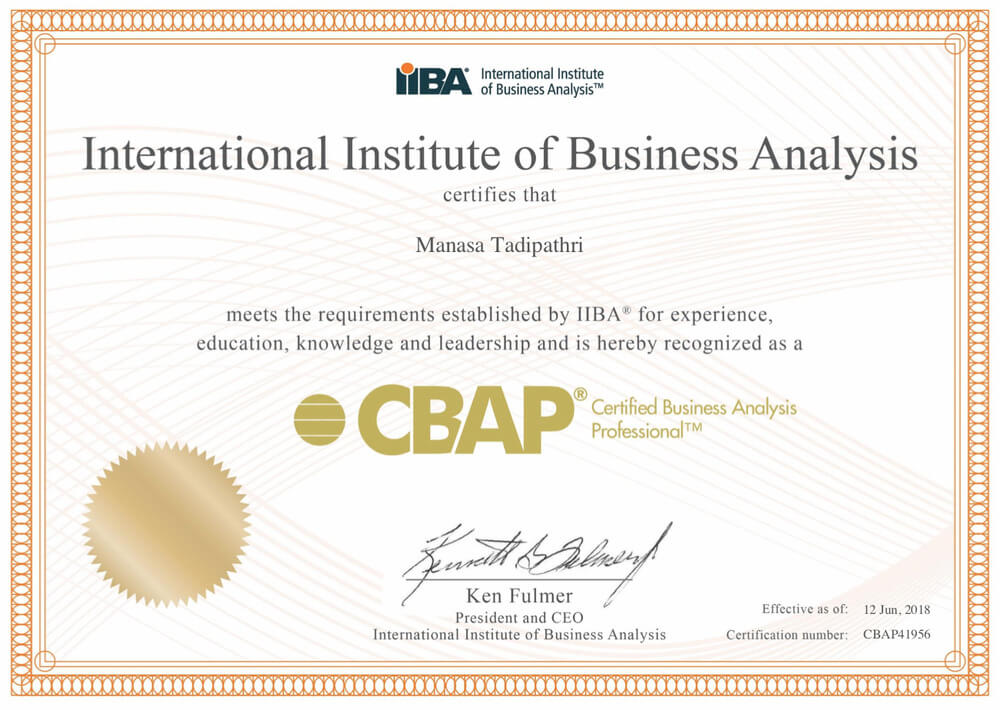
There is no doubt that the CBAP applications and the exams are difficult. While there is no particular path to CBAP, the path you should take strongly depends on the time you want to invest, your budget, and your schedule to become certified, there are certain general phases to prepare for this certification that each individual must pass through.
Step 1: Confirm your business analysis experience
The application of the CBAP requires about 5-10 years (7,500 hours) of business analysis experience, as defined by the BABOK Guide. It means that in any given project, if you’ve worked 1000 hours in total, and only 25% of this time has been allocated to business analysis activities, then you can only use 250 hours to apply toward your eligibility. Your practical experience must align with at least 4 of the 6 areas of knowledge (900 hours).
This is a challenging task as it requires that you look back and recall information about each of the projects you’ve worked on. You will need to remember the project name, description, hours worked on each project, hours spent on business analysis tasks on each project, etc. Documenting your experience, in itself, strengthens trust.
Step 2: Earn appropriate professional development hours
To complete your CBAP application, you must have 35 documented professional development hours. Many training courses in business analysis and some conferences qualify you for professional development credits.
Step 3: Prepare and submit your CBAP application
All applications are submitted to IIBA and the entire CBAP certification process is published on their website at iiba.org. In addition to your business analysis experience and PDs, you must provide proof that meets the minimum education requirement (high school or equivalent) and have two references.
Step 4: Understanding BABOK
Becoming a CBAP represents that you are a senior business analyst professional, as IIBA defines it through A Guide to the Business Analysis Body of Knowledge (BABOK Guide). It means to prepare for the CBAP®, you are required to understand the content of the BABOK Guide and be able to pass an exam demonstrating your knowledge and application of the material.
The BABOK Guide is a dense text. It’s likely that several readings will be necessary to fully appreciate the information contained in it.
Many business analysts report improved experience at this stage from joining a BABOK Guide study group. Study groups can be informal, and focused mostly on reading and discussing the BABOK Guide contents, or more formal, and focused on exam preparation. Study groups can be hosted by an IIBA chapter, an employer, or anyone who wants to coordinate one.
Another beneficial resource here is the exam simulators to check their knowledge and ability to respond to the types of questions that must be responded to in the exam.
Step 5: Schedule and pass your CBAP exam
Once your application is approved, schedule an examination within 2-3 months. You can always reschedule the exam or, if you take the exam and do not pass, you can take it again within one calendar year of your application being approved. Scheduling the test instantly keeps you motivated.
Conclusion
This article helps you better understand the importance of business analyst certifications. Also, we list the top eight certifications you should consider to pursue this career path. Sit for the exam and try your best to gain the business analyst certification. If there are any questions, you can leave a comment on Facebook, X, and LinkedIn. Designveloper is willing to help you all the time!
Also published on

Share post on










Related Articles



30 Best Web Development Blogs To Follow In 2026
30 Best Web Development Blogs To Follow In 2026 Published July 30, 2026
Key SaaS Metrics: Formulas, Benchmarks, And How To Use Them
Key SaaS Metrics: Formulas, Benchmarks, And How To Use Them Published July 28, 2026
Business Intelligence Examples: 10 Inspiring Use Cases for 2026
Business Intelligence Examples: 10 Inspiring Use Cases for 2026 Published May 04, 2026