













AI Model Monitoring: Metrics, Drift, And Production Reliability

AI model monitoring helps teams check whether a deployed model is still useful, not just whether its endpoint is online. It tracks changes in production data, predictions, measured results, and service health. These signals help teams investigate problems before deciding to repair data, recalibrate, roll back, or retrain the model.
What Is AI Model Monitoring?
AI model monitoring tracks a model’s inputs, outputs, measured quality, and runtime health after deployment. The team compares those signals with agreed expectations, then investigates meaningful changes. Monitoring is one part of the wider process explained in our MLOps lifecycle guide, alongside training, release, and model governance.
A healthy prediction endpoint is not necessarily a healthy model. An API can return successful responses in milliseconds while its forecasts become less accurate. Service monitoring shows whether the application is available. Model monitoring also asks whether the answer remains useful and whether the input data still matches the model’s assumptions. IBM’s guide to monitoring machine learning makes the same distinction between production data, actual outcomes, and system health.
For example, a model that predicts product demand may keep returning numbers even after a retailer changes how it records promotions. Monitoring can reveal the changed input distribution before anyone can calculate the forecast error. Once actual sales are available, the team can check whether accuracy truly suffered. That separation prevents a routine change from being treated as proven model failure.
Which AI Model Monitoring Metrics Matter In Production?
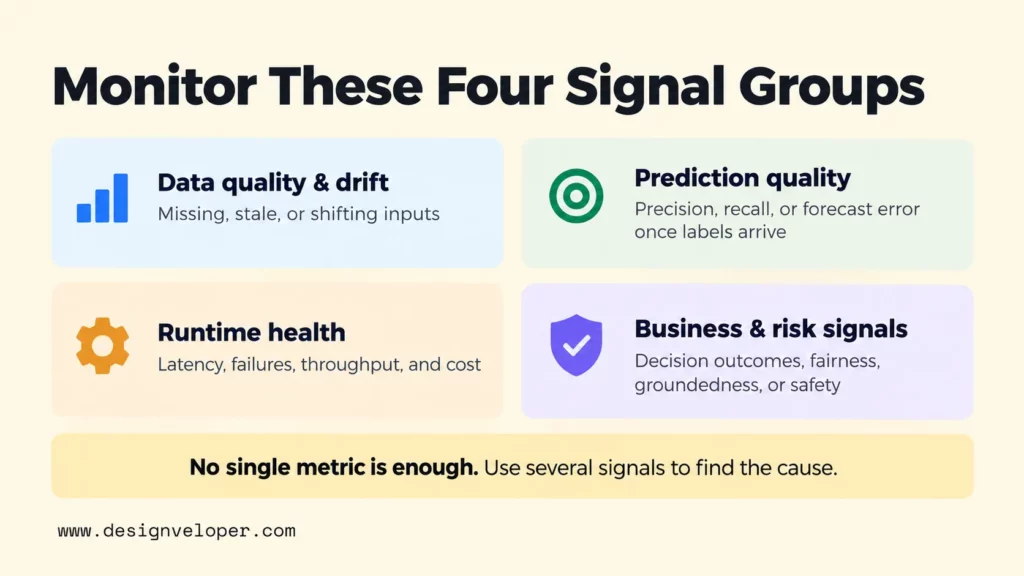
The right model monitoring metrics depend on the decision the model supports and the harm caused by an error. Start with one measure of decision quality, then add data and runtime signals that help explain changes. Most teams need several signals because no single number reveals both the problem and its cause.
Data Quality And Data Drift Metrics
Data quality metrics detect broken or unreliable inputs. Track missing-value rates, unexpected data types, values outside accepted ranges, and data freshness. These checks can catch a failed upstream process even when the model itself has not changed. A sudden rise in missing product prices, for instance, may call for a pipeline repair rather than retraining.
Data drift detection answers a different question: has the distribution of valid inputs changed? Teams can compare production features with a suitable reference window using measures such as the Kolmogorov-Smirnov statistic or Population Stability Index. The score must be interpreted in context. A seasonal shift may be expected, while a smaller shift in a critical feature may matter more. Microsoft’s Azure model monitoring documentation explains comparisons between production data and reference distributions.
Prediction Drift And Model Performance Metrics
Prediction drift measures changes in the outputs a model produces. For a classifier, that might be a sudden rise in high-risk predictions. It can be calculated before the true outcomes arrive, but it does not establish whether those predictions are correct. The shift could reflect a new customer mix, a broken feature, or a real change in the world.
Direct measures of predictive performance require ground truth: the actual outcome associated with a prediction. For classification, precision measures how often predicted positives are correct, while recall measures how many actual positives the model finds. For forecasts, mean absolute error measures the average size of a miss. Choose the measure that reflects the decision cost. A fraud model may prioritize missed fraud; a demand forecast may care more about the size of inventory errors. Labels must be matched to the original prediction and model version, not merely compared with the latest output.
Latency, Errors, Throughput, And Cost Metrics
Runtime metrics show whether the model can support its intended workflow. Track response latency, failed or timed-out requests, request volume, and cost per useful prediction or completed task. A model can remain accurate yet become unsuitable if users wait too long for results or if processing costs exceed the value of the decision.
Compare these signals with real operating requirements rather than one generic industry threshold. A nightly forecast has different latency needs from a live checkout decision. Check traffic and infrastructure changes alongside latency. This helps distinguish a capacity problem from slower model inference. For self-hosted serving, CPU or GPU use and available memory can help explain capacity limits. These measures may not be visible when a provider manages the infrastructure. AWS’s Machine Learning Lens recommends monitoring model quality and endpoint behavior with alerts tied to meaningful risk.
Business Outcomes And Risk-Specific Signals
Business signals show whether model behavior is improving the decision it was built to support. A forecast may affect stockouts and excess inventory. A ticket classifier may affect wrong-queue assignments and response delays. These outcomes can move for reasons outside the model, so interpret them with operational context rather than assuming every change is an AI failure.
High-impact use cases also need targeted risk checks. A credit decision system may require error-rate comparisons across relevant groups. Such comparisons need suitable samples and permitted group data. Overall accuracy alone cannot prove or rule out a fairness problem.
For a support assistant using retrieval-augmented generation (RAG), sample answers and check whether the retrieved policy passages support them. Track whether users complete the task or need human help. Record failed tool calls and token costs when they affect the workflow. Review possible safety or policy violations using an appropriate evaluation process.
These checks help separate a weak answer from its possible cause. If fewer answers appear supported, inspect document freshness and retrieved passages before changing the model. Automated groundedness scores are screening signals, not confirmed ground truth. MLflow’s production tracing and monitoring documentation describes sampled traces, automated quality checks, and user feedback for this work.
The table links common signals to their evidence requirements and a reasonable first action. The responses are investigative starting points, not automatic instructions to replace the model.
| Signal | What It Reveals | Data Needed | Possible Response |
|---|---|---|---|
| Missing values or stale features | Inputs may be incomplete or late | Production feature values, schema, timestamps | Check ingestion and repair the data pipeline |
| Input data drift | Feature distributions differ from the reference | Current inputs and a comparable baseline | Inspect important features and affected segments |
| Prediction drift | Output distribution has changed | Prediction scores and a reference window | Check population changes and feature calculations |
| Precision, recall, or forecast error | Measured prediction quality has changed | Versioned predictions matched with actual outcomes | Investigate errors; test recalibration or a new model |
| Latency, failure rate, or cost per task | The service may be too slow, unstable, or costly | Request logs, timing, error and billing data | Inspect capacity, retries, and serving configuration |
| Decision outcomes or group-level error gaps | Business impact or context-specific risk may be changing | Outcome records and permitted segment labels | Review decision rules, human oversight, and risk controls |
| RAG or agent answer quality | Answers may lack source support, fail tasks, or breach policy | Sampled answers and retrieved context, evaluation results, feedback, tool traces, and token usage | Inspect document freshness, retrieval, prompts, tool failures, and safety controls before changing the model |
How To Set Up Production AI Model Monitoring
Set up production AI model monitoring by defining what failure means, capturing comparable evidence, and giving every actionable alert an owner. You do not need an elaborate dashboard first. You need a small set of signals that can answer what changed, why it matters, and who can respond.
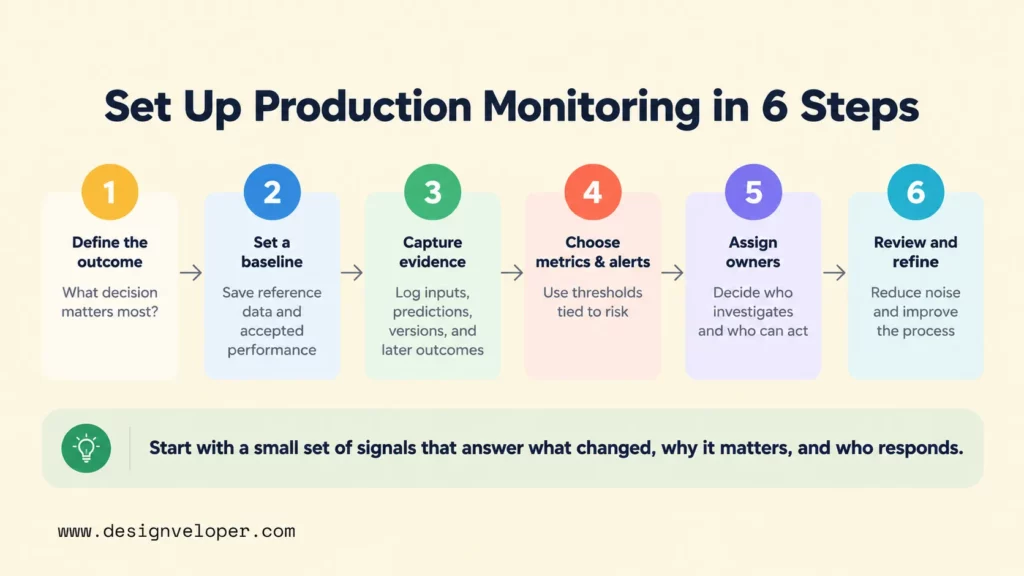
- Define the outcome and the cost of errors. Identify the decision the model influences. Decide which mistake is most harmful and how people can intervene. For a support-ticket router, misplacing a security incident might matter more than an ordinary routing delay. Make that difference part of the release and alert criteria.
- Establish reference data and baselines. Save a representative training or validation distribution and the model’s accepted evaluation results. Also capture a known-good production period when available. Document the population, dates, segment mix, and model version. A recent reference can reflect current operations, but it should not silently replace the original baseline.
- Capture production evidence safely. Log permitted features or derived statistics, predictions, timestamps, request identifiers, and model or configuration versions. Link later outcomes to the predictions that generated them. Define retention, access controls, and redaction before recording customer data. Our guide to taking an AI MVP into production explains why testing and monitoring have to become part of normal product operations.
- Choose metrics, windows, and alert conditions. Set a threshold only after checking normal variation and the consequences of a breach. A busy model may provide enough evidence for daily drift checks. A low-volume model may need a longer window. Separate a warning that deserves investigation from a critical condition that may require pausing automated decisions.
- Assign response owners and escalation paths. Name who receives each alert, who can inspect the data, and who may roll back or pause the model. Put the steps in a short incident runbook with a route to a human fallback. Our comparison of AI and ML engineer responsibilities explains why model and application monitoring need shared ownership rather than an unclear handoff.
- Review alerts and refine the process. Check whether alerts caught genuine problems or mostly produced noise. Update reference windows when there is a documented, accepted change in operations. Review labels as they arrive and check whether a fix improved quality. Keep a record of what triggered each investigation and what the team changed.
Microsoft’s Azure model monitoring guidance describes data collection, scheduled metric runs, user-defined thresholds, and alert investigation. These ideas also apply when a team assembles its own tools, although the available signals depend on the data and model type.
How To Detect Model Drift And Respond To AI Performance Decay
Detect model drift by comparing current inputs or outputs with a suitable reference, then test whether the change affects prediction quality or business decisions. Drift is a reason to investigate, not proof that the model needs retraining. Actual performance decay means the model’s usefulness has declined, which normally needs outcome evidence or a credible evaluation.
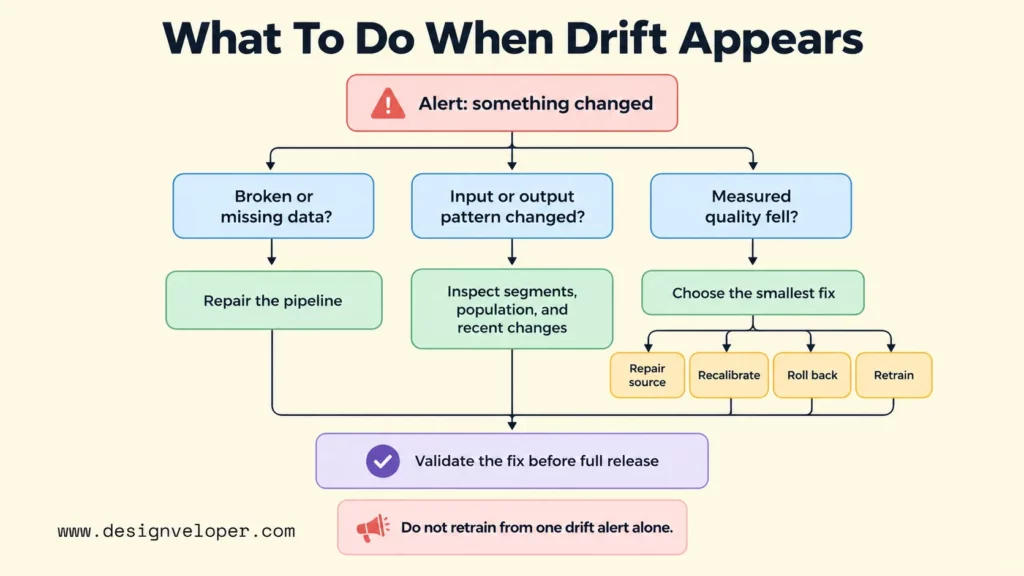
First, classify what the alert really shows. A data-quality failure means a field may be missing or wrong. Data drift means valid input values follow a different pattern. Prediction drift means outputs have shifted. Concept drift means the relationship between inputs and outcomes has changed; this is harder to confirm without ground truth. Keeping these cases separate directs the investigation toward the likely cause.
Next, find where the change began. Compare affected features, data-source timestamps, serving code, and model versions. Break the results down by useful segments, such as region or product category. If the shift follows a new data transformation, repair and verify that transformation first. If the inputs are correct but errors rise for a key group, evaluate whether the decision threshold or the model itself needs changing.
Hypothetical example: A retailer’s demand model starts receiving many more high-promotion products. Its input drift alert fires, but the service stays healthy. The team checks the promotional calendar and finds a planned campaign. Early sales results still fall within the accepted forecast-error range. Retraining immediately could be unnecessary. The team continues tracking the campaign segment and waits for enough actual sales to test the model’s accuracy. If errors later rise, it can investigate whether promotion effects have changed.
Choose the smallest fix that addresses the diagnosed cause. Repair a broken source or feature calculation when the data is wrong. Recalibrate predicted probabilities when scores no longer match observed rates, or adjust a decision threshold when its cutoff no longer fits. Roll back a harmful release when the previous version remains valid. Retrain when representative new data and evaluation show that the learned relationships need updating. Our guide to training an AI model explains how to compare a candidate against a baseline before changing production behavior.
Validate the proposed fix on held-out or otherwise suitable evaluation data, including the segments that triggered the alert. Check quality, latency, and the cost of harmful errors before release. A staged rollout with a clear rollback condition limits the risk of exchanging one problem for another. Snowflake’s model monitoring guide also distinguishes drift alerts from the evidence needed for retraining decisions.
AI Model Monitoring Vs. AI Observability
In this article, AI model monitoring means tracking selected production signals for a deployed model and its inputs. AI observability connects those signals with events and traces from the wider application to explain a result. This is a useful working distinction, not a universal naming rule. Some platforms treat monitoring as part of observability or use the terms interchangeably, as Evidently’s model-monitoring guide explains.
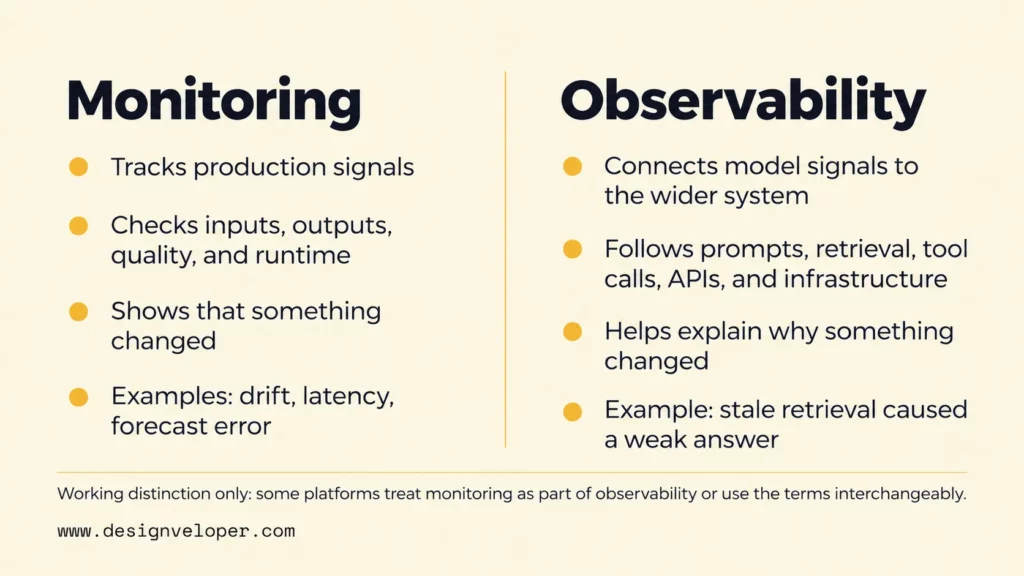
For a conventional forecast model, this wider view may cover the input pipeline, serving API, business rule, and database that receives the result. For a generative AI assistant, it may also cover prompts, retrieved documents, model responses, tool calls, and infrastructure. OpenTelemetry’s generative AI conventions describe telemetry fields for model operations, retrieval, tools, and token usage. Such traces require appropriate privacy controls because prompts and retrieved content may contain sensitive information.
Consider a support assistant that starts giving outdated answers. Model-level monitoring may show normal latency and no obvious change in response length. End-to-end traces could reveal that its document search returned old material. This is a retrieval problem, not necessarily a failing language model. Our guide to building a RAG system explains how source documents, retrieval, and evaluation work together. Teams should monitor the model and trace surrounding steps when a user-facing outcome depends on both.
FAQs About AI Model Monitoring
How Do You Monitor Model Performance Before Ground-Truth Labels Arrive?
Use early-warning signals such as missing features, input drift, prediction drift, and changing confidence patterns. Also track relevant operational or user-review signals. These can reveal trouble, but they are proxies for quality, not measured accuracy. Keep predictions and version IDs so actual outcomes can be joined later. When labels arrive, calculate the chosen performance metric on a sufficiently representative set and revisit the earlier alerts.
How Often Should Production AI Models Be Monitored?
Monitor availability and critical errors as often as the workflow requires. Run drift and performance checks at a frequency supported by enough new data. High-volume, high-risk services may need frequent automated checks, while a weekly batch forecast may need longer windows. Account for label delays as well as traffic volume. Review thresholds after major releases or data changes instead of choosing a universal daily schedule.
Should You Retrain A Model As Soon As Data Drift Appears?
No. First confirm that the change is real and investigate its cause. A new customer segment or seasonal event may change inputs without reducing accuracy. If the cause is a broken pipeline, repair the pipeline. Retrain when reliable evaluation and representative new data support it, then verify that the replacement improves the relevant outcomes before deployment.
Can AI Model Monitoring Detect Bias And Fairness Issues?
It can flag possible fairness problems when the use case has suitable group-level measures and the organization is allowed to use the needed data. Compare relevant error rates or decision outcomes across groups, not just total accuracy. Differences require review of data quality, sample sizes, context, and potential harm. Monitoring alone cannot prove that a system is fair. NIST’s AI risk measurement playbook provides a broader approach to documenting and managing such risks.
Also published on

Share post on









Related Articles


LLM Deployment Pipeline: Stages, Testing, And Production At Scale
LLM Deployment Pipeline: Stages, Testing, And Production At Scale Published October 20, 2026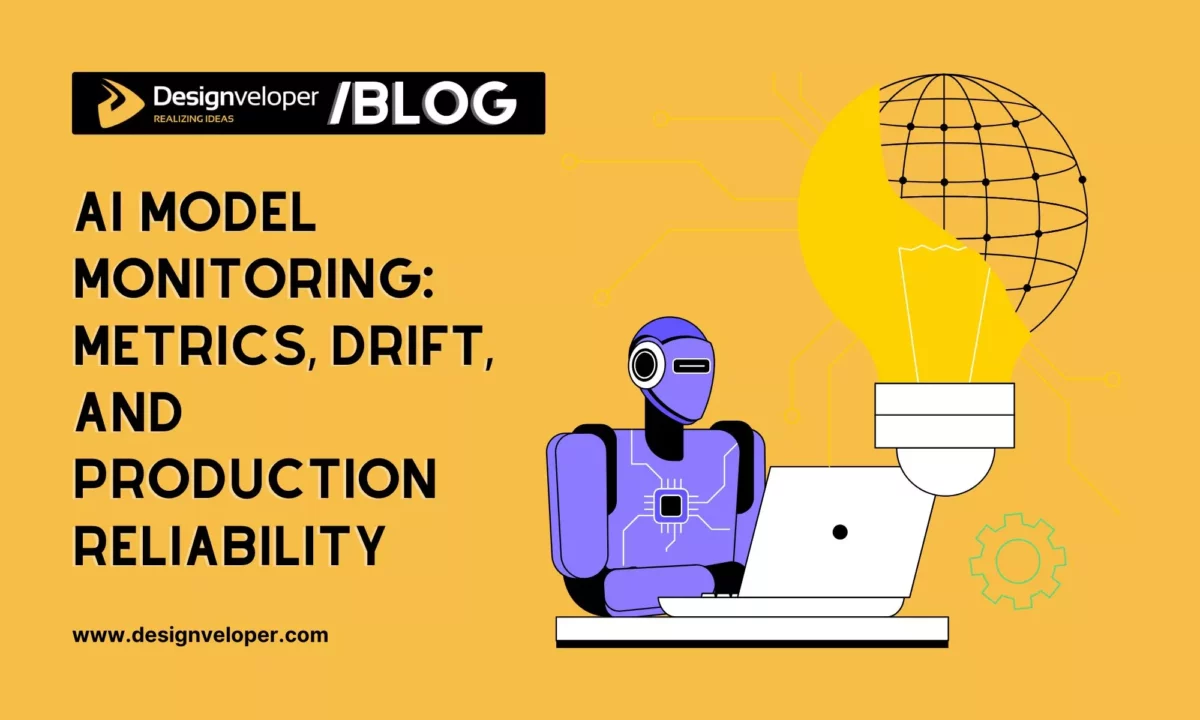
AI Model Monitoring: Metrics, Drift, And Production Reliability
AI Model Monitoring: Metrics, Drift, And Production Reliability Published October 20, 2026
Enterprise AI Governance Framework: Roles, Risks, And Controls
Enterprise AI Governance Framework: Roles, Risks, And Controls Published October 20, 2026