












Enterprise AI Governance Framework: Roles, Risks, And Controls

An enterprise AI governance framework gives a company common rules for deciding which AI uses can operate, who approves them, and how they are monitored. These rules cover internally built systems, third-party services, and AI features inside existing software. They help teams make consistent decisions when AI handles sensitive data, affects people, or changes after deployment.
What Is An Enterprise AI Governance Framework?
An enterprise AI governance framework is an organization-wide system of roles, decision rights, policies, processes, and controls for overseeing AI from initial approval through use, change, and retirement. An ethics policy may state values such as fairness and transparency. Model validation tests whether one model performs as intended. Enterprise governance connects both activities to named owners, permitted uses, purchasing, release approval, and ongoing review.
Its scope is the AI use case, not only the underlying model. A sales forecast, hiring tool, employee chatbot, and autonomous agent may use similar technology but affect different people and decisions. Each needs controls based on its purpose, data, users, and potential consequences. A company should also record who can stop or change an AI-enabled process when its behavior becomes unsafe.
Governance and AI strategy answer related but different questions. Strategy chooses useful business problems and investments. Governance decides the conditions under which those choices may operate. Our guide to building a data and AI strategy explains why objectives, usable data, responsible teams, and review of results need to connect. Governance turns those broad decisions into repeatable rules for individual AI uses.
What Should An Enterprise AI Governance Framework Include?
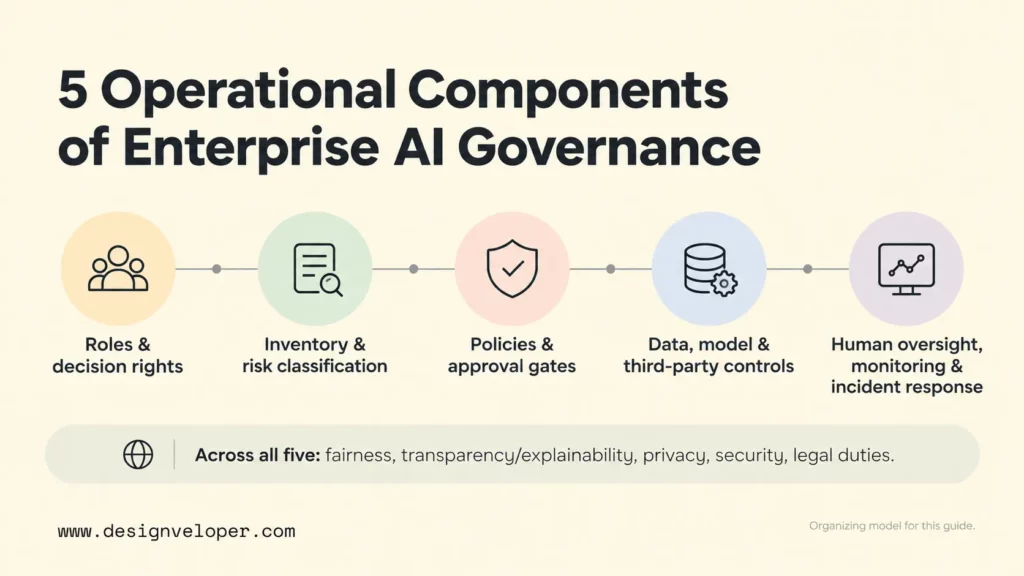
This guide groups enterprise AI governance into five operational components. They help teams assign owners, decide which controls apply, and keep evidence of their decisions. Five is an organizing choice, not a universal number of pillars. Fairness, transparency or explainability, privacy, security, and applicable legal duties matter across all five. Teams should assess them in proportion to each use case’s impact, even when the company’s department structure differs.
AI Governance Roles And Decision Rights
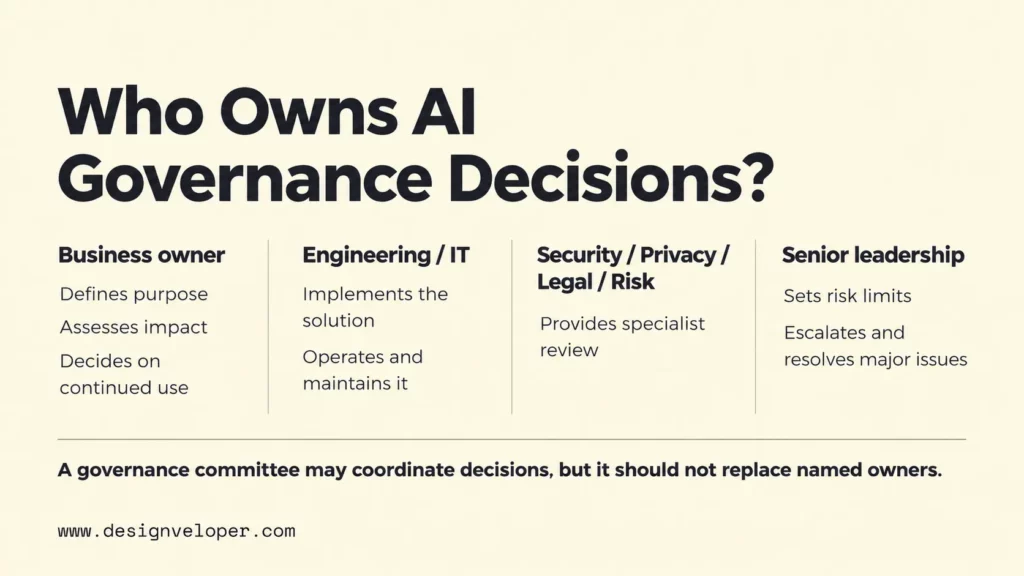
Give every AI use case one accountable business owner and a clear technical operator. The business owner is responsible for the purpose, impact, and decision to continue using it. Engineering or IT manages implementation and operations. Security, privacy, legal, and risk specialists review issues within their expertise. Senior leaders set risk limits and resolve decisions that go beyond a team’s authority.
Document who may approve a low-risk use, who must review a sensitive one, who accepts remaining risk, and who can suspend a system. A governance committee can coordinate difficult decisions, but it should not replace named owners. For consequential releases, consider keeping the reviewer separate from the person who built the system. The output is a responsibility and decision-rights record, not merely an organization chart.
Enterprise AI Inventory And Risk Classification
Maintain one register of AI uses across internal applications, purchased tools, embedded product features, experiments, and employee-adopted services. Record the business purpose, owner, vendor, affected users, data types, location of use, lifecycle status, and most recent review. Include a link to the technical system or supplier record so teams can trace each use to its actual components.
Classify each use by likely harm and exposure rather than the model’s marketing label. A draft summary for internal review usually needs a different level of oversight from a tool used to rank job applicants. Evaluate the stakes, the sensitivity of data, the people affected, and whether a human can detect or reverse a mistake. Internal risk tiers are management tools; they must not be confused with legal categories under the EU AI Act.
AI Governance Policies And Approval Gates
Policies should tell employees which AI uses are allowed, which are prohibited, and what requires approval. Set rules for data input, vendor selection, disclosure, testing, access, retention, and incorrect outputs. Where AI may affect people, require checks for unfair outcomes and a way to question consequential recommendations. Explain how a team requests an exception and who can grant it. An exception should name the risk, compensating control, owner, and expiry or review date.
Put approval gates into work that already happens. Procurement can ask whether a service contains AI and request supplier evidence. A product release can require a documented risk review and test results. Operational change control can reopen an approval when the model, data access, business purpose, or level of automation changes. Microsoft’s organizational AI governance guidance distinguishes assessing risks, documenting policies, enforcing them, and monitoring results. That distinction helps prevent policies from remaining paperwork.
Data, Model, And Third-Party AI Controls
Controls must follow the data and actions an AI system can reach. Check the source and permitted use of information, user access, encryption and retention, and whether a supplier may use submitted data for its own purposes. Record relevant model or application versions. Test the complete workflow after material changes because a model can perform well alone yet cause errors when connected to business data or software.
Third-party assurances need to match the actual use. A vendor’s general security statement does not show that a particular AI feature is suitable for sensitive customer records. Ask for applicable security documentation, data-handling terms, update notices, operational support, and an exit plan. When supplier details are unavailable, restrict the use until the remaining exposure is understood and accepted by the right owner.
Technical design makes these limits enforceable. In our guide to enterprise AI architecture and control boundaries, we explain how access checks, approval points, and audit records belong in the data and execution paths. A practical design review should show what the AI may read, what it may change, and which independent system enforces each permission. That is more useful than relying on a written instruction that asks a model to behave safely.
Human Oversight, Monitoring, And Incident Response
Human oversight should change an outcome, not merely add a person to an approval screen. Give reviewers enough context to challenge a recommendation, reject an action, and explain their choice. Define which decisions stay with people and when the AI must hand over control. Our article on human review in AI-driven decisions develops this distinction for workflows that affect customers and business operations.
Once a system is live, monitor errors, user complaints, unexpected behavior, access violations, and changes in performance. Assign someone to investigate alerts and decide whether to pause, roll back, or narrow the system’s use. Keep incident records and track corrective actions through completion. Define retention and access to these records according to applicable legal and business needs. Governance must continue after the launch approval.
The following is an illustrative ownership and evidence map. Job titles can change by organization; each row still needs an accountable role and a record that can be inspected.
| Governance component | Accountable owner | Evidence artifact |
|---|---|---|
| Roles and decision rights | Executive AI governance lead | Decision-rights matrix and approval log |
| Inventory and risk classification | AI portfolio or risk lead | AI register with dated assessments |
| Policies and approval gates | Policy or compliance lead | Approved policy, gate records, and exception register |
| Data, model, and supplier controls | Technical or security owner | Data map, test results, and supplier review |
| Oversight and incident response | Business operations owner | Review records, alerts, incidents, and closure evidence |
How To Build An Enterprise AI Governance Framework
Build the framework by moving from a defined business boundary to repeatable decisions and operational evidence. The six steps below follow one hypothetical example: a customer-support assistant that drafts refund responses using approved account information. It suggests an action but cannot issue a refund. The example shows how the documents and decisions connect; its proposed risk tier is not a legal classification.
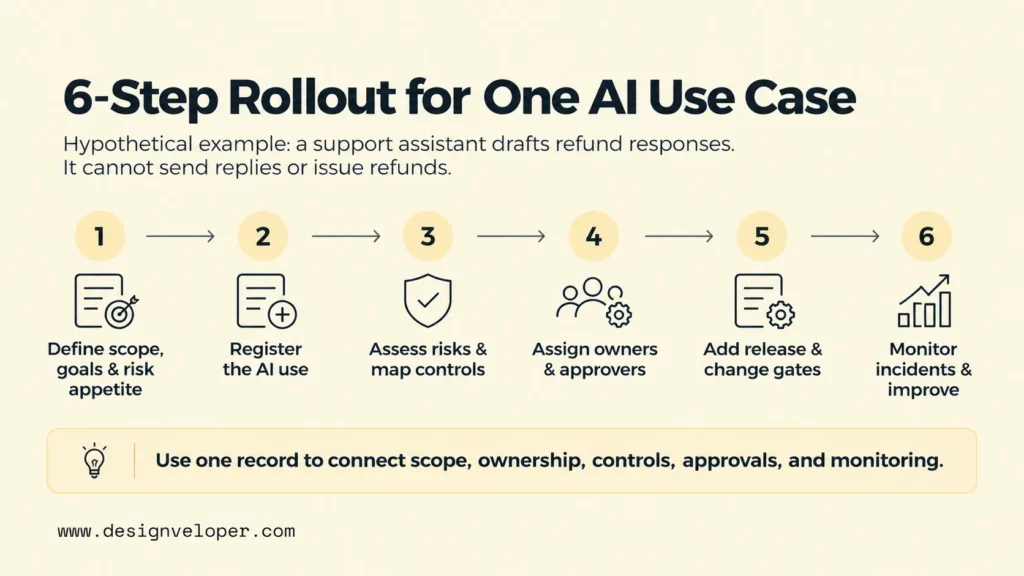
- Define scope, goals, and risk appetite. Decide which AI uses the framework covers, who has authority to set limits, and which outcomes matter. In the example, the goal is to help support staff prepare accurate replies. The assistant may use approved account information but must not send a reply or change a customer’s balance. Record those boundaries in a use-case charter. This makes later testing and approvals specific: the team is reviewing a drafting assistant, not an autonomous refund system.
- Find and register the AI already in use. Check IT and purchasing records, software catalogs, development teams, and employee disclosures. Include AI added through an update to an existing customer-service platform. The support assistant receives a register entry with its owner, supplier, data types, intended users, and connected applications. Compare the register with other discovery sources on a recurring basis. Unregistered tools should enter a review path instead of remaining invisible.
- Assess risks and map controls. Consider inaccurate refund advice, exposure of personal data, and staff following a wrong suggestion. For illustration, the company puts this assistant in a higher internal review tier because it handles account information. It requires restricted data access, sample-based quality tests, visible source records, and human approval of every outgoing reply. The assessment should record both the initial risks and the risks that remain after controls are applied. Legal reviewers separately check whether any relevant law creates a specific obligation.
- Assign accountable owners and approvers. The support manager owns the business outcome and approves permitted use. The application owner operates the integration. Security and privacy reviewers assess access and data handling. A named approver accepts any remaining risk within the company’s rules. Record who can block release or suspend use after an incident. This avoids a common gap in which engineering assumes the business accepted a risk while the business assumes IT approved it.
- Insert gates into purchasing, development, release, and change control. Supplier review checks data terms before procurement. Development tests wrong-account retrieval, misleading replies, and access boundaries. Release approval links to those test results and the signed risk decision. Operations reopens review if the assistant gains permission to issue refunds, switches supplier, or serves a new region. Our guide to moving an AI product from MVP to production explains why tested guardrails and operational readiness matter beyond a successful prototype.
- Monitor, respond, and improve. The support owner checks sampled drafts, correction patterns, complaints, and whether staff bypass the review step. Operations tracks incidents and time to contain them. If the assistant exposes the wrong account details, the team pauses access, investigates, records the impact, and confirms the fix before resuming. Reviews also ask whether controls remain proportionate to the current use. Monitoring evidence feeds back into policy and testing rather than staying in a separate dashboard.
Start with a manageable set of important use cases instead of waiting to discover every AI tool. Make registration and review easy enough for teams to use, then expand coverage. For autonomous tools that can execute actions, a separate control review is needed for permissions, action logs, and safe shutdown. Our AI agent governance guide covers those production-specific questions without replacing the broader enterprise framework.
How Do NIST AI RMF, ISO/IEC 42001, And The EU AI Act Fit Together?
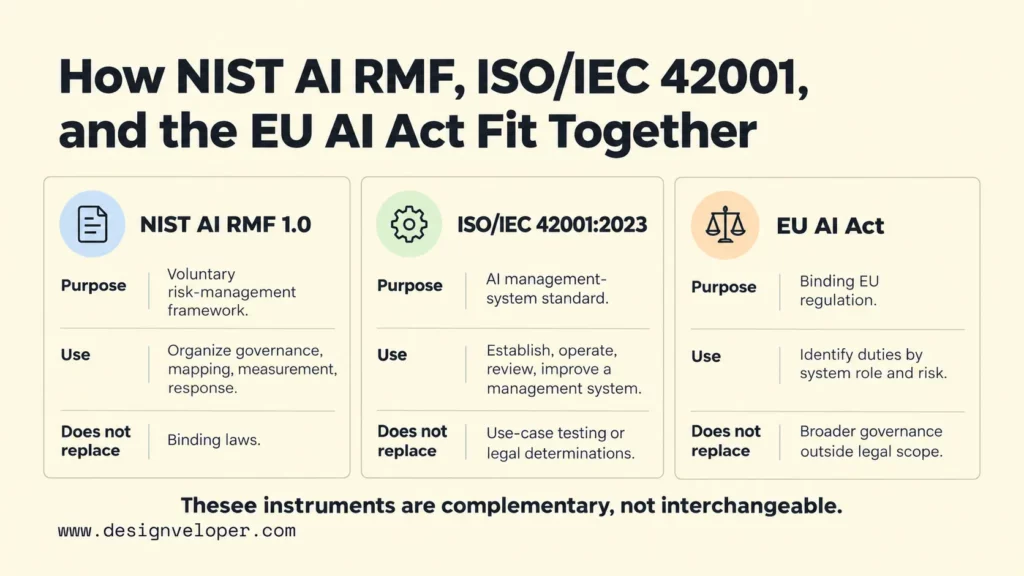
These three instruments serve different purposes. NIST AI RMF guides AI risk management. ISO/IEC 42001 sets requirements for an organizational AI management system. The EU AI Act creates binding obligations for systems and actors within its scope. An enterprise can use all three, but following a voluntary framework or management-system standard does not, by itself, establish legal compliance.
| Instrument | Main purpose | Practical use | Does not replace |
|---|---|---|---|
| NIST AI RMF 1.0 | Voluntary AI risk management framework | Organize governance, risk mapping, measurement, and response | Binding laws or a complete organization-specific control plan |
| ISO/IEC 42001:2023 | Requirements for an AI management system | Establish, operate, review, and improve company-wide management practices | Use-case testing or legal determinations |
| EU AI Act | EU regulation with risk- and role-based duties | Identify applicable obligations for specific systems and actors | Broader governance for uses and risks outside its scope |
The NIST AI Risk Management Framework Core groups activities under Govern, Map, Measure, and Manage. Govern works across the other functions. Its guidance includes AI inventories, clear responsibilities, third-party risk, monitoring, and safe retirement. As of October 2026, AI RMF 1.0 remains the published version, and NIST states that a revision is in progress. It is a voluntary framework, not a certification or law.
ISO/IEC 42001:2023 is the published first edition of the AI management-system standard. It specifies requirements for establishing, implementing, maintaining, and continually improving an AI management system. This gives management a way to assign responsibility and review the program over time. It does not decide whether a particular employment or healthcare use is lawful, nor does it remove the need to test the system’s real behavior.
The European Commission’s AI Act overview explains that obligations depend on an AI system’s risk and the organization’s role. As of 19 October 2026, the Act has applied in stages. Initial prohibited-practice rules and AI-literacy duties have applied since 2 February 2025. Rules for general-purpose AI models began applying on 2 August 2025, and certain transparency duties on 2 August 2026. Transitional exceptions still matter for individual systems.
Regulation (EU) 2026/1744, the AI Omnibus amendment, moved the application of specified high-risk requirements for Annex III systems to 2 December 2027. For high-risk systems covered by the relevant Annex I product legislation, the date is 2 August 2028. These dates do not suspend every other AI Act duty. Before deciding what applies, check the system’s classification, the company’s role, and any transitional rules or exceptions.
A workable approach is to maintain one AI inventory and control record, then map each use to NIST risk activities, relevant management-system processes, and any binding legal requirements. Keep the legal assessment separate and dated. A risk score used internally is not an EU legal classification, and a well-documented control is not proof that every applicable obligation has been met. Jurisdiction-specific counsel should review uncertain cases before consequential deployment.
How To Measure Enterprise AI Governance Effectiveness
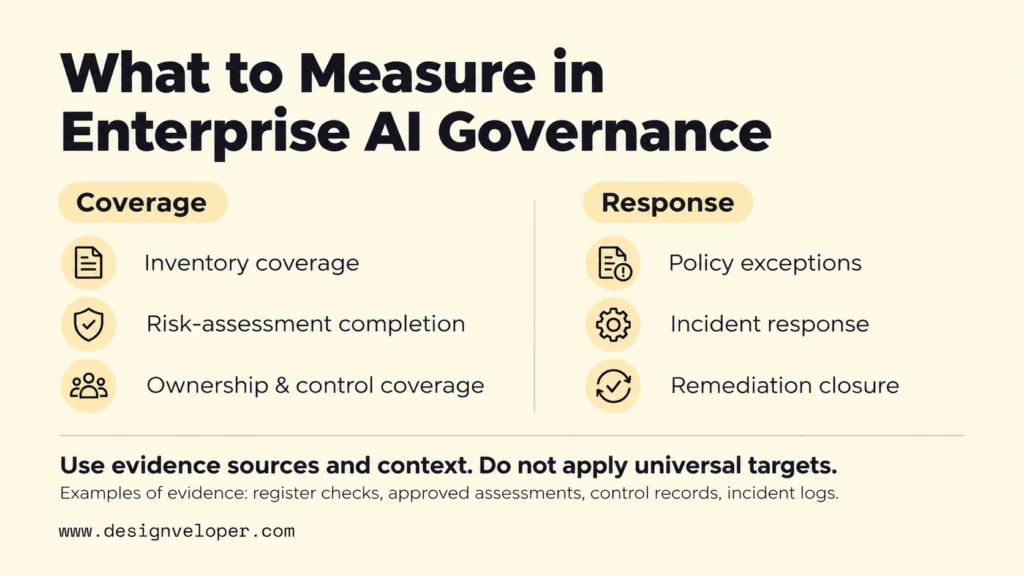
Measure whether the organization can find its AI, make justified decisions, and respond when controls fail. Policy publication alone is not an outcome. A useful governance report combines coverage measures with evidence of review quality, incidents, and finished corrective work. Set targets from the company’s risk profile and baseline rather than claiming one percentage is right for every enterprise.
| Metric | Definition | Evidence source |
|---|---|---|
| Inventory coverage | Registered uses divided by all uses found through register, purchasing, application, and team checks | AI register reconciled with procurement, application, and team records |
| Risk assessment completion | In-scope uses with current approved assessments divided by in-scope uses requiring assessment | Dated assessment and approval records |
| Ownership and control coverage | Share of in-scope uses with a named owner and evidence for all required controls | Owner fields, access reviews, tests, and control records |
| Policy exceptions | Open, overdue, and repeated exceptions, by risk tier | Exception register and expiry dates |
| Incident response | Time from detection to containment, with incident severity | Alerts, incident tickets, and response timeline |
| Remediation closure | Corrective actions closed by due date, including verified fixes | Issue tracker, retest results, and owner sign-off |
Interpret these numbers together. Inventory coverage only measures known discoveries; undiscovered shadow AI remains outside its denominator. More recorded exceptions may mean controls are weak, or that employees have started reporting them. A quick incident closure is less reassuring if the same failure returns. Review a sample of assessments and approvals to check their quality, then use findings to change controls, training, or decision rights.
Give each metric an owner, reporting period, and action threshold based on its consequences. For example, a newly discovered use of sensitive personal data may require immediate review, while a missing low-risk inventory field may enter a routine cleanup queue. The governance program is effective when its evidence changes decisions before avoidable harm repeats.
FAQs About Enterprise AI Governance
Does AI Governance Apply To Third-Party And Embedded AI Tools?
Yes. Enterprise governance should cover the AI a business uses, even when a supplier built the model or added the feature to ordinary software. Record the business owner, data shared, actions the tool can perform, and supplier responsibilities. Apply purchasing and change reviews when a vendor enables new AI features. Contract terms and vendor tests can support the review, but they do not transfer all responsibility for the company’s own use.
How Should An Enterprise Handle Shadow AI Already In Use?
Start by making disclosure safe and straightforward, then assess what the tools actually do. Ask employees which services they use, what data they enter, and whether outputs affect customers or decisions. Triage sensitive or externally connected uses first. Where a tool is unsuitable, provide an approved alternative and a practical migration path. Restrict urgent risks immediately, but avoid treating every unregistered low-risk experiment as an identical incident; that can discourage reporting.
How Often Should AI Use Cases Be Reassessed?
Use a risk-based review schedule and reassess whenever a material change occurs. Triggers include new data types, a new supplier or model, more autonomy, a different population of users, a new region, or a serious incident. Higher-impact systems may need more frequent review and monitoring. Put the next review date in the inventory and define who can reopen approval between scheduled reviews. No single reassessment interval fits every use case.
What Is The Difference Between AI Governance And AI Compliance?
AI governance is the organization’s ongoing system for making AI decisions, setting controls, and checking outcomes. AI compliance means meeting the specific legal and regulatory obligations that apply to a system and being able to demonstrate that result. Good governance helps teams manage compliance work, but it also covers business and ethical risks that a particular law may not address. The next practical step is to map each important AI use to an owner, a risk assessment, and a separate list of applicable legal duties.
Also published on

Share post on










Related Articles


LLM Deployment Pipeline: Stages, Testing, And Production At Scale
LLM Deployment Pipeline: Stages, Testing, And Production At Scale Published October 20, 2026
AI Model Monitoring: Metrics, Drift, And Production Reliability
AI Model Monitoring: Metrics, Drift, And Production Reliability Published October 20, 2026
Enterprise AI Governance Framework: Roles, Risks, And Controls
Enterprise AI Governance Framework: Roles, Risks, And Controls Published October 20, 2026