
















AI Voice Agent Platforms: Best Options For Business In 2026

AI voice agent platforms are software for building and operating agents that listen and respond over the phone or other voice channels. The best fit depends on your team’s skills and the task each call must complete. Retell AI suits production phone workflows, Vapi offers developer control, and Synthflow provides a more guided setup. Larger contact centers may prefer PolyAI or Cognigy. These recommendations compare published capabilities, integrations, and pricing, not independent hands-on benchmarks. Before choosing, test the full cost of a call, human handoff, and what happens when a business system fails.
Best AI Voice Agent Platforms At A Glance
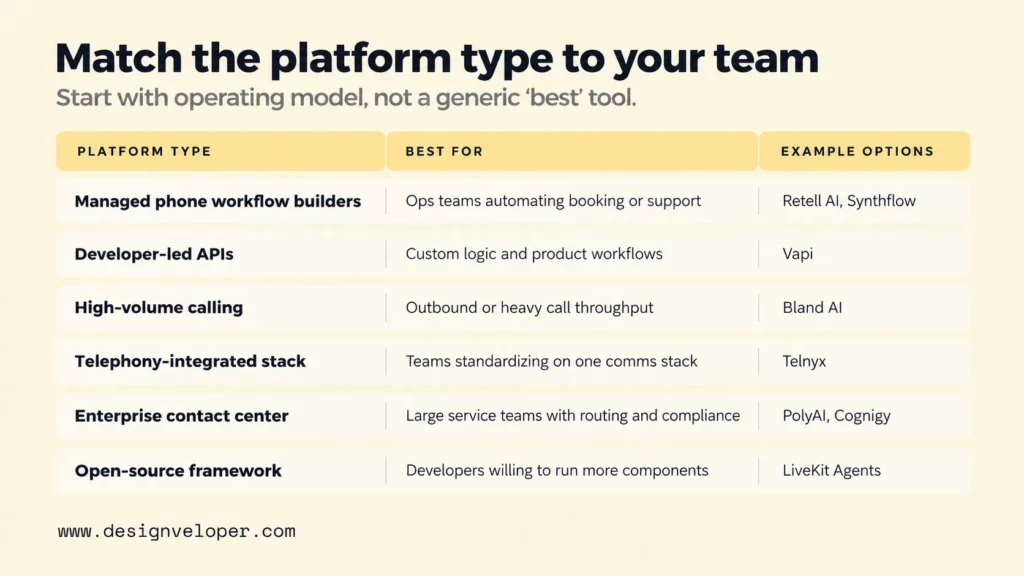
AI voice agent platforms differ in how much work they leave to your team. Start with the deployment model rather than an overall winner. Ask whether your team can operate that workflow with its current skills and systems. For the broader definition, use cases, and call mechanics, our guide to how AI voice agents work explains how speech, reasoning, and workflow actions fit together.
| Platform | Best fit | Deployment model | Integration approach / examples | Pricing model |
|---|---|---|---|---|
| Retell AI | Phone support and scheduling in production | Hosted voice-agent builder and APIs | API and webhooks; phone-provider connections | Usage-based voice minutes; enterprise quote |
| Vapi | Teams building customized voice products | Developer-first APIs and hosted orchestration | Telephony providers; APIs and model-service connections | Hosting per minute plus model and transport charges; optional plans |
| Bland AI | Outbound campaigns and high call throughput | Hosted API and visual conversation paths | Twilio; Session Initiation Protocol (SIP) for internet calls; webhooks | Per-minute usage with plan-dependent monthly fees |
| Synthflow | Guided setup for business phone workflows | Managed, low-code or no-code oriented platform | CRM and calendar connections; SIP and webhooks | Quoted enterprise contract |
| Voiceflow | Voice and chat customer experience journeys | Collaborative agent builder and managed deployment options | Zendesk; APIs and voice-channel connections | Agency usage billing; business quote |
| Telnyx | Voice agents tightly linked to phone infrastructure | Communications APIs and hosted voice-agent runtime | SIP and phone numbers; webhooks and agent tools | Voice-engine minutes plus models and telephony |
| PolyAI | Large existing contact centers | Enterprise voice platform integrated with current stack | NICE, Five9, Salesforce, Twilio | Quoted per-minute enterprise arrangement |
| Cognigy | Complex enterprise service and routing flows | Enterprise AI platform and Voice Gateway | Genesys, NICE, other contact-center systems | Contract-based licensing and scoped costs |
Starter offers let buyers test a workflow, but they do not establish production cost. As of October 2026, Retell lists $10 in trial credits and Vapi lists $5. Bland’s Start plan includes two credits and an inbound phone number that Bland values at $15 per month. Voiceflow offers agencies and partners a free trial without a credit card; businesses request a quote. Check eligibility and usage limits before planning a pilot.
Teams that need an open-source option can consider LiveKit Agents, the Apache 2.0 voice-agent framework. Developers can build agents in Python or Node.js, connect phone calls through SIP, and deploy to LiveKit Cloud or their own environment. It is not a like-for-like managed SaaS alternative to the platforms in the table. The team must plan model services, telephony, hosting, integrations, and ongoing operations separately.
Best AI Voice Agent Platforms By Use Case
Each platform can support several workflows. The distinctions below describe where its published capabilities and commercial model provide a useful starting fit, and what a buyer still needs to prove in a pilot.
Retell AI For Production Phone Automation
Retell AI is best for teams that want to automate an established phone task, such as booking or first-line support, without assembling every voice component themselves. Its hosted platform provides call analytics, transcripts, simulation tests, safety controls, and access to webhooks and APIs. These features matter when a manager needs to inspect failed calls and refine the workflow before sending more traffic to the agent.
For integrations, confirm how a Retell agent will read records, perform approved actions, and transfer calls through your chosen phone provider. The Retell AI pricing page lists voice-agent usage at $0.07-$0.31 per minute depending on configuration, with custom enterprise terms and $10 in starter credits. Telephony and optional capabilities can affect the final bill. The main limitation is that a working call script still needs external data access, permissions, and end-to-end testing.
Vapi For Developer-Led Voice Agents
Vapi is best when developers need to control the agent’s models, tools, and application behavior. Rather than treat the agent as an isolated phone bot, a team can combine its voice infrastructure with selected speech services, language models, and business APIs. That flexibility is useful for a product with unusual conversation rules or existing backend services.
Vapi supports connections to telephony providers and external tools, but engineers must own more of the configuration and failure handling. The Vapi pricing page lists $0.05 per minute for hosting on the entry option, with model costs passed through and transport charges depending on provider. It also lists $5 in starter credits and optional paid support packages. The important limitation is that the hosting rate is not the total price of an answered call.
Bland AI For High-Volume Calls
Bland AI is a candidate for teams managing many routine outbound or inbound conversations. Its conversation pathways, batch calling tools, monitoring, and concurrency limits make call throughput an explicit buying factor. High volume is not proof of better outcomes, however. The agent still needs safeguards against repeated contacts, bad data, and unsuccessful transfers.
Bland supports Twilio, SIP connections, webhooks, and tool-based integrations. The Bland AI pricing page lists a Start tier at $0.14 per minute with no monthly platform fee and a Build tier at $0.12 per minute plus $299 monthly. Enterprise pricing is quoted. The listed minute rates include the language model and speech services, while telephony is separate. Check daily call caps and concurrent-call allowances before assuming either tier can handle your peak demand.
Synthflow For No-Code Phone Agents
Synthflow is worth considering when operations teams want a more guided way to launch phone agents and work with an implementation partner. Its published enterprise offering covers routing, escalation, testing, and launch support. It can connect to calendars, CRM systems, webhooks, and APIs. Its official Bubble integration guide explains how to connect a no-code Bubble app. This reduces some setup work but does not remove the need to define business rules.
The Synthflow pricing page says enterprise contracts start at $30,000 annually, with the final figure based on traffic, phone setup, integrations, security, and support. This is a significant qualification to its no-code positioning: a smaller business should request a current quote and confirm whether any suitable self-service arrangement is available. Do not assume an older published pay-as-you-go offer still applies.
Voiceflow For Customer Experience Workflows
Voiceflow is best for teams coordinating voice and chat support around the same customer journey. Its agent builder, collaboration tools, monitoring, and support-system connections help teams design more than a simple scripted phone answer. For example, a caller may ask about an existing case and need the result logged to a helpdesk rather than merely spoken aloud.
The Voiceflow Zendesk integration guide documents actions such as creating and updating tickets, as well as phone-channel integrations and APIs. The Voiceflow pricing page advertises a free trial and usage billing for agencies, while business teams request pricing. The limitation is procurement clarity: confirm the charges, phone connection, human routing, and included support for your specific setup rather than treating the trial as an enterprise quote.
For service teams, our AI voice agents for customer service guide explains why caller context and reliable handoff matter as much as speech quality. Use that distinction when deciding whether a general-purpose builder can meet a contact center’s operating rules.
Telnyx For Telephony-Integrated Voice AI
Telnyx is best for teams that want the voice agent and phone network managed within a closely connected communications stack. It combines call handling with agent orchestration and offers tools for interruptions, speech processing, and external actions. This setup may reduce the number of vendors a developer needs to coordinate, although it also makes the telephony relationship more important.
The Telnyx voice-agent pricing page lists $0.05 per minute for the engine, including orchestration and hosted speech-to-text and text-to-speech. Language-model tokens and carrier charges are additional. Telnyx’s online estimate leaves out voice-engine rounding to 60-second increments for each call. Actual charges can be higher, especially for short calls. Telnyx also publishes pay-as-you-go and committed-spend options. The limitation is geographic and technical fit: verify number coverage, carrier routing, and actual model usage for the countries and languages you serve.
PolyAI And Cognigy For Enterprise Contact Centers
PolyAI and Cognigy are best evaluated by contact centers that already have routing, workforce processes, and compliance responsibilities. Specifically, PolyAI emphasizes voice conversations linked to the existing customer-service stack. The PolyAI integrations page lists NICE, Five9, Salesforce, and Twilio. According to the PolyAI pricing page, ongoing use is billed per minute with support and maintenance included. A standard amount is not published for every buyer.
Cognigy takes a broader enterprise orchestration approach. The Cognigy Voice Gateway page describes connections between AI conversations and contact-center phone systems, with call control, live handoff, and monitoring. The Cognigy contact-center integrations page lists systems including Genesys and NICE. Commercial terms need a scoped vendor quote. For either product, ask for a working demonstration with your routing rules and data before signing a large agreement. Neither enterprise label guarantees a successful migration.
How To Choose An AI Voice Agent Platform
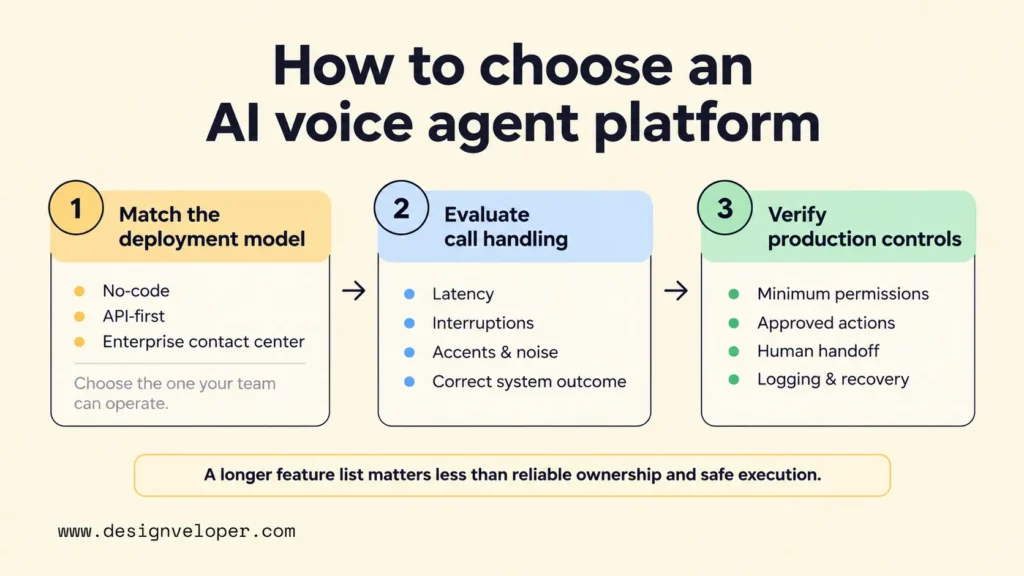
Choose an AI voice agent platform by testing who will maintain it, how callers experience it, and what it can safely do in your systems. A platform is suitable only if the team can keep the whole journey working after the initial demo.
Match The Deployment Model To Your Team
Use a no-code or guided builder when one operations team owns a narrow workflow and needs to change prompts without regular engineering help. Choose an API-first platform when the agent must share application logic, data access, and release controls with other software. An enterprise contact-center product fits better when phone routing, staff handoff, security review, and vendor support already span several departments.
Ask who will repair a failed booking at 9 p.m. If nobody can trace the failed API call, a flexible developer product may be too demanding. If every business change requires a vendor request, a managed platform may be too restrictive. The right deployment model reflects real ownership, not simply the number of features in a sales presentation.
Evaluate Voice Quality And Call Handling
Measure the conversation under ordinary and difficult calling conditions. Test response delay after a caller finishes speaking, interruptions while the agent talks, recognition of names and booking numbers, accents, language changes, background noise, and dropped connections. A smooth sample recording is not a useful substitute for these tests.
For an appointment agent, try a caller who changes the date halfway through, interrupts to ask about cancellation, then gives a noisy phone number. Check the final calendar record and not just the transcript. A small delay may be tolerable when the result is correct. A fast answer that books the wrong appointment is not. Measure the full caller journey rather than relying on an unscoped latency claim from a provider.
Verify Integrations And Production Controls
A voice agent should access only the records and actions required by its task. Before purchase, test phone-number setup, CRM or calendar connections, identity checks, human transfer, logging, retention controls, and error recovery. Ask where call recordings and transcripts are stored and who can access them. Security documents alone do not prove that your implementation is configured correctly.
Ask each vendor to demonstrate one approved action against a test CRM or calendar. Check that the agent requests only necessary permissions, records the result, and handles a rejected request without claiming success. Our guide to AI chatbot integration explains how to test these connections as complete business workflows. Voice adds real-time responses and call-transfer requirements to that foundation.
What Do AI Voice Agent Platforms Cost?
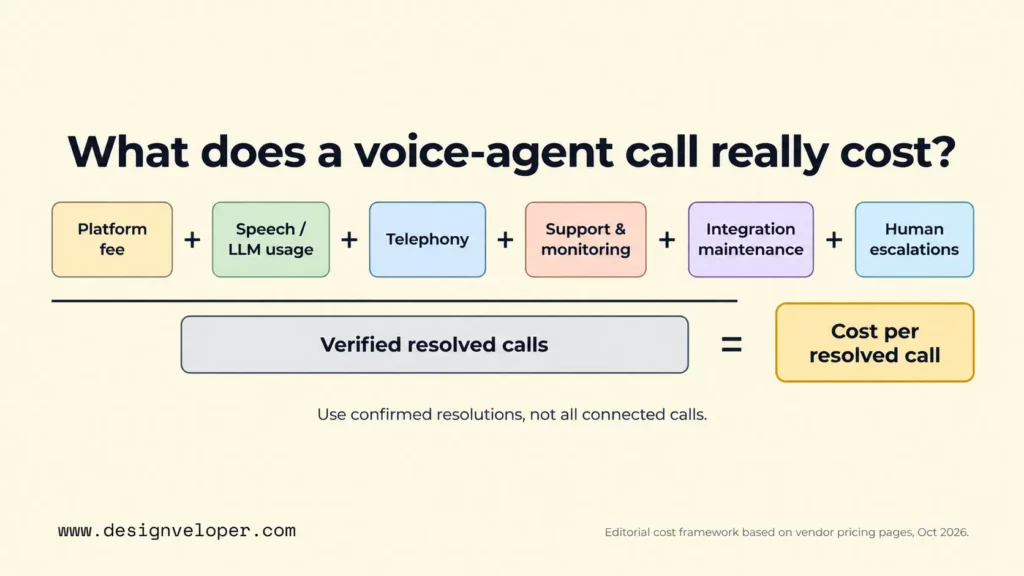
AI voice agent software can have a per-minute fee, a fixed subscription or contract, and extra charges for the services that complete a call. The advertised number often covers different components from one vendor to another. Compare a full resolved call, not two headline minute rates.
Per-minute pricing can cover different parts of a call. Start by asking whether the fee includes the agent engine, speech processing, and language-model usage. Then check phone carrier charges, number rental, minimum commitments, and support. Request a price for the same sample workflow from each vendor. The quote should show what is included and what is billed separately.
Budget for the phone connection as a separate line even when the agent platform offers its own numbers. For example, Twilio’s U.S. voice pricing lists $0.014 per minute for outbound local calls and $0.0085 for incoming local calls. Twilio labels those rates current as of August 2026. They cover U.S. programmable voice calls, not global calling or complete AI-agent costs. Rates differ by destination, number type, and features.
Estimate your monthly cost from call volume, platform and model usage, carrier and phone-number charges, support, and monitoring. Include ongoing integration maintenance and the cost of human escalations. Divide that total by verified resolved calls, not all connected calls. If an illustrative month has 1,000 connected calls but only 600 confirmed resolutions, use 600 as the denominator. Keep one-time implementation work in a separate budget, as explained in our AI app development cost guide.
Pilot A Voice Agent Before Scaling
Run a limited pilot on one repeatable task before connecting an AI agent to your main phone traffic. Support overflow, appointment booking, or basic lead qualification are practical candidates when the business rules are clear and a human can take over. Define success using completed actions in the underlying system, not only calls answered.
- Bound the task. Name what the agent may answer or change, what needs confirmation, and when it must transfer to a person.
- Connect one trusted system. Test a read action and an approved write action, including timeouts, invalid inputs, and duplicate requests.
- Use representative calls. Cover accents, interruptions, noise, wrong numbers, corrections, unexpected questions, and deliberate requests for a person.
- Measure verified outcomes. Track task completion, latency, transcription errors, successful handoffs, integration failures, repeat contacts, and cost per resolved call.
- Set a release decision. Agree on acceptable failure rates and review real cases before increasing volume. Keep a rollback and human-only route ready.
In an illustrative clinic pilot, the agent checks calendar availability and repeats the selected time. It writes the booking only after the caller confirms. If the calendar API times out, it transfers the request and collected context to staff. An API-first platform may suit a team that already maintains scheduling integrations. A guided builder may take less setup work, but it needs the same confirmation and failure tests. Our guide to building agentic AI explains how to define tool permissions, stop rules, and evaluation before expanding the agent’s authority.
Before scaling, ask whether the agent completes the approved task accurately and transfers difficult calls with useful context. Check that it meets your security and service requirements. Then compare cost per verified resolution with the existing process. If an answer is unknown, extend the pilot instead of buying more minutes.
If connecting a chosen platform to a CRM, scheduling system, or custom application is the remaining obstacle, we can help scope that integration through our AI development services. Begin with the exact business action, required access, failure response, and acceptance test. That specification is useful whether you build the connection with us or with your own team.
Also published on

Share post on










Related Articles


AI Voice Agent Platforms: Best Options For Business In 2026
AI Voice Agent Platforms: Best Options For Business In 2026 Published October 15, 2026
Generative AI Vs. Discriminative AI: Key Differences and Use Cases
Generative AI Vs. Discriminative AI: Key Differences and Use Cases Published October 15, 2026
RAG Cost: What It Takes To Build And Run A RAG System
RAG Cost: What It Takes To Build And Run A RAG System Published October 15, 2026


















