











POC Vs MVP Vs Prototype: How To Choose The Right Validation Step

KEY TAKEWAYS:
- POC vs MVP vs prototype is a decision about which risk to test first: technical feasibility, user experience, or real-world value.
- Use a POC when the main question is whether a capability, integration, model, or architecture can work under required constraints.
- Use a prototype when the main question is whether users understand, trust, and complete the proposed workflow.
- Use an MVP when feasibility and usability are clear enough, and the next question is adoption, retention, willingness to pay, or operational behavior.
- A strong validation flow defines one hypothesis, measurable evidence, ownership, success criteria, and a decision rule before the team builds more.
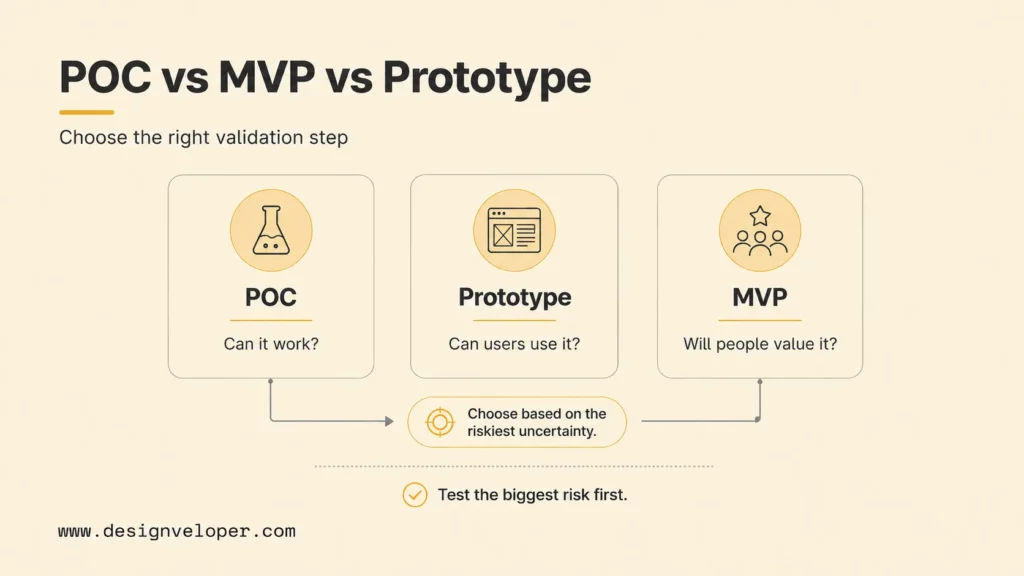
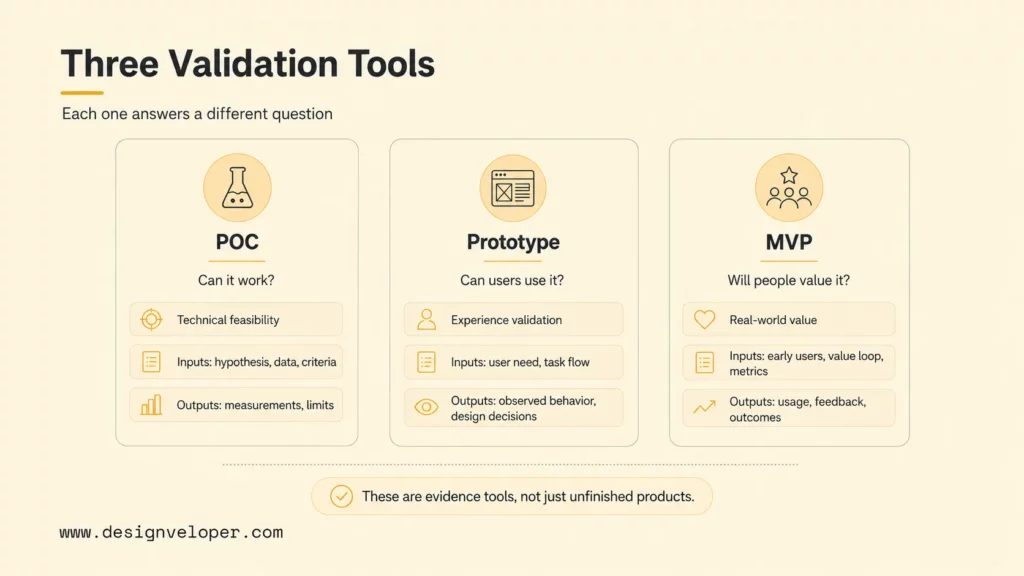
POC vs MVP vs prototype is a choice between three different validation questions. A proof of concept asks whether a difficult technical idea can work. A prototype asks whether users understand and can navigate the proposed experience. A minimum viable product asks whether real users receive enough value from a functioning product to adopt, return, pay, or change behavior.
Teams do not always need all three stages, and the stages do not have to follow a rigid sequence. The correct starting point is the riskiest unproven assumption. A team with uncertain AI accuracy may need a POC before interface design. A team with proven technology but an unclear workflow may start with a prototype. And a team with strong feasibility and usability evidence may move directly to a narrow MVP.
Quick decision guide: Choose a POC when failure is mainly technical, a prototype when failure is mainly about comprehension or usability, and an MVP when the next unknown is real-world value or demand. Define one decision and measurable success criteria before building. Stop, revise, or change the validation method if the evidence cannot answer that decision.
| Primary uncertainty | Best validation step | Evidence to collect | Typical next decision |
|---|---|---|---|
| Can the technology achieve a required outcome? | POC | Accuracy, latency, integration, throughput, security, or cost measurements | Proceed, change the technical approach, narrow scope, or stop |
| Can users understand and complete the intended workflow? | Prototype | Observed task completion, errors, comprehension, and usability feedback | Revise the flow, compare alternatives, or prepare the build scope |
| Will people use and value a working product in context? | MVP | Activation, repeat use, workflow outcome, conversion, willingness to pay, and support burden | Iterate, pivot, scale, or stop |
Recommended for you:
- MVP Development Cost In 2026: Budget Guide And Timeline
- 10 Notable Minimum Viable Product (MVP) Examples
- MVP in Agile: Trends, Types, and Development Guide
What Is POC Vs MVP Vs Prototype?
POC, prototype, and MVP are evidence-producing tools, not three names for an unfinished product. Each tool controls investment by testing a different class of risk before the team commits to a larger build. The clearest distinction is the question being answered, the audience observing the result, and the standard of quality required. Teams that also use Agile software development can connect each experiment to a delivery decision instead of treating validation as a separate phase.
Explore more:
- How To Develop A Low-Code MVP: A Step-By-Step Guide
- How To Build An App For Your Business In 10 Steps?
- App Development Project Management: Methodologies And Tools
Proof Of Concept (POC)
A proof of concept is a bounded technical experiment used to determine whether a capability is feasible under stated conditions. A POC may test whether an AI model reaches an acceptable evaluation score, an external API supports a critical workflow, a migration preserves data, an algorithm performs within a latency target, or an automation can handle representative exceptions.
A POC does not need a polished interface or production architecture unless those qualities are part of the uncertainty. The output is usually test code, measurements, constraints, failed cases, and a recommendation. A successful POC should explain not only that something worked once, but under which data, load, security, integration, and cost assumptions it worked.
AWS Prescriptive Guidance treats a generative AI POC as a way to validate business value, data readiness, technical feasibility, and risk mitigation rather than as a demo alone. Its POC architecture guidance recommends connecting technical measurements to business goals and evaluating integrations, privacy, security, scalability, maintainability, latency, concurrency, and unit economics. The same discipline is useful beyond AI.
- POC input: one technical hypothesis, representative data or dependencies, constraints, and pass/fail criteria.
- POC output: measurement results, limitations, unresolved risks, reusable learning, and a proceed/change/stop recommendation.
- POC warning: a controlled result does not prove usability, demand, operational readiness, or scalability beyond the tested conditions.
Prototype
A prototype is a representation of the product experience used to explore, communicate, and test a design. It can be a paper sketch, wireframe, clickable interface, service blueprint, conversational script, coded interaction, or physical model. Fidelity should be high enough to elicit realistic behavior but no higher than the question requires.
Prototype testing focuses on whether people notice the right information, understand labels, predict outcomes, complete tasks, recover from errors, and trust the workflow. Stakeholder approval can support alignment, but it cannot replace sessions with representative users. Users should attempt realistic tasks while the team observes behavior instead of relying only on opinions about appearance.
The GOV.UK prototyping guidance recommends using prototypes to explore and test designs before committing to production and notes that prototype code does not need production-level security or performance. That difference matters: prototype code may be disposable, and copying it into a live service can carry hidden accessibility, security, data, and maintainability problems.
- Prototype input: user need, task scenario, design hypotheses, alternative flows, and a research plan.
- Prototype output: observed behavior, comprehension problems, task breakdowns, design choices, and revised workflow requirements.
- Prototype warning: realistic appearance does not prove that integrations, business rules, or infrastructure work.
Minimum Viable Product (MVP)
A minimum viable product is the smallest functioning product that delivers a coherent outcome to a defined early-user group and captures evidence about value. The word viable is essential. An MVP needs enough reliability, security, support, and workflow completeness for the intended context, even when the feature set and audience are deliberately narrow.
An MVP tests behavior in real conditions: whether users activate, complete the core task, return, invite others, pay, save time, reduce errors, or produce another defined outcome. ProductPlan’s minimum viable product overview describes an MVP as having enough features to attract early adopters and validate an idea through user feedback. The useful unit is not feature count; it is the smallest end-to-end value loop that generates reliable learning.
An MVP may include manual operations behind the interface when the team is testing demand rather than automation. Manual work must be safe, disclosed where necessary, and measurable. A concierge workflow can test whether customers value a service before the team builds a complex recommendation engine, but it cannot prove that the future automation will be feasible or economical.
- MVP input: validated problem, defined early-user segment, core value loop, launch safeguards, and learning metrics.
- MVP output: usage behavior, outcome data, qualitative feedback, operational cost, support patterns, and business-model signals.
- MVP warning: minimum does not mean incomplete, unsafe, or confusing; low quality can invalidate the market test.
POC Vs Prototype Vs MVP: Key Differences
The key difference is the evidence target. A POC produces feasibility evidence, a prototype produces experience evidence, and an MVP produces real-use evidence. They may share tools or code, but a shared artifact does not make their decision purpose interchangeable.
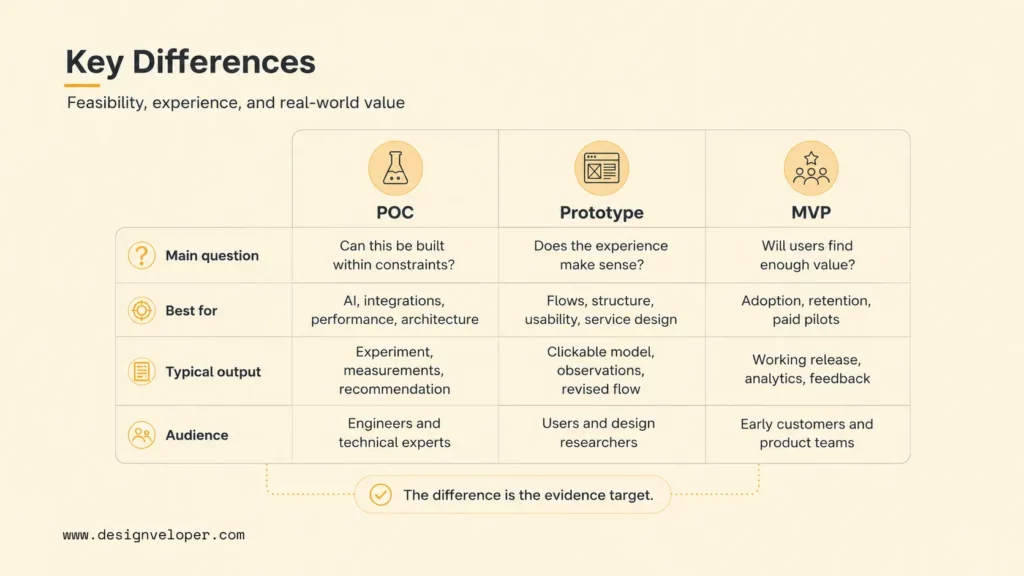
| Validation Type | Main Question | Best For | Typical Output |
|---|---|---|---|
| POC | Can this be built or integrated within required constraints? | Technical feasibility, data readiness, performance, algorithms, AI, and architecture | Experiment, measurements, limitations, feasibility decision, and technical recommendation |
| Prototype | Does the experience make sense to users and stakeholders? | Flows, information structure, interaction, usability, service design, and alignment | Sketches or clickable model, research observations, revised flow, and design decisions |
| MVP | Will real users find enough value in a functioning product? | Adoption, retention, workflow outcomes, paid pilots, and business-model learning | Working release, analytics, user feedback, operational evidence, and product decision |
The audience also differs. Engineers, architects, security specialists, and domain experts often evaluate a POC. Representative users and design researchers evaluate a prototype. Early customers, product managers, support staff, operations, and business owners participate in MVP learning. Involving the wrong audience creates false confidence: an executive may like a prototype, but cannot reveal whether a new customer understands onboarding.
The build standard increases as exposure increases. A disposable POC may use test data and temporary infrastructure. A prototype may simulate a response and protect access so it is not mistaken for a live service. An MVP handles real users or real operational work, so authentication, data handling, accessibility, monitoring, backup, incident response, and support must match the launch risk.
A validation artifact is successful when it changes a decision, not when it looks impressive in a presentation.
When To Use Each Product Validation Step
Use the validation step that tests the most consequential uncertainty with the least irreversible investment. A project can use more than one method in parallel when technical and experience risks are independent, but each experiment should retain its own hypothesis and success criteria.
Further reading:
- 20 Web App Ideas: Health, FinTech, AI, E-commerce
- Best Small Business Applications For Owners And Freelancers
- 10 Tech Startup Ideas Can Scale from MVP to Real Business
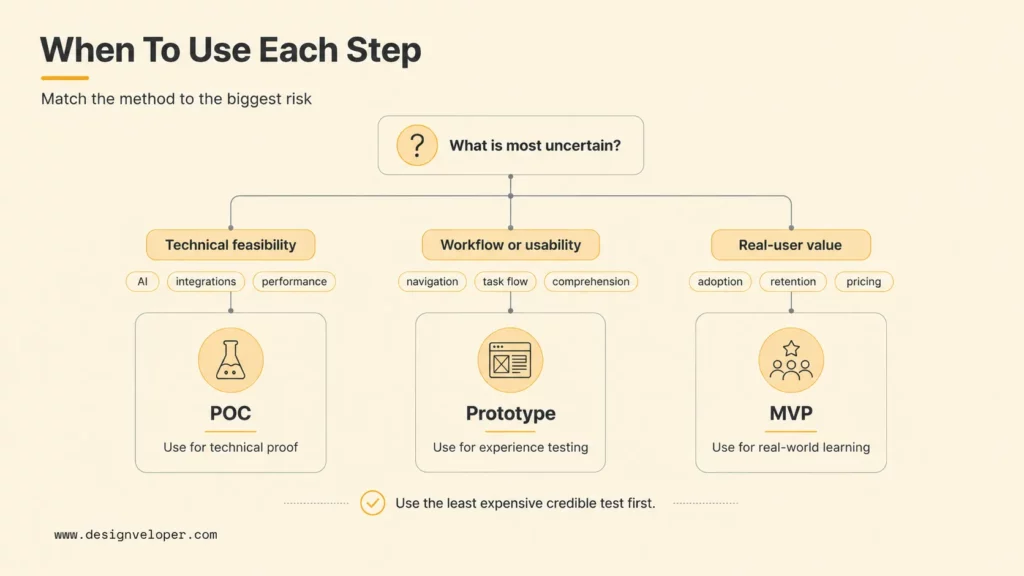
Use A POC For Technical Feasibility
Use a POC when the business case depends on a capability that has not been demonstrated in the target environment. Common candidates include AI features, complex integrations, new algorithms, automation workflows, data pipelines, third-party APIs, legacy migration, unusual hardware, high-volume processing, or uncertain architecture.
Write the POC as a falsifiable hypothesis. For example: “The document classifier will correctly route at least 90% of a representative 500-document evaluation set, return within three seconds at the expected concurrency, and keep model cost below the agreed amount per document.” The numbers must come from the business context; their role is to prevent a handpicked demo from being called proof.
Use representative inputs, including messy and failure cases. Record environment, versions, test data, assumptions, and repeatability. For an integration, test rate limits, authentication, timeouts, errors, retries, sandbox differences, and data mapping. For AI, test output quality, retrieval, permissions, latency, model variability, misuse, and human escalation. End with the conditions under which the result remains valid.
Use A Prototype For UX And Stakeholder Validation
Use a prototype when the team needs to compare workflows, test comprehension, explore interaction, communicate a service, or align stakeholders before production engineering. Prototypes are especially valuable for multi-step onboarding, approvals, dashboards, checkout, booking, mobile navigation, conversational interfaces, and workflows with handoffs between people.
Choose fidelity deliberately. Paper sketches make alternative concepts cheap. Clickable wireframes test navigation and labels. High-fidelity interfaces can reveal trust and content problems. Coded prototypes support realistic device behavior or accessibility exploration. Higher fidelity can make participants believe the product is finished, so researchers should explain what is simulated without describing the intended answer.
Create task scenarios based on real user goals. Observe whether participants start in the expected place, understand choices, complete the task, recognize success, and recover from errors. The GOV.UK moderated usability testing guide recommends watching participants perform specific tasks and using think-aloud behavior to understand what they are doing, thinking, and feeling.
Use An MVP For Real-User Validation
Use an MVP when technical feasibility and the core experience are sufficiently clear, but demand, repeated value, adoption, pricing, or operational behavior remains uncertain. Suitable contexts include a private customer pilot, a new internal workflow with one team, a limited regional launch, a single-segment SaaS product, or one marketplace category.
Define the value event before defining features. For a scheduling product, the event may be a completed booking without staff intervention. For document automation, it may be an approved output that saves review time. For an AI assistant, it may be a task completed correctly with acceptable human correction. Build only the path necessary to deliver and measure that outcome safely.
Plan both product and operational metrics: acquisition source, activation, task completion, time to value, repeat use, retention, payment or pilot continuation, failure rate, support contacts, manual effort, infrastructure cost, and security events. Interview behaviorally: ask about the last completed task and observed alternatives instead of asking whether someone would hypothetically use a future feature.
Key Decision Points Before Building An MVP
Before building an MVP, confirm that the remaining uncertainty requires a working product in real conditions. If the main question can be answered by an interview, landing-page test, technical spike, or clickable flow, an MVP may be an unnecessarily expensive experiment.
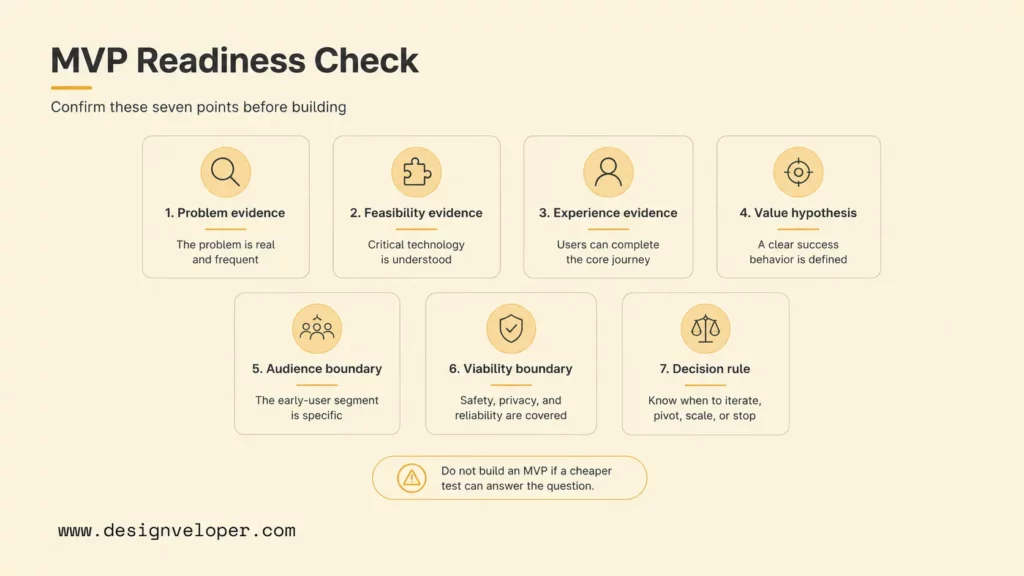
- Problem evidence: representative users experience the problem often enough, and the current alternative has a meaningful cost.
- Feasibility evidence: critical technology, data, integrations, and constraints are understood well enough to estimate a safe first release.
- Experience evidence: users can understand the core journey and the team has addressed major workflow failures.
- Value hypothesis: the team can name the behavior or outcome that would justify continued investment.
- Audience boundary: a specific early-user segment, access model, and recruitment path exist.
- Viability boundary: the release includes appropriate security, privacy, accessibility, reliability, monitoring, support, and recovery.
- Decision rule: success, ambiguity, and failure lead to predefined iterate, pivot, scale, or stop actions.
For POC vs MVP, choose a POC when feasibility remains uncertain; choose an MVP when the team needs evidence of real demand or behavior. A technically successful POC does not prove that customers care, while a failed technical assumption can make an MVP too slow or unreliable to test demand fairly.
For prototype vs MVP, choose a prototype when navigation, content, trust, or workflow still needs clarification; choose an MVP when the product must operate with real identities, data, integrations, outcomes, and support. Prototype feedback reveals interaction problems, while MVP usage reveals whether the complete value exchange survives everyday conditions.
| Decision test | Evidence is ready when… | If it is not ready… |
|---|---|---|
| Technical risk | Critical capability meets defined conditions with known limitations | Run or extend a POC |
| Workflow risk | Representative users complete the core journey and understand outcomes | Prototype alternatives and test again |
| Launch risk | Security, data, accessibility, monitoring, support, and recovery fit the pilot | Narrow the audience or strengthen the release |
| Learning value | Real usage will answer a decision that cheaper research cannot | Use a smaller experiment before an MVP |
Product Validation Flow From Idea To MVP
A risk-first validation flow begins with the riskiest assumption, selects the cheapest credible test, and converts evidence into an explicit investment decision. The flow can loop or skip a method. Product validation is not a conveyor belt in which every idea automatically reaches an MVP.
For practical examples, check out:
- 7 Stages of Mobile App Development Process
- Web App Development Cost: 2026 Breakdown
- Top 20 Web App Development Companies
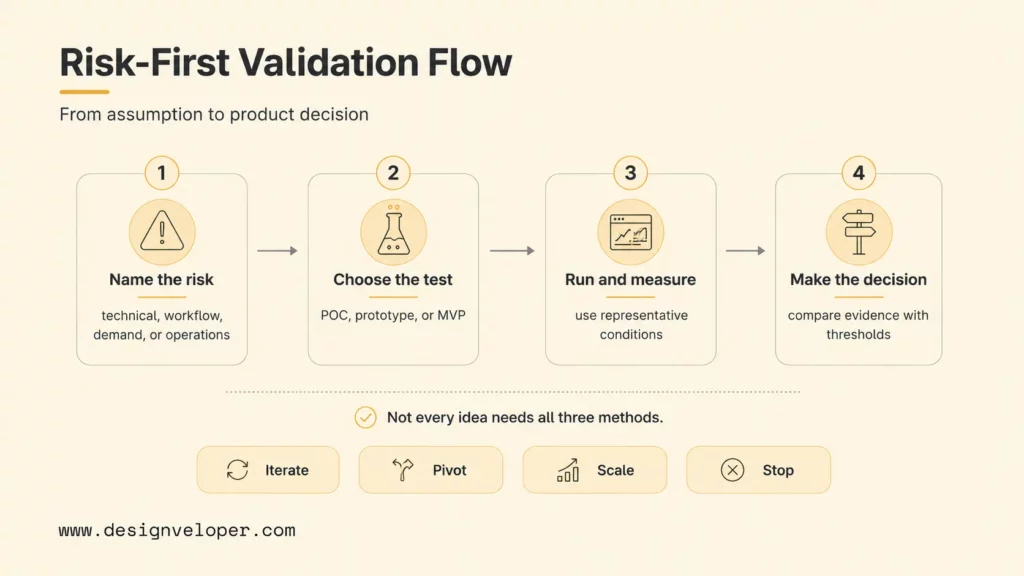
Reader asset: POC, prototype, and MVP are selectable tests inside one learning loop, not mandatory consecutive deliverables.
Start by writing an assumption backlog. Score each assumption by the damage if it is false and the current lack of evidence. Test the highest combined risk first. A product may have a desirable user problem but an infeasible integration; another may use proven technology but lack a trusted workflow. The risk score prevents the most visible feature from dominating the validation plan.
Define a decision memo before the experiment. Include the hypothesis, why it matters, method, sample or test data, success threshold, timebox, owner, evidence storage, and decision options. Precommitment reduces the temptation to reinterpret weak results as success. When evidence is mixed, identify which uncertainty caused ambiguity and design the next smallest test.
Validation can stop an idea without making the work a failure. A POC that reveals unacceptable latency, a prototype that exposes a misunderstood workflow, or an MVP that fails to retain early users can prevent a much larger loss. Preserve the findings so a future team does not repeat the same experiment under the same assumptions.
Build the smallest test that can disprove the most expensive assumption before it becomes architecture, roadmap, and sunk cost.
Converting Validation Evidence Into A Focused Build Plan
Validation evidence becomes useful for delivery when findings are translated into scope, acceptance criteria, architecture constraints, and a learning plan. A screenshot deck or successful demo is not enough. The build team needs to know what was tested, what was simulated, what failed, and what remains unknown.
Related reading:
- AI In Product Development: From Concept To Market Faster
- What Is Quality Control? Short Guide About QC Responsibility
- How To Build And Use AI Business Process Automation Effectively
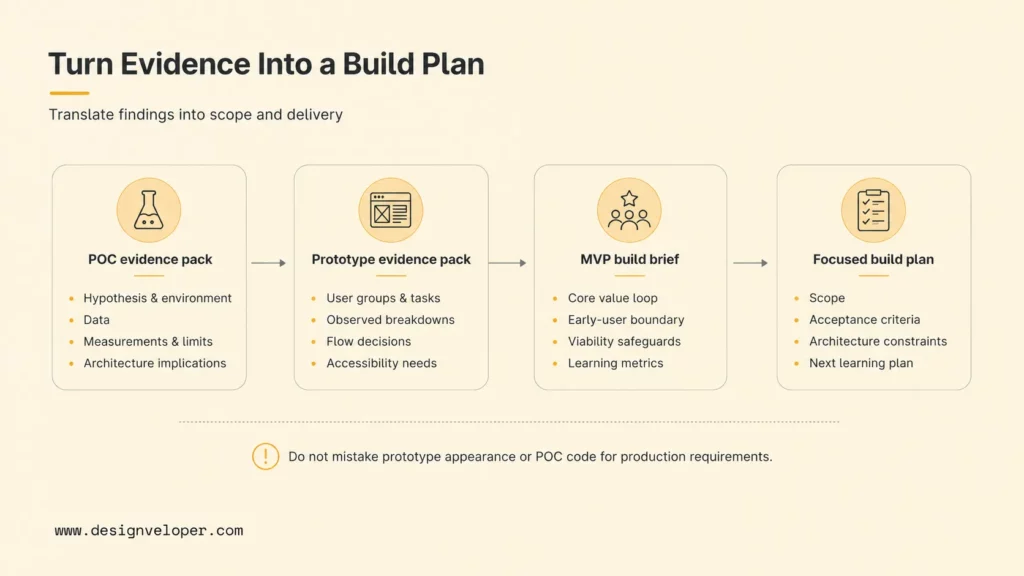
- Hypothesis and environment
- Representative data
- Measurements and limits
- Architecture implications
- Unresolved technical risks
- User groups and tasks
- Observed breakdowns
- Flow and content decisions
- Accessibility needs
- States not yet tested
- Core value loop
- Early-user boundary
- Viability safeguards
- Learning metrics
- Iterate, pivot, scale, stop rules
Reader asset: the evidence handoff prevents prototype appearance or POC code from being mistaken for production requirements.
Do not treat a prototype as a working product. Identify every simulated interaction, hardcoded response, temporary identity, sample record, manual handoff, and omitted state. Rebuild production components to the necessary standard. Prototype code can inform behavior, but its security, performance, accessibility, and maintainability should not be assumed.
Do not build an MVP before critical technical risk is clear. Convert POC findings into architecture decisions with measured thresholds and review triggers. For an AI feature, that may include the evaluation set, minimum quality, retrieval boundaries, model routing, latency, human review, cost per successful task, and failure handling. For an integration, it may include rate limits, reconciliation, retry safety, and contractual dependency.
Define success metrics before development begins. Separate leading product behavior from lagging business outcomes. Activation and task completion may show that users reach value; retention and paid continuation show repeated value; support effort and unit cost show whether the workflow is operationally sustainable. Attach an owner, event definition, baseline, target, observation period, and decision to every important metric.
Plan architecture, integrations, AI requirements, security, and future scalability according to what the evidence proves. Avoid scaling assumptions that the MVP cannot test, but do not create a dangerous dead end. A modular design, documented interfaces, basic observability, migration discipline, and protected data can preserve options without introducing enterprise-scale complexity.
At Designveloper web application development services, we help teams translate POC results and prototype feedback into a focused software build plan, realistic technical scope, integration decisions, and a first release designed to produce useful evidence. Our software development services can support product discovery, UX validation, architecture, MVP delivery, and the path from a narrow pilot toward a reliable product without overbuilding too early.
Teams preparing an MVP can also use our MVP development guide to turn the evidence into audience definition, objectives, feature priorities, technology choices, testing, and launch planning. The output should be a build backlog connected to hypotheses, not a wish list grouped by stakeholder.
FAQs About POC Vs MVP Vs Prototype
Can You Build A Prototype Before A POC?
Yes. Build a prototype first when the workflow, user need, or interaction is the riskiest assumption and the technology is sufficiently understood. A prototype can reveal that users do not understand or value the proposed flow, avoiding an unnecessary technical experiment. A POC can then target only the technical elements needed by the validated experience.
Run a POC first when the interface depends on an uncertain capability, such as real-time model output, specialized hardware, complex data access, or an external API. POC and prototype work can also run in parallel if the teams use shared assumptions and do not present simulated behavior as technical proof.
How Long Does A POC Usually Take?
A tightly scoped software POC often takes roughly two to eight weeks, but complexity, data access, security approval, integration setup, hardware, and evaluation requirements can extend the work. The schedule should be derived from one hypothesis and a bounded evidence plan, not from a generic industry duration.
Timebox the experiment, but do not force a conclusion when required data is missing. Define entry criteria, test cases, success thresholds, and the decision date before work starts. If the team cannot state what will be known at the end, the POC is probably too broad.
Is A Clickable Prototype Enough To Validate A Product Idea?
A clickable prototype can validate comprehension, navigation, task flow, perceived usefulness, and design alternatives. It cannot by itself validate technical feasibility, real performance, retention, willingness to pay, operational cost, or sustained behavior. Participants also know they are in a research setting, so positive feedback is weaker than repeated real-world use.
Combine prototype observation with problem interviews, current-behavior evidence, and an appropriate demand test. If the next decision depends on actual use, build a narrow MVP only after the prototype resolves major workflow uncertainty.
What Should Be Included In An MVP Launch?
An MVP launch should include one complete value loop for a defined user group, production-appropriate identity and data controls, critical integrations, clear onboarding, error and recovery states, accessibility appropriate to the audience, analytics, monitoring, backup, support, privacy information, and a way to collect feedback. Include payment only when willingness to pay or transaction behavior is part of the hypothesis.
The launch plan should specify recruitment, rollout limits, owners, incident response, success metrics, observation period, and iterate/pivot/scale/stop rules. Exclude features that do not help deliver the core outcome, keep the product safe, or measure the decision.
Who Should Be Involved In Product Validation?
Product validation needs a cross-functional group: product leadership, representative users, UX research and design, software engineering, architecture, quality assurance, data or AI specialists where relevant, security, operations, support, and business-domain owners. Sales, finance, legal, compliance, or customer-success roles should join when pricing, contracts, regulation, or adoption affects the hypothesis.
Assign one decision owner while preserving independent evidence. Engineers should not define usability success alone, and stakeholders should not declare technical feasibility from a polished demo. The people affected by the workflow should participate early enough to change the direction, not only approve a nearly finished result.
Also published on

Share post on









Related Articles


30 SaaS Ideas To Build In 2026: Choose A Niche Worth Testing
30 SaaS Ideas To Build In 2026: Choose A Niche Worth Testing Published October 19, 2026
How To Build An App For Your Business In 10 Steps?
How To Build An App For Your Business In 10 Steps? Published October 16, 2026
What Is A Minimum Viable Product (MVP)? A Practical Guide
What Is A Minimum Viable Product (MVP)? A Practical Guide Published July 27, 2026