














Is Agile Dead? What AI Means For Agile Teams And Delivery Today

KEY TAKEAWAYS:
- Use Agile principles and values to judge practices by how well they help a team learn and deliver.
- Check customer feedback, decision rights, work in progress, release quality, and outcome measures before changing frameworks.
- AI can assist with drafts and analysis, but people remain accountable for priorities, human review, and release decisions.
- Choose a workflow for the work’s uncertainty, dependencies, and risk; do not infer success from ceremonies or tickets completed.
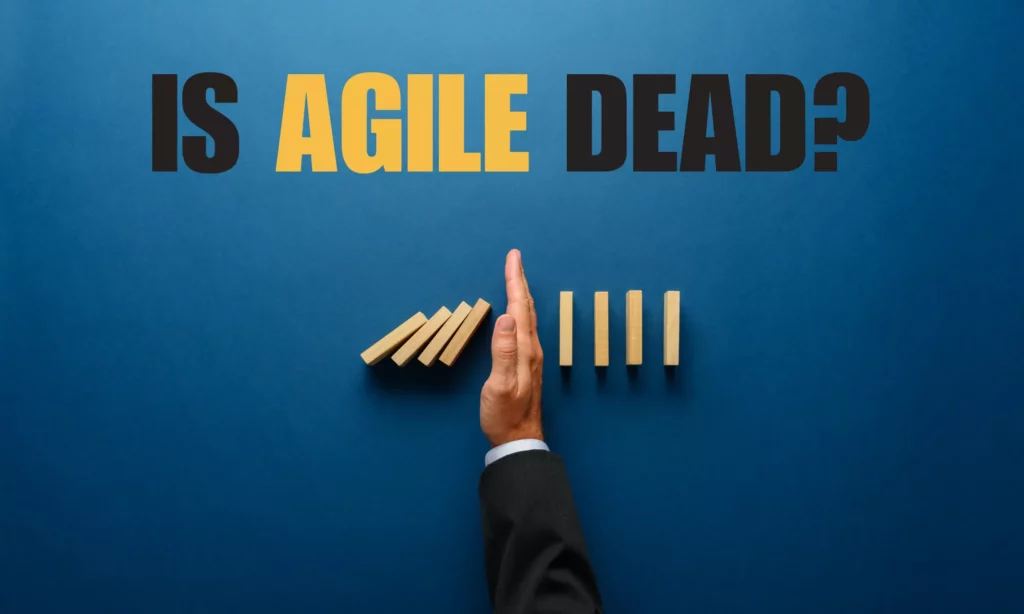
Is Agile dead? No—but the word is often used to describe work that no longer learns from users. Agile software development rests on values and principles for delivering useful software and adapting when evidence changes. Scrum and Kanban are not synonyms for Agile, and neither is a set of meetings. A team can run every ceremony and still be slow if decisions sit elsewhere, work stays unfinished, or success means only tickets closed. AI can change how some tasks are done, but it cannot decide what to build or verify outcomes by itself. The useful question is whether a team’s current workflow helps it learn, deliver, and protect quality.
Why Do Some Teams Say Agile Is Dead?
The criticism usually points to a gap between Agile’s stated purpose and the way work feels day to day. A team may plan in short cycles yet wait months for a release. Its backlog may no longer reflect user needs, or it may spend more time reporting activity than examining results.
Those symptoms do not prove that iterative delivery has stopped working. They show that a process label cannot fix missing customer access, unclear priorities, weak technical quality, or decisions that teams are not allowed to make.
Further reading:
- What Is an Agile Team? Structure, Roles, and How to Build One
- Agile Sprint Cycle: Definition, Execution, and Steps Explained
- What Are Agile Acceptance Criteria? Definition and Examples
When Ceremonies Become the Measure
Planning, reviews, and retrospectives can help a team coordinate and learn. They become overhead when the meeting happens because the calendar says so, but no decision changes, no risk becomes visible, and no feedback reaches the next piece of work. The same is true when a team treats sprint completion or story points as a customer outcome.
A practical check is to ask what each recurring activity helps the team decide. If a meeting does not clarify the goal, expose a constraint, review an increment, or lead to an improvement, change its purpose or format rather than protecting the ceremony.
When Teams Own Delivery but Not Decisions
A team cannot adapt quickly if every product choice, technical adjustment, or release needs a distant approval. Cross-team dependencies, shared platforms, compliance reviews, and funding rules can add legitimate constraints. Teams still need clear decision owners and a way to resolve blocked work.
Scale alone does not make Agile fail. As the number of teams and dependencies grows, coordination becomes harder; the useful question is whether teams can make progress, integrate changes, and get feedback without waiting through avoidable handoffs. A framework such as the Scaled Agile Framework (SAFe) may help some organizations coordinate. Teams should still test whether its added structure earns its cost.
Before calling this a failure of Agile, trace one item from user need to production feedback. Mark where it waits: a priority decision, specialist review, integration, release approval, or user testing. That map separates a team-level practice issue from a system constraint and shows whether a new ceremony would help or merely add another handoff.
Agile Principles Are Not the Same as Scrum or Kanban
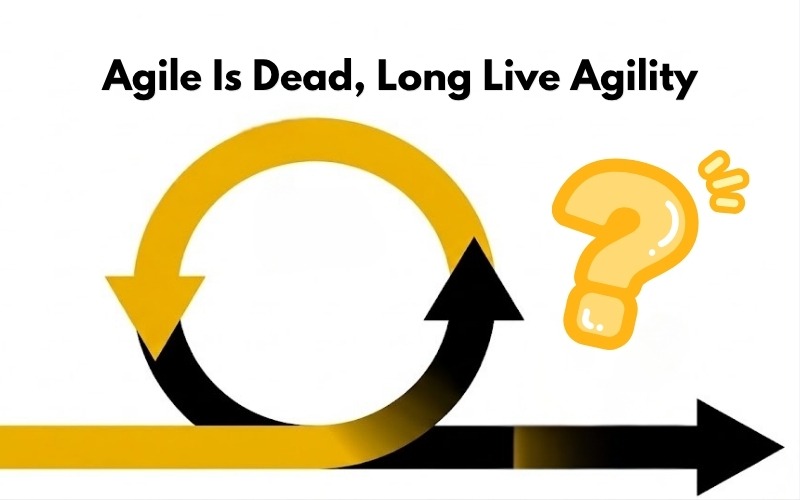
Agile is a set of values and principles, not one required project process. The Agile Manifesto favors people working together, usable software, customer collaboration, and responding to change. Its value about responding to change does not say that planning is useless; it means a team should revisit a plan when new evidence changes what matters.
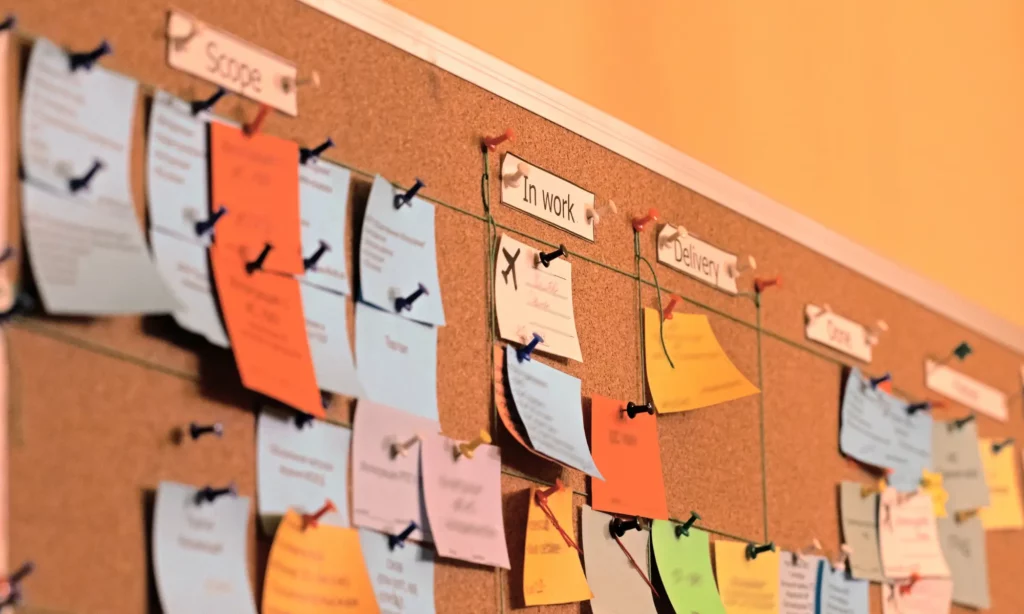
Scrum and Kanban describe different ways to organize work. The official Scrum Guide defines Scrum as a framework with accountabilities, events, artifacts, and rules. The Kanban Guide describes Kanban as a strategy for improving the flow of value through a process. Neither is a synonym for the Agile Manifesto.
This distinction matters when teams compare frameworks. A Scrum team can inspect an increment at a review; a Kanban team can make waiting work visible and manage its flow. Both can support learning, but neither guarantees that the product solves a useful problem. For a closer comparison, see what an Agile framework is and this guide to Agile vs. Scrum.
- Keep the principle: deliver useful work, collaborate with users, and adjust when evidence changes.
- Adapt the practice: use only the planning, review, and coordination activities that help this team do that work.
- Check the result: look at feedback, quality, and completed user outcomes, not just whether a process was followed.
Do not ask which label is automatically “more Agile.” A team might use a sprint goal to coordinate a complex feature while also limiting work in progress between releases. The useful test is whether those choices make responsibilities clear, keep work visible, and let people change direction when customer evidence warrants it.
What AI Changes in Agile Work—and What It Does Not
AI tools can help with parts of software work, but faster drafts do not automatically create a better product or a more adaptive team. A useful way to think about AI in software development is as assistance inside a workflow whose priorities, controls, and acceptance decisions still need accountable people.
Where AI Can Assist
Depending on the tool, codebase, and permissions, an AI assistant may help a developer draft or refactor code, suggest test cases, summarize documentation, or organize information for planning. These are possible uses, not guaranteed time savings or evidence that generated code is correct.
Teams should review suggestions against the actual requirements and repository, run the normal test and security checks, and decide what data may be sent to the tool. A generated test can miss an important behavior; a plausible summary can omit context. Keep that review in the workflow instead of treating generated output as approved work.
What the Adoption Data Can—and Cannot—Show
Digital.ai’s 18th State of Agile report says AI adoption among respondents rose from 68% to 84%. It also reports that 74% used hybrid, blended, or homegrown Agile models, while 49% had AI governance guardrails. The 2025 survey drew nearly 350 participants. Most were Agile coaches and consultants at enterprises with more than 20,000 employees. These figures describe that sample, not all organizations. They do not show that AI caused hybrid work or improved delivery outcomes. See the report release and its survey context.
The governance gap makes it important to set simple controls before expanding use. Name who approves access to code or customer data, who reviews AI-generated changes, and who can stop a release when tests or security checks fail. Measure the actual workflow change rather than assuming that adoption equals value.
Controls should match the use case. Limit a tool to the repositories and data it needs. Keep credentials and sensitive customer information out of prompts. Require the same review and test gates used for human-written changes. If generated suggestions create more review work or defects, pause that use case and inspect the prompt, permissions, or task boundary before expanding it.
A team can trial one low-risk use case for a defined review period. Before starting, record the current effort and a quality signal, assign a reviewer, then compare review time, rework, and test results after the trial. If drafting gets faster but review queues, defects, or data risk increase, the whole workflow has not improved. Stop or narrow the use case and check again.

A Practical Health Check for an Agile Team
Judge the workflow by observable conditions, not by whether the team uses sprints, a board, or a particular job title. Pick a few checks that match the problem, record a baseline, and assign an owner and review date before changing the process.
| Check | Evidence to review | If the signal is weak |
|---|---|---|
| Customer feedback | How often users or stakeholders see working increments and influence the next priority. | Shorten the distance between delivery and feedback; do not add meetings as a substitute. |
| Decision rights | Who owns product, technical, and release decisions, and how long work waits for an answer. | Make the decision owner and escalation path explicit; remove approvals that do not manage a real risk. |
| Flow and dependencies | Work in progress, aging items, blocked time, and handoffs between teams. | Limit parallel work or resolve the dependency before starting more items. |
| Quality and learning | Test results, rework, incidents, and whether a release changed the intended user outcome. | Protect testing and improvement time; revise the hypothesis or acceptance criteria when results disagree. |
Use the measures to answer a decision, not to create a single Agile score. For example, record blocked time and a product outcome. Give a team lead or product manager ownership of reviewing both on an agreed date. Set a change trigger in advance, such as escalating when a decision wait exceeds the team’s agreed limit. A dashboard without a decision owner is just another report.
Separate delivery signals from product results. Work-in-progress and blocked time can show where the workflow waits; they do not show whether a feature helped users. Pair one flow measure with a product outcome and a quality safeguard, then review the trend in context. When the result is unclear, gather better feedback or narrow the next change instead of treating a single metric as a verdict on the team.
Choose a product signal the team can observe, such as completion of a booking step, time to finish onboarding, or support contacts about a recurring issue. No single measure captures the full user experience, so pair it with a quality or flow measure. Agree on a review cadence and a threshold for taking action before the trial begins.
Illustrative example: A team maintaining an online booking flow sees users abandon one step. It ships a small change, then reviews completion, errors, and support contacts with the product owner. An AI assistant may draft a test, but an engineer checks edge cases and the team runs its normal test suite. The product owner decides whether the evidence supports keeping the change or trying another one. No result is assumed in advance; if a sprint closes many tickets without improving the user outcome, the team revisits its priorities and workflow.
For a useful trial, choose one outcome, one quality safeguard, a person who owns the review, and a date to inspect the evidence. Sprint planning can help teams make that commitment, but the format should fit the work; see Agile sprint planning for the practice itself.
What Could Replace Agile—and What Usually Complements It?
There is no single drop-in replacement for Agile because Agile describes values and principles, while methods and frameworks organize work in different ways. A team should choose based on uncertainty, dependencies, release risk, and how it can get feedback—not on which label is newest.
- Scrum can provide a defined framework for complex work when a team benefits from a shared goal and regular inspection.
- Kanban can help a team make flow and work in progress visible, especially when work arrives continuously.
- Lean practices can help examine delays and waste across a process; they do not require replacing every existing team practice.
- DevOps supports collaboration and delivery practices such as automation and release feedback. It can complement Agile rather than replace its values; see how Agile and DevOps can work together.
These options do different jobs, so compare them by the constraint you need to address. If work arrives continuously, flow management may help; if a team needs a shared cadence to inspect a complex product, a framework can supply one. If releases are risky or manual, delivery automation and explicit controls may matter more than changing the planning method. Teams can combine these practices, provided each one has a clear purpose.
For work with stable requirements, external controls, or high coordination costs, teams may retain more up-front planning or add explicit review gates. That is a context choice, not proof that a whole organization must abandon feedback and adaptation. A useful hybrid keeps the controls needed for risk while preserving short learning loops where the work is uncertain.
Framework choice also depends on how teams are connected. Groups sharing release windows or architecture may need explicit integration planning; teams working on independent product areas can have more room to select a local workflow. Keep coordination proportional to dependency risk, and remove steps that no longer produce useful decisions.
Before replacing a framework, name the specific problem it fails to solve, test a smaller change, and review the same outcome and quality signals used in the health check. This avoids swapping one set of ceremonies for another without changing how work reaches users.
FAQs About Agile
Will AI Replace Agile Teams?
No. Agile is a way of organizing work, not a team that software can replace. AI may assist with code, tests, or summaries, while people remain accountable for user needs, priorities, trade-offs, review, and release decisions.
Should Sprint Velocity Be the Main Measure of Team Performance?
No. Velocity can help a team discuss its own planning over time, but it is not a customer outcome and should not be used to compare teams. Pair delivery measures with product results, quality, and feedback, and use the combination to decide what to change.
What Should a Team Do First When Its Agile Meetings Are Not Useful?
Start with one meeting and write down the decision or learning it is meant to support. Ask the people doing the work whether the current format provides that result. Then change its purpose, participants, or frequency and review whether decisions, blocked work, or user feedback improve. Keep the change small enough to reverse if it does not help.
Conclusion: Is Agile Dead?
The answer to “Is Agile dead?” is no. Its usefulness depends on whether a team can deliver valuable work, learn from evidence, make decisions, and protect quality—not on whether it follows a fixed set of ceremonies. Keep practices that improve those conditions, change the ones that do not, and use AI or a different framework only where it solves a defined problem. That is a more reliable test than declaring Agile either alive or obsolete.
Also published on

Share post on










Related Articles



What Is Velocity In Agile? Formula, Examples, And Common
What Is Velocity In Agile? Formula, Examples, And Common Published October 15, 2026
What Is The Scaled Agile Framework (SAFe)? How It Works At Scale
What Is The Scaled Agile Framework (SAFe)? How It Works At Scale Published October 14, 2026
Jira And Agile Project Management: Complete Guide
Jira And Agile Project Management: Complete Guide Published October 14, 2026