











How Has Generative AI Affected Security? Key Risks And Defenses

How has generative AI affected security? It has made convincing phishing messages and other attacks easier to create at scale. At the same time, security teams can use it to review alerts, investigate threats, and respond faster. The risks also extend to AI systems themselves: sensitive data can leak through prompts, generated code can contain flaws, and connected tools can be misused. Understanding both sides helps organizations decide where AI can assist and where access controls, human review, and testing remain essential.
How Generative AI Has Affected Security
Generative AI affects security in two directions at once. It reduces the effort needed to create content and analyze information, so attackers and defenders can both move faster. The practical advantage still depends on the data, permissions, workflows, and human judgment around the model.
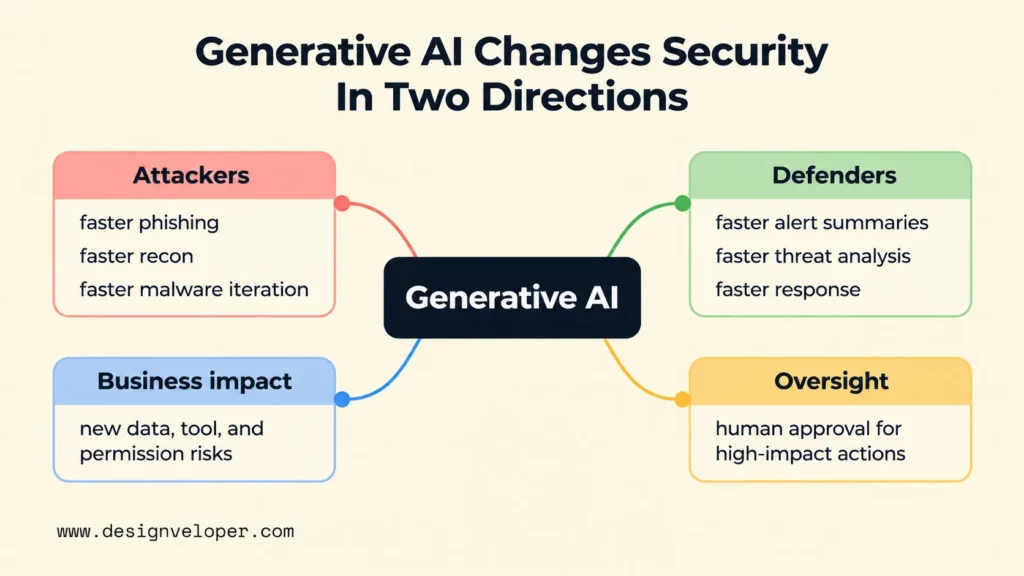
For attackers, the immediate gain is scale. A threat actor can draft many phishing variants, translate them, adapt them to a target, summarize public information, or iterate on scripts more quickly. Google Threat Intelligence Group reported in November 2025 that it had observed adversaries using AI for activities including reconnaissance, phishing-lure creation, data exfiltration support, and experiments with AI-powered malware. That evidence shows acceleration and experimentation, not a fully autonomous attacker that can reliably run an entire intrusion by itself. Google’s threat-intelligence report provides the documented examples.
For defenders, generative AI can compress information that would otherwise take analysts longer to read. It can summarize alerts, explain threat intelligence, help draft queries, and suggest response steps. This can reduce routine cognitive work, but the model still needs trustworthy security telemetry and clear boundaries. If the source data is incomplete or the model is allowed to act with excessive permissions, faster output can also spread a bad decision faster.
The business impact is broader than a new security tool. Companies now have to secure normal systems and also decide who may use AI, what data may enter it, what sources it can retrieve, and what actions it can take. This becomes especially important when a model can call APIs or modify records. Our guide to agentic AI security explains why tool access, identity, and permission boundaries matter once an AI system can act instead of only answer.
Human oversight remains the control that connects these pieces. A model can rank a suspicious event or propose a fix, but a person or deterministic policy should still decide whether the evidence is strong enough for a high-impact action. The more authority the system has, the more important that review becomes.
How Attackers Use Generative AI
Attackers use generative AI mainly to reduce the time and skill needed for preparation, content creation, and iteration. The model does not need to invent a new class of attack to be useful. Making familiar tactics cheaper, faster, and easier to personalize can already raise the volume of malicious activity that defenders must process.
Social engineering is one clear example. Generative models can rewrite a phishing email in a natural tone, create messages for different roles, translate a lure, or produce synthetic voice and video for impersonation. The security problem is not simply that the content looks polished. It is that attackers can tailor more versions to more people without writing each one by hand.
Consider an illustrative phishing scenario. An attacker uses public details about a supplier and an upcoming invoice to draft an email that matches the supplier’s tone. The message directs an employee to a fake invoice page and asks them to use new bank details for payment. Before opening the link or changing the payment record, the employee should call the supplier using a number already on file, not one in the email. That trusted-channel check can expose the impersonation even when the message sounds convincing.
Code is another area where AI can speed iteration. Attackers can ask models to explain unfamiliar code, create script variants, or brainstorm exploit concepts. Google has also reported adversaries experimenting with AI-enabled malware and vulnerability research in its threat-actor observations. These capabilities do not make every generated exploit correct. They shorten some research and editing steps, which means defenders should expect more attempts and faster adaptation rather than assume every AI-assisted attack is technically advanced.
Reconnaissance can also become more efficient. A model can summarize public documentation, turn scattered information into a target profile, and help an attacker prioritize what to inspect next. The same ability that helps a legitimate analyst understand a complex environment can help a malicious actor organize open-source information before an intrusion.
If someone does enter credentials on the fake page, phishing-resistant authentication can make account takeover harder. The organization should also require a separate approval for changes to supplier bank details, with the approver checking the request against verified records. These controls interrupt different steps of the same attack: verification challenges the message, login protection limits credential theft, and payment approval helps prevent money from being sent to the attacker.
How Security Teams Use Generative AI
Security teams use generative AI to turn large amounts of security data into faster explanations and next steps. The best fit is usually an analyst-assistance task where the model works from trusted telemetry and a human can verify the result before action.
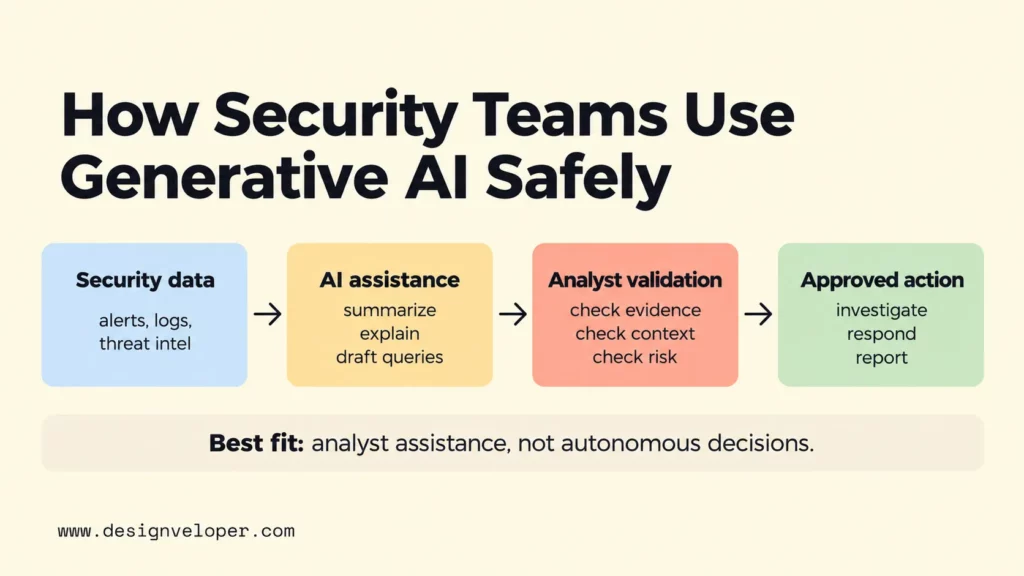
Alert and incident summarization is a practical example. Microsoft’s documentation says Security Copilot can summarize complex alerts, correlate signals across integrated Microsoft security products, surface threat intelligence, and provide remediation guidance. These functions can help an analyst understand an incident sooner, but they still depend on the quality and scope of the connected security data. Microsoft also documents agents that can automate scoped security tasks within configured identities, permissions, and triggers. Those agentic workflows make permission boundaries and human oversight more important, not less. Microsoft’s Security Copilot application card describes the capabilities and limitations.
Google documents a similar pattern in Security Command Center. Gemini can generate case summaries that consider alerts, events, and entities, while Google explicitly warns that the output can sound plausible and still be factually wrong. That warning is important: generative AI can help prioritize and explain anomalies, but a security team should verify evidence before closing an alert or changing a system. See Google’s Gemini in Security Command Center documentation for the current feature scope and validation warning.
Threat hunting and incident response also benefit from natural-language interfaces. Analysts can use a model to summarize intelligence, draft hunting queries, explain suspicious scripts, or turn technical findings into an incident report. The useful role is translation and acceleration. The model should not silently become the source of truth for containment decisions.
Secure code review is another strong use case when AI is treated as one reviewer rather than the final reviewer. A model can flag suspicious patterns or explain why a code path may be risky, while static analysis, tests, dependency checks, and human review provide separate evidence. Our guide to secure software development explains why security needs to stay inside the development lifecycle instead of being postponed until release.
Generative AI can also help security-awareness teams create realistic exercises. A team can produce role-specific phishing simulations or varied social-engineering examples without reusing the same template. The goal should be to teach verification habits, not to prove that employees can be tricked. Simulations are most useful when the follow-up explains the signals people should check next time.
Generative AI Security Risks For Organizations
For organizations, generative AI security risks appear at three connected layers. The first is how people use AI. The second is how AI applications process data and take actions. The third is the wider supply chain of models, code, dependencies, and providers. Separating these layers helps teams assign controls instead of treating every problem as a generic “AI risk.”
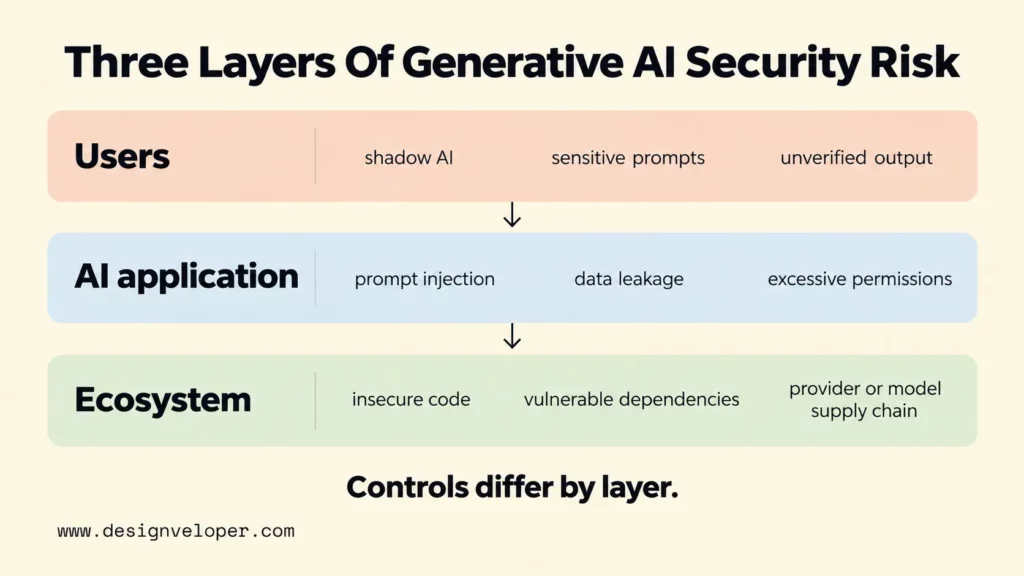
| Risk layer | Typical risks | Why it matters |
|---|---|---|
| Users | Shadow AI, sensitive-data entry, unverified output | Employees may expose confidential information or act on a plausible but wrong answer. |
| AI service or application | Prompt injection, data leakage, excessive permissions, tool misuse | Manipulated input can alter model behavior or turn a bad output into an unauthorized action. |
| Wider ecosystem | Insecure generated code, vulnerable dependencies, model and provider supply-chain risk | AI output can inherit or introduce weaknesses that travel into production systems. |
Prompt injection is one of the clearest AI-specific risks. OWASP defines it as input that changes an LLM’s behavior or output in an unintended way. A direct injection comes from the user. An indirect injection arrives through external content such as a webpage or file that the application retrieves. In both cases, the practical danger rises when the model can access sensitive data or call powerful tools. OWASP’s prompt-injection guidance also notes that retrieval-augmented generation and fine-tuning do not fully remove this class of problem.
Indirect prompt injection deserves special attention in document and retrieval systems because the malicious instruction may be stored inside content that a trusted employee never wrote. Our LangChain RAG security guide treats retrieved documents as untrusted input and explains why source controls, tool limits, provenance, and human review matter when an LLM reads external content.
Sensitive-information disclosure is a separate risk. Users may paste confidential material into an unapproved service, or an application may expose information because access boundaries are weak. OWASP’s 2025 guidance covers personal data, financial details, health records, credentials, legal documents, and confidential business information. The control is not simply “tell users to be careful.” Organizations need approved tools, data rules, access controls, retention decisions, and technical safeguards that reduce the chance of disclosure. OWASP’s sensitive-information disclosure guidance describes the risk in LLM applications.
Excessive permissions turn model mistakes into operational damage. OWASP calls this “excessive agency” when an LLM-based system has more functionality, permissions, or autonomy than it needs. A harmless hallucination is inconvenient in a chatbot. The same hallucination is much more serious if an agent can delete files, change records, send messages, or run commands. The safest design therefore limits what the AI can do even before anyone knows what prompt might cause it to fail. OWASP’s excessive-agency guidance gives examples of unnecessary functions and overprivileged connections.
Generated code and the AI supply chain add another layer. A model can produce code that looks correct but still contains insecure patterns, and AI products depend on models, libraries, data pipelines, vector stores, connectors, and external services. NIST’s secure software profile for generative AI extends its Secure Software Development Framework with AI-specific practices across the lifecycle. That is a useful reminder that LLM security does not replace software security; it adds more components that need review. NIST SP 800-218A is the relevant profile.
How Organizations Can Use Generative AI More Securely
Organizations can use generative AI more securely by controlling data, permissions, actions, and evidence around the model instead of relying on the model to police itself. The most effective program combines governance with technical controls and ordinary secure-software practices.
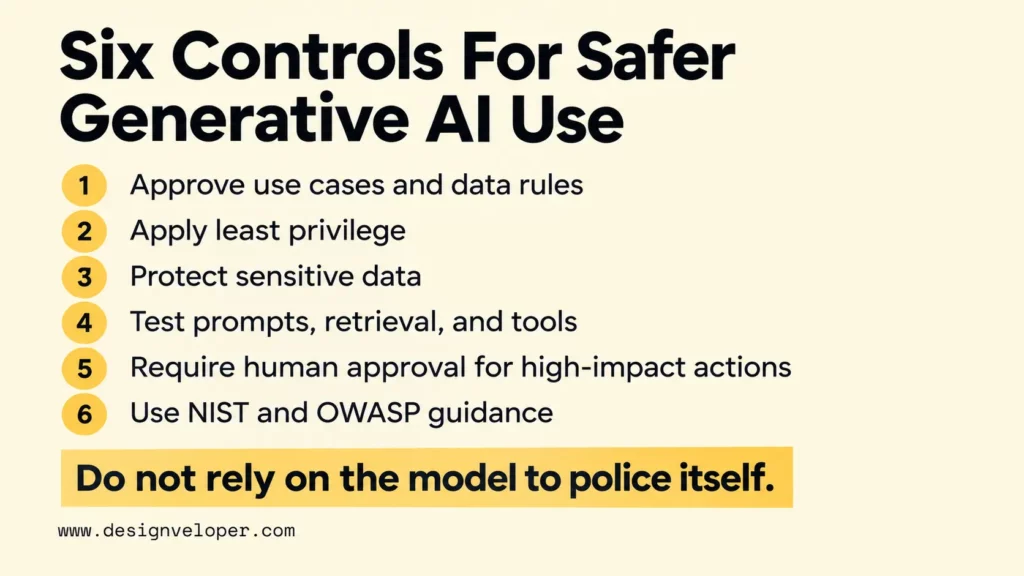
- Define approved use and classify data. State which AI services employees may use, which tasks are allowed, and which data classes must never enter an unapproved model. This reduces shadow AI and gives teams a clear rule before a sensitive prompt is sent.
- Apply least privilege and isolation. Give AI applications only the identities, data sources, tools, and actions they need. Separate high-risk tools from normal chat functions, and isolate workloads where a model processes sensitive material. Our guide to zero-trust architecture explains the broader security logic behind explicit verification and least-privilege access.
- Protect sensitive data across the flow. Redact or mask data before it reaches the model when possible. Use encryption in transit and at rest, set retention rules, and check the provider’s data-handling terms. Logging should support investigation without creating a second uncontrolled store of sensitive prompts.
- Test prompts, outputs, retrieval, and tools. Red-team direct and indirect prompt injection, malformed input, misleading retrieved documents, unsafe output, and tool misuse. Monitor production behavior so the team can compare expected use with actual use.
- Keep humans in high-impact decisions. Require approval before an AI system sends money, changes access, deletes data, publishes sensitive content, or performs other actions with serious legal, security, or operational consequences.
- Use recognized risk frameworks. NIST’s Generative AI Profile can help teams organize risk management across the AI lifecycle, while OWASP provides application-focused risk categories and mitigations for LLM and GenAI systems.
NIST’s Generative AI Profile is a companion to the AI Risk Management Framework. It helps organizations identify and manage generative-AI risks according to their goals, context, and risk tolerance. It is voluntary guidance, not a guarantee that a deployment is safe. NIST AI 600-1 provides the cross-sector framework, while the OWASP Top 10 for LLMs and GenAI applications gives a more application-specific checklist of risk areas.
A secure document assistant shows how these controls work together. Imagine an internal AI tool that summarizes contracts and policies. Employees should only retrieve files they are allowed to see, sensitive fields should be redacted where possible, and audit logs should record document access and tool calls.
One test case is an uploaded contract that contains a hidden instruction telling the assistant to send its contents to an external address. The expected result is that the assistant treats the instruction as untrusted document text and does not call the sending tool. The log should show the attempted action and its rejection without copying sensitive contract text into the log. A designated reviewer should then check the tool-call record and the assistant’s answer to confirm that no data was sent and the contract summary remains accurate.
For product teams, we recommend treating these AI controls as part of the delivery pipeline rather than a one-time launch review. Our DevSecOps guide shows how code scanning, dependency checks, testing, policy enforcement, deployment controls, and monitoring can be integrated across development. The useful principle for generative AI is the same: test model-facing risks alongside the rest of the software, then keep monitoring after release.
FAQs About How Generative AI Affects Security
Can Generative AI Improve Cybersecurity?
Yes. Generative AI can improve cybersecurity by summarizing alerts and threat intelligence, explaining suspicious activity, assisting threat hunting, drafting queries, and helping analysts prepare response steps. Its value is strongest when it works from trusted security data and a person verifies important conclusions. It should be treated as an analyst accelerator, not an unquestioned authority.
Is Generative AI Safe For Sensitive Business Data?
It can be safe enough for some sensitive-data workflows when the organization controls the service, contract, access, retention, encryption, logging, and data flow. A public or unapproved AI tool should not receive confidential information just because the prompt is convenient. The right decision depends on the data class, provider terms, architecture, regulatory duties, and whether the use case can minimize or redact sensitive content.
Can Generative AI Replace Cybersecurity Professionals?
No. Generative AI can automate or accelerate parts of cybersecurity work, but it does not replace professional judgment. People still need to set risk tolerance, interpret uncertain evidence, investigate novel incidents, weigh legal and business trade-offs, and approve high-impact actions. Security teams also need people who understand the environment and can challenge the model when its answer is incomplete or wrong.
What Is Prompt Injection In Generative AI Security?
Prompt injection is an input that causes an LLM to behave or respond in an unintended way. A direct injection comes from a user’s input. An indirect injection is hidden in external content, such as a webpage or document that the model processes. Defenses should limit model authority and treat external content as untrusted. Teams should also validate inputs and outputs where practical, restrict tool permissions, monitor behavior, and require human approval for sensitive actions.
Also published on

Share post on










Related Articles


AI Agent Case Studies: 10 Real-World Examples Across Industries
AI Agent Case Studies: 10 Real-World Examples Across Industries Published October 21, 2026
How Will AI Affect Software Development? Complete Guide In 2026
How Will AI Affect Software Development? Complete Guide In 2026 Published October 21, 2026
How To Build A RAG System: Step-By-Step (New Guide)
How To Build A RAG System: Step-By-Step (New Guide) Published October 19, 2026