











Generative AI Vs. Predictive AI: Key Differences and Use Cases

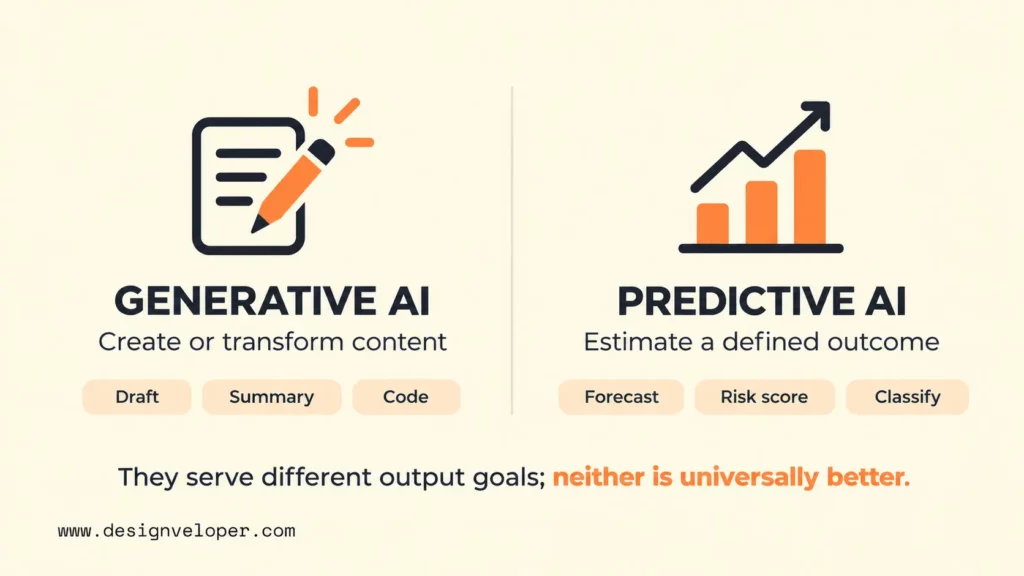
Generative AI creates or transforms content, while predictive AI estimates defined outcomes such as demand, churn risk, or fraud likelihood. Choose generative AI when you need a draft, summary, or answer. Choose predictive AI when you need a forecast, classification, or score to inform a decision. Some business workflows need both: a prediction followed by generated content that people can review. Neither category guarantees accuracy. The right data, evaluation, and controls depend on the task.
What Is Generative AI?
Generative AI is a subset of artificial intelligence that creates new content or transforms existing information into a new output. It can produce text, code, images, audio, video, summaries, and structured responses from prompts or application instructions. For a broader foundation before comparing model types, our guide to generative AI explains how these systems work and where they fit in business products.
Many modern generative applications use foundation models. These are broad models trained on large and diverse datasets so they can support many downstream tasks. AWS’s foundation model overview describes them as adaptable starting points for tasks such as language understanding, text generation, image generation, and question answering.
Large language models, or LLMs, are one important class of model for language tasks. They learn patterns across text and generate responses from the context they receive. Other generative systems may use different architectures to create images or audio. Therefore, generative AI is the broader category, not another name for LLMs.
The key boundary is the output. A generative system is useful when a user needs a draft, explanation, summary, image, code sample, or other newly assembled response. It may use retrieval, rules, or other models around the generator, but the user-facing job still centers on creating or transforming information.
What Is Predictive AI?
Predictive AI uses patterns in historical or current data to estimate an outcome, probability, category, score, or future value. Typical examples include predicting customer churn, forecasting product demand, estimating revenue, scoring leads, detecting suspicious transactions, or estimating when equipment may fail.
The model is usually built around a defined target. A team might ask, “How many units will we need next month?” or “Which customers are most likely to cancel?” The system then learns relationships in relevant data and produces an estimate that supports a decision. Google Cloud’s predictive analytics overview describes this process as using historical and current data, statistical modeling, and machine learning to forecast future outcomes.
Predictive AI is not limited to a single algorithm. A forecasting problem may use time-series methods, while a churn problem may use classification. Fraud detection can use classification, anomaly detection, or a combination of methods. What matters is that the output is an estimate about a defined target rather than newly generated content.
That makes predictive AI especially useful for prioritization and decision support. A probability or score can tell a team which cases deserve attention first. Our AI-driven decision-making guide expands on how data, predictions, business rules, and human judgment can work together without treating a model score as the decision itself.
Generative AI Vs. Predictive AI: Key Differences
When comparing generative AI vs predictive AI, start with the job each system is optimized to do. Generative AI produces or transforms content. Predictive AI estimates a target such as demand, risk, propensity, category, or future value. AWS’s comparison of generative and predictive AI uses the same output-level distinction. The table below compares the two without assuming that every implementation uses the same data format, model size, or infrastructure.
| Dimension | Generative AI | Predictive AI |
|---|---|---|
| Objective | Create, transform, summarize, explain, or synthesize information. | Forecast, classify, rank, score, or estimate a defined outcome. |
| Output | New text, code, images, audio, video, summaries, or structured responses. | Forecasts, probabilities, labels, rankings, anomaly flags, or numeric estimates. |
| Common tasks | Drafting, summarization, conversation, code generation, content transformation, and synthetic data generation. | Demand forecasting, churn scoring, fraud detection, lead scoring, risk estimation, and predictive maintenance. |
| Input data | Can work with prompts and many forms of structured or unstructured context. Model pretraining may use large and diverse datasets. | Usually relies on task-relevant historical or operational data tied to a defined prediction target. Data may be structured, unstructured, or time based. |
| Evaluation | Depends on the task and may include factuality, relevance, instruction following, safety, consistency, and human acceptance. | Depends on the target and may include error measures, precision, recall, ranking quality, calibration, and business impact. |
| Explainability and traceability | Sources and logs can help trace information used in a response, but a generated explanation may not reveal the model’s actual reasoning or causes. | Features, scores, and model-specific methods may help explain a prediction, but some predictive models are difficult to interpret. |
| Business value | Reduces effort in creation, transformation, explanation, and knowledge-heavy interaction. | Reduces uncertainty by estimating what is likely to happen or which cases deserve attention. |
Input format and resource needs should not be treated as fixed rules. Generative systems often work well with unstructured material, but they can also consume structured data. Predictive systems often use tables and time series, but they can also work with text, images, sensor streams, and other signals. Model size and infrastructure depend on the method, latency target, traffic, data volume, and deployment design.
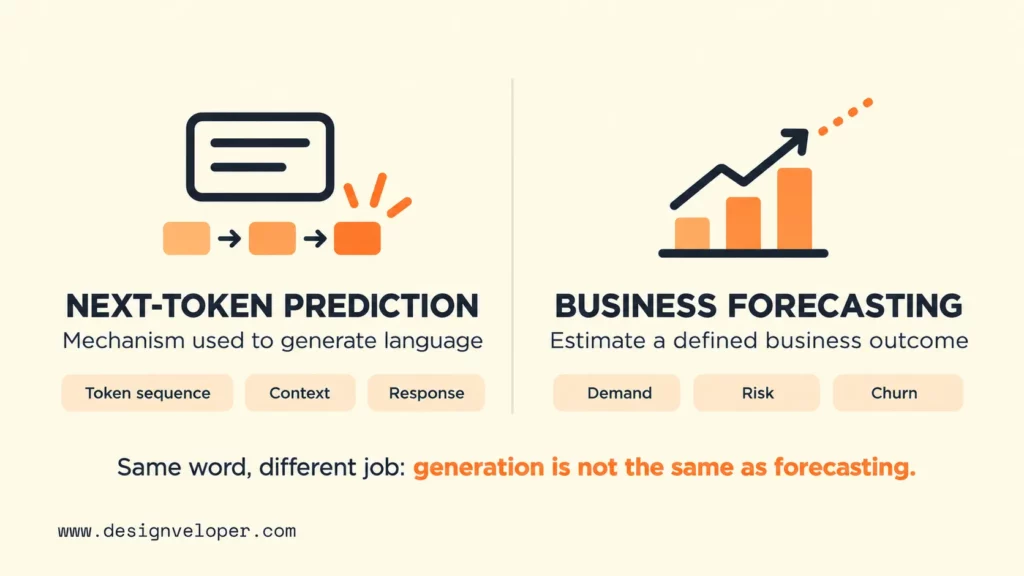
The word “predictive” also needs care. Text-generating models commonly produce language by predicting the next token from prior context. AWS’s generative AI explanation describes this next-item prediction inside generation. That does not turn a writing assistant into a demand-forecasting system. The first prediction is a mechanism used to generate content; the second is a business outcome the system is explicitly trained or configured to estimate.
Evaluation follows the same distinction. A generated answer can be fluent yet factually wrong, so teams need task-specific tests for accuracy, relevance, safety, and acceptable output. AWS’s foundation-model evaluation guidance likewise treats open-ended generation and model risk as evaluation problems. A predictive model can produce a precise-looking score that is poorly calibrated or weak on important subgroups. In both cases, technical model metrics should connect to the real business consequence of errors.
Before deployment, define how reviewers will verify each output. For predictive AI, compare scores with known outcomes and monitor error rates. For generative AI, check answers against approved sources and set clear review or escalation rules. These checks put the context-sensitive approach in NIST’s AI trustworthiness guidance into practice.
Common Generative AI Use Cases
Generative AI fits work where the desired result is a new or transformed artifact. The strongest use cases give the model enough context, define what good output looks like, and keep review proportional to the risk. Our guide to generative AI applications explores more examples across industries.
Creating And Transforming Content
Generative AI can draft emails, product descriptions, reports, campaign copy, images, audio, or design concepts. It can also rewrite existing material for a different tone, format, audience, or language. The useful pattern is not “publish whatever the model writes.” It is “produce a faster first version, then apply the review needed for the content’s stakes.”
For example, a marketing team might provide approved product facts, brand guidance, and a campaign goal. The model can draft several variants. A person then checks claims, brand fit, legal requirements, and final wording before publication. The generation saves blank-page time, while human review protects accuracy and accountability.
Conversational Interfaces And Knowledge Assistance
Generative AI can turn search, retrieval, and business data into a conversational interface. An employee might ask a policy question in natural language, or a customer might describe a support issue without knowing the exact menu or keyword. The model can interpret the request and generate an explanation based on the context the application provides.
This use case becomes more dependable when the system can show or trace the source material behind the answer. A model should not be treated as a complete knowledge base by itself. Retrieval, permissions, freshness rules, and escalation paths become part of the product when users need reliable business information.
Generating Code, Summaries, Or Synthetic Data
Generative AI can produce code scaffolds, tests, documentation, summaries, structured extracts, and synthetic examples. These tasks share one pattern: the system transforms instructions and context into a new artifact that still needs validation against the real requirement.
Synthetic data can be useful when teams need additional test or training examples, but it should not be assumed to reproduce the full distribution of real data. Teams still need checks for realism, bias, privacy, and whether the synthetic records preserve the relationships required by the downstream task.
Common Predictive AI Use Cases
Predictive AI fits work where the business needs a forecast, probability, ranking, classification, or early warning. The model is most useful when the target is clearly defined and the historical data has enough signal to support the estimate.
Demand And Revenue Forecasting
Demand and revenue forecasting estimate future values from past patterns and relevant drivers. A retailer might forecast unit demand by product and region. A subscription business might estimate recurring revenue under different assumptions. The forecast can support inventory, staffing, budgeting, or capacity decisions.
Forecast quality depends on more than model choice. Seasonality, promotions, market changes, missing data, and one-off events can all weaken a pattern learned from history. Teams should compare predictions with a baseline and track error over time rather than assume a complex model is automatically better.
Churn, Lead, And Risk Scoring
Scoring models rank or classify cases so teams can focus attention. A churn model can estimate which customers are more likely to leave. A lead model can rank prospects by likelihood of conversion. A risk model can identify cases that deserve additional review.
The score should inform a decision, not hide the decision logic. Teams need to know what action follows each score range and how false positives and false negatives affect users. They also need to check whether the model remains reliable when customer behavior or operating conditions change.
Fraud Detection And Predictive Maintenance
Fraud detection uses patterns in transactions or behavior to flag unusual or high-risk activity. Predictive maintenance uses equipment and operating data to estimate when a component may fail or need service. Both use cases help teams intervene earlier, but the cost of an error can be high.
A fraud system that flags too many legitimate transactions creates customer friction. A maintenance system that misses a real failure can create downtime or safety risk. That is why deployment thresholds, review rules, monitoring, and feedback loops matter as much as offline model accuracy.
How Businesses Can Combine Generative And Predictive AI
Businesses can combine generative and predictive AI by assigning each system a different job. A predictive model estimates what is likely to happen. A generative model turns that estimate into a useful explanation, draft, or next-step artifact. This separation makes the workflow easier to evaluate and control.
- Churn workflow: a predictive model identifies customers with elevated churn risk. Generative AI drafts a retention message using approved offers and customer context. A person reviews the message before it is sent.
- Demand planning workflow: a forecasting model estimates expected demand. Generative AI turns the forecast, assumptions, and constraints into planning scenarios or a concise explanation for decision-makers.
- Campaign workflow: analytics or predictive models segment customers or estimate response propensity. Generative AI drafts campaign variations for each approved segment, with brand and compliance checks before launch.
These are illustrative workflows, not claims about a specific company’s deployment. The useful design principle is separation of responsibilities. The predictive component should be evaluated on the quality of its estimate. The generative component should be evaluated on the quality and safety of the content it produces from that estimate.
Google Cloud’s AI selection guidance also notes that some use cases are better served by combining traditional predictive methods with generative AI. In practice, the connection needs clear data contracts: what prediction is passed forward, what context the generator may use, and what happens if either component is uncertain.
Human review should be placed where mistakes can materially affect customers, money, access, safety, or compliance. Predictions should support decisions rather than create a false sense of certainty. Generated explanations and messages also need controls because fluent wording can make a weak prediction look more confident than it is.
For broader workflow design, our AI business process automation guide explains how rules, AI judgment, approvals, and integrations can work together. It also shows why fallback paths and human control matter when a workflow uses AI.
When Should You Choose Generative AI Or Predictive AI?
Choose the AI approach by the output your business needs, then test whether your data and evaluation plan can support it. Do not begin with the question “Which model is more advanced?” Begin with “What decision or artifact must this workflow produce?”
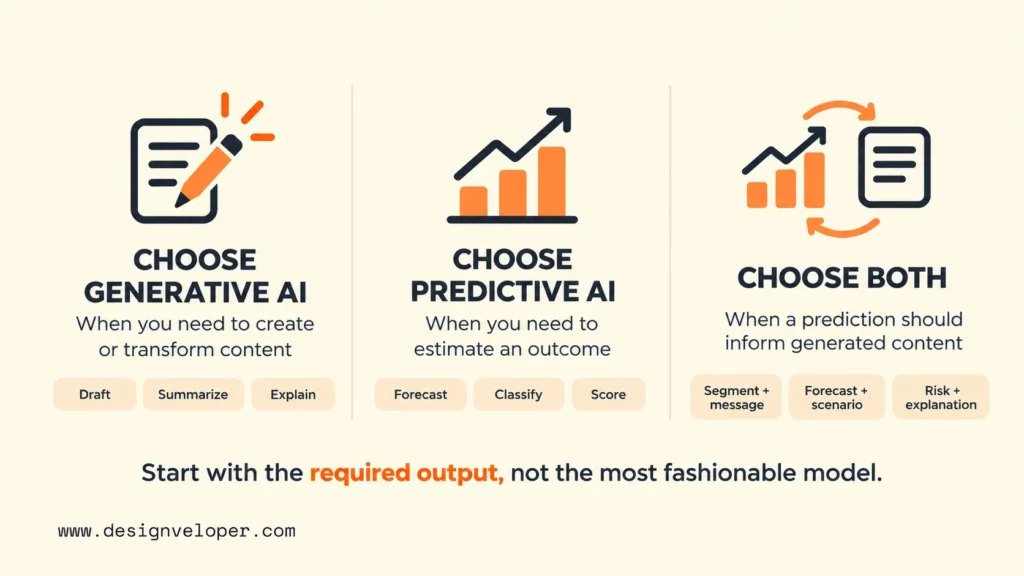
- Choose generative AI when the task is to create, transform, summarize, or explain content.
- Choose predictive AI when the task is to forecast, classify, rank, score, or estimate risk.
- Consider both when a workflow needs a prediction followed by a generated explanation, recommendation draft, or response.
Data readiness is the first practical filter. Predictive models need representative data tied to the target you want to estimate. Generative applications need suitable prompts or context, plus reliable source data when answers must be grounded in company knowledge. If the data is incomplete, inaccessible, stale, or legally restricted, model selection will not solve the underlying problem.
Evaluation is the second filter. Define what a good result means before implementation. A forecasting system needs an error measure and a business tolerance for wrong forecasts. A generative assistant needs test cases for factuality, instruction following, acceptable tone, safety, and escalation. The exact metrics vary by task, but both approaches need a measurable acceptance threshold.
Integration, privacy, and oversight are the third filter. The system may need access to CRM records, ERP data, documents, sensor streams, or internal APIs. That access should follow the least data and permissions needed for the task. NIST’s AI Risk Management Framework emphasizes testing, evaluation, verification, and validation as part of operational AI risk management rather than treating governance as a final checklist.
FAQs About Generative AI Vs. Predictive AI
Is ChatGPT Generative AI Or Predictive AI?
ChatGPT is a generative AI product built on large language models (LLMs). “LLM” names a model family built to work with language, while “generative AI” describes the broader capability to create or transform content. OpenAI Academy’s ChatGPT introduction confirms that ChatGPT is built on LLMs and can help with drafting, rewriting, and explaining information.
The fact that language models predict tokens during generation does not make ChatGPT “predictive AI” in the business-forecasting sense used in this article. If you want a deeper product-level distinction, our ChatGPT vs generative AI guide explains how the application relates to the broader technology category.
Is Generative AI The Same As Predictive AI?
No. Generative AI and predictive AI can share machine-learning foundations, but they are optimized for different outputs. Generative AI creates or transforms content. Predictive AI estimates outcomes, probabilities, categories, rankings, or future values. A business may use both in one system without treating them as interchangeable.
Can Generative AI Be Used For Business Forecasting?
Generative AI can help explain a forecast, explore assumptions, write analysis code, or turn model results into planning scenarios, but it should not automatically replace a validated forecasting method. When the core requirement is a numeric or probabilistic business forecast, use an appropriate predictive or statistical model and evaluate it on historical or holdout data. Then use generative AI around that forecast if natural-language explanation or scenario drafting adds value.
If your team needs engineering support after choosing the right approach, our AI development services cover custom AI software and generative AI solutions. The useful next step is to scope one workflow, its data sources, its expected output, and its acceptance criteria before committing to a model or platform.
Also published on

Share post on










Related Articles


How To Build And Use AI Business Process Automation Effectively
How To Build And Use AI Business Process Automation Effectively Published October 27, 2026
AI Agents Vs. RPA: How To Choose The Right Fit For Your Workflow
AI Agents Vs. RPA: How To Choose The Right Fit For Your Workflow Published October 23, 2026
AI Proof Of Concept Development: How To Test Before You Scale
AI Proof Of Concept Development: How To Test Before You Scale Published October 22, 2026