















Enhancing Web Presence: How To Improve Online Visibility And Brand Trust

KEY TAKEWAYS:
- Enhancing web presence means improving every place where customers discover, judge, and contact a business online: the website, search visibility, local listings, social channels, reviews, content, and conversion paths, web application requirements, and customer actions need to work together.
- A stronger online presence starts with the basics: clear positioning, useful content, mobile-friendly pages, fast loading, accessible design, search-friendly structure, and consistent business information across channels.
- Website work and SEO work should not be separated. Design, speed, content, technical SEO, analytics, and conversion tracking all affect whether traffic becomes qualified leads or sales.
- Professional website and WordPress services help when a business needs better architecture, performance, security, integrations, content workflows, or a scalable foundation for long-term growth.
- The main mistakes are chasing traffic without intent, using inconsistent messaging, ignoring reviews and local visibility, publishing thin content, and failing to measure the actions that connect visibility with revenue.
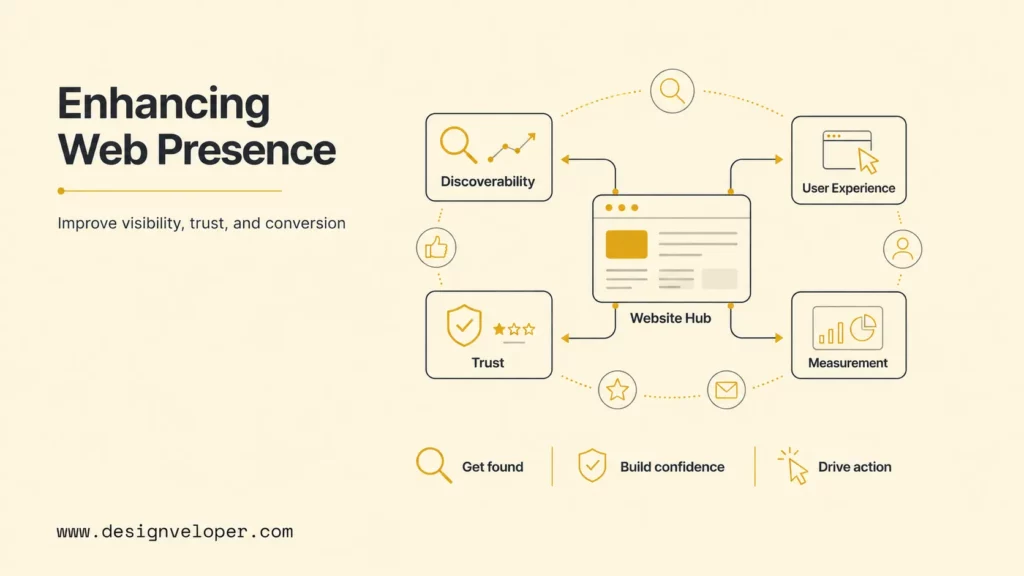
Enhancing web presence is the disciplined work of improving how a business is discovered, understood, trusted, and contacted across its website, search results, business profiles, social channels, reviews, and third-party mentions. The website is the central hub, but visibility grows only when every channel presents an accurate promise and leads people toward a useful next action.
A practical web presence program does not begin with posting more often. It begins by locating the weakest part of the journey. A business may have poor search coverage, an outdated website, inconsistent messaging, slow pages, missing proof, weak local profiles, or conversion tracking that cannot distinguish attention from qualified demand. The right roadmap fixes that constraint first and measures the business result.
Quick decision guide: Start with discoverability when qualified impressions are low, start with experience when visitors leave or struggle, and start with proof and conversion paths when engaged visitors do not become leads. Add more channels only after the website, message, and measurement foundation can support them.
| Presence problem | Evidence to inspect | Priority response |
|---|---|---|
| The business is difficult to find | Indexing, non-branded impressions, local profile views, referral traffic | Repair crawl paths, intent coverage, listings, and distribution |
| People visit but do not explore | Landing-page engagement, mobile behavior, Core Web Vitals, usability findings | Align the opening message, navigation, performance, and accessibility |
| Visitors hesitate to act | CTA use, form starts, proof engagement, sales objections | Clarify the offer, evidence, process, price context, and next step |
| Channels tell different stories | Homepage, profiles, directory descriptions, campaign pages, review themes | Create one message system and assign channel owners |
| Results cannot be explained | Analytics coverage, event definitions, CRM outcomes, consent state | Build a measurement chain from impression to qualified conversion |
Further reading:
- Web App vs Website: Similarities, Differences and Misconceptions
- 20 Web App Ideas: Health, FinTech, AI, E-commerce
- Web App Development Cost: Breakdown
What Is Web Presence And Why Does It Matter?
Web presence is the complete set of signals and experiences through which people encounter a business online. Owned properties include the main website, landing pages, knowledge base, blog, customer portal, and email destinations. Managed properties include social accounts, Google Business Profile, marketplace listings, and review profiles. Earned presence includes backlinks, press coverage, recommendations, community discussions, and customer reviews.
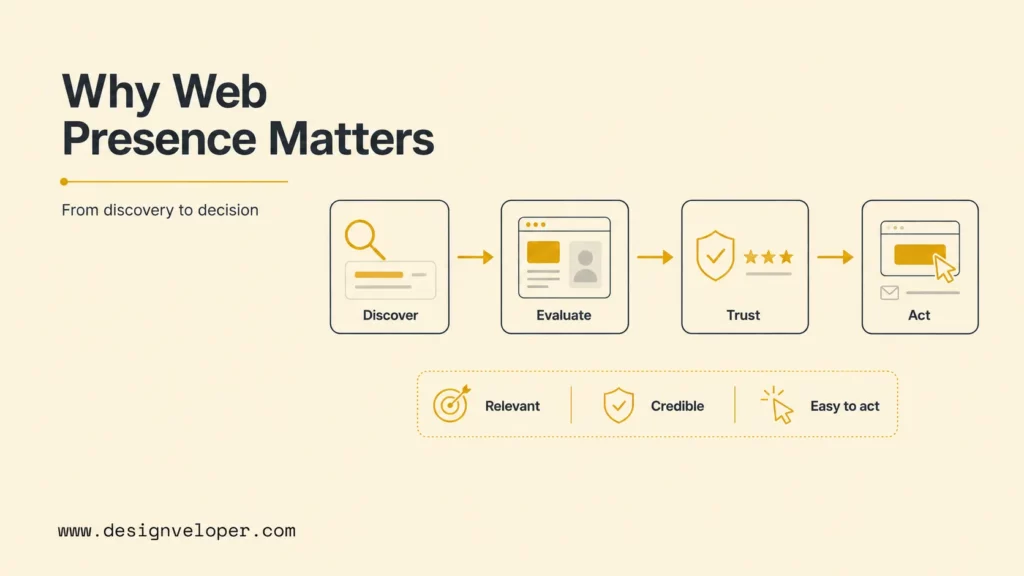
The combined footprint matters because buying journeys are fragmented. A decision-maker may discover a guide through Google, check the company page on LinkedIn, compare service pages, read a project example, search the brand name, and return days later from an email. Each interaction should help the person answer the same core questions: Is this relevant to my need? Is the business credible? What makes its approach different? What should I do next?
Search visibility is one important entry point. Google’s Google Search Central SEO Starter Guide frames SEO as helping search engines understand content and helping searchers decide whether to visit. That definition connects technical access with reader value. A crawlable page that does not answer the query is weak; an excellent page that search engines and users cannot reach is equally limited.
Brand trust develops through consistency and evidence. Accurate contact details, secure browsing, realistic claims, accessible interactions, clear authorship, current content, visible support paths, and independent reviews reduce uncertainty. An impressive visual design cannot compensate for broken forms, contradictory offers, or unanswered criticism. Trust is an operating outcome, not a visual style.
Web presence should ultimately support a business task. That task may be a quote request, booking, product purchase, trial, subscription, store visit, partnership inquiry, or support resolution. Defining the intended action prevents teams from treating follower counts, raw traffic, or average ranking as final success. Visibility is valuable when the right audience can progress with confidence.
Web presence is the promise people encounter before they speak to the business – and the evidence that tells them whether to continue.
Core Elements Of A Strong Online Presence
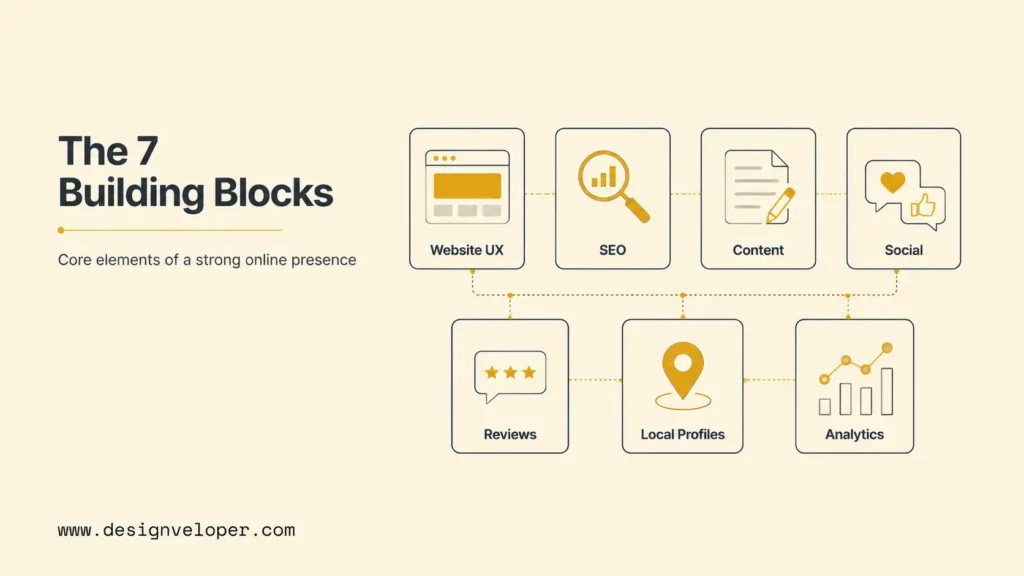
A strong online presence depends on seven connected capabilities. A weakness in one can limit the return from all the others, so improvement priorities should follow evidence rather than channel popularity.
| Element | Why It Matters | What To Improve |
|---|---|---|
| Website design and user experience | Helps visitors understand the offer and complete important tasks | Information hierarchy, responsive behavior, navigation, accessibility, proof, and forms |
| SEO and search visibility | Connects useful pages with active search demand | Crawlability, indexing, intent alignment, titles, internal links, schema, and content quality |
| Content marketing | Answers questions and demonstrates practical expertise | Topic ownership, original insight, editorial standards, updates, distribution, and CTAs |
| Social media presence | Creates repeated exposure and direct audience interaction | Channel fit, native formats, cadence, community response, and tracked destinations |
| Online reviews and reputation | Adds independent proof and reveals service gaps | Ethical requests, response policy, escalation, profile monitoring, and feedback loops |
| Local listings and business profiles | Helps local buyers verify identity, location, hours, and services | Verification, categories, contact data, photos, services, hours, and duplicate control |
| Analytics and conversion tracking | Shows which activity leads to meaningful outcomes | Consent, event taxonomy, key events, CRM connection, attribution, and reporting ownership |
Website design and user experience should make the offer understandable before asking for commitment. The first screen needs a specific audience, outcome, differentiator, and action. Navigation should reflect visitor tasks. Forms should explain what happens next. Mobile layouts should preserve content priority, readable type, generous touch targets, and error recovery rather than simply compressing desktop components.
Accessibility and performance are part of that product experience. The W3C advises using the current W3C WCAG 2.2 Recommendation when developing or updating accessibility policies. Google recommends good Core Web Vitals, with reference thresholds of 2.5 seconds for Largest Contentful Paint, below 200 milliseconds for Interaction to Next Paint, and no more than 0.1 for Cumulative Layout Shift at the 75th percentile. These measures do not replace usability research, but they expose common barriers.
SEO and content marketing provide discovery and depth. Technical SEO gives crawlers stable access to canonical pages. On-page work makes the topic and purpose clear. Useful content answers the question with more than a generic definition; it can include a decision rule, working process, annotated example, checklist, benchmark interpretation, or original experience. Each major page should have a defined intent and a meaningful internal-link path.
Social activity, reviews, and profiles create external confirmation. Channel selection should follow audience behavior. A specialist B2B company may earn more qualified attention from a weekly technical explanation and active community replies than from daily posts across every network. A local service business may rely more on Google Business Profile completeness, location pages, recent photos, review responses, and accurate opening hours.
Analytics connects those efforts. Search Console measures search impressions and clicks. Web analytics measures sessions, engagement, and configured events. Call tracking, ecommerce data, or a CRM records downstream quality. Because platforms use different attribution and identity rules, totals may differ. The measurement model should be consistent enough to support decisions, not engineered to create false precision.
Recommended for you:
- How To Choose A Web Development Company: A Practical Checklist
- 20 Web Design Tools for Different Types of Web Design Software
- 30 Web Design Trends and Tips
How To Enhance Web Presence Step By Step
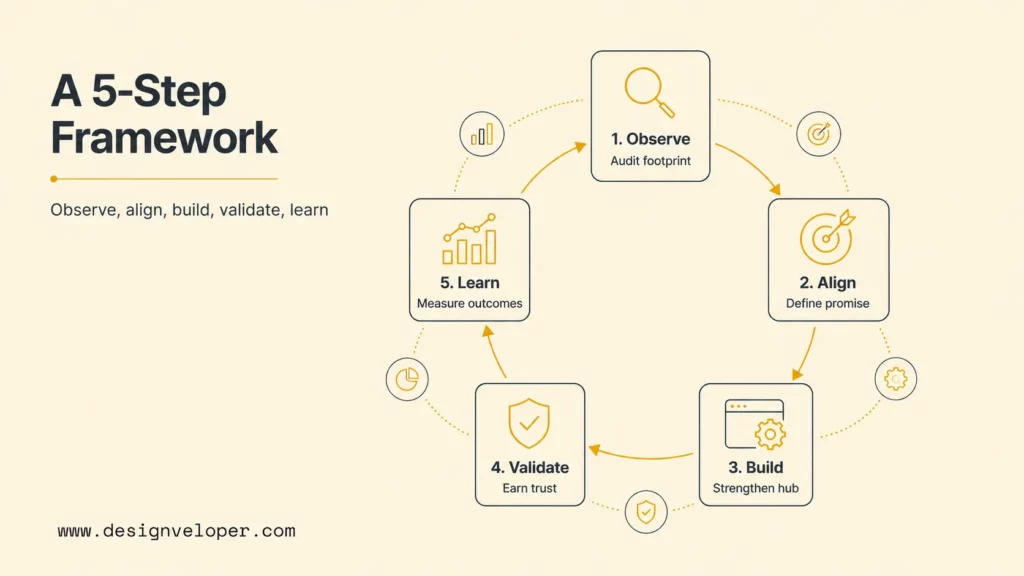
Enhancing web presence works as a repeatable operating cycle. The five layers below move from evidence to strategy, execution, external trust, and measurable learning.
Step 1. Audit Your Website Visibility And Digital Channels
Create a channel inventory before proposing changes. Include the main domain, subdomains, landing pages, important templates, social accounts, Google Business Profiles, directories, review sites, campaign destinations, marketplaces, analytics properties, and customer-facing portals. For each property, record the owner, audience, purpose, update date, traffic, conversions, dependencies, and whether it should be improved, consolidated, redirected, or retired.
Run a website audit across four dimensions. Discovery checks cover index status, robots rules, sitemaps, canonical URLs, redirects, internal links, structured data, and search demand. Experience checks cover mobile layouts, accessibility, navigation, copy clarity, forms, and Core Web Vitals. Trust checks cover secure delivery, contact details, authorship, policies, reviews, and proof. Measurement checks cover consent, tag coverage, event definitions, attribution, CRM handoff, and reporting.
Follow several real journeys from first exposure to completion. Search a priority query and inspect the result snippet. Open the destination on a phone. Try the primary task with keyboard navigation. Submit the form using valid and invalid inputs. Check the confirmation, notification, and CRM record. The output should be a ranked issue list with evidence, affected audience, business risk, owner, effort, and acceptance criteria.
Step 2. Define Your Audience, Goals, And Brand Message
Define audiences through situations rather than demographics alone. A useful audience statement identifies the role, triggering problem, desired outcome, constraints, trusted evidence, and decision process. “Marketing manager at a growing B2B company who needs a maintainable lead-generation site without relying on developers for every update” gives design, content, and platform teams a concrete problem to solve.
Set one primary outcome for each high-value journey. A service page may aim for qualified consultation requests. A product page may aim for trial starts or purchases. A knowledge-base page may aim for successful self-service. Supporting indicators can include search clicks, engaged sessions, proof interactions, form starts, completion, and acceptance by sales or support.
Build a message architecture that can travel across channels. Document the category, audience, main outcome, differentiator, evidence, objection answers, tone, and next step. Adapt the message to a page title, homepage opening, profile description, social bio, campaign landing page, and sales introduction. The wording may change by format, but the underlying promise should remain recognizable.
Step 3. Improve Website Design, Speed, SEO, And Content
Start with templates and pages closest to revenue or service delivery. Improve the homepage, priority service pages, product pages, location pages, conversion flows, and high-impression articles before redesigning low-value areas. Each page should open with the answer or offer, then provide the detail, proof, and next action needed for that intent.
Fix performance by cause. Compress and size images correctly, reduce unused scripts, defer noncritical code, control third-party widgets, optimize fonts, improve caching, and address slow server or database work. Google’s Google Core Web Vitals guidance recommends assessing real-world loading, responsiveness, and visual stability. Use field data to identify affected templates and lab tools to diagnose them.
Organize SEO around canonical topic ownership. Map one primary intent to one strong page, connect related resources with descriptive anchors, and consolidate overlapping content when several weak pages compete. Titles and descriptions should represent the actual answer. Search engines need access to the same meaningful content users receive, so important copy and links should not depend on fragile interactions or blocked resources.
Create content that earns attention after the click. Original diagrams, evaluation criteria, templates, calculations, examples, technical explanations, and experienced judgment provide information gain. Assign an owner and review date to claims that can change. Pair every major content asset with a natural next resource or action so the visitor does not reach a dead end.
Step 4. Build Social Media, Reviews, And Local Visibility
Choose social channels where the intended audience already learns, compares, or asks for recommendations. Design a sustainable content system: one substantial website asset can support a native explanation, short demonstration, expert opinion, visual summary, and discussion prompt. Respond to useful questions and route people to the website only when it provides the needed depth.
Request reviews after genuine service milestones, such as successful delivery, onboarding, a resolved issue, or a confirmed outcome. Google says reviews must represent real experiences and prohibits incentives offered in exchange for posting, changing, or removing a review. Ask for honest feedback, avoid review gating, respond professionally, and turn repeated themes into operational improvements.
Local businesses should verify their Google Business Profile and keep the name, category, address or service area, hours, phone number, website, services, and photos accurate. Google’s Google Business Profile local ranking guidance explains that relevance, distance, and prominence are the main factors. Complete information helps Google understand the business, while reviews and links contribute to prominence.
Step 5. Track Online Presence Metrics And Keep Optimizing
Track the journey as a chain: eligible pages and profiles, impressions, clicks or visits, engaged use, key interactions, conversions, qualification, revenue, and repeat behavior. Give each metric an owner and definition. A “conversion” should specify the event, while a “qualified lead” should state the criteria used by sales or operations.
Use the right system for each question. Search Console explains which queries and pages receive impressions and clicks. Web analytics shows acquisition and on-site behavior. A CRM or commerce platform records quality and commercial outcome. Page-speed monitoring, uptime alerts, accessibility tests, and form-error reporting reveal experience risk. Combine the systems in a compact dashboard rather than forcing every detail into one platform.
Review trends by intent, page type, device, geography, channel, and new versus returning users when data volume and privacy rules allow. Compare equivalent periods and annotate redesigns, campaigns, outages, tracking changes, and seasonal events. Choose the next experiment from the largest verified constraint, define the expected outcome and guardrails, then keep a decision log.
The purpose of measurement is not to prove that every channel worked; it is to reveal which constraint should be removed next.
How Professional Website And WordPress Services Support Web Presence
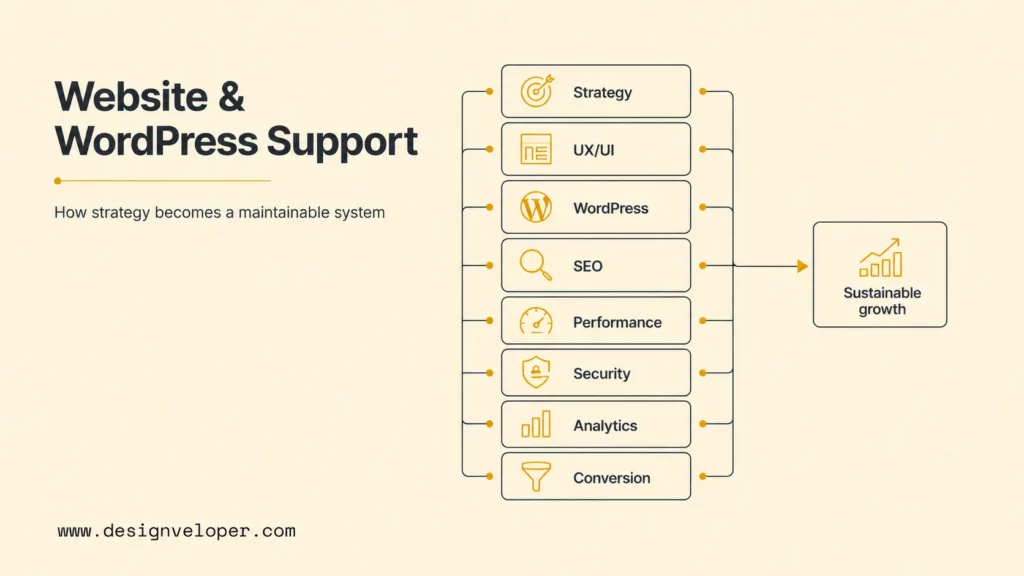
Professional website and WordPress services support web presence by turning strategy into a maintainable system. The value is not simply access to a page builder. It is coordinated ownership of design, engineering, content operations, search foundations, security, performance, analytics, and conversion quality.
- Custom website design translates audience tasks and brand positioning into information architecture, responsive components, accessible interactions, and credible conversion journeys.
- WordPress development and maintenance gives editors controlled publishing tools, reusable blocks, tested releases, backups, monitoring, updates, and recovery procedures.
- SEO-friendly site structure establishes crawlable navigation, canonical URLs, metadata controls, internal links, structured data, sitemaps, and redirect governance.
- Performance optimization addresses hosting, server response, caching, database work, images, fonts, scripts, plugins, CDNs, and real-user metrics.
- Security and plugin management reduces risk through supported software, least privilege, update policies, staging tests, backups, logs, and incident readiness.
- Content publishing workflows define briefs, roles, approvals, reusable components, media standards, accessibility checks, link QA, and update ownership.
- Conversion-focused landing pages match one audience and acquisition promise with relevant proof, a focused action, reliable validation, and complete event tracking.
WordPress is a practical choice when marketing or editorial teams need frequent updates without engineering every page. Governance still matters. WordPress recommends keeping plugins current for security and performance and making a current backup before updates. A production workflow should also test critical updates on staging, remove unused extensions, restrict administrative access, monitor failures, and document rollback.
Architecture should follow the operating model. A conventional WordPress build suits many marketing and publication sites. Headless WordPress can support multi-channel delivery but adds preview, cache invalidation, search, form, and deployment complexity. A custom web application is more appropriate when authenticated workflows, integrations, calculations, permissions, or product logic dominate the experience. The least complex architecture that meets the real requirements is usually the most maintainable.
At Designveloper, we connect strategy, software development services, UX/UI, quality assurance, deployment, and ongoing improvement around the business journey. This coordinated approach lets performance requirements influence design, gives editors usable content models, includes analytics before launch, and tests conversion paths as working product flows rather than decorative pages.
A strong engagement should leave the internal team with durable operating assets: a message architecture, content model, component library, redirect plan, analytics specification, SEO baseline, accessibility checklist, deployment process, maintenance schedule, and prioritized roadmap. Our delivery process explains how discovery, planning, implementation, testing, and support can be organized around clear outcomes.
Related reading:
- 11 Best Web Development Languages for Front-End and Back-End
- How To Build An App For Your Business In 10 Steps?
- Ecommerce Business: How To Start, Grow, And Use Technology
Common Mistakes That Hurt Online Visibility
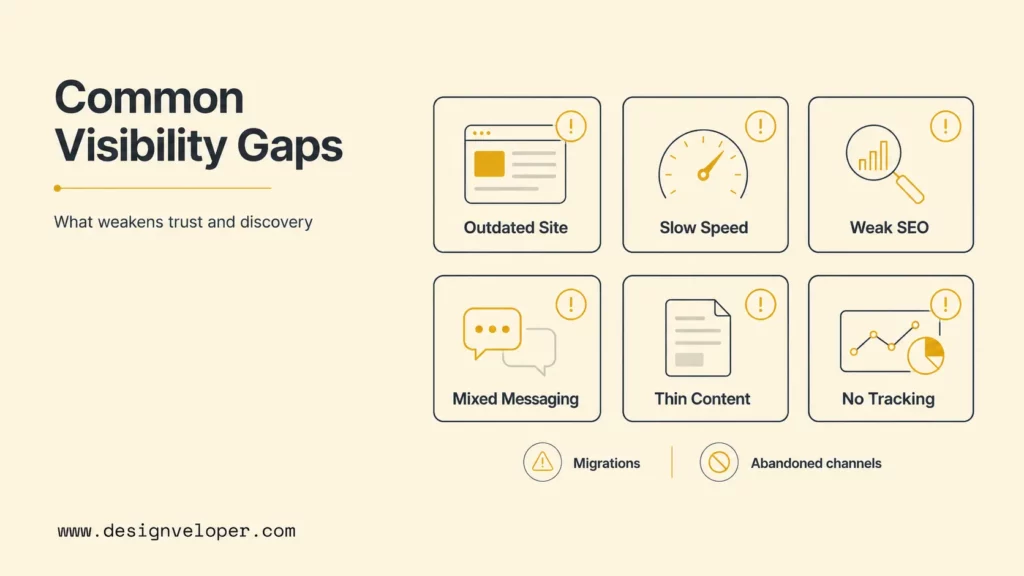
Online visibility usually declines through accumulated inconsistencies rather than one dramatic error. The following problems are common because they cross team boundaries and often lack a clear owner.
- Outdated website design: old offers, dates, layouts, team details, and broken components create doubt. Refresh high-value journeys and evidence before applying a cosmetic theme.
- Slow loading speed: oversized media, excessive scripts, weak hosting, plugin overhead, and ungoverned tags delay the answer users need. Diagnose by template and real-user segment.
- Weak SEO structure: orphan pages, duplicate intent, unstable URLs, missing redirects, vague titles, and poor internal links prevent discovery and dilute topic ownership.
- Inconsistent brand messaging: profiles, campaigns, and website pages promise different outcomes. Maintain a shared message architecture and review it when services change.
- Thin or outdated content: generic summaries create little information gain, while old facts and screenshots can mislead. Consolidate overlap and assign review dates.
- Poor review management: buying reviews, gating criticism, using identical replies, or ignoring problems reduces credibility. Request genuine feedback and route themes into service improvement.
- No analytics or conversion tracking: teams optimize traffic without knowing which journeys produce qualified outcomes or where visitors fail.
Migration errors are especially damaging. Launching a redesign without a complete URL map can remove search entry points and break trusted links. Indexable staging sites can create duplicate pages. Changed analytics tags can make a successful launch look like a traffic collapse. Every release plan should cover redirects, canonicals, robots rules, sitemaps, tracking, forms, metadata, structured data, and rollback.
Another mistake is channel accumulation. An abandoned profile with outdated information can be worse than no profile. A new tool can add performance, privacy, accessibility, and maintenance cost. Before adding a channel or widget, define its audience, owner, content capacity, measurement, review cadence, and exit criteria.
Finally, avoid treating launch day as the finish line. Content changes, plugins age, integrations fail, customer language evolves, and competitors improve. A web presence needs service levels for critical defects, scheduled content reviews, monitored conversions, and a funded improvement backlog.
Connect Website Visibility With Customer Conversion
Website visibility converts when the landing experience continues the promise that earned the visit. Match content to intent. Informational searches need a direct answer and useful next resource. Commercial comparisons need criteria, tradeoffs, proof, and fit. High-intent service searches need a specific offer, delivery confidence, objection handling, and a low-friction contact path.
Treat conversion as an end-to-end workflow. Define the entry page, information requirements, proof, CTA, form fields, validation, privacy notice, confirmation, internal notification, CRM record, response owner, and expected response time. Track form starts, field errors, abandonment, successful submission, qualification, and outcome. A form that records submissions but silently loses notifications is not a working conversion system.
Place evidence beside the uncertainty it resolves. A technical service claim should link to a process or project pattern. A security-sensitive form should explain data handling. A complex engagement should clarify discovery and decision gates. Testimonials should be specific and genuine. Pricing can be expressed as a range, model, or cost drivers when a fixed figure would be misleading.
Connect pre-sale visibility with post-sale experience. Useful onboarding, account tools, status communication, knowledge content, and support paths help customers receive the promised value. Satisfied customers can create honest reviews, referrals, repeat visits, and branded search demand. The web presence then becomes a growth loop rather than a top-of-funnel campaign.
Run controlled improvements with a written hypothesis. For example: “Replacing generic service claims with industry-specific proof and a shorter consultation flow will increase qualified organic submissions without raising spam.” Define the eligible audience, primary metric, guardrails, minimum observation period, and decision rule before the change. Record the result so the team builds organizational knowledge.
We can help align website strategy, WordPress or custom development, UX/UI, SEO foundations, performance, analytics, security, and conversion work into one practical growth roadmap. Contact our team to discuss the audience journey, platform constraints, and measurable outcomes the website needs to support.
FAQs About Enhancing Web Presence
How Can I Improve My Website Visibility?
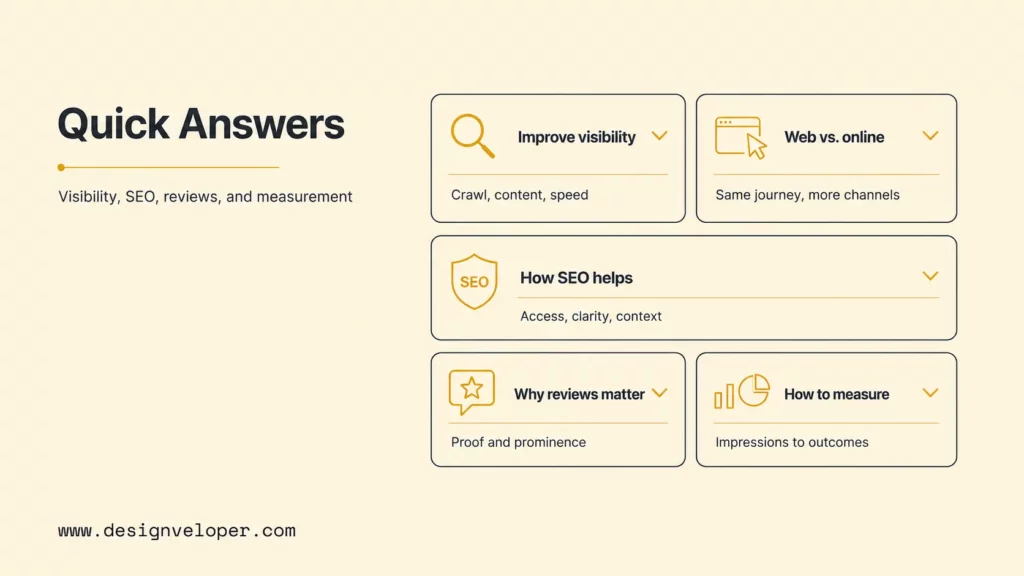
Confirm that search engines can crawl and index the important pages, then align each page with a real audience need. Improve titles, opening answers, internal links, mobile usability, accessibility, speed, and original evidence. Distribute strong resources through relevant communities, profiles, email, and partnerships. Measure qualified impressions, clicks, engagement, and conversion so the next action addresses the actual constraint.
What Is The Difference Between Web Presence And Online Presence?
Web presence and online presence are commonly used as synonyms. Web presence often emphasizes discoverable websites, pages, links, search results, and browser-based profiles. Online presence may include a broader set of apps, marketplaces, messaging platforms, and social channels. The practical task is the same: inventory every important touchpoint and manage it as one consistent customer journey.
How Does SEO Help Improve Online Presence?
SEO helps search engines find, render, understand, and present relevant pages to people with matching needs. Technical SEO improves access and canonicalization. On-page work clarifies the topic and answer. Internal and external links create discovery paths and context. Structured data can describe eligible content and entities. SEO cannot guarantee rankings, but it makes useful pages easier to discover and evaluate.
Why Are Online Reviews Important For Brand Visibility?
Online reviews provide independent information about customer experience and can help profiles stand out. Google states that review volume and positive ratings can contribute to local prominence, while thoughtful replies show that feedback matters. Reviews should be genuine. Ask at appropriate service milestones, do not buy or gate feedback, respond professionally, and use recurring themes to improve the offer.
How Do You Measure Web Presence?
Measure the chain from presence to outcome: valid indexed pages, search impressions, clicks, referral and social visits, profile actions, engaged sessions, Core Web Vitals, accessibility issues, CTA interactions, qualified conversions, sales, repeat use, reviews, and retention. Segment by page type, intent, channel, device, and geography. Use trends and business outcomes to choose the next improvement instead of combining unrelated metrics into one vanity score.
Also published on

Share post on










Related Articles


Enhancing Web Presence: How To Improve Online Visibility And Brand Trust
Enhancing Web Presence: How To Improve Online Visibility And Brand Trust Published July 31, 2026
What is Nano Banana? Features of Google’s New AI Image Editing Model
What is Nano Banana? Features of Google’s New AI Image Editing Model Published September 30, 2025
6 Proven Ways Chicago Brands Can Build Loyalty That Lasts
6 Proven Ways Chicago Brands Can Build Loyalty That Lasts Published July 02, 2025