













10 Case Studies Of AI In Healthcare: Evidence, Results, And Limits

KEY TAKEAWAYS:
- Evidence stage matters: research, pilots, vendor reports, and deployments support different claims.
- Metric definitions matter too; a model score, estimated hours, and a hospital-flow measure are not comparable.
- Human review remains central when tools prioritize findings or draft clinical content.
- For imaging workflows, see how medical computer vision supports image-analysis tasks without making a research result equivalent to a clinical diagnosis.
Case studies of AI in healthcare cover different workflows: a model may review a scan, surface a cancer follow-up, forecast bed demand, or draft clinical notes. Each task has its own inputs, handoffs, and measures of success. This article examines ten examples across imaging, oncology, patient flow, documentation, pharmaceutical research, and pediatric care. It explains each system’s task and identifies who acted on its output. The evidence notes then show how far a result can reasonably travel, helping healthcare teams turn published cases into better questions for their own workflows.
10 Case Studies of AI in Healthcare
The examples below are grouped by the work the AI supports, not ranked by performance. Evidence labels describe the source reviewed and do not imply that a result will transfer to another hospital or patient population.
1. Moorfields Eye Hospital: Retinal OCT Referral Support
Evidence status: Retrospective research. Moorfields Eye Hospital and DeepMind studied a model that analyzed optical coherence tomography (OCT) scans to support referral decisions for sight-threatening retinal disease. The research compared model recommendations with expert referral decisions; it did not measure general diagnostic accuracy across eye conditions.
The research reported 94% accuracy against those expert referral decisions. That figure belongs to the study’s specific task and comparison. It does not mean that the system diagnoses 94% of eye diseases or guarantees a correct treatment decision. The Moorfields research update and Google’s research explanation describe the work and its research context.
- What the case supports: AI can be studied as a way to help prioritize specialist review of retinal scans.
- What it does not establish: routine deployment, improved patient outcomes, or performance on other diseases and populations.

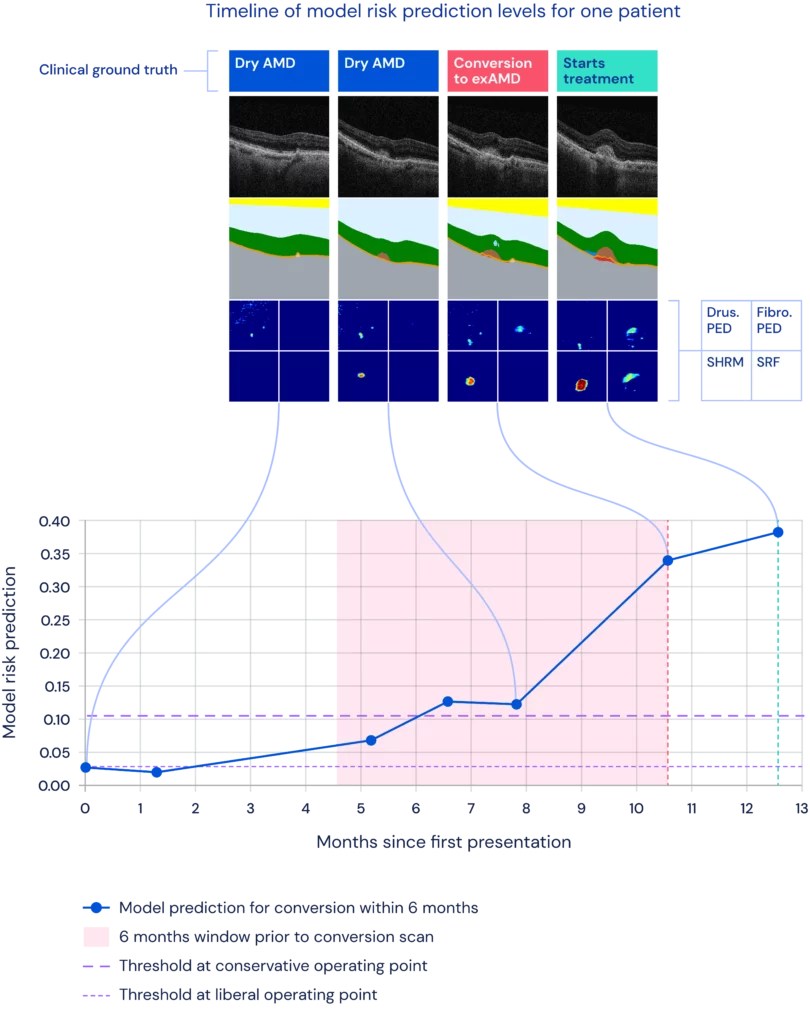
A separate research question was progression risk. A retrospective study used OCT scans from 2,795 patients who had wet age-related macular degeneration (AMD) in one eye. It tested whether an AI model could predict conversion to wet AMD in the other eye within six months. This was not the same endpoint as deciding whether an OCT scan should be referred for specialist review, and it was not evidence of routine-care use or improved patient outcomes. The Nature Medicine study reports the research design.
The progression analysis offers a second example of how image models may be evaluated: one model output concerns a referral decision, while another estimates future risk from historical data. Neither result alone shows that a system is part of routine care or that acting on its prediction improves vision.
- Interpret the visual as a risk estimate: it illustrates a research output, not a diagnosis or a treatment instruction.
- Check before applying it: study design, validation population, time horizon, and the clinician’s role in using the result.
2. HCA Healthcare: AI-Supported Oncology Navigation
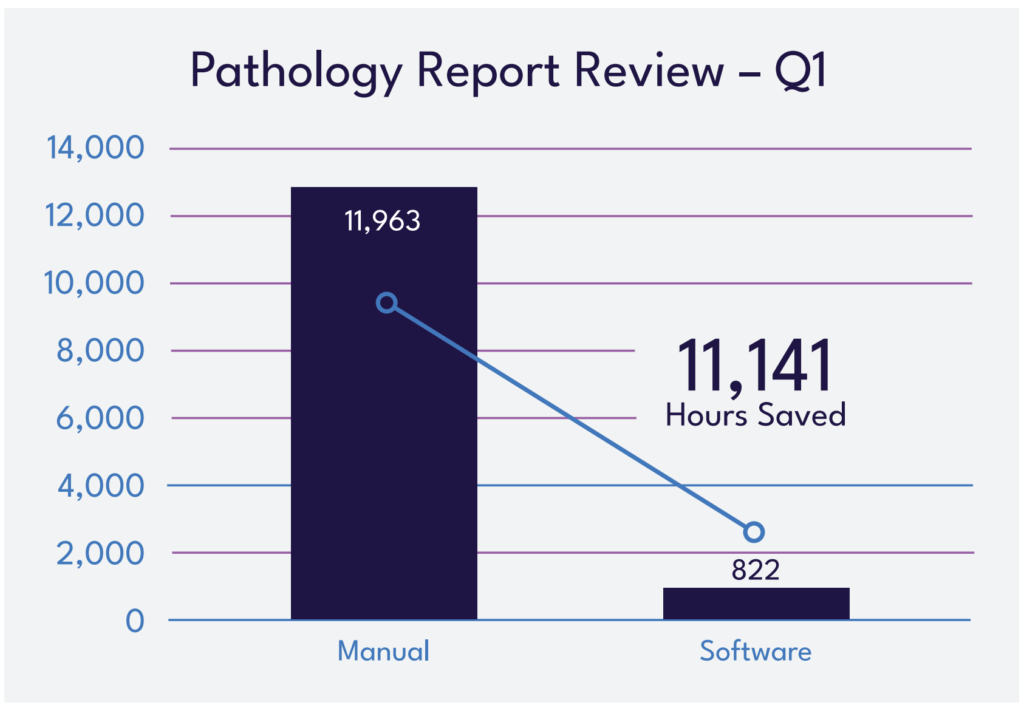
Evidence status: Vendor-reported customer deployment. HCA Healthcare used Azra AI in an oncology workflow that identifies pathology information for follow-up by patient navigators. The intended operational job is to help care teams find patients who may need the next step in cancer care.
Azra’s customer case study reports a seven-day reduction in average time from diagnosis to first treatment. Separately, it estimates 11,141 review hours avoided by comparing 822 hours of software review with 11,963 estimated hours of manual review. The report also lists 10,227 net-new oncology patients over 14 months and says 65% of nurse navigators’ time went to outreach, navigation, and coordination after implementation. These are vendor-reported figures; the PDF does not clearly establish that every number shares one denominator or measurement window, or that Azra alone caused the changes.
- What the case supports: AI-assisted case finding may help route oncology work to a navigation team.
- Evidence limit: these figures come from a vendor case study. They do not show that Azra alone caused the changes or provide an independent comparison group.
Keep the result tied to the source, period, and workflow. A health system considering a similar tool would need to define how it measures diagnosis-to-treatment time, which patients count, and whether staff workload or care quality changes.
3. Duke Health: Command Center Support for Patient Flow
Evidence status: Health-system outcomes reported by a vendor announcement. GE HealthCare describes its Command Center software as coordinating hospital operations, including bed demand and patient flow. The company attributes several reported outcomes to Duke Health’s use of the workflow.
GE HealthCare’s Command Center outcomes page reports a 66% reduction in Duke’s time from bed request to assignment, but it does not show the measurement period for that figure. A GE HealthCare Research article attributes a 50% reduction in temporary-labor use and a 6% productivity increase to Duke’s use of these tools. The company’s 2024 announcement dates the labor comparison to 2020 and introduces Hospital Pulse Tile as a later feature. These vendor-reported measures are not an independent comparison; do not attribute earlier results to the new tile.
- What the case supports: operational AI and command-center tools can be evaluated against specific flow and staffing measures.
- Evidence limit: the figures are reported in a vendor release, not a controlled clinical trial or a cross-hospital benchmark.
Before borrowing the result, define the local baseline and measure the same interval and staffing category. Otherwise, a percentage can hide differences in case mix, capacity, or how each hospital records the metric. For more examples of AI predictive analytics in healthcare, compare the forecast with the human decision and workflow it is meant to support.

4. University Hospitals: AI Prioritization for Imaging Findings
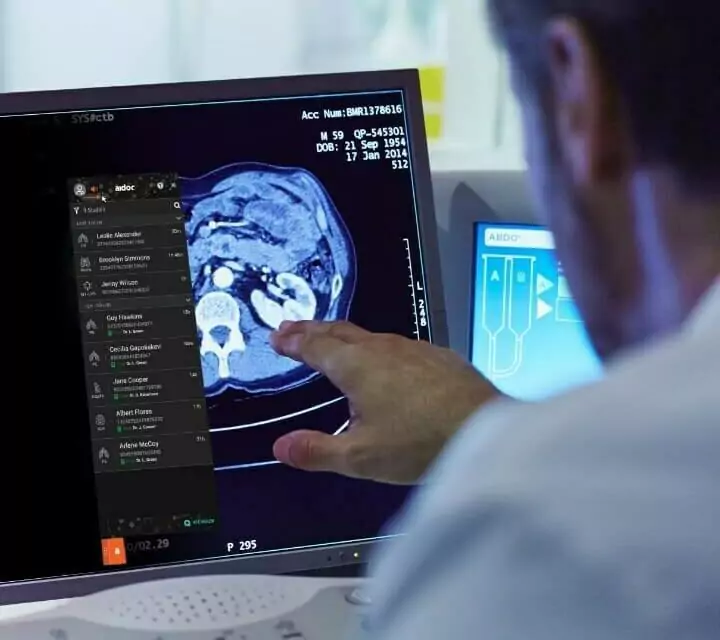
Evidence status: Health-system deployment announcement. In June 2024, University Hospitals (UH) announced deployment of Aidoc’s aiOS platform across 13 hospitals and dozens of outpatient locations. UH said the system provided access to 17 FDA-cleared AI algorithms at that time.
The platform brings imaging-AI outputs into radiology workflows so findings can be prioritized for review. A platform does not make every algorithm or use case equivalent: regulatory status applies to specific software functions and indications. Radiologists remain responsible for reviewing findings and making clinical decisions.
- What the case supports: a health system can integrate multiple imaging tools across a broad care network.
- Evidence limit: the announcement documents deployment scope, not a measured reduction in diagnostic time or a guarantee that no finding will be missed.
UH’s deployment announcement is the source for the hospital count and platform scope. Do not convert access to cleared algorithms into a claim that the entire platform has one blanket clearance.
5. Johns Hopkins Medicine: Draft Notes and Patient Messages
Evidence status: Post-pilot clinical workflow with human review. Johns Hopkins reports that an ambient note-writing tool became available to employed clinicians after a pilot. With patient permission, it uses a recording of a visit to produce a draft clinical note and after-visit summary.
Separate tools can prepare draft replies to selected patient messages. Nurses or clinicians review, edit, or discard the drafts before they are sent. Johns Hopkins’ FY24 annual report describes the rollout, while its AI use in patient care page explains its review expectations.
- What the case supports: generative AI can draft documentation or messages for a care team to check.
- Evidence limit: a draft is not a clinician-approved record or medical response. The sources do not support a universal time-saving percentage.
This example makes the handoff visible: the tool produces a draft, but a human remains responsible for deciding whether it is accurate and appropriate. It is one of the practical generative AI applications where review determines what reaches a patient record or inbox.
6. Sanofi: Separate AI Programs for Research and Supply Planning
Evidence status: Company-reported programs and operating measures. Sanofi describes AI efforts in biologics research, predictive modeling, and lipid-nanoparticle (LNP) research for mRNA. These are distinct tasks, not one system that accelerates every stage of drug development.
In a 2023 company release, Sanofi said AI reduced the time for a specific LNP prediction process from months to days. The company also reported that its plai platform could predict 80% of low-inventory positions in its biopharma supply chain. The figures are company-reported and measure different work: one concerns a research prediction process, while the other concerns inventory planning.
- What the case supports: AI models can be applied to bounded research and supply-planning tasks.
- Evidence limit: faster prediction is not the same as faster drug approval or better patient outcomes. The reported inventory percentage is not an 80% reduction in shortages.
Sanofi’s company announcement describes the programs and reported measures. Keep each figure attached to the specific task and its source.
7. Humber River Health: Virtual Queue and Triage Project
Evidence status: Project described as preparing for implementation. Humber River Health announced an AI-enabled virtual triage and queue-management application for its emergency department. The proposal uses patient urgency and service capacity to forecast queues and help assign a time slot to some patients with less urgent needs.
Humber’s 2024 update described the hospital as preparing to implement the online queue with partners. The sources reviewed do not report a completed evaluation of patient outcomes or waiting-time changes. The hospital’s current emergency department information describes a virtual home waiting room for eligible patients. It does not confirm that this is the same AI system or provide evidence of an AI outcome.
- What the case supports: queue forecasting and virtual access are proposed ways to manage parts of an emergency-department workflow.
- Evidence limit: a planned or prepared system is not proof of deployment, clinical safety, or reduced waiting time.
The 2024 project update describes implementation preparation. Treat later status as unconfirmed unless the hospital publishes results tied to this specific application.
8. Boston Children’s Hospital: Predicting Patient Placement
Evidence status: Retrospective study. Boston Children’s researchers evaluated the Prediction of Patient Placement (POPP) model using records from 59,033 emergency-department visits. The model aimed to estimate whether a patient would be admitted so bed-management teams could plan for demand.
At a threshold with 90% specificity (correctly classifying 90% of emergency-department visits that did not lead to admission), the model identified 73.4% of eventual hospitalizations. The paper also reports an area under the curve (AUC) of 0.91, a separate measure of ranking performance rather than an accuracy percentage. It estimated that a real-time version could potentially save the emergency department 5,917 hours per year, or 30 minutes per hospitalization. These were projected savings, not results measured after deployment.
- What the case supports: retrospective hospital data can be used to evaluate admission-prediction models against a defined threshold.
- Evidence limit: historical model performance and projected time savings do not establish prospective performance or real-world savings.
The peer-reviewed POPP study gives the population and metrics. Keep the study’s specificity, sensitivity, and AUC distinct when describing the result.
9. Diagnostikum in Linz: AI Measurements From Chest CT
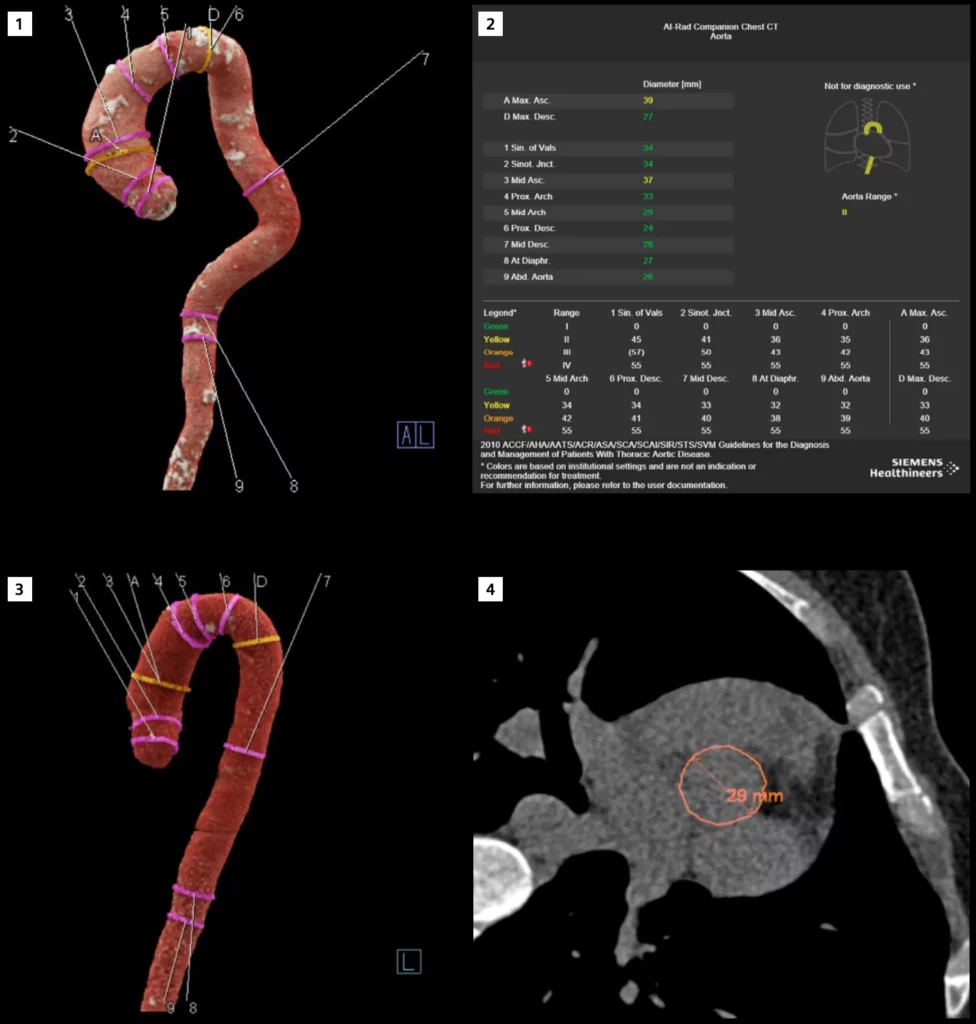
Evidence status: Vendor customer story. A Siemens Healthineers case describes AI-Rad Companion Chest CT producing measurements from a specific non-contrast chest CT protocol used at Diagnostikum in Linz. A radiologist reviews the measurements as part of the imaging workflow.
This example is useful because it names the input, output, and human reviewer. It is not a general recommendation to skip contrast, creatinine tests, or other clinical checks. Those decisions depend on the patient’s case and the protocol selected by the clinical team.
- What the case supports: image-analysis software can generate quantitative measurements for radiologist review in a defined protocol.
- Evidence limit: a vendor customer story does not prove that the same workflow fits every scan, site, or patient.
The Siemens customer story describes the protocol and radiologist review.
10. UF Health: Machine Learning to Identify Postoperative Undertriage
Evidence status: Retrospective observational study. UF Health researchers evaluated whether a validated machine-learning model using automated preoperative and intraoperative electronic health record data could identify patients at elevated risk after surgery. The model generated risk estimates at the end of the procedure, when the care team made a ward-versus-ICU triage decision.
In the validation cohort, 12,348 postoperative ward admissions were analyzed; 1,306 (10.6%) were classified as undertriaged using the model’s risk criteria. Researchers compared this group with risk-matched ICU admissions and found associations with higher mortality and morbidity. The JAMA Network Open study describes the cohort and method.
- What the case supports: EHR features can be evaluated for patient-level postoperative risk assessment at a defined triage point.
- Evidence limit: the retrospective study identifies a higher-risk group; it does not show that an AI intervention changed triage decisions or improved outcomes.
What These Cases Show About Healthcare AI
The examples point to three practical lessons for anyone comparing healthcare AI results:
- Evidence stage changes the claim. A retrospective model can show how it performed on historical data; it cannot by itself show that care improved after deployment. A project announcement shows intent and planned workflow, not a completed outcome.
- Human review is part of the design. Radiologists review imaging outputs, clinicians approve note drafts, and care teams act on workflow alerts. Removing that handoff from the description can make a support tool sound autonomous.
- Metrics need their own definitions. Accuracy, specificity, estimated hours, time to treatment, and staffing requirements answer different questions. Name the source, population, period, denominator, and baseline where available.
These distinctions also help prevent a common mistake: treating an impressive result from one site as a forecast for another. Local patient mix, data quality, workflow, software integration, and staffing all affect what a system can do in practice.
How to Evaluate a Healthcare AI Case Before Adapting It
Use a case study to form a testable question, not as a deployment blueprint. Before a health system adapts an example, check the following:
- Match the task and population. Confirm what the model receives, the decision it supports, which patients were included, and whether the local workflow asks the same question.
- Check the evidence stage and measure. Separate retrospective research, a pilot, an announced project, a deployed product, and a vendor-reported outcome. Record the baseline, sample, time period, denominator, and independent validation status.
- Map the human handoff. Name who reviews the output, who can override it, what happens when it is missing or wrong, and how staff raise a safety concern.
- Verify the intended use and regulatory context. For a U.S. medical-device function, check the exact product and indication in the FDA’s AI-enabled medical-device resources. A platform claim should not be extended to every model or use.
- Set local success and stop rules. Measure a baseline first, assign an owner to review safety and workflow metrics, and define when the team will continue, change, or stop the pilot.
The product work also matters: identity, data access, integrations, consent, auditability, and support must fit the care setting. A healthcare app development plan should describe these dependencies alongside features, not leave them for a late technical phase.
Taken together, these case studies of AI in healthcare are starting points for local validation, not templates to copy into another care setting. Designveloper’s public ODC project describes a telehealth platform for patients and providers; it is healthcare software experience, not evidence of an AI deployment or clinical outcome. For a scoped conversation, contact Designveloper’s AI Development Services team after confirming the clinical, regulatory, and delivery capabilities required for the project.
Also published on

Share post on










Related Articles


10 Case Studies Of AI In Healthcare: Evidence, Results, And Limits
10 Case Studies Of AI In Healthcare: Evidence, Results, And Limits Published October 12, 2026
Healthcare App Development In 2026: Features, Costs, And Process
Healthcare App Development In 2026: Features, Costs, And Process Published July 29, 2026
Build Smarter Healthcare: How Software Brings Medical Devices to Life
Build Smarter Healthcare: How Software Brings Medical Devices to Life Published April 24, 2026