











AI Proof Of Concept Development: How To Test Before You Scale

AI proof of concept development tests whether an AI approach can solve one business workflow before a company invests in scaling it. The aim is to get enough evidence for a sound investment decision, not to build a polished demo.
What Is An AI Proof Of Concept?
An AI proof of concept (PoC) is a time-boxed experiment built around one hypothesis. It tests whether a chosen AI approach can solve a specific business problem using available, approved data. The team agrees on success measures and acceptable risks before testing. The owner records a go/no-go decision or identifies a gap to revise and retest. The timebox depends on scope, data access, and evaluation work; no fixed duration suits every project. A PoC may have a simple interface or none at all because its purpose is evidence, not a finished product.
That purpose separates a PoC from related validation methods. A demo shows a capability, but may use carefully selected inputs. A prototype helps people assess an experience or workflow. A minimum viable product (MVP) tests whether a working product delivers enough value in real use. Our PoC vs MVP vs prototype comparison explains how to choose the right test for the uncertainty you face.
AI makes this distinction especially important because a fluent answer may still be wrong. A support assistant might answer common questions convincingly yet invent refund rules on rare cases. A PoC should expose those cases before anyone promises that the assistant can replace an existing process.
For a business owner, success is not simply proving that a model runs. It is learning whether the model improves a meaningful task under conditions the business can accept. AWS’s guidance on successful generative AI PoCs likewise connects business value with data readiness, feasibility, and delivery risk.
AI Proof Of Concept Development Template And Success Criteria
A useful AI PoC template states what will be tested, how it will be judged, and who will make the decision. Complete it before building the experiment. That prevents a promising-looking result from becoming a reason to change the success criteria afterward.
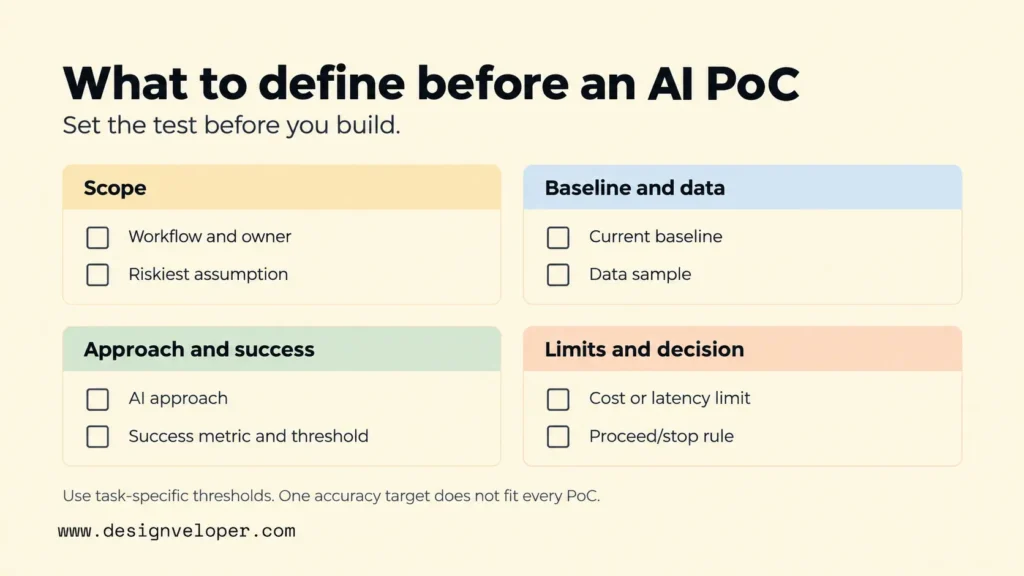
| Template field | Fill in for your PoC |
|---|---|
| Workflow and owner | [One task, the people who perform it, and the decision owner] |
| Riskiest assumption | [The claim that would make the project unattractive if false] |
| Current baseline | [Current method, measured quality, time, and review effort] |
| Data sample | [Approved source, sample size, date range, and difficult cases] |
| AI approach | [Rules, existing model, retrieval, or custom model, with the reason] |
| Success metric and threshold | [Metric, how it is calculated, minimum acceptable result, and any hard safety limit] |
| Cost or latency limit | [Maximum cost per completed task and/or acceptable response time] |
| Proceed or stop rule | [Who decides; required evidence for a pilot, retest, or stop] |
Choose metrics from the work itself. For document extraction, a count of correctly captured fields may matter more than whether the output looks well formatted. For an internal assistant, the team may need to check whether each answer is supported by an allowed source. For a forecasting task, the relevant measure may be error against known outcomes. None of these jobs shares one universal accuracy target.
Record the baseline using comparable cases. If staff currently correct extracted invoice fields, measure both their field errors and the minutes spent reviewing them. Then assess the AI-assisted version on similar documents. A higher model score alone does not prove savings if people must spend longer checking uncertain outputs.
Some conditions should be hard gates rather than average scores. For example, an internal knowledge assistant must not expose a restricted document to an unauthorized employee, even if it answers most other questions correctly. The NIST AI Risk Management Framework measurement guidance supports choosing tests that reflect the system’s intended context and risks.
AI Proof Of Concept Development Process
The AI proof of concept development process should move from a testable business question to evidence and a written decision. Six steps keep the experiment narrow while leaving enough detail for another team to understand the result.
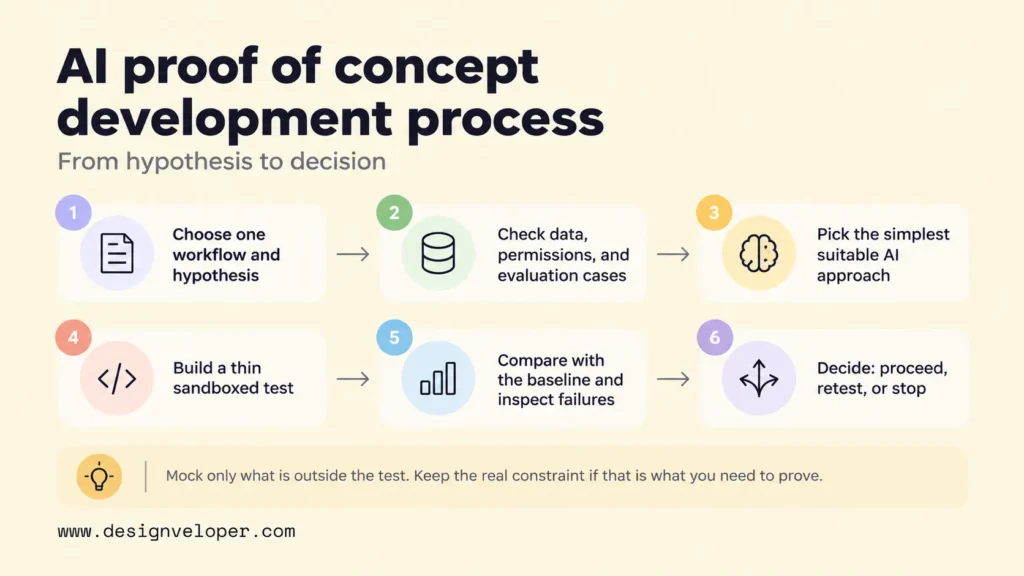
- Choose one workflow and state the hypothesis. Identify an actual task, its owner, and the main problem with the current method. Write a claim that can be disproved. For example, an illustrative support-team hypothesis is that a document-backed assistant can answer approved policy questions with fewer unsupported claims than the existing search workflow. Do not combine customer support, sales forecasting, and billing into one test.
- Check data and prepare evaluation cases. Confirm who owns the source material and whether the team may use it for testing. Check completeness, duplicates, stale records, privacy, and access permissions. Prepare ordinary and difficult cases, including missing information. When answers need professional judgment, ask a subject expert to verify expected facts. Keep evaluation cases separate from examples used to tune the system, so the final test is not simply a memory check.
- Select the simplest suitable approach. Begin with existing rules or software if the task is deterministic. Test an established model for language-heavy work. Consider retrieval-augmented generation (RAG) when answers must use approved documents; retrieval finds relevant information before a language model replies. Our guide to building a RAG system details the retrieval and evaluation steps. Custom machine learning may make sense when a narrow prediction task and sufficient labeled data justify it. Choose based on the assumption being tested, not on which technology seems newest.
- Build a thin experiment in a controlled environment. Connect only the components needed to test the hypothesis. Use approved or suitably de-identified data. Mock an email sender or accounting integration if it is not central to the test. However, do not mock the very constraint you need to prove: if permission-aware retrieval is the main risk, the test must enforce real permission rules or a faithful test equivalent.
- Compare results with the baseline and inspect failures. Run the agreed cases and record output quality, review time, latency, and cost per completed task. Keep examples of wrong, incomplete, or unsupported answers. Check how outcomes differ by document type, user role, or unusual input. Record access failures separately. Averages can hide a harmful pattern in a small but important group of cases.
- Present the evidence and make a decision. Show the owner the original hypothesis, sample limitations, measured results, and failure cases. Distinguish what was directly tested from what remains unknown. Recommend a controlled pilot, one specific retest, or a stop. Keep the code, test cases, and decision memo available so the next team does not need to reconstruct the experiment.
The evaluation set deserves special care because generative answers are not always identical. For some questions, an expert can specify expected facts instead of one exact sentence. AWS’s guidance on evaluating generated outputs explains how reference answers and expected facts serve different tasks.
Keep a record of model versions, test settings, data dates, and any human review used in scoring. Otherwise, two runs may appear comparable when the underlying conditions changed. The final recommendation can be conditional: an approach may meet quality goals but need a cheaper model or faster retrieval before a pilot is worth funding.
AI Proof Of Concept Examples By Workflow
The best AI PoC measures the uncertainty that matters most for its workflow. The same test plan will not tell you whether a knowledge assistant respects document permissions, an extraction tool reduces review work, and a finance assistant records transactions correctly.
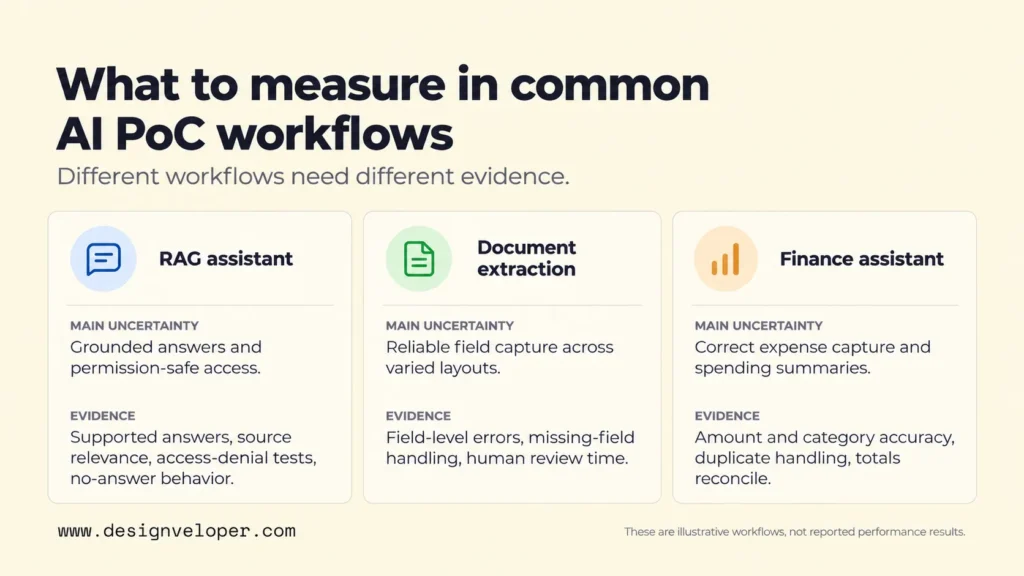
| Workflow | Key uncertainty | Evidence to collect |
|---|---|---|
| RAG knowledge assistant | Can it ground answers in allowed, current documents without leaking restricted content? | Supported answers, source relevance, permission-denial tests, and no-answer behavior. |
| Document extraction | Can it capture required fields across varied layouts without creating excessive corrections? | Field-level errors by document type, missing-field handling, and human review time. |
| Conversational finance assistant | Can it record an expense from natural language and return accurate spending summaries? | Correct transaction amounts and categories, duplicate handling, and totals reconciled to stored records. |
Consider a RAG assistant used by employees with different access rights. A general answer-quality test is insufficient. The team must also try questions whose answers exist only in restricted files. If the assistant reveals that information, its permission control has failed even when the wording is accurate.
For document extraction, review effort is part of the outcome. An invoice system might identify most fields yet repeatedly confuse tax and total amounts. The PoC should report those errors separately and measure how much time a reviewer spends finding them. This helps the owner compare automation with the current manual process.
Our public personal-finance assistant project illustrates a conversational workflow: a user can record an expense by messaging the assistant and later ask about spending. That is a useful capability example, not evidence of a measured PoC result. The public description does not establish its evaluation scores, development cost, or return on investment.
AI PoC Development Services: What Should A Partner Deliver?
A capable AI PoC partner should deliver a testable answer to the agreed business question, not just a working demonstration. The contract should name the evidence, files, responsibilities, and decision outputs the buyer will receive.
Ask for a written hypothesis with scope boundaries and acceptance rules. The partner should identify which workflow steps are included and which integrations are intentionally mocked. A good scope also explains what is not being proved. For example, an experiment that only processes redacted historical invoices cannot establish that live invoice feeds are ready.
Data handling needs its own plan. It should specify approved sources, access roles, retention, deletion, and the location of testing. The buyer should know which staff can view test records and whether outside model services receive data. These questions matter before any sensitive information leaves an internal system.
The working experiment should arrive with its evaluation evidence. Request the test-case definitions, aggregate results, important failure examples, configuration details, and known limits. Ask who owns the code, prompts, test data, and documentation. Agree on the rights to reuse or transfer each item before work begins. Ownership questions become harder to resolve after the experiment succeeds.
Cost assumptions should separate the one-time build from recurring use. Model requests, hosting, data processing, human review, and maintenance may change with workload. If suppliers offer different estimates, compare them against the same volume, data access, evaluation standard, and integration boundaries. Our AI development cost guide explains how to separate build expenses from ongoing operation.
When a business needs help connecting an AI capability to an existing workflow, we can discuss the software and integration work covered by our AI development services. A practical starting point is to share the template’s hypothesis, sample data constraints, and acceptance tests. Those inputs make the scope easier to evaluate. They do not imply that every idea needs a custom build or that we guarantee a PoC outcome.
From AI PoC To Pilot: Decide What To Scale
A successful PoC supports a decision to test the idea in a controlled real-world setting. It does not prove that the system is ready for full deployment. A pilot adds actual users, operational constraints, and safeguards that a small experiment may have deliberately excluded.
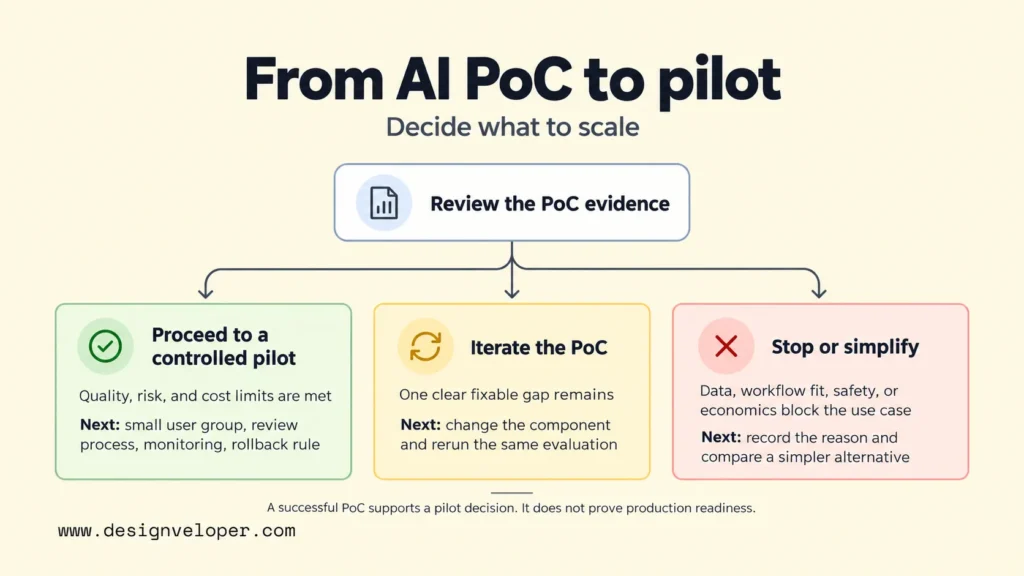
| Decision | Evidence | Next action |
|---|---|---|
| Proceed to a controlled pilot | Required quality, risk, and cost limits are met on representative cases; remaining unknowns can be tested safely. | Set a small user group, review process, monitoring, and rollback rule. |
| Iterate the PoC | One clear, fixable gap remains, such as poor retrieval on a document type. | Change that component and repeat the same agreed evaluation. |
| Stop or simplify | Data access, workflow fit, unsafe failures, or operating economics block the use case. | Record the reason and compare a rules-based or manual alternative. |
This boundary matches the Australian Government’s guidance on AI transition stages. It distinguishes the feasibility tested in a PoC from the real-world value and readiness examined in a pilot, and from the sustained operations required in production. Although the guidance addresses government agencies, that distinction is useful to commercial teams too.
Before expanding access, decide who reviews uncertain answers, how incidents are handled, and what happens if performance falls. A pilot should measure actual task completion and user behavior, not only the same offline test score. If that next step succeeds, our guide to moving AI products into production explains the separate work of monitoring, support, and ongoing reliability.
FAQs About AI Proof Of Concept Development
How Long Does AI Proof Of Concept Development Take?
There is no reliable universal duration. A narrow test using accessible data and an existing model can finish sooner than one requiring security approval, expert labels, or custom training. Plan the schedule around the steps that produce evidence: scoping, data access, case preparation, implementation, evaluation, and the decision review. Ask the team for a timebox with named dependencies instead of accepting a fixed duration without a defined scope.
How Much Does AI Proof Of Concept Development Cost?
Cost depends on the data work, model choice, number of real integrations, required safeguards, and evaluation effort. A small hosted-model experiment has different cost drivers from custom machine learning or a secure internal knowledge assistant. Request an estimate by work package, including expert review and repeat testing. Also ask for an expected cost per completed task at the intended usage level. A vendor’s headline PoC price is not a reliable estimate for a differently scoped project.
Can AI PoC Code Be Reused In Production?
Some components can be reused, but PoC code should not be treated as production-ready by default. Test cases, data transformations, and well-isolated logic may remain useful. Shortcuts around permissions, error handling, secret storage, logging, and reliability need review or replacement. Decide what to keep only after documenting its quality and ownership. The purpose of the PoC is to preserve trustworthy learning, not necessarily every line of its first implementation.
Also published on

Share post on










Related Articles


AI Proof Of Concept Development: How To Test Before You Scale
AI Proof Of Concept Development: How To Test Before You Scale Published October 22, 2026
LLM Deployment Pipeline: Stages, Testing, And Production At Scale
LLM Deployment Pipeline: Stages, Testing, And Production At Scale Published October 20, 2026
AI Model Monitoring: Metrics, Drift, And Production Reliability
AI Model Monitoring: Metrics, Drift, And Production Reliability Published October 20, 2026