













LLM Deployment Pipeline: Stages, Testing, And Production At Scale

An LLM deployment pipeline is a repeatable process for testing, releasing, and monitoring a language-model application in production. It moves a known version of the model configuration and application through quality checks, staging, a controlled rollout, and ongoing monitoring. The pipeline can deploy a hosted API integration or a self-hosted model server; it does not require training a new model.
The goal is not merely to make a model answer requests. It is to know what changed, decide whether the change is safe, and restore the previous working version if users encounter problems. That makes deployment a software delivery and operations task as much as an AI task.
What Is An LLM Deployment Pipeline?
An LLM deployment pipeline connects a selected model and application configuration to a reliable release process. Its input may be a new prompt, model reference, application build, or retrieval setting. Its output is a traceable production release with tests, an owner, and a way to respond when the release underperforms.
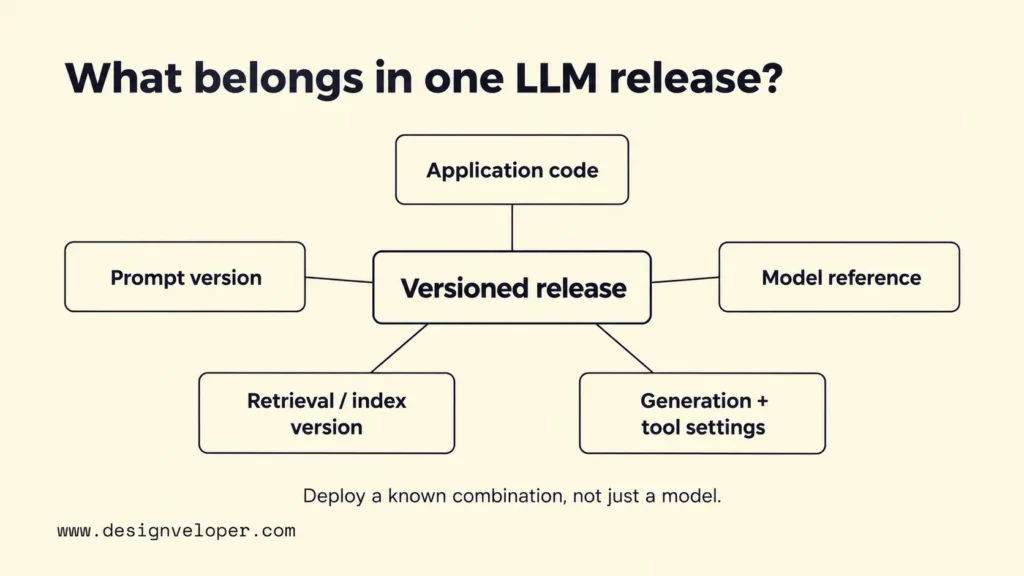
The core stages are versioning, automated validation, staging, production promotion, and monitoring. Continuous integration checks proposed changes. Continuous delivery prepares a tested release, while a team may keep production approval manual for sensitive workflows. Our guide to CI/CD pipelines explains these software delivery foundations. LLMs add another question at every gate: does the application still give acceptable answers?
LLMOps is the broader practice of developing, evaluating, deploying, and maintaining LLM applications. The deployment pipeline is its release path, not the entire lifecycle. Microsoft’s LLMOps guidance separates iterative evaluation from production deployment, monitoring, and feedback. That distinction matters because a successful build says little about how a response behaves with real users.
A hosted-model team might release only its application image and a pinned provider model identifier. A self-hosting team may also release a serving image and model weights. Both need access rules, test cases, alert thresholds, and a rollback plan. Neither approach becomes safer simply by adding fine-tuning.
Hosted LLM API Vs. Self-Hosted Model Serving: Which Fits?
Choose a hosted LLM API when managed inference and a smaller operations burden fit your data requirements. Consider self-hosted serving when you need more control over the model, its runtime, or where processing occurs, and can operate that infrastructure. Compare the full application workload rather than assuming one route is always cheaper or safer.
| Decision factor | Hosted LLM API | Self-hosted model serving |
|---|---|---|
| Control | Control prompts and application logic; model runtime is provider-managed. | Control model selection, serving software, and runtime configuration, subject to model license. |
| Data requirements | Review provider terms, retention, processing location, and available controls. | Choose infrastructure location and access controls; your team remains responsible for protecting data. |
| Infrastructure effort | Integrate an API and manage credentials, limits, and fallbacks. | Provision compute, package the server, patch dependencies, and manage availability. |
| Scaling | Provider supplies serving capacity within quotas and service terms. | Team plans capacity, concurrency, memory, and autoscaling. |
| Operating responsibility | Provider runs model inference; team still owns application quality and incidents. | Team owns the application plus the model-serving service. |
A hosted service can reduce startup effort, but rate limits or provider changes can still interrupt the product. Self-hosting offers more runtime control, yet idle compute, maintenance, and on-call work may outweigh its benefits at low usage. Test both options against the same representative requests and compare quality, response time, total cost, and security conditions.
For self-hosted inference, serving tools such as vLLM can expose a model through an API and report operational metrics. Our vLLM setup and serving tutorial covers that implementation work. Keep the deployment pipeline focused on making its configuration testable and releasable, rather than mixing release governance with installation instructions.
A hybrid setup can route ordinary requests to a hosted model while handling a restricted or specialized workload on approved infrastructure. This is useful only when the split solves a measured constraint. Both routes must enforce the same user permissions and share release tracking, observability, and fallback rules. Routing between models without testing answer differences creates another failure mode.
How To Build An LLM Deployment Pipeline With CI/CD
Build the pipeline around a versioned release unit, automated checks, a staging environment, and gradual promotion. Continuous integration and continuous delivery (CI/CD) should run when a change is proposed, but a production rollout should wait until the new version meets the workload’s agreed acceptance criteria. The steps below follow one illustrative support-assistant prompt update.
Version Prompts, Model References, And Retrieval Settings
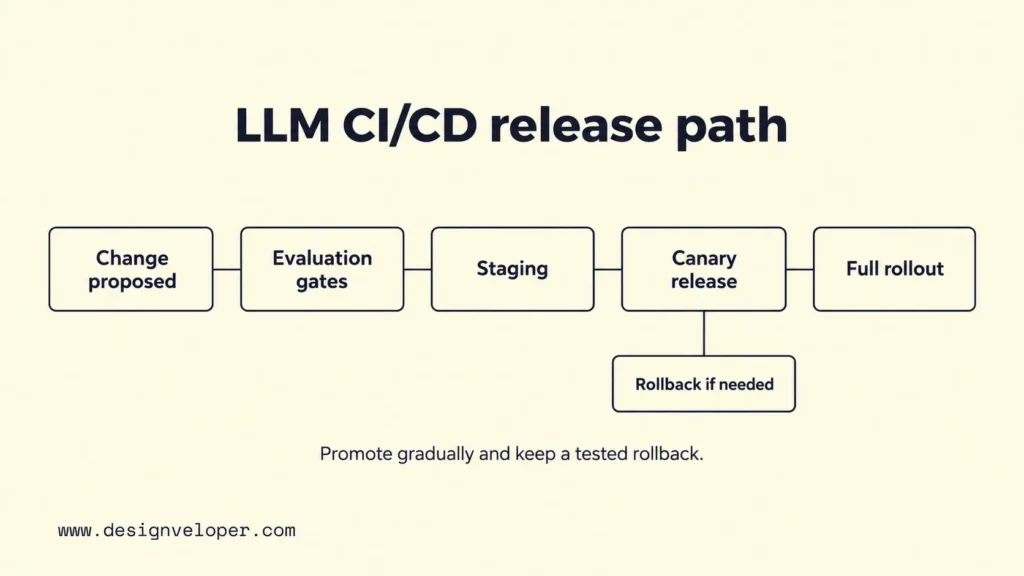
Start by recording every input that can change an answer. Store application code with its commit identifier, and record the prompt version, selected model identifier, generation settings, tool permissions, and retrieval configuration. For a self-hosted service, also record the model artifact and serving-image digest. Keep credentials in a secrets manager rather than in this manifest.
For example, suppose a support assistant’s prompt changes to ask one clarifying question before explaining a refund policy. The change request should identify the old and new prompt versions, the policy source used in tests, and the intended improvement. A prompt registry can help: MLflow’s prompt lifecycle documentation describes immutable prompt versions and environment aliases. Record the resolved version at release time, since an alias can later point elsewhere.
If the assistant uses retrieval-augmented generation (RAG), version the index or collection reference alongside the retrieval settings. RAG fetches approved source passages before generation, so a document update can change answers even when the prompt stays fixed. Our RAG chatbot construction guide explains the retrieval mechanics; the release pipeline needs to know which index version was actually tested.
Add Quality, Safety, And Integration Gates
Test the candidate against a fixed set of representative tasks before it reaches staging. Include common requests, policy exceptions, ambiguous questions, requests that should be refused, and attempts to override instructions. Give each case a clear expectation: required facts, forbidden claims, approved sources, or an expected handoff. Compare the candidate with the current production version under the same test conditions.
Do not rely on an exact-text match for every generated answer. First use deterministic checks for required fields, valid formats, permissions, and tool arguments. Then use task-specific scoring or human review for answer correctness and tone. Treat automated model-based judges as fallible: calibrate them against reviewed examples and investigate disagreements before using their scores as a release gate.
Integration tests must exercise real application boundaries. A support assistant might retrieve a policy successfully yet fail when the ticket API times out. Verify that it does not claim to have opened a ticket and that the user receives an appropriate fallback. Our guide to AI chatbot integration explains why testing the complete business action matters more than judging the wording of the answer alone.
For the hypothetical prompt change, a release should fail if it introduces an unsupported refund promise or skips required identity checks. It can proceed when reviewed policy answers improve without breaking refusal, escalation, or tool-call cases. The specific thresholds should come from the product’s risk level and a documented baseline, not a universal score copied from another application.
Build A Reproducible Artifact And Deploy To Staging
Package the tested application so staging and production use the same release contents. Build an immutable container image or equivalent artifact, pin dependencies, and record the deployment manifest that resolves model and prompt references. Rebuilding from a moving dependency tag can produce a different release even when the source code has not changed.
Deploy that artifact to staging with production-like authentication, networking, logging, and service limits. Use synthetic or approved de-identified test data where possible. Check startup readiness, secret access, provider quotas, retrieval access, and integration contracts. Staging does not prove production capacity, but it catches environment failures that prompt evaluations cannot.
Run a small load test that represents expected conversation length and concurrent requests. Measure response delay and error behavior, not just successful outputs. If the model is self-hosted, verify that its serving configuration can handle request queues and memory demand. If it is hosted, verify timeouts, quota errors, retry limits, and the impact of retries on cost.
Promote Releases Gradually And Keep A Tested Rollback
Promote a release in stages so early failures affect fewer users. For the support-assistant example, route a small, selected share of traffic to the new prompt version, compare it with the current version, then expand only after the agreed observation window. This is a canary release. A canary needs request-level version labels; otherwise, the team cannot tell which version caused a failure.
Define rollback conditions before traffic shifts. The release owner could stop promotion if reviewed policy errors rise, a critical safety test fails in live sampling, or latency and error rates exceed the product’s accepted limits. Name who can make that decision, how alerts reach them, and how long they have to respond. A low overall error rate is not reassuring if a serious failure is hidden in a small segment.
Rollback must restore the entire compatible release, not just the application container. That may mean restoring the earlier prompt reference, routing rule, model identifier, and retrieval index pointer. Kubernetes deployment documentation supports workload rollouts and revision rollback, but its rollback tracks the Pod template. External prompt aliases and indexes require their own recovery steps. Rehearse those steps in staging before production needs them.
How To Monitor And Scale LLM Deployments In Production
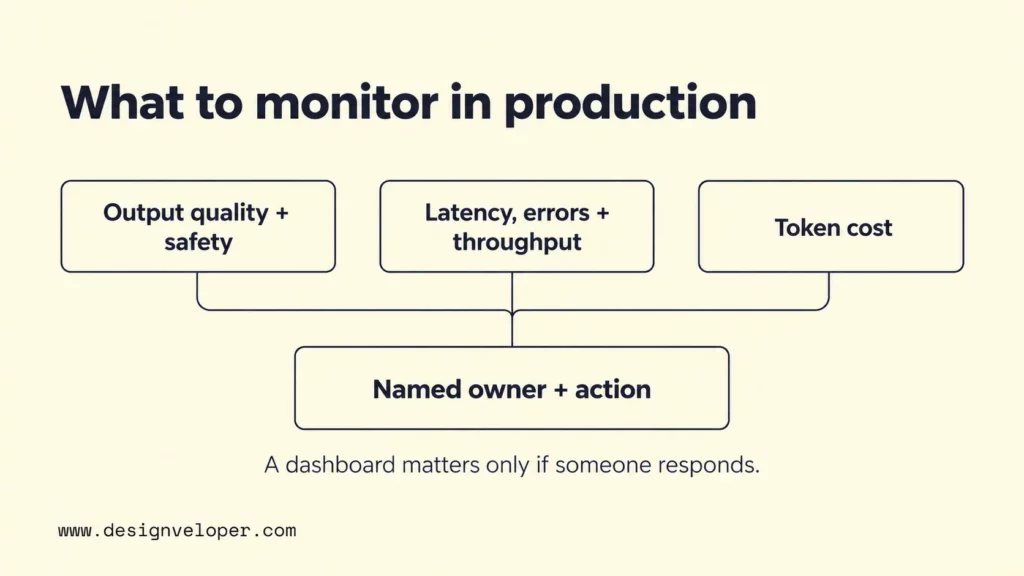
Monitor both the answers users receive and the service delivering them. A request can succeed technically while giving unsafe or incorrect advice. Conversely, a correct response can arrive too slowly or cost too much for the product to remain useful. Set separate quality, reliability, and cost signals, then assign a response to each serious alert.
Track Output Quality And Safety
Review a representative sample of production outcomes, including failed handoffs and complaints. For a support assistant, check whether answers match the approved policy, whether refusals occur when needed, and whether the assistant invents a completed action. Segment results by task and release version. A high average score can conceal a serious problem with one policy category.
Collect feedback and traces with clear data-handling rules. Remove or restrict personal information, apply retention limits, and control reviewer access before storing conversation content. Where full text cannot be retained, record safer metadata and use approved test sessions for deeper analysis. The service owner should know what evidence is available before an incident occurs.
Give each critical quality alert an action. An application owner may disable a risky tool, turn off the new prompt, or move affected requests to a human team. A content owner may correct an outdated policy source. These are different causes, so a generic alert to an unowned dashboard is not enough.
Monitor Latency, Errors, Throughput, And Token Costs
Track time to first token for streamed answers, total request duration, error rate, and throughput under load. Record input and output tokens where the provider or serving stack exposes them, then calculate cost for the actual workload. Include retrieval and tool calls in end-to-end timing. A quick model response does not help if document retrieval delays the conversation.
For self-hosted systems, watch queue depth, active requests, and memory pressure before increasing replicas. vLLM’s metrics documentation identifies request latency, time to first token, token counts, and waiting requests. For hosted APIs, examine provider quotas and throttling along with the same application-level experience.
Scale against the actual bottleneck. Additional model replicas may help when the serving queue is saturated, but they will not repair a slow database or an overloaded integration API. Set spending alerts too: more capacity and longer generated answers can increase cost even when traffic stays constant. Assign an operations owner to capacity incidents and a product owner to changes that raise cost per completed task.
Feed Production Failures Back Into Evaluation Tests
Turn confirmed production failures into regression tests before the next release. If an assistant applies the wrong exception to a refund policy, preserve an approved, redacted version of the request, the correct source, and the expected behavior. Add it to the evaluation set and test both the current and proposed releases. This closes the gap between what the team tested and what users actually asked.
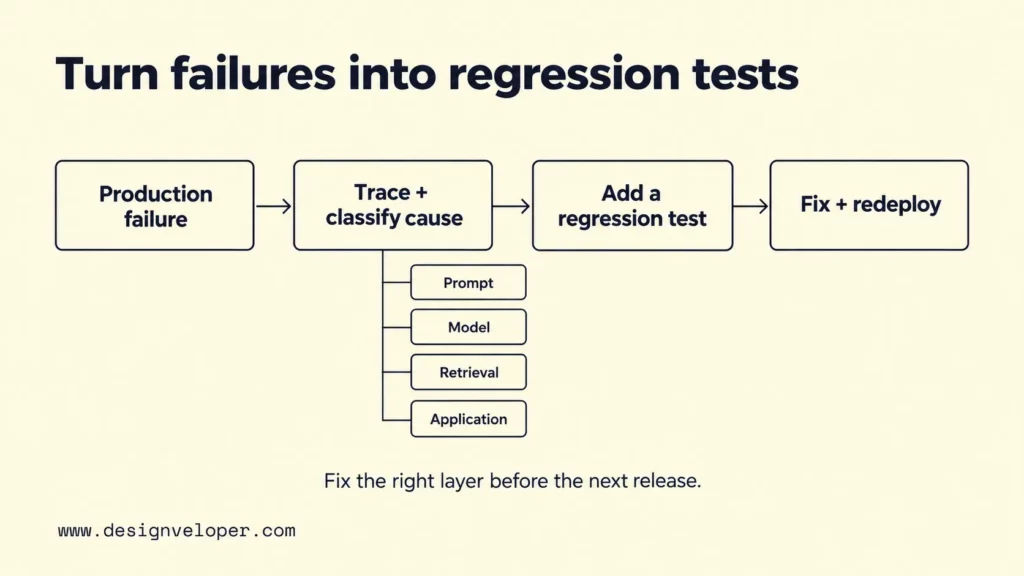
MLflow’s production-trace evaluation guide documents retrieving traces and applying scorers to them. A trace helps locate a failure, but a reviewer must still confirm its cause. If retrieval selected the wrong policy passage, fix the index or search rules. If a tool returned an error, repair the integration rather than rewriting the prompt.
We recommend treating the next release as a direct response to a measured failure, with one owner for the fix and one test proving it works. Our MLOps lifecycle guide places monitoring and feedback inside the ongoing model operation process. For LLM deployment, the practical addition is to trace each issue to the prompt, model, retrieval, or application layer before deciding what to change.
FAQs About LLM Deployment Pipelines
Does An LLM Deployment Pipeline Require Fine-Tuning?
No. Many deployments use an existing hosted or self-hosted model with versioned prompts and application logic. Fine-tuning is a separate training step that may help with a stable task or output pattern. It does not replace release testing. Our RAG versus fine-tuning comparison explains when changing retrieved knowledge is a better answer than changing model parameters.
How Do You Test LLM Outputs That Are Not Deterministic?
Test observable requirements rather than expecting identical wording. Use exact checks for structured outputs and security rules, then evaluate meaning with defined criteria and reviewed examples. Repeat selected tests to see whether results vary, and compare new and old releases on the same inputs. Human review remains important for high-impact failures and for validating automated scoring.
Should RAG Index Updates Use The Same Pipeline As Model Releases?
They should follow compatible versioning, testing, and approval rules, but they do not need to run in one job. A document or index update can move through its own pipeline if it records the index version and checks retrieval quality, permissions, and source freshness. Integration tests should verify that the released application works with the new index. Preserve an earlier compatible index for rollback.
How Can Teams Avoid Lock-In Across LLM Providers?
Keep model access behind a small application interface and make provider-specific behavior explicit. Record model versions, response formats, tool-call rules, quotas, and data-handling requirements. Test a second provider on the same workload before promising portability: an API-compatible request does not guarantee the same output quality or safety behavior. Retain a documented fallback only if it meets the product’s acceptance tests.
Also published on

Share post on










Related Articles


LLM Deployment Pipeline: Stages, Testing, And Production At Scale
LLM Deployment Pipeline: Stages, Testing, And Production At Scale Published October 20, 2026
AI Model Monitoring: Metrics, Drift, And Production Reliability
AI Model Monitoring: Metrics, Drift, And Production Reliability Published October 20, 2026
Enterprise AI Governance Framework: Roles, Risks, And Controls
Enterprise AI Governance Framework: Roles, Risks, And Controls Published October 20, 2026