
















Offshore Dedicated Development Team: How To Hire And Manage One

An offshore dedicated development team can add stable capacity when your product roadmap grows faster than local hiring. The decision goes beyond finding lower developer rates. You need to know who will guide the work, whether the same people can build product knowledge, and what the engagement will cost once support and handover are included. Before committing, weigh the model against your backlog and your ability to make timely decisions. That starts with understanding what “offshore” and “dedicated” mean in the agreement you are signing.
What Is An Offshore Dedicated Development Team?
An offshore dedicated development team is a stable group of software professionals based in another country and assigned to one client’s product or program. “Offshore” describes where the team works. “Dedicated” describes its focus and continuity: the same named people are expected to stay with the same client instead of rotating across unrelated projects.
The contract defines how this focus works in practice, including the people assigned to your account and the responsibilities of each side. A dedicated team is an engagement model, not a fixed set of job titles. Our guide to choosing a dedicated development team explains how to evaluate team composition and provider fit.
How Does The Offshore Dedicated Team Model Work?
The model works when the client keeps product direction close while the provider removes part of the local staffing and operating burden. In a common setup, the client decides what the product should achieve and which work matters next. The provider makes sure the agreed team exists, is employed correctly under its setup, and can work with the client over time.
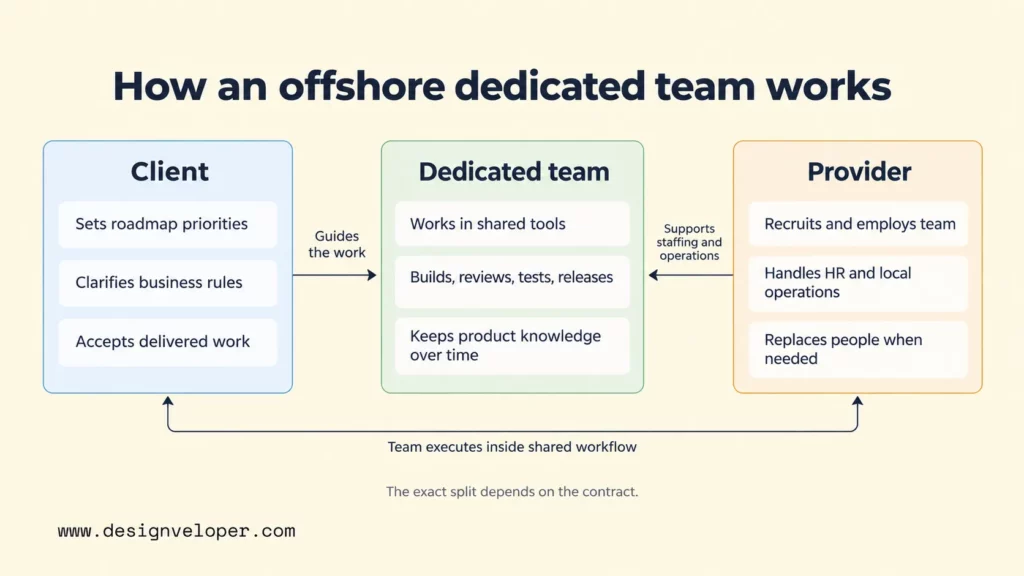
That split should be explicit before delivery starts. A product owner or business lead should be able to decide priorities and clarify business rules. A technical decision-maker should be able to resolve architecture, integration, and engineering trade-offs. On the provider side, responsibilities can include recruiting, employment, HR administration, local facilities, team changes, and sometimes project or delivery management.
The offshore software development team should then join the same delivery system as the rest of the product organization. That normally means access to the relevant repositories, issue tracker, documentation, design files, communication channels, test environments, and release process. Planning, code review, QA, demos, and acceptance should happen inside shared workflows rather than in a separate vendor-only process.
A dedicated development team structure should follow the roadmap rather than a standard package.
- Business analyst or product specialist: turns business needs into requirements the team can build.
- Engineering lead: guides architecture and code quality.
- Developers and designers: build features and shape how people use them.
- QA engineers: check that the product behaves as agreed.
Add other specialists only when the roadmap creates a real need for them.
The practical test is whether responsibility is clear at every decision point. If a feature is blocked, the team should know who can change scope, who can approve a technical compromise, and who can accept the result. Without that clarity, a dedicated team can still spend days waiting for answers even if every role is staffed.
Offshore Dedicated Team Vs. Staff Augmentation, Project Outsourcing, And An ODC
The key difference is what the engagement provides and who manages the work. Staff augmentation usually adds individuals to an existing team. Project outsourcing buys a defined delivery outcome from a provider. A dedicated team provides stable capacity for an ongoing product. An offshore development center, or ODC, usually points to a broader and more durable offshore operating setup, although providers use the term in different ways.
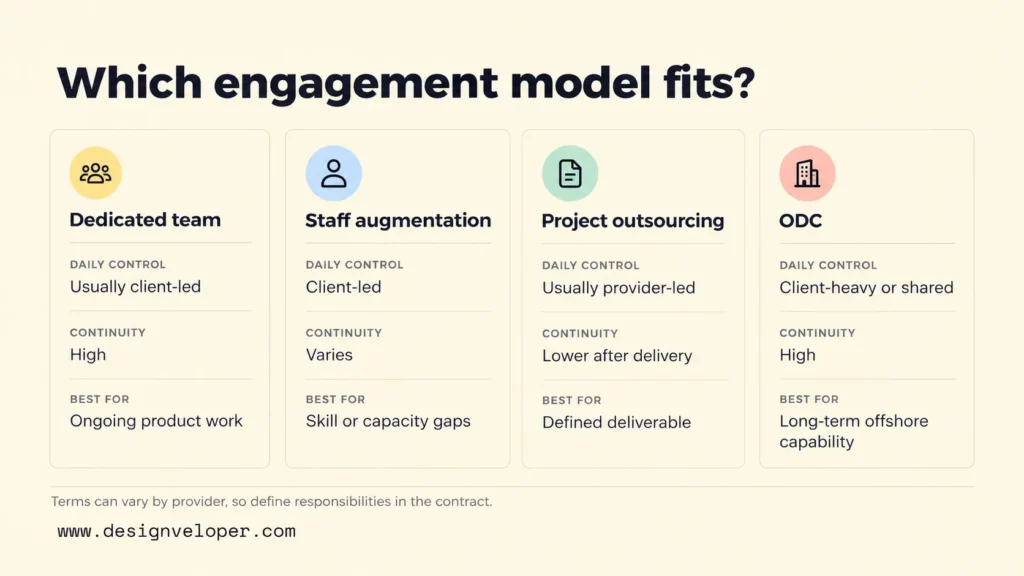
| Model | Who directs daily work? | Team continuity | When it fits |
|---|---|---|---|
| Offshore dedicated team | Usually the client sets product priorities; delivery management may be shared with the provider. | High by design because named people stay focused on the same client. | Ongoing product development, evolving backlogs, and sustained engineering capacity. |
| Staff augmentation | The client usually directs the added specialists inside its existing team. | Depends on individual contracts and assignment length. | Specific skill or capacity gaps when the client already has strong management and delivery processes. |
| Project outsourcing | The provider usually manages delivery against an agreed scope, milestones, or outcome. | May be lower after the project ends because the provider can reassign people. | A defined deliverable where scope and acceptance can be stated clearly. |
| Offshore development center (ODC) | The client often has strong operational control, while a local partner may run hiring, facilities, compliance, and administration. | Usually high and designed for a long-term offshore capability. | A larger or longer-lived offshore operation that needs more local structure than a single delivery team. |
These labels are not standardized across vendors, so the contract matters more than the marketing name. Define who employs each person and who approves work. State whether team members are exclusive to your account, how replacements work, who owns deliverables and intellectual property, and what happens when the engagement ends.
If you are still deciding between outcome-based outsourcing and capacity-based models, our overview of software development outsourcing models explains the wider choice. If you are considering a more permanent offshore operation, our guide to setting up an offshore development center covers the additional operating questions.
When Does An Offshore Team Fit A Product Roadmap?
An offshore dedicated team fits best when the roadmap is long enough for continuity to matter and uncertain enough that you cannot sensibly define every deliverable in advance. Ongoing SaaS development, legacy modernization, evolving feature backlogs, and sustained needs for specialist engineering or QA are common examples.
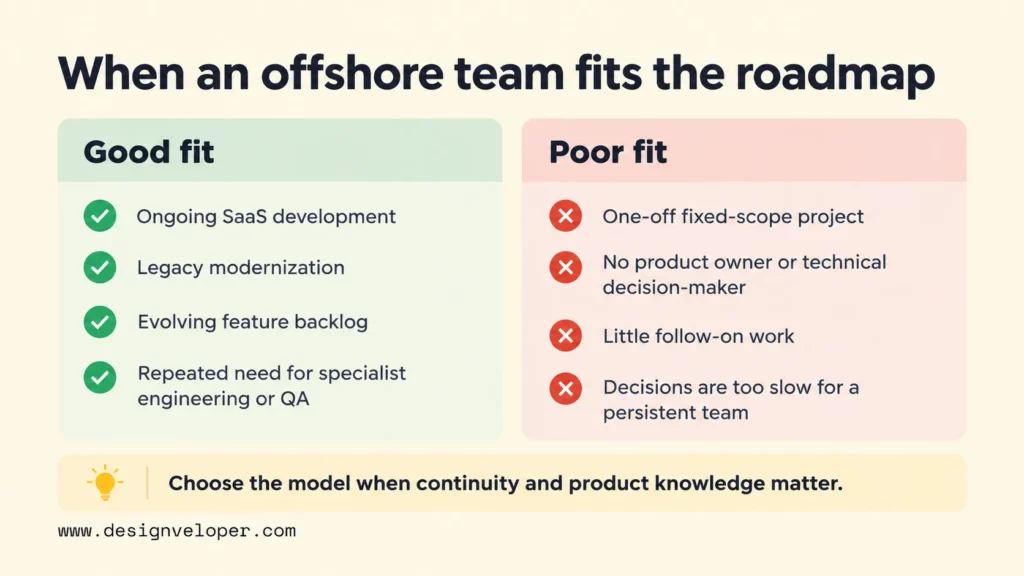
The model is especially useful when the work benefits from accumulated product knowledge. A team that repeatedly works in the same codebase can learn its architecture, constraints, release risks, and business rules. That knowledge makes it easier to discuss trade-offs without re-explaining the whole system at the start of every project phase.
It is a poor fit when the work is a one-off deliverable with a tight, stable scope and little need for follow-on development. In that case, project outsourcing may create a clearer commercial boundary. It is also a poor fit when the client has no product owner, technical decision-maker, or other person able to make timely decisions. A provider can add delivery support, but it cannot safely invent the client’s product priorities.
Use the roadmap to test the fit. Ask whether your planned roadmap contains a continuing stream of related work. Then ask whether the same people will benefit from learning the domain and whether your organization can give them decisions fast enough to keep moving. If the answer is no, adding a persistent team may create fixed capacity without a stable decision system.
Our published maritime-logistics example shows why requirements discovery matters when a product need is still being shaped. A client wanted a way to build a customer list for sea orders and search customer information. Our business analyst clarified which information mattered, how search should work, and how customer names related to other data. Those answers were then translated into features and documented requirements. The example illustrates the value of turning user needs into buildable decisions; it does not establish that this project used an offshore dedicated team.
For a wider view of the location-related benefits and risks, including communication and security considerations, see our overview of offshore software development.
What Does It Cost To Hire An Offshore Dedicated Development Team?
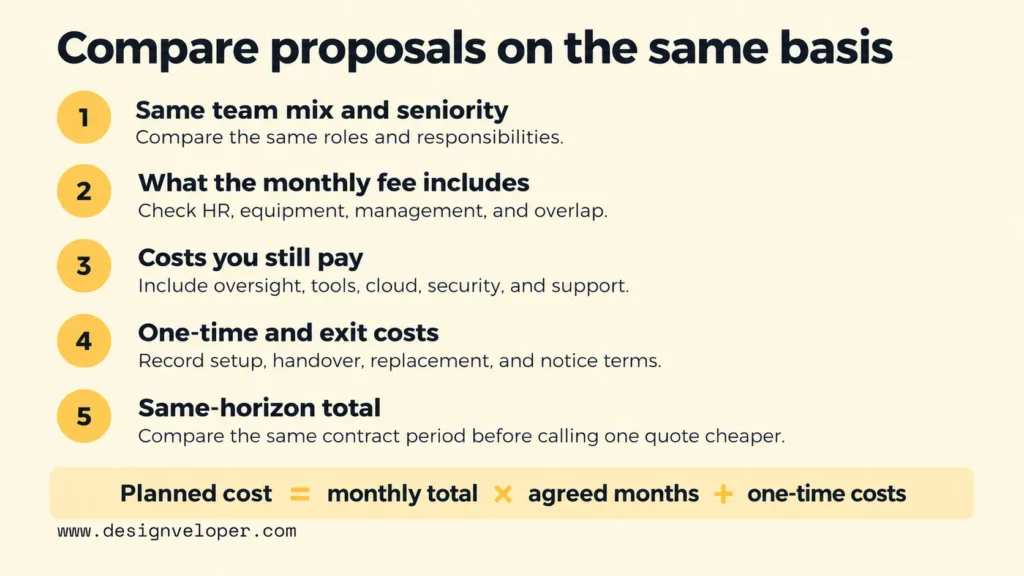
Estimate the cost from the agreed team, the services included in the provider’s fee, and the costs that remain with you. Separate monthly charges from setup and handover costs, then compare proposals over the same period. There is no single price that covers every team mix, location, or working-hour arrangement.
Location matters because compensation, employment costs, taxes, office costs, and provider overhead vary by market. Role and seniority matter just as much: a senior platform engineer, a mid-level frontend developer, and a QA engineer are not interchangeable units. Team size also changes the need for leads, coordination, and management support.
Recruitment and provider fees can be priced in different ways. One provider may bundle sourcing, HR, equipment, and local management into a monthly rate. Another may quote engineering labor separately and charge for recruitment, management, or infrastructure. Required working-hour overlap can also affect staffing because late or shifted schedules may need special arrangements.
Compare total engagement cost, not just the quoted developer rate. Your estimate should account for the people on the team, provider or recruitment fees, delivery or people-management roles, software and cloud tools, security controls, onboarding time, and planned knowledge transfer. Add any travel, equipment, compliance, or support costs that your contract leaves with you.
For an illustrative comparison, ask two providers to quote one technical lead, two developers, and QA support at half-time. This is a planning example, not a standard team size or market price. Keep seniority, work hours, management duties, currency, and contract period the same. Check whether part-time roles are shared and whether replacement work is included. Use the fields below to find costs hidden by a headline rate.
| Quote field | Reference request / comparison rule | Provider A | Provider B | Buyer check |
|---|---|---|---|---|
| Team mix / allocation | Illustrative only: 1 technical lead, 2 developers, QA at 50% allocation; use the same seniority and responsibilities. | To confirm | To confirm | Is the half-time role dedicated to your account or shared? Record what the contract says. |
| Monthly people / provider charges | Use the same currency, billing period, paid hours, holiday assumptions, and required overlap. | To confirm | To confirm | Mark whether HR, equipment, and management are included so you do not count them twice. |
| Client-retained recurring costs | Include product or technical oversight, tools, cloud, security, and support that the client still pays. | To confirm | To confirm | Keep the scope the same; internal staff time is not automatically a vendor invoice. |
| One-time / exit / change costs | Record onboarding, setup, handover, notice, replacement or ramp-up charges, and rate-change terms. | To confirm | To confirm | Separate fixed charges from costs that occur only under a stated scenario. |
| Same-horizon total | Monthly total × agreed months + applicable one-time costs; record assumptions for variable costs. | To confirm | To confirm | Compare the same horizon and scope before calling one proposal cheaper. |
For a stable team, planned engagement cost equals the monthly total multiplied by the agreed number of months, plus applicable one-time costs. Include only costs not already bundled into another line. Where staffing or usage may change, show those assumptions separately rather than treating the estimate as a fixed quote.
How To Hire And Onboard An Offshore Dedicated Development Team
Hire the team only after you can describe the work, the needed skills, and who will make key decisions on your side. This prevents providers from staffing against a vague brief and gives you a consistent basis for evaluating proposed people.
- Define the roadmap and ownership. State the near-term product outcomes, major workstreams, technical constraints, and who owns product, architecture, security, and acceptance decisions.
- Translate the roadmap into roles and seniority. Identify which skills must be present from day one and which specialists can be added later. Separate true senior decision-making needs from work that a mid-level engineer can own safely.
- Evaluate the proposed people, not only the provider brand. Review relevant delivery experience, interview key team members, and test how they explain trade-offs. Ask how the provider protects team stability and what happens if a member leaves. Ask for a client reference with a similar product and team setup, then discuss how the provider handled a replacement or handover. Our guide to choosing a software development company gives a broader vendor due-diligence checklist.
- Agree on communication and delivery practices. Define planning cadence, written status expectations, code review, QA, demos, incident escalation, and the working-hour overlap needed for decisions.
- Close the contract gaps before access is granted. Confirm intellectual-property ownership, confidentiality, data handling, security responsibilities, replacement terms, exit terms, and knowledge-transfer duties. Use legal counsel where the contract or jurisdiction requires it.
Onboarding should make the team productive without giving broader access than the work requires. Create accounts through your normal identity process, grant repository and environment access by role, document coding and review standards, and establish how secrets and production access are handled. NIST’s Secure Software Development Framework recommends protecting code from unauthorized access and applying secure development practices throughout the lifecycle. That guidance supports treating repository permissions and access reviews as part of onboarding rather than an afterthought.
Before the first sprint, make the first goals small enough to expose working problems early. The team should know where the product documentation lives, how a ticket becomes accepted work, how code is reviewed, how QA evidence is recorded, and who can unblock a decision. A short initial delivery cycle is useful because it tests the operating system around the team, not just individual coding skill.
How To Manage An Offshore Development Team Across Time Zones
Offshore development team management across time zones works best when you design for asynchronous progress first, then protect a small amount of live overlap for decisions that genuinely need it. The goal is not to make everyone share the same working day. It is to make sure work can move when part of the team is offline.
Agree on overlap hours and response expectations explicitly. Define which questions need a same-day answer, which can wait until the next working day, and which situations use an escalation path. Review the arrangement when daylight-saving changes or team locations shift. GitLab’s Support cross-region handbook shows how regional support teams share ticket responsibility during overlap and hand work to the next region. That is a useful example of explicit ownership, not a ready-made schedule for an offshore engineering team.
Documentation should carry decisions across the time gap. A ticket should contain enough context for someone to act without waiting for a meeting. Architecture decisions should record the chosen option and the reason. Demos, pull requests, test results, and release notes should make progress visible to people who were not online when the work happened.
Keep quality visible through shared planning, code review, automated tests, demos, and clear acceptance criteria. These practices reduce the chance that distance hides a delivery problem until the end of a sprint. They also make feedback specific: instead of asking whether the team is “on track,” you can inspect what has been reviewed, tested, accepted, or released.
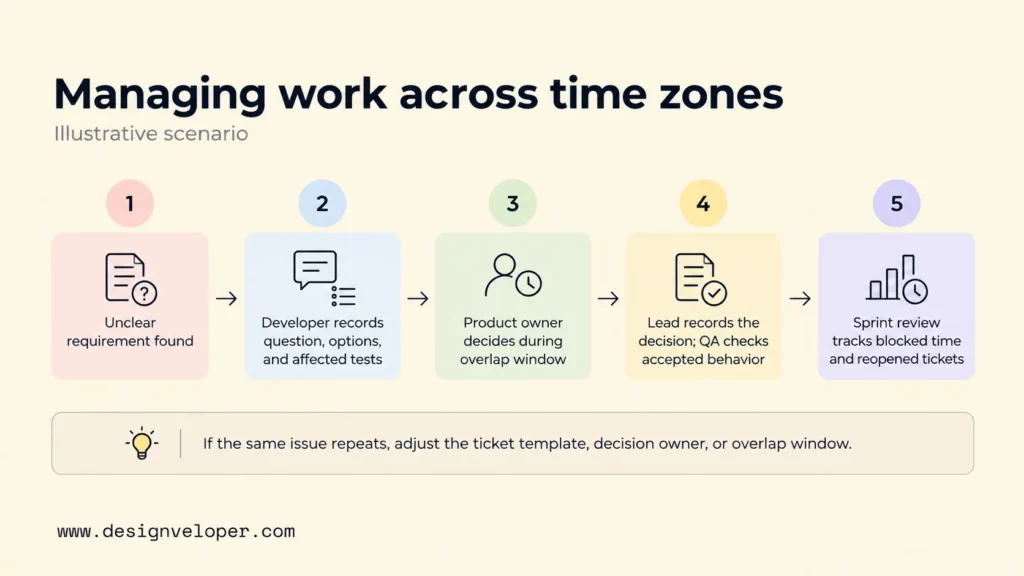
Consider a UK product owner working with a development team in Vietnam on a SaaS billing feature. A developer finds that the brief does not explain how to handle a cancelled subscription. Instead of guessing, the developer records the question, two options, and the affected tests in the ticket. The product owner chooses the rule during the agreed overlap window. The lead records the decision, and QA checks the accepted behavior before release. The team can work on unrelated tickets while that decision is pending; it should not change billing rules without approval.
At each sprint review, the product owner and engineering lead can review time spent waiting for decisions and tickets reopened because requirements were unclear. Use the first delivery cycles as a baseline. If the same kind of question keeps blocking work, adjust the ticket template, decision owner, or overlap window before adding more people. Agree on response targets with the team; there is no universal target for every product.
Protect continuity as deliberately as delivery speed. Use least-privilege access, document critical decisions, and avoid leaving one person as the only owner of an important subsystem. Plan handovers before a team change happens. The aim is to keep product and system knowledge inside shared records and practices rather than inside one person’s memory.
A dedicated team is one option for ongoing delivery. If you also need help shaping the product, defining its scope, and building it, our software development services cover that broader product-build need. Before choosing an engagement model, discuss the roles, delivery responsibilities, and working arrangement your roadmap needs.
Also published on

Share post on










Related Articles



Offshore Dedicated Development Team: How To Hire And Manage One
Offshore Dedicated Development Team: How To Hire And Manage One Published October 12, 2026


















