









Chatbot Vs ChatGPT: Differences, Features, And Which Is Better

KEY TAKEAWAYS:
- A chatbot is the category, while ChatGPT is one generative AI product inside that category.
- Traditional chatbots are usually better for predictable workflows, control, and repeatable support tasks.
- ChatGPT is usually better for open-ended reasoning, writing, coding, summarization, and flexible internal productivity.
- For many businesses, the strongest production setup is a hybrid AI chatbot with rules for control, generative AI for depth, and human review for sensitive actions.
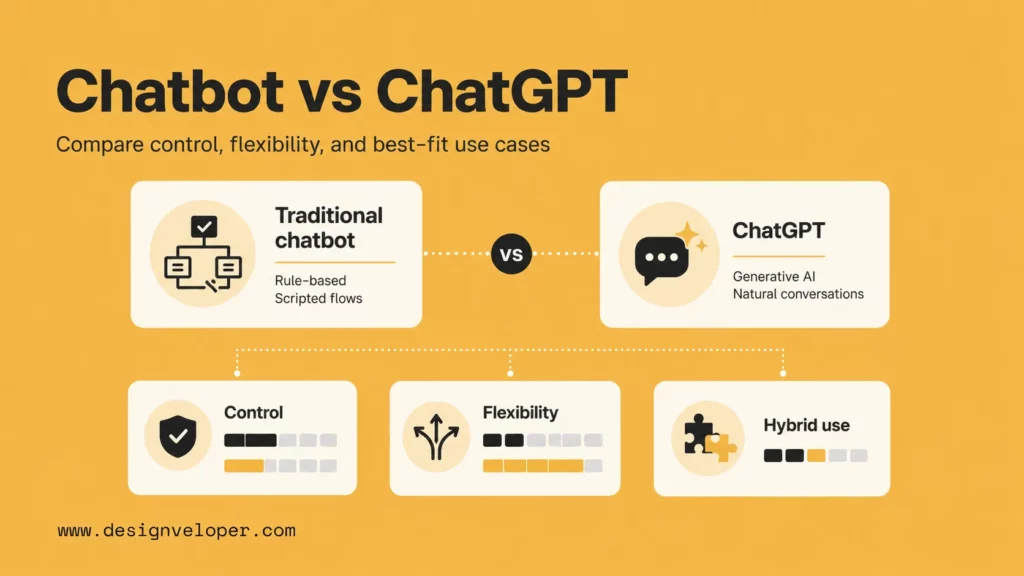
The chatbot vs chatgpt question is really a question about scope. A chatbot is a broad category of conversational software. ChatGPT is a specific generative AI chatbot from OpenAI. Some chatbots follow fixed rules, some use natural language understanding, and some use large language models similar to ChatGPT. That is why two tools can look almost identical in a chat window but behave very differently behind the scenes.
For businesses, the difference matters. A traditional chatbot can be better for predictable support flows, order tracking, lead forms, and tightly controlled answers. ChatGPT can be better for open-ended questions, writing, coding, research, summarization, and flexible reasoning. Many real product teams eventually use a hybrid approach: rules and integrations for control, generative AI for depth, and human review for high-risk actions.
See more: AI Agent Vs. Chatbot: Key Differences & Which One Do You Need?
Chatbot Vs ChatGPT: What Is The Difference?
A chatbot is any software interface designed to hold a conversation with users through text or voice. IBM describes a chatbot as software that can simulate human conversation, from rigid decision-tree navigation to modern conversational AI systems. That broad definition matters because a basic FAQ bot, a voice assistant, a customer support widget, and ChatGPT can all be called chatbots.
ChatGPT is narrower. It is OpenAI’s conversational AI product, built around large language models that can generate natural language, analyze information, write code, summarize content, and reason across many topics. OpenAI’s ChatGPT pricing page shows consumer and business plans, while OpenAI’s business data page explains business privacy and control commitments for organizational use.
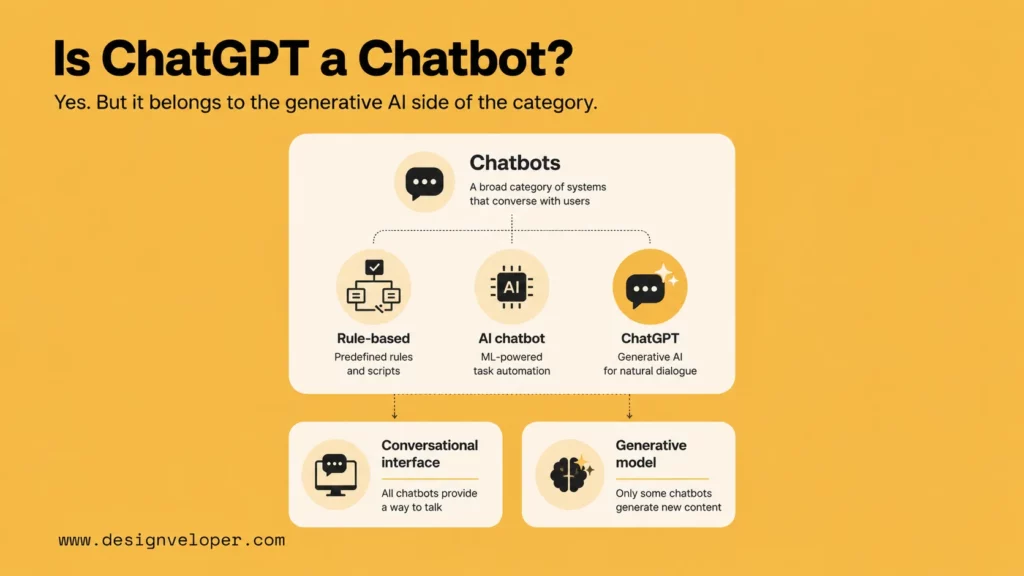
The simplest distinction between chatbot vs chatgpt is this: a chatbot is the category; ChatGPT is one product inside that category. A chatbot may be rule-based, retrieval-based, AI-powered, or custom-built. ChatGPT is a general-purpose generative AI assistant with a chat interface, broad language capability, and OpenAI-specific plans, limits, controls, and model behavior. If you need a broader framing first, Designveloper’s guide to chatbot vs conversational AI helps clarify where generative systems fit in the wider landscape.
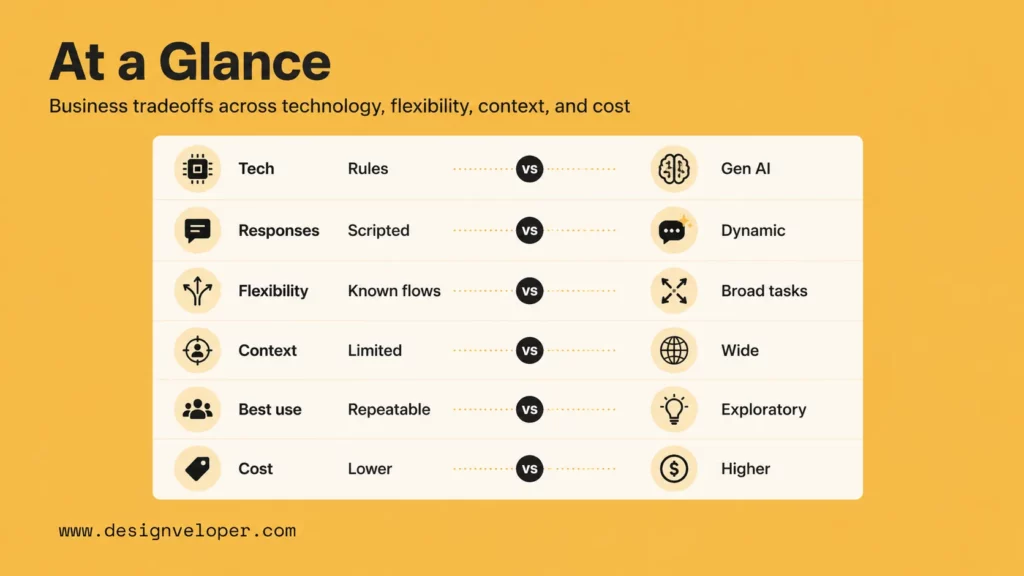
Chatbot Vs ChatGPT At A Glance
The table below compares the two at a business level. The exact details vary by vendor, implementation, and plan, but the pattern is consistent: traditional chatbots usually trade flexibility for control, while ChatGPT trades fixed predictability for broader reasoning and language depth.
| Category | Traditional Chatbot | ChatGPT |
|---|---|---|
| Technology | Rules, decision trees, natural language understanding, retrieval, or workflow logic | Generative AI assistant based on OpenAI language models |
| Response Style | Predictable, scripted, menu-driven, or template-based | Dynamic, conversational, and able to generate new phrasing |
| Flexibility | Best inside known flows and narrow domains | Strong across open-ended questions, writing, analysis, and complex prompts |
| Context Handling | Often limited to session state, forms, CRM fields, or configured knowledge | Can handle broader conversational context, files, instructions, and connected tools depending on plan |
| Best Use Cases | FAQs, order status, routing, booking, lead capture, simple support | Research, drafting, coding, summarization, brainstorming, complex support assistance |
| Setup And Maintenance | Requires flows, intents, knowledge, integrations, and ongoing updates | Fast to start as a product; custom business use still needs governance, prompts, data controls, and integrations |
| Cost | Ranges from low-cost widgets to enterprise support platforms | Subscription, team, enterprise, or API-based costs depending on use |
Is ChatGPT A Chatbot?
Yes, ChatGPT is a chatbot in the broad sense because users interact with it through conversation. It can answer questions, continue context, ask clarifying questions, and respond in natural language. But calling it only a chatbot can hide what makes it different.
Traditional chatbots often follow prebuilt flows. They identify an intent, collect required information, trigger a known action, and return a controlled answer. ChatGPT uses generative AI, so it can create new responses, explain concepts, transform text, write code, compare options, and reason through less structured prompts. That makes it more flexible, but it also means businesses need stronger rules around accuracy, data exposure, and when human review is required.
So the clean answer is: ChatGPT is a generative AI chatbot, but not every chatbot is ChatGPT. A chatbot app may use OpenAI, another model provider, a traditional rules engine, or a custom combination of several systems. If your team is also evaluating more autonomous systems, that broader architecture question matters too.
You might also like:
- Best AI Chatbot Options to Consider
- How To Use ChatGPT Effectively For Work, Writing & Everyday Tasks
- AI Chatbot Development: Detailed Step-by-Step Guide
What Traditional Chatbots Usually Do Better
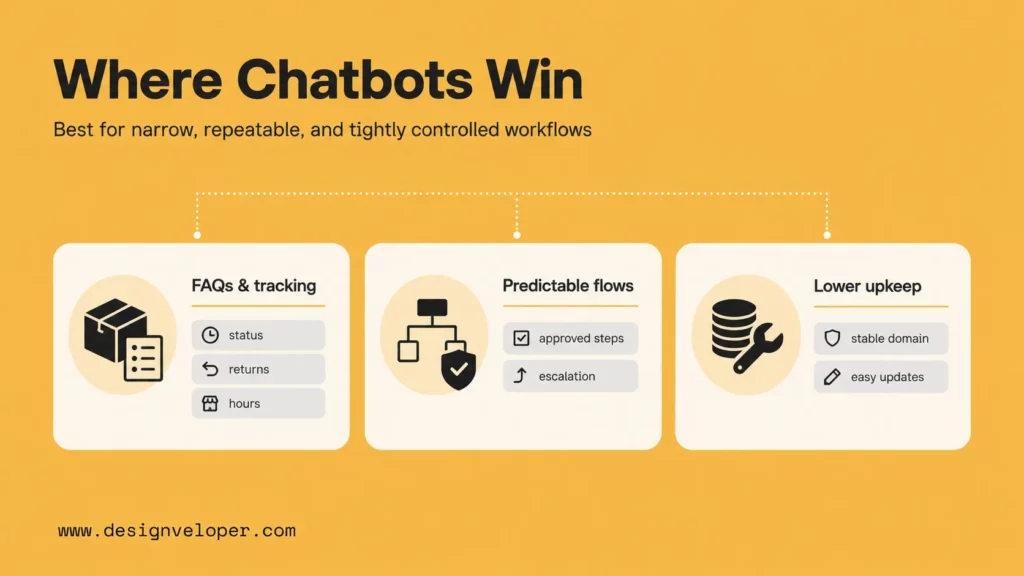
Traditional chatbots still matter because many business conversations are repetitive, structured, and operational. This section shows where a fixed-flow or tightly governed chatbot usually outperforms a broad generative assistant.
FAQs, Order Tracking, And Repetitive Support Tasks
Traditional chatbots are often better when the task is repetitive, narrow, and connected to a known business system. A user asks about delivery status, return policy, appointment times, store hours, account setup, or support routing. The bot can collect a few fields, check a database, and return a predictable answer.
This is why business platforms still invest heavily in controlled conversational systems. Google Cloud’s Dialogflow CX documentation describes conversational agents that can analyze text or audio and use flows for explicit conversation control. That kind of design is useful when businesses need a reliable support path more than a creative answer.
For customer support teams, repeatability is not a weakness. It is the point. A clear order-tracking flow that works every time can be better than a brilliant answer that occasionally invents a policy or misses a required verification step. That is one reason many companies still start with a narrow support flow before moving into broader AI chatbot integration.
Predictable Flows With Tighter Control
Traditional chatbots also win when the business needs strict control. A bank, clinic, ecommerce store, insurance company, or SaaS support team may need exact language, compliance checks, identity verification, or an approved escalation path. In those cases, the bot should not freely improvise.
Flow-based bots let teams define allowed paths. They can restrict answers to approved content, require fields before an action, and escalate when a user falls outside the supported scenario. They are less flexible, but their limits are visible. That makes them easier to test, monitor, and approve.
Generative AI can still be added, but it should be wrapped in guardrails. For example, the system might use fixed buttons for refund eligibility, a retrieval source for policy answers, and a generative model only to rewrite a response in a warmer tone.
Lower Cost And Easier Maintenance
Simple chatbots can be cheaper to run than generative AI systems. A rule-based FAQ bot does not need expensive model calls for every interaction. It also avoids some of the testing, monitoring, and data-governance work that comes with open-ended generative responses.
Maintenance can be easier when the domain is stable. If a company has 30 common questions and five routing paths, a traditional chatbot can be updated by editing flows, templates, and knowledge articles. The tradeoff appears when users ask questions outside the script. Then the bot may repeat itself, misunderstand the user, or hand off too quickly.
Here’s a helpful guide:
- AI Chatbot Integration: 5 Key Steps for Successful Implementation
- What Is CRM?
- 11 Best AI Chatbot Platforms to Use for 2026
What Gives ChatGPT An Edge
ChatGPT becomes more valuable when the workflow is less rigid and the user needs flexible explanations, synthesis, or language-heavy assistance. That is where a general-purpose generative model can create more business value than a strict rules engine.
Dynamic Responses Instead Of Fixed Scripts
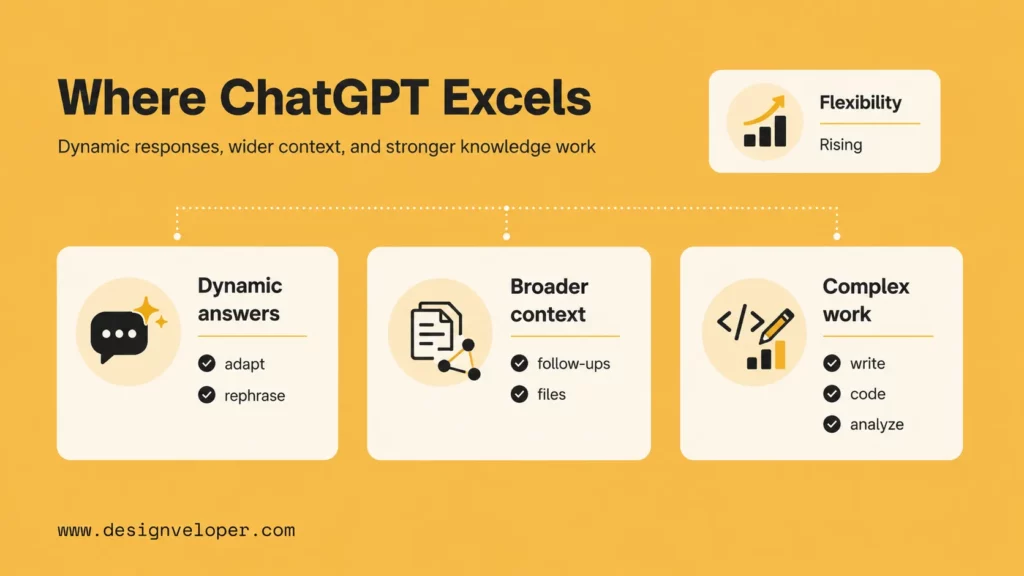
ChatGPT’s main advantage is dynamic language generation. It can explain an idea in different ways, adapt to a user’s wording, summarize long inputs, compare alternatives, and continue a nuanced conversation. This is useful when a user does not know exactly how to ask the question or when the answer needs synthesis rather than a fixed template.
That flexibility explains why tools like ChatGPT changed user expectations. People now expect chat interfaces to understand messy questions, not only match keywords. Generative AI can expand chatbot functionality through natural language understanding, content generation, summarization, translation, and prediction.
For business teams, this makes ChatGPT useful as an assistant for drafting, analysis, ideation, and internal productivity. It can help a support agent summarize a long ticket, help a marketer draft variations, or help a developer reason through a code problem. Teams that are new to this workflow can start with Designveloper’s practical guide on how to use ChatGPT more effectively.
Better Context Handling And Broader Conversations
ChatGPT can handle broader conversations than many traditional bots. A user can ask a follow-up, change direction, paste context, request a different format, or ask the assistant to compare several factors. Depending on the plan and tools enabled, ChatGPT can also work with files, custom GPTs, connectors, and workspace controls.
OpenAI’s help center explains that ChatGPT Business is designed for organizational use, while OpenAI’s enterprise privacy materials describe ownership and control over business data. These controls are important because broader context handling can create business value only when data access is governed properly.
Traditional bots can be context-aware too, especially when connected to CRM, help desk, ecommerce, or internal databases. The difference is that ChatGPT is stronger when context is unstructured or when the user needs reasoning across many pieces of information.
Stronger Support For Writing, Coding, And Complex Queries
ChatGPT is usually better than a traditional chatbot for writing, coding, analysis, and complex knowledge work. A traditional bot can route a coding question to documentation. ChatGPT can explain the error, suggest a fix, refactor a function, and generate a test. A traditional HR bot can point to a policy. ChatGPT can summarize the policy, compare scenarios, and draft a manager response.
This does not mean ChatGPT should act without limits. For production workflows, companies still need approved knowledge sources, permission checks, monitoring, and human review. But for internal teams, ChatGPT’s flexible reasoning can reduce the friction of everyday knowledge work.
Is A Chatbot App The Same As ChatGPT?
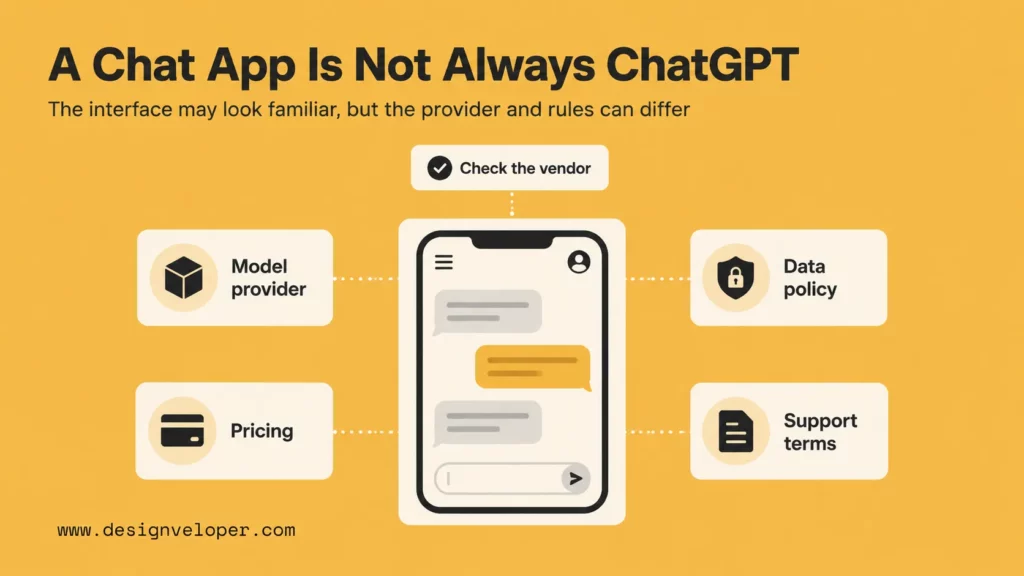
No. A chatbot app is not automatically the same as ChatGPT. Some apps use OpenAI models behind the scenes. Others use Google Gemini, Anthropic Claude, open-source models, custom fine-tuned models, rules engines, or a mix of several systems. A familiar chat interface does not prove what technology, privacy policy, pricing model, or reliability standard sits underneath.
This is especially important for third-party apps. A mobile app may advertise AI chat features but route prompts through a separate provider, store conversation history differently, or add its own subscriptions. Users and businesses should check the official vendor, data policy, model provider, and support terms before sharing sensitive information.
For business use, official access matters. If a team wants ChatGPT specifically, it should use official OpenAI ChatGPT plans or a properly governed API integration. If a team wants a chatbot experience inside its own product, it may be better to build a custom layer using OpenAI, another model provider, or a hybrid architecture that fits the workflow. That build-vs-buy decision becomes clearer when teams evaluate implementation scope, governance, and long-term support needs together.
Chatbot Vs ChatGPT: Cost, Control, And Flexibility
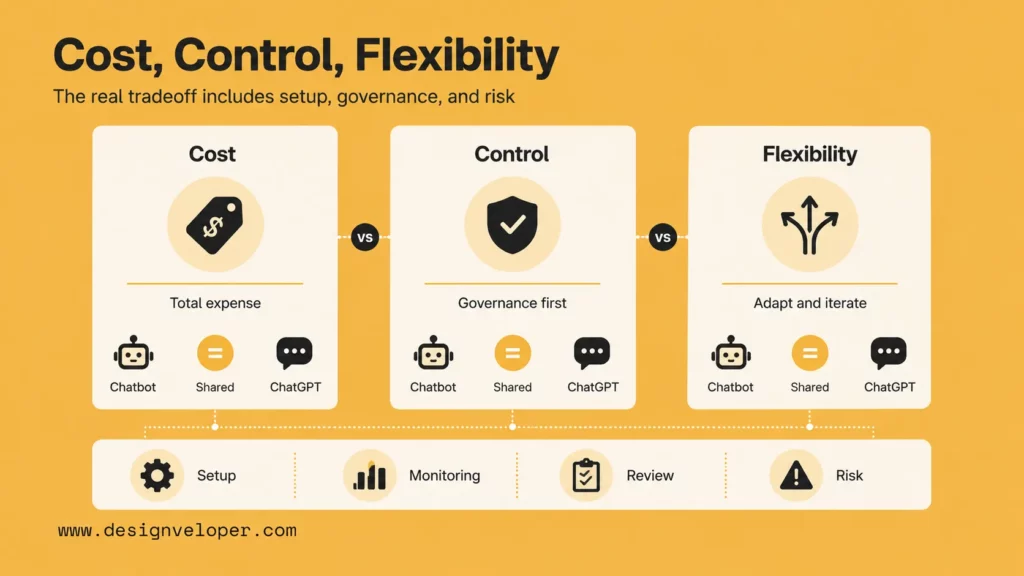
Cost is not only the monthly subscription. It includes setup, maintenance, review, integrations, monitoring, escalation, and failure handling. A cheap chatbot that frustrates customers can become expensive. A powerful AI assistant without controls can also become expensive if it creates errors, data exposure, or rework.
Control and predictability favor traditional chatbots. They are easier to constrain, test, and document. Response flexibility and depth favor ChatGPT. It can generate better explanations and handle less structured questions, but it needs stronger governance when used in business contexts.
Integration complexity depends on the goal. A simple website FAQ chatbot may be straightforward. A support chatbot connected to orders, refunds, CRM records, and human handoff needs real product design. ChatGPT can be part of that design, but it is not the whole system. Teams still need authentication, logging, knowledge management, analytics, and permission-aware tool access.
Security also matters. The OWASP Top 10 for Large Language Model Applications highlights risks such as prompt injection, sensitive information disclosure, improper output handling, and excessive agency. Those risks apply most strongly when a chatbot uses generative AI and can access tools or sensitive business data.
Which Option Is Better For Different Use Cases?
The right choice depends less on hype and more on workflow shape. This section breaks the decision down by task complexity, control requirements, and how much operational risk the business can tolerate.
When A Traditional Chatbot Is The Better Choice
A traditional chatbot is the better choice when the workflow is predictable, the answer set is limited, and the business needs tight control. Examples include store hours, appointment booking, order lookup, refund eligibility checks, lead capture forms, password reset guidance, and triage questions.
It is also the better starting point when the company has low technical resources and a small set of common questions. A simple bot can reduce repetitive work quickly. Later, the team can add generative AI only where users need more flexible explanations.
When ChatGPT Is The Better Choice
ChatGPT is the better choice when users need open-ended help. Examples include summarizing documents, drafting emails, analyzing a problem, brainstorming ideas, writing code, explaining concepts, generating options, or answering complex internal questions.
It is also useful for teams that need a general-purpose AI workspace. Employees can use it across research, content, operations, support, product, and engineering tasks. The main requirement is a clear policy for what data can be shared and how outputs should be reviewed before customer-facing or high-risk use.
When A Hybrid AI Chatbot Makes More Sense
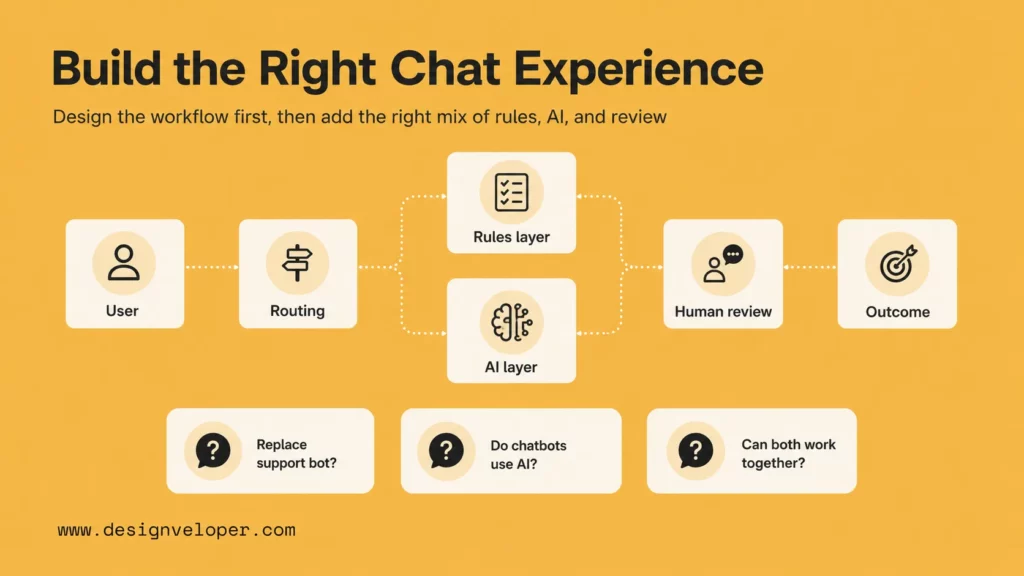
A hybrid AI chatbot makes more sense when a business needs both control and flexibility. The fixed chatbot layer handles routing, identity checks, forms, allowed actions, and integrations. The generative AI layer handles summarization, natural explanations, draft responses, and messy user language. Human review handles sensitive or high-value decisions.
This is often the strongest production pattern. It avoids forcing a rule-based bot to answer every nuanced question, and it avoids giving a generative model too much unchecked freedom. It also lets teams start with a narrow use case and expand safely as the system proves itself.
Building The Right Chat Experience For Real Product Needs
The best choice depends on workflow complexity, risk tolerance, and user expectations. A simple FAQ page may need only a basic chatbot. A customer support operation may need a help desk chatbot with CRM and order integrations. A knowledge-heavy SaaS product may need a hybrid AI assistant with retrieval, role-based access, analytics, and human escalation.
Designveloper treats chat experiences as product systems, not isolated widgets. As an AI-first software and automation partner, the team helps businesses decide when to use rule-based flows, when to use generative AI, and when to combine both inside a safer workflow. That includes designing data access, user journeys, prompt behavior, integration points, approval steps, and post-launch monitoring.
The practical goal is not to copy ChatGPT into every product. The goal is to build the right conversation layer for the job. Sometimes that means a narrow chatbot. Sometimes it means ChatGPT. Often it means a custom hybrid system that gives users natural language flexibility while keeping the business in control.
Discover more here:
- AI Development Services for Custom Business Use Cases
- Explore More AI and Software Insights from Designveloper
FAQs About Chatbot Vs ChatGPT
Can ChatGPT Replace A Traditional Customer Support Chatbot?
ChatGPT can replace some support chatbot functions, especially when users need flexible answers or help with complex questions. However, it should not replace controlled workflows without safeguards. Order tracking, refunds, identity checks, regulated answers, and account actions often need structured flows, approved data sources, and human escalation.
Do Chatbots Always Use AI?
No. Some chatbots use AI, but many are rule-based. A rule-based chatbot follows menus, decision trees, keywords, or fixed templates. An AI chatbot uses natural language processing, machine learning, generative AI, or retrieval to understand and generate responses. ChatGPT is an AI chatbot, but not all chatbots are AI-powered.
Chatbot AI Vs ChatGPT: Which Is Better For Internal Team Workflows?
ChatGPT is often better for broad internal knowledge work such as writing, summarizing, coding, research, and analysis. A custom chatbot AI may be better when the internal workflow needs strict permissions, approved data sources, repeatable actions, and integration with HR, finance, CRM, or IT systems. Many teams combine both.
Is Chatbot App Legit?
A chatbot app may be legitimate, but users should verify the provider, privacy policy, subscription terms, and whether it uses official model access. A chat interface alone does not prove the app is ChatGPT or that it follows OpenAI’s business privacy commitments. Businesses should use official vendor plans or governed API integrations for sensitive work.
Can A Business Combine ChatGPT With A Traditional Chatbot?
Yes. This is often the best approach. A business can use traditional chatbot flows for predictable steps and ChatGPT-style generative AI for flexible explanations, summarization, and complex language tasks. The combined system should include clear tool permissions, human handoff, logs, analytics, and safeguards for sensitive actions.
Also published on

Share post on








Related Articles


Is Vibe Coding Legal? Ownership, Copyright, and Release Risks
Is Vibe Coding Legal? Ownership, Copyright, and Release Risks Published October 16, 2026
How to Build a Chatbot with LangChain in Python: 6 Steps
How to Build a Chatbot with LangChain in Python: 6 Steps Published October 16, 2026
Agentic AI Replacing AI: How Workflows Change and When to Switch
Agentic AI Replacing AI: How Workflows Change and When to Switch Published October 16, 2026