














How to Choose a Web Development Company: Practical Guide

KEY TAKEAWAYS:
- Write a comparable project brief before contacting vendors so each web development company prices and plans against the same goals, scope, assumptions, and constraints.
- Compare the assigned team and delivery evidence, not just the agency brand, portfolio screenshots, or sales presentation.
- Use non-negotiable pass/fail gates for relevant expertise, security, references, client-controlled access, IP ownership, and support before applying a weighted scorecard.
- Normalize proposals for exclusions, assumptions, testing, handover, and ongoing costs; a low quote is not comparable if it covers less work.
- For a large or uncertain build, validate the working relationship with paid discovery or a tightly scoped pilot before committing to full delivery.
Choosing a web development company is a long-term product decision disguised as a vendor shortlist. The consequences surface after launch: who can change the code, fix an integration, protect user data, or keep the product accessible and fast as the business changes. A polished portfolio can show craft, but the harder question is whether the assigned team understands the project’s risks and will leave your organization able to operate what it builds. That makes preparation as important as the interview: set scope and constraints before comparing candidates, then use evidence to test whether the proposed relationship fits the work.
Web Development Company Vs Freelancer: Which Should You Choose?
Choose between a freelancer, a company, or a hybrid team based on project complexity, the number of disciplines required, and how much continuity you need after launch—not on which option sounds more prestigious.
| Partner model | Often fits | Strengths | Risks to plan for |
|---|---|---|---|
| Freelancer | A bounded website, landing page, specialist review, or feature with stable requirements | Direct communication, focused expertise, flexible capacity, and less coordination overhead | Single-person availability, limited parallel capacity, narrower discipline coverage, and handover or support gaps |
| Web development company | A multi-role build, complex integration, ecommerce or SaaS product, modernization, or ongoing delivery | Access to several roles, structured QA and delivery, backup coverage, and broader support options | More coordination, potentially higher cost, and a risk that the proposed senior team differs from the assigned team |
| Hybrid team | An internal product owner or technical lead needs extra delivery capacity or specialist skills | Combines internal context and decision ownership with external expertise | Requires clear architecture ownership, decision rights, knowledge transfer, and day-to-day communication |
When A Freelancer Is A Sensible Choice
A freelancer fits bounded work one person can deliver and support. Define who reviews the code, controls accounts, handles incidents, and takes over if that person becomes unavailable. Even a small engagement needs a written scope and handover plan.
When A Company Adds Useful Coverage
Consider a company when design, engineering, QA, security, or maintenance roles must work together. Ask who is assigned and how much time they will spend. A large brand does not guarantee that the proposed specialists will join or remain available after launch.
How A Hybrid Arrangement Can Work
A hybrid team combines internal product ownership with external capacity or expertise. For background on that delivery model, see What Is Software Development Outsourcing? Agree who makes technical decisions, reviews work, controls repositories and production accounts, accepts deliverables, and maintains documentation. Assign any missing internal technical responsibilities instead of assuming the vendor owns them.
For a starting point to compare potential firms, see Top 20 Web App Development Companies (Ranked). Treat any shortlist as a source of candidates, not a substitute for checking the specific team proposed for your project.
Define Your Web Development Project Before Hiring
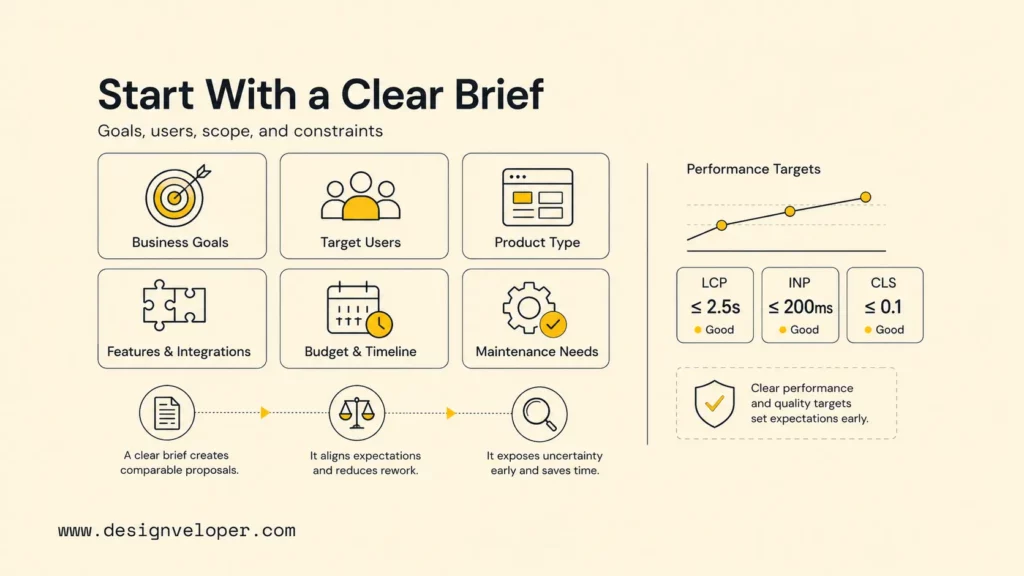
A clear project brief makes proposals easier to compare and exposes unknowns before they become change requests. You do not need to prescribe the architecture; describe the business outcome, users, critical workflows, constraints, and how you will decide whether the work is successful.
Build A Comparable One-Page Brief
Give every candidate the same core information. Mark estimates and assumptions as such, and distinguish must-have outcomes from ideas that can wait.
- Business goal: State what should change, such as generating qualified leads, selling products, reducing manual work, launching a subscription service, or replacing a legacy workflow.
- Users and context: Identify visitors, customers, administrators, internal teams, partners, devices, languages, regions, accessibility needs, and relevant permission levels.
- Product type and workflows: Clarify whether the project is a content site, ecommerce store, SaaS application, marketplace, portal, dashboard, or custom system. Sketch the most important user journeys.
- Features and integrations: List essential capabilities and known dependencies such as a CMS, CRM, payment service, ERP, identity provider, analytics, inventory, search, or AI service.
- Content and data: Describe what must be created, migrated, cleaned, retained, or deleted, and who provides or approves it.
- Constraints: Share budget range, business deadline, existing technology, security or regulatory requirements, third-party access, internal staffing, and approval process.
- Success and ownership: Name measurable outcomes, acceptance owners, maintenance expectations, and the person accountable for decisions.
For a plain-language distinction between a content website and an interactive product, see What Is A Web Application (Web App)? Is It the Same as Website?. The project brief should make that distinction clear because a website and a web application can call for different workflows, data, integrations, and support.
Make Acceptance Criteria Testable
Translate broad goals into observable outcomes. Instead of asking for a “fast website,” ask the shortlisted company to propose performance budgets, testing conditions, and how real-user performance will be monitored. Google’s Core Web Vitals guidance describes LCP, INP, and CLS as measures of loading, responsiveness, and visual stability, assessed at the 75th percentile of page views; agree on relevant thresholds for the product and user context.
Accessibility and security should also become reviewable requirements. The W3C WCAG 2.2 Recommendation provides testable accessibility criteria. The OWASP Application Security Verification Standard (ASVS) provides security verification requirements. Ask the vendor to explain which requirements apply, how they become design and engineering tasks, and what evidence will be delivered. The target depends on product risk, user needs, and applicable obligations.
Separate Known Scope From Discovery Work
If content inventory, user research, data quality, or third-party API access is incomplete, state that uncertainty. Ask candidates to price discovery separately and explain what it will resolve. A proposal with a precise total but hidden assumptions is not more reliable than a phased estimate that identifies what remains unknown.
Related reading:
- 13 Different Types of Software Development Services in 2026
- How Long Does It Take To Build A Web App? Timeline And AI Impact
- 11 Best Web Development Languages for Front-End and Back-End
Key Factors To Look For In A Web Development Company
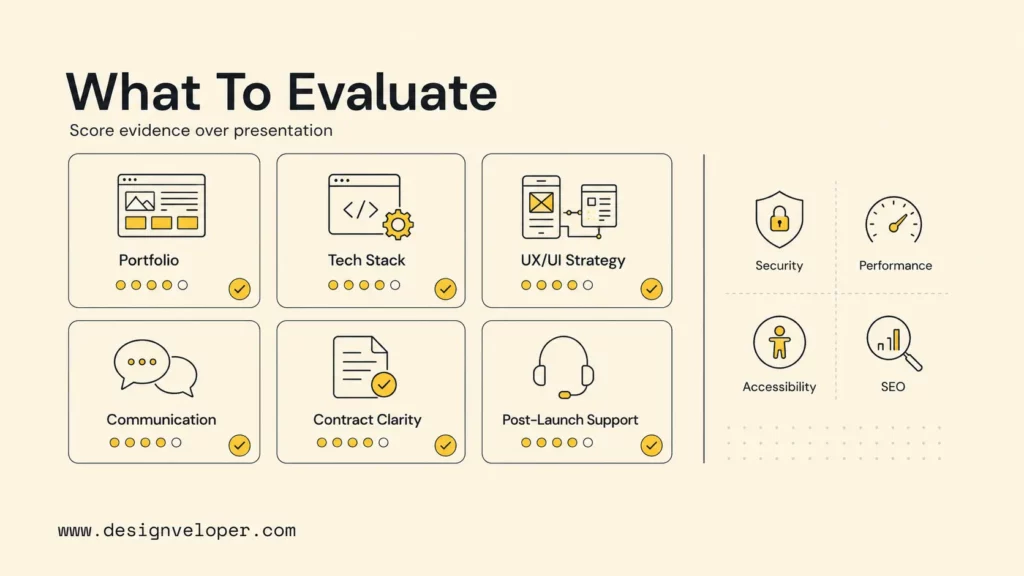
Strong candidates connect relevant delivery evidence to the requirements in your brief. Review the factors below consistently and record what proves each claim; a compelling portfolio or presentation should not outweigh missing evidence.
Relevant Work And The Team Behind It
Look for projects with similar users, workflows, integrations, constraints, or delivery risk. Ask what the company delivered, which people did the work, what changed, and what happened after launch. A different-industry case can still fit if its product complexity is similar; screenshots alone do not prove delivery responsibility.
Request the proposed lead, role profiles, allocation, availability, backup, and access to specialists. Confirm who will make product and technical decisions. If a company presents a case as its experience, ask whether the proposed team delivered it.
Technical Judgment And Quality Practices
A capable partner explains why a technical option fits and what trade-offs it creates. Ask who owns architecture, code review, tests, dependencies, deployment, production access, and rollback. The company should compare relevant options without forcing every project into its preferred stack.
Clarify testing for integrations, user workflows, accessibility, browsers, performance, security, content, analytics, and acceptance. Ask who performs each check, what evidence is shared, and what blocks a release.
Discovery, Communication, And Risk Reporting
Good discovery connects user needs to scope and priorities. Ask how the team maps workflows, prototypes risky areas, validates integrations, and records decisions. Agree on demos, updates, feedback time, escalation, and who approves changes so risks reach decision-makers early.
Commercial Clarity, Security, And Long-Term Ownership
Compare scope, exclusions, acceptance, change requests, payment, IP, termination, and handover. Confirm who controls source code, repositories, design files, domains, cloud accounts, data, analytics, credentials, and documentation. Prefer client-controlled accounts where practical.
Clarify security, privacy, backups, updates, incident response, warranty, and support after launch. Agree on severity levels, response expectations, support hours, maintenance costs, and what happens when the engagement ends.
Before comparing price, use a comparison sheet to normalize UX, migration, hosting, third-party fees, project management, QA, accessibility, security, analytics, training, warranty, and maintenance. Record assumptions for workflows, integrations, environments, and review rounds.
Questions To Ask Before Hiring A Web Development Company
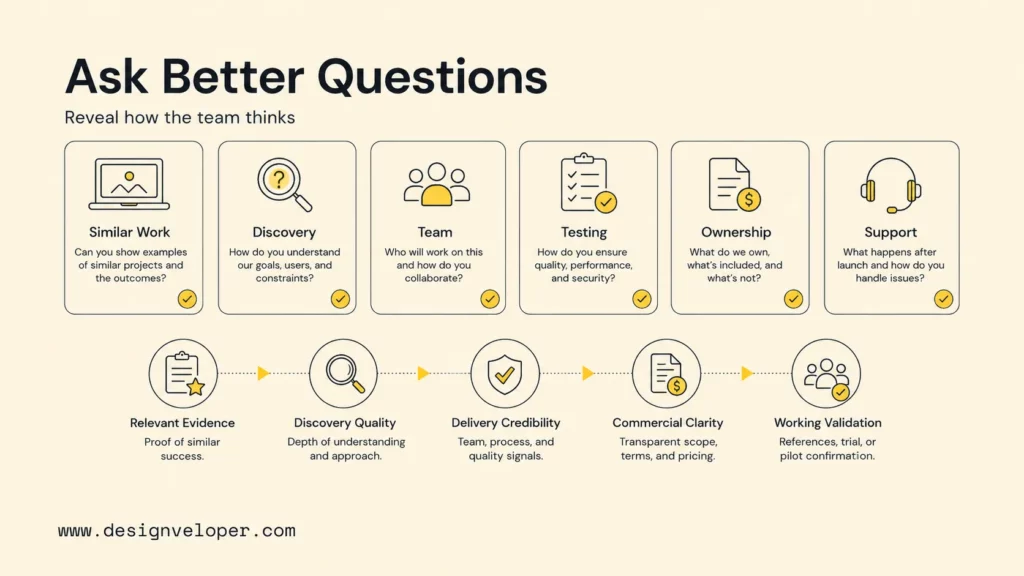
Ask every shortlisted company the same core questions, then follow the answer to a concrete example, artifact, or named owner. The goal is to understand how the team reasons—not to reward confident sales language.
Questions About Discovery And Product Fit
- Which comparable projects have you delivered, and what was your team’s specific role?
- How will you learn about our users, business goal, current workflow, and constraints?
- Which assumptions or integrations would you test before committing to a full build?
- What would you leave out of the first release, and what evidence would change that decision?
Questions About The Assigned Team And Delivery
- Who will work on the project, at what allocation, and who covers an absence or role change?
- How will we see progress, review demonstrations, record decisions, and escalate a risk?
- How are estimates built, what assumptions or dependencies could change them, and how is contingency handled?
- How do you assess the effect of a change on scope, schedule, architecture, testing, and price before approval?
Questions About Testing, Ownership, And Support
- What testing is included, who performs it, and what evidence is shared before release?
- How will repositories, cloud accounts, credentials, data, design files, and source code be controlled and handed over?
- What warranty, monitoring, backup, security update, incident response, and support terms apply after launch?
- Can we speak with a recent client whose project had similar complexity? What should we ask that reference?
Listen for clear assumptions, options, risks, and accountable owners. A reliable partner should be willing to challenge a feature that does not serve the stated goal or flag a dependency that could change the plan. Before making the larger commitment, move from discussion to evidence: check references, meet the proposed delivery team, and validate the riskiest part of the work.
Red Flags When Choosing A Web Development Company
A red flag is a gap between a vendor’s confidence and the evidence it can provide. One issue may have a reasonable explanation, but repeated gaps around delivery, money, or ownership should slow the decision.
Commercial And Sales Warning Signs
- One unexplained price: The proposal has no scope assumptions, exclusions, named roles, acceptance rules, or change process.
- Unrealistic certainty: The vendor guarantees a date or outcome before content, integrations, stakeholder availability, and technical constraints are understood.
- Pressure to sign quickly: The company discourages reference checks, team introductions, or time to review the contract.
- Overpromising: Claims such as guaranteed first-place rankings, perfect security, zero defects, or no need for maintenance have no credible basis.
Delivery And Ownership Warning Signs
- Unclear team contribution: Portfolio claims cannot be tied to the company’s role or the people proposed for your project.
- No discovery or testing plan: The team wants to build from a feature list without clarifying the problem, acceptance, quality checks, or release risks.
- Weak communication before contract: Missed meetings, inconsistent answers, slow responses, and absent written recaps may continue during delivery.
- Vague IP and access: Nobody can explain who controls the repository, domains, infrastructure, credentials, design files, or client data.
- No post-launch plan: Warranty, incident response, updates, backups, and handover are missing or deferred until after signing.
Low price is not itself a warning sign, and a high price is not evidence of quality. The concern is a quote that cannot be reconciled with the team, scope, quality level, and timeline. Ask what is excluded, what your staff must provide, and which events would trigger a change request.
Match The Company To Your Web Project Type
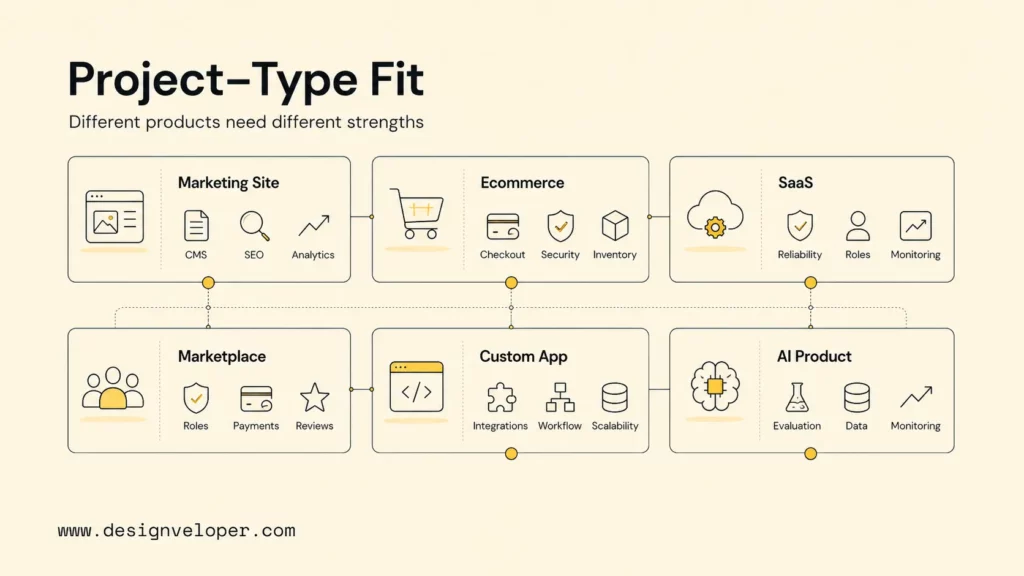
Build a shortlist around the capabilities that carry the most risk in your product. A vendor with a strong general portfolio may still lack the workflow, integration, or operating experience your project needs.
Marketing Sites And Ecommerce Stores
A marketing-site partner should show experience with CMS editing, content migration, redirects, accessibility, analytics, technical SEO, performance, and reusable components. For ecommerce, also check catalog data, inventory, payments, tax, fulfillment, returns, customer support, promotions, and reconciliation. Ask to see how the team handles operational edge cases, not only the storefront.
SaaS, Marketplaces, And Custom Applications
A SaaS or marketplace team should be ready to discuss identity, roles, tenants, subscriptions, data ownership, notifications, audit trails, integrations, and administrator workflows. A custom application may need domain and data modeling, migration, secure workflows, testing, deployment, maintenance, and knowledge transfer. Look for evidence of product evolution after launch, not only a successful initial release.
AI-Enabled Web Products
An AI-enabled product adds model and data boundaries, evaluation cases, grounding, tool permissions, human approval, fallback behavior, privacy, monitoring, model changes, and variable usage costs. Ask the vendor to explain the complete user workflow and how it verifies quality and handles failure. A chatbot demonstration alone does not establish production readiness.
These capabilities vary by product type; use the categories as prompts for your shortlist, not as a score that automatically favors the largest company.
Score And Validate Your Final Shortlist
Use a scorecard only after screening for minimum expertise, security, references, ownership, and support. Score candidates that pass those gates. The weights below are a starting model, not an industry benchmark.
Set Pass/Fail Gates Before Scoring
Agree what evidence is mandatory before reviewing presentations. A candidate should not compensate for a failed security, integrity, or ownership requirement with a high portfolio score.
- Can the assigned team show relevant delivery experience and required skills?
- Can the company meet your minimum security, privacy, and accessibility needs?
- Can you verify references and speak with the proposed delivery lead?
- Will the client retain clear ownership or control of code, data, accounts, and handover materials?
- Are support, change, termination, and acceptance terms explicit enough to review?
Rate Evidence, Not Presentation Quality
Rate each factor from 1 to 5. Multiply the rating by its weight and divide by five to calculate weighted points. Record proof—such as a case study, assigned team member, test artifact, reference, or contract clause—and use the same scale for every candidate.
| Factor | Starting weight | Evidence to record |
|---|---|---|
| Relevant delivery evidence | 25% | Comparable case, the company’s role, constraints, assigned team, and post-launch result |
| Discovery and product understanding | 20% | Quality of questions, workflow analysis, assumptions, risks, and first-release priorities |
| Assigned team and continuity | 15% | Named roles, allocation, experience, availability, backup, and decision ownership |
| Technical and quality approach | 15% | Architecture rationale, testing plan, security, accessibility, performance, and release evidence |
| Communication and project controls | 10% | Demo cadence, written updates, decision log, escalation route, and change control |
| Commercial clarity and ownership | 10% | Comparable scope, exclusions, IP, accounts, acceptance, handover, and support terms |
| Price competitiveness | 5% | Cost against the same scope, team assumptions, quality obligations, and ownership period |
Adjust weights to project risk; a security-sensitive application may give more weight to verification and ownership. A high total does not erase a weak category, so review the evidence and gaps before selecting a preferred firm.
Use Paid Discovery Or A Pilot For High-Risk Work
For a large, uncertain, or strategically important project, buy a small, bounded phase before the full build. It might map one critical workflow, test a third-party integration, prototype the riskiest journey, assess an existing system, or produce an implementation plan. Define deliverables, access, acceptance, price, IP, and how the work can transition to another team.
Evaluate how the proposed team handles ambiguity, documents decisions, responds to feedback, raises risks, and changes its view when evidence contradicts an assumption. A paid pilot cannot guarantee future delivery, but it provides more direct evidence of collaboration and technical judgment than another sales call.
Keep The Service Conversation Separate
Apply the same brief, evidence questions, ownership checks, and pilot criteria to Designveloper and every other shortlisted company. If an external team could help with discovery through delivery and post-launch iteration, review Web Application Development after completing the independent comparison.
FAQs About Choosing A Web Development Company
How Much Does It Cost To Hire A Web Development Company?
Cost depends on scope, team, location, integrations, security, content, and support. Clutch’s September 2026 pricing search listing showed many marketplace-listed web development companies at $25–$49 per hour. Direct access to the pricing page was restricted during this review, so treat that range as a directional marketplace signal, not a verified project estimate. Compare proposals against the same scope, assumptions, exclusions, and ongoing ownership costs. See Web App Development Cost: Breakdown for a related cost framework.
How Long Does A Web Development Project Take?
Timelines vary with product scope, content readiness, integrations, migration, approvals, security, testing, and team availability. Ask each vendor for milestones, dependencies, assumptions, and a confidence range rather than treating one generic number as a commitment.
What Should I Prepare Before Contacting Companies?
Prepare business goals, users, critical journeys, product type, essential features, known integrations, content and data needs, quality constraints, budget range, deadline, decision owners, and success measures. Mark unknowns so candidates can price discovery instead of hiding assumptions.
How Can I Tell If A Web Development Company Is Reliable?
Look for relevant evidence, precise questions, access to the assigned team, documented assumptions, realistic trade-offs, a clear testing plan, client-controlled ownership, and specific support terms. Validate claims with references and a bounded discovery or pilot before making a large commitment.
Also published on

Share post on










Related Articles



Animated Website Templates In 2026: 9 Sources to Explore & Compare
Animated Website Templates In 2026: 9 Sources to Explore & Compare Published September 30, 2026
11 Web Server Software Options and Related Platforms Compared
11 Web Server Software Options and Related Platforms Compared Published September 30, 2026
How to Choose a Web Development Company: Practical Guide
How to Choose a Web Development Company: Practical Guide Published September 29, 2026