














Data And AI Strategy: A Practical Roadmap For Business Growth

A data and AI strategy connects a measurable business goal to the data, AI work, and responsible people needed to improve a decision. It helps leaders avoid starting with a model or platform before they know what should change. The plan should also make it possible to test results and revise investments when the evidence changes.
What Is A Data And AI Strategy?
A data and AI strategy is a unified plan for connecting business goals with data, analytics, AI applications, governance, and the people needed to use them. A data strategy makes information reliable, accessible, and properly controlled. An AI strategy decides where prediction, automation, or generation could solve a useful problem. The unified strategy makes those choices work toward the same measurable result.
For example, a retailer might use reliable stock and sales data to test demand forecasts, while its planners remain responsible for ordering decisions. The full path from data to action matters more than the prediction alone.
This distinction matters because an accurate model is not the same as a better decision. Our guide to data-driven decision-making shows how teams move from a defined question through evidence and action to a measured outcome. A data and AI strategy makes that cycle a shared business commitment rather than an isolated experiment.
What A Data And AI Strategy Should Include
A useful data and AI strategy framework covers the decisions that link business value to delivery. The final document does not need to be long, but it must tell business leaders and delivery teams what they are trying to change and what makes the change possible.
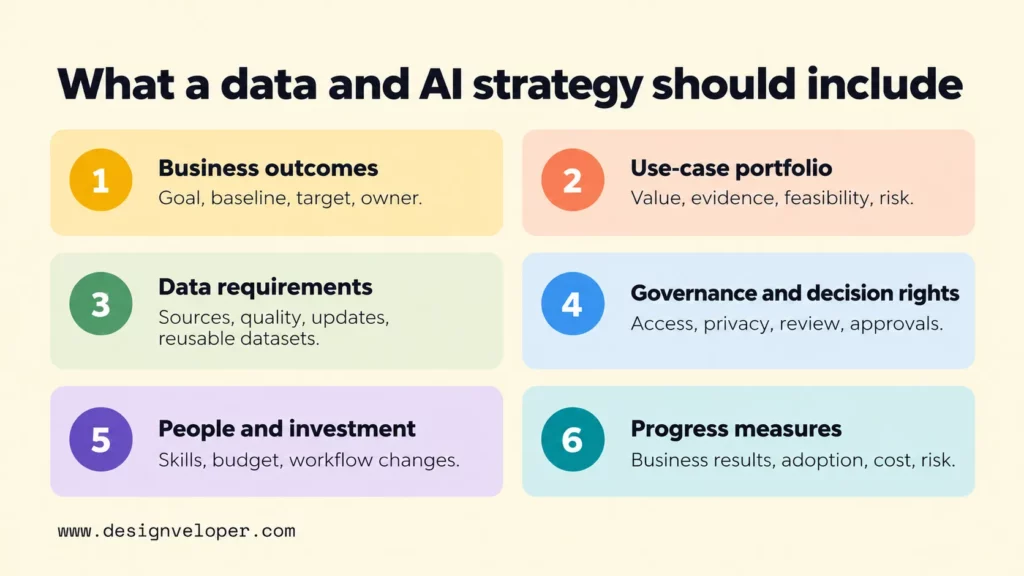
- Business outcomes: Name the process or decision to improve, record its current performance, set a realistic target, and assign a business owner. The baseline makes the target easier to evaluate against current performance.
- Use-case portfolio: Record each proposed AI application, its expected value, evidence behind that expectation, delivery difficulty, and risk. Distinguish ideas worth testing from initiatives already approved for scale.
- Data requirements: Identify the sources each use case needs and how teams will check their quality, update them, and exchange information. Record who owns the sources and which prepared datasets other approved teams can reuse.
- Governance and decision rights: Set access rules, privacy safeguards, acceptable use, human review points, and approval responsibilities. Describe who can stop or change a system when something goes wrong.
- People and investment: Name the staff who will build and use the solution, the skills they need, the budget for delivery and ongoing operations, and the changes required in daily work.
- Progress measures: Track business results alongside data reliability, model performance, adoption, cost, and risk. Decide when owners will review the evidence and change the roadmap.
These parts must agree with each other. A promise to forecast inventory every hour, for instance, is unrealistic if stock records arrive only once a day. The strategy should either fund a better data feed or choose a slower forecast cycle. Google Cloud’s data strategy guidance likewise connects business priorities, current readiness, and a roadmap rather than treating data infrastructure as an end in itself.
Governance belongs in the plan from the start. The voluntary NIST AI Risk Management Framework organizes risk work around governing, mapping, measuring, and managing AI risks. It does not replace applicable law, but it gives teams a practical way to assign responsibilities and review risks throughout a system’s life.
How To Build A Data And AI Strategy
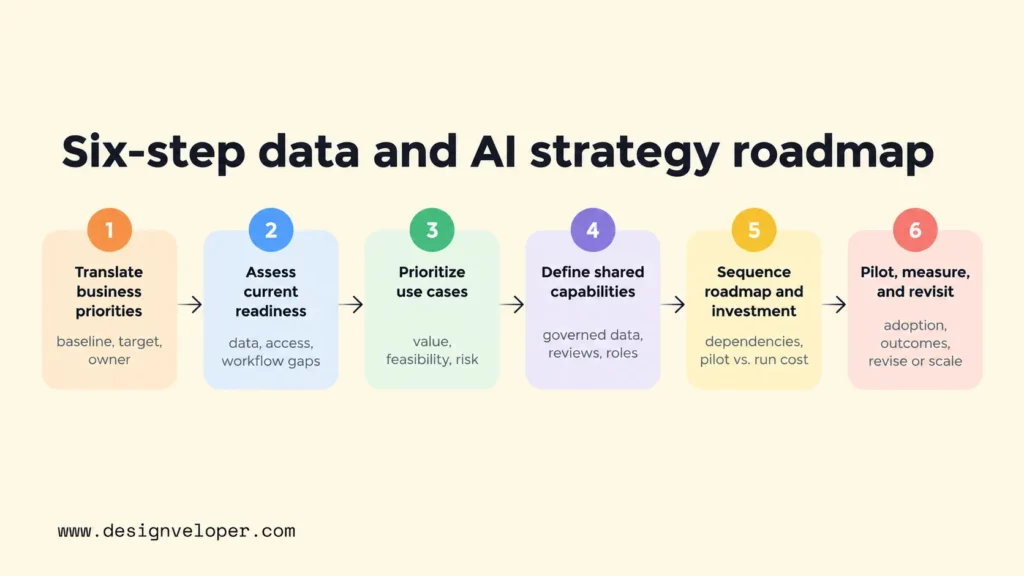
Build the strategy by moving from a measurable problem to a small, testable delivery plan. The six data and AI strategy steps below produce decisions and evidence, not just a list of technology projects.
Step 1. Translate Business Priorities Into Measurable Outcomes
Start with one outcome that a business leader owns. Ask what is going wrong, who makes the affected decision, and how the business measures it today. The answer might be fewer stockouts, faster claim reviews, or less time spent sorting support requests.
Record the current measure and a target so the team has a clear reference for evaluating change. Specify the period and population to support a fair comparison. For a stockout goal, record the share of relevant product-store days when an item was unavailable. Also track excess inventory so the team cannot meet its target simply by overordering.
The first output should be a short business case: owner, baseline, desired change, decision affected, constraints, and how progress will be checked. Gartner’s 2026 strategy guidance also puts business priorities and measurable outcomes ahead of individual data or AI initiatives.
Step 2. Assess Current Data And AI Readiness
Assess readiness against the chosen decision, not against a wish list of every possible data capability. Identify where the required information lives, whether teams can legally access it, and whether its meaning is consistent across systems. Check for missing records, delays, duplicates, and changes in how data was collected.
Then check operational readiness. Can the business put a prediction into the existing workflow? Who would review unusual results? Does the team have the engineering skills and access needed to run a safe pilot? A technically strong dataset will not solve a problem if nobody can act on its output.
Finish with a short gap list linked to business impact. For demand forecasting, missing supplier lead times may matter more than a modern cloud warehouse. Fix the gaps that block the pilot first. Put broader improvements on the roadmap only when another use case or operational need justifies them.
Step 3. Prioritize Use Cases By Value, Feasibility, And Risk
Compare use cases using the same questions: how meaningful is the potential outcome, how credible is the evidence, how difficult is implementation, and what could go wrong? An attractive idea should not win solely because a demonstration looks impressive.
Value means a plausible improvement in revenue, service quality, time, or cost. Feasibility means having usable inputs, an available delivery path, and people who can adopt the result. Risk covers issues such as sensitive data, harmful errors, weak oversight, or expensive failure. A high-value use case may still need extra controls or a narrower first release.
Test simpler options before committing to a custom model. Better reporting or clear business rules may address the problem at lower cost. Our guide to deciding when to train an AI model separates rules, existing AI services, and custom training by task and evidence. The best first pilot is usually the option with a meaningful outcome that the team can test safely.
Step 4. Define Shared Data, AI, And Governance Capabilities
Define shared capabilities around the use cases the business has selected. These may include reliable data feeds, agreed field definitions, access controls, model evaluation, and human review. The aim is to give related projects dependable foundations without buying or building more than they need.
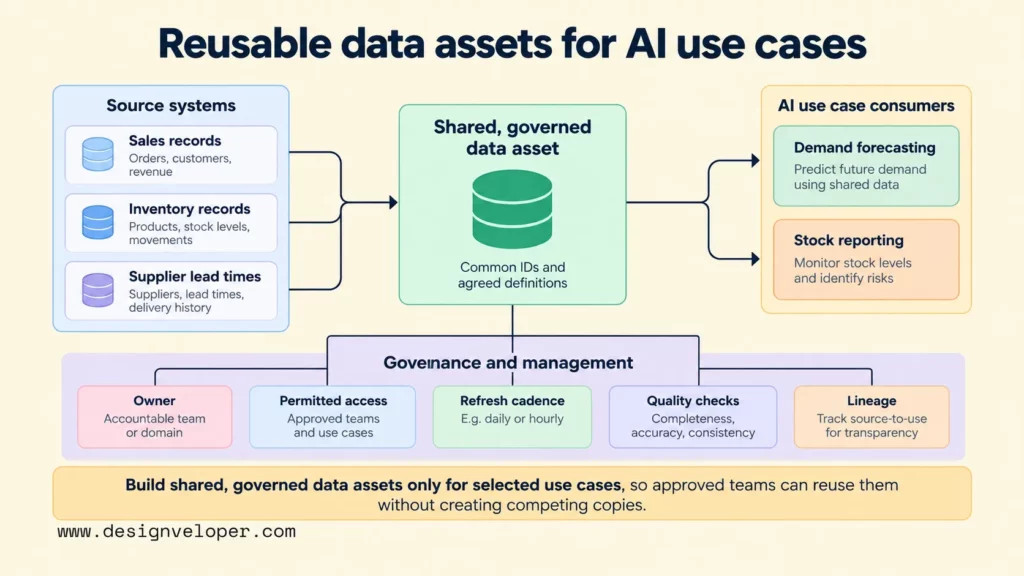
A reusable data asset can become a data product when a team maintains it for known users. Name its owner and the applications that use it. Write a simple data product agreement that records field meanings, permitted access, update times, and quality checks. Keep a record of where the inputs came from and how they changed. That record is called data lineage.
Teams can then reuse the approved asset instead of building competing copies. For example, forecasting and stock reporting may both need the same governed inventory records. Build that shared asset when the selected use cases justify it, rather than preparing every possible dataset in advance.
Assign decision rights before deployment. A data owner approves source access. A business owner accepts the operational result. The technical team maintains the system, while designated reviewers handle exceptions and incidents. These roles can overlap in a small organization, but the responsibilities should not disappear.
A Harvard Data Science Review analysis of data and AI strategy likewise treats leadership, talent, and the operating model as part of execution. That is why the governance plan must name people and decisions, not merely list policies.
Keep low-risk experiments easy to review without skipping safeguards. A test on approved, non-sensitive data may need a lighter process than an automated decision with serious customer impact. Governance should be proportionate to risk while remaining visible and documented.
Step 5. Sequence The Roadmap, Dependencies, And Investment
Build a data and AI strategy roadmap around dependencies rather than a shopping list. Show which data fixes, permissions, workflow changes, and AI tests must happen before the next decision can be made. Mark the person responsible for each item and the evidence required to move forward.
Split investment into what is needed to test the idea and what is needed to operate it if the pilot succeeds. The second part may include data maintenance, model monitoring, staff training, security reviews, and support. A low-cost prototype can become an expensive product if these continuing responsibilities are ignored.
Run focused data repairs alongside the pilot when it is safe to do so. Waiting for every dataset to become perfect delays learning. Running a model without fixing known critical defects creates different risks. A sensible sequence improves the exact foundation the selected use case needs, then tests the business effect.
Step 6. Pilot, Measure, And Revisit The Strategy
Run a limited pilot against a clear baseline and a pre-agreed decision rule. Test its technical performance, but also measure whether people use the output and whether their actions improve the target outcome. Where possible, compare similar periods or groups and record other changes that may affect the result.
For a forecast pilot, compare predictions with later sales and available demand estimates for the same periods and products. Flag stockout periods, when recorded sales may understate demand. Track whether planners accepted, adjusted, or ignored recommendations. Then measure stockouts and excess inventory. A lower forecast error alone cannot prove the business gained value if purchasing decisions never changed.
Set reviews at a cadence that fits the decision and data cycle. Business owners decide whether to stop, revise, or expand the use case. Technical owners check reliability, changing inputs, operating cost, and failures. Our explanation of MLOps and model monitoring covers the longer-term work needed when predictive models reach production.
When a selected use case needs software that staff can operate, we can support its build and integration through our AI development services. Before requesting development, define who will use the system, which data it may access, where people review outputs, and what tests it must pass. These decisions give the software team clear requirements. The business still owns the strategy and its outcomes.
Data And AI Strategy In Practice: Demand Forecasting
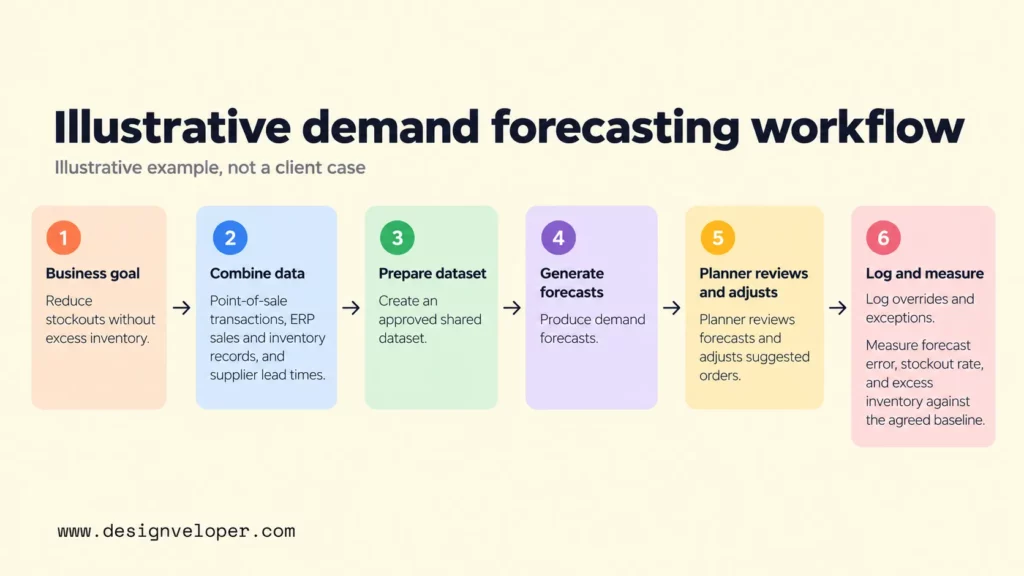
Demand forecasting shows how business goals, data work, and AI delivery must fit together. Consider an illustrative retailer that wants to reduce stockouts without tying up too much cash in surplus inventory. The AI use case is to predict future product demand. The business action is a planner deciding what to reorder and when.
| Business Goal | AI Use Case | Data And Capability Needs | Outcome Measures |
|---|---|---|---|
| Reduce stockouts without excessive inventory | Forecast demand by product and location to support replenishment decisions | Reliable sales and inventory histories; supplier lead times; consistent product identifiers; forecast evaluation; planner review | Forecast error, stockout rate, and excess inventory, compared with agreed baselines |
In this illustrative implementation, the retailer combines point-of-sale transactions with stock records from its enterprise resource planning (ERP) system. It also brings in supplier lead times. The team prepares an approved sales-and-inventory dataset with common product identifiers and clear rules for missing records. Its owner checks whether updates arrive on time and whether the data is fit for forecasting.
Data quality needs more than cleaning duplicate records. A product may record no sales because it was out of stock, not because customers wanted none. The team should also check promotions and delayed deliveries before deciding what the model can learn. These checks help avoid treating recorded sales as a complete measure of demand.
The retailer then tests a simple forecast against its current planning method. The forecast appears in a planner review screen, where staff can approve or change suggested orders. The application records overrides and unusual cases so the team can investigate errors. During the pilot, the business compares forecast error, stockouts, and excess inventory with the agreed reference measures. It should expand the workflow only if those results and the review effort justify it.
N-iX’s data and AI strategy discussion also uses demand forecasting to show how model update cycles can influence data architecture. The precise update schedule is a design choice for each business, not a universal rule.
This example is not a promise that AI will reduce stockouts. Forecast quality and business results depend on the underlying data, buying rules, supplier behavior, and human decisions. Our guide to AI-driven decision-making explains the wider distinction between generating a prediction and using it to support a real business choice.
Common Data And AI Strategy Pitfalls
The most damaging data and AI strategy mistakes break the connection between the intended result and the work meant to deliver it. Avoid them by checking the decision, the dependencies, and the people involved before each investment.
- Choosing technology before the outcome: A platform purchase or model choice does not explain what will improve. Define a business owner, baseline, and measurable decision first. Choose technology only after the required behavior is clear.
- Keeping data and AI plans separate: One team may improve databases while another builds models that require different data. Review both roadmaps together, share key dependencies, and make the owners accountable for the same outcome.
- Waiting for perfect data: A company can spend years improving information that the first useful application does not need. Start with an approved, narrow pilot and repair its critical data gaps. Do not confuse a limited scope with permission to ignore safety or quality.
- Adding governance too late or making it obstructive: Late privacy reviews can force expensive redesigns. Overly broad approval processes can also delay harmless tests. Define access, risk categories, reviewers, and stopping rules early, with controls matched to the use case.
- Measuring models but not results: Strong test accuracy can hide low adoption, growing operating costs, or no improvement in the decision. Review technical measures alongside user behavior and business impact before expanding the project.
A good strategy does not require every team to use AI. It gives leaders a way to decide where AI is useful, where better data or simpler rules will do more, and when to stop an experiment. Start with one owned business problem and a baseline, then build only the data and AI capabilities needed to test a better decision.
Also published on

Share post on










Related Articles



How To Build And Use AI Business Process Automation Effectively
How To Build And Use AI Business Process Automation Effectively Published October 27, 2026
AI Agents Vs. RPA: How To Choose The Right Fit For Your Workflow
AI Agents Vs. RPA: How To Choose The Right Fit For Your Workflow Published October 23, 2026
AI Proof Of Concept Development: How To Test Before You Scale
AI Proof Of Concept Development: How To Test Before You Scale Published October 22, 2026