
















Best Frontend Frameworks: 8 Options, Tradeoffs, And Tips

KEY TAKEWAYS:
- The best frontend framework depends on product fit: team skills, app complexity, performance needs, ecosystem maturity, hiring, and long-term maintainability matter more than popularity alone.
- React, Vue, Angular, Svelte, Solid, and meta-frameworks each serve different tradeoffs across developer experience, structure, performance, routing, rendering, and ecosystem support.
- Framework choice should follow architecture decisions such as SSR, SSG, SPA, edge rendering, design systems, API patterns, testing, and deployment constraints.
- AI tools can speed up scaffolding, refactoring, test writing, and documentation, but teams still need frontend fundamentals in HTML, CSS, JavaScript, accessibility, performance, and security.
- A practical selection process compares frameworks through a small prototype, measurable criteria, and maintenance review before committing a product roadmap.
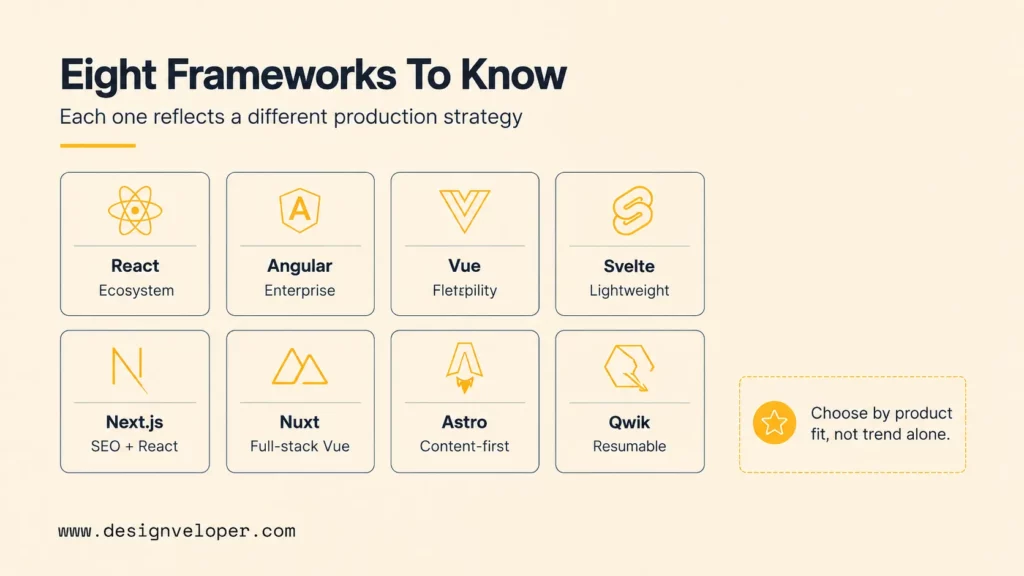
The best frontend framework in 2026 is the one that matches the product’s rendering needs, interaction complexity, team skills, deployment model, and maintenance horizon. React remains the broad ecosystem choice, Angular offers an integrated enterprise platform, Vue balances flexibility with conventions, Svelte compiles concise components, and meta-frameworks such as Next.js, Nuxt, Astro, and Qwik add distinct rendering and delivery models. Comparing front end frameworks only by popularity misses the architecture decision.
A framework choice affects far more than component syntax. It shapes routing, data loading, state boundaries, server rendering, static generation, testing, observability, design-system integration, accessibility, hiring, upgrades, hosting, and how much JavaScript reaches the browser. This guide compares eight important options and shows how to validate one against a real product before committing.
Quick decision guide: Choose React or Vue when ecosystem flexibility matters, Angular when a large team benefits from one opinionated platform, Svelte when concise compiled UI is attractive, Next.js or Nuxt when the corresponding ecosystem needs full-stack rendering, Astro when content dominates, and Qwik when resumability and minimal startup work justify a newer architecture.
| Primary need | Strong starting point | Validate first |
|---|---|---|
| Large component ecosystem and hiring pool | React with an appropriate framework | Routing, data model, rendering, and state conventions |
| Structured enterprise application | Angular | Team TypeScript depth, upgrade policy, and bundle strategy |
| Flexible progressive adoption | Vue.js | Application conventions and Vue/Nuxt boundary |
| Compact compiled components | Svelte or SvelteKit | Ecosystem coverage and team familiarity |
| SEO-aware React or Vue application | Next.js or Nuxt | Per-route rendering, caching, hosting, and server ownership |
| Content-heavy website with selective interaction | Astro | Island boundaries and CMS integration |
| Fine-grained lazy execution at the edge | Qwik | Resumability constraints, tooling maturity, and hiring |
Recommended for you:
- 11 Best Web Development Languages for Front-End and Back-End
- Front-End vs Back-End: Which Suits You Best?
- Typescript and JavaScript: A Complete Comparison
What Are Frontend Frameworks?
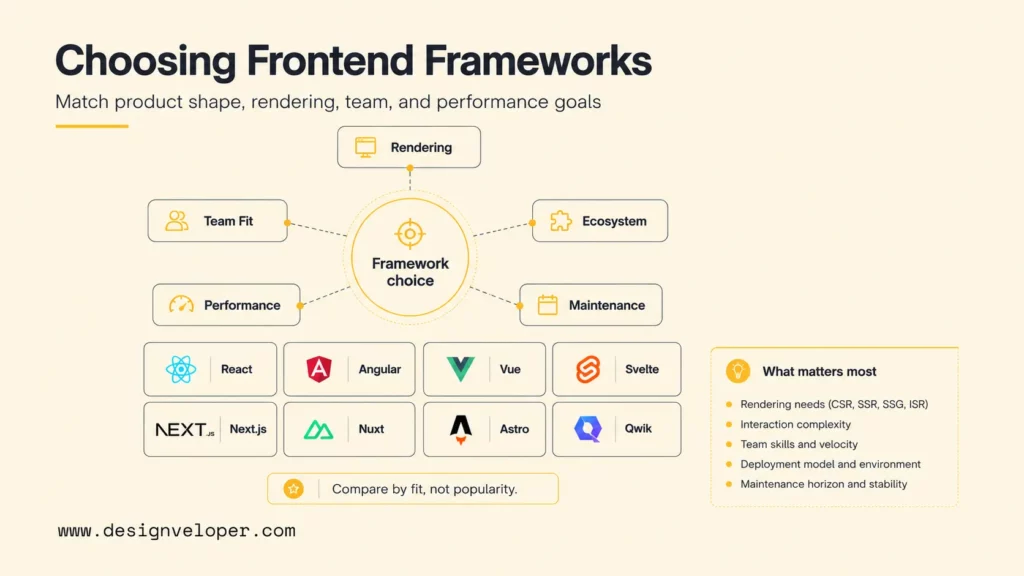
Frontend frameworks help developers build browser interfaces with reusable components, predictable update models, routing, state patterns, rendering options, build tools, and development conventions. They reduce the amount of infrastructure each team must invent and make complex interfaces easier to divide into testable, maintainable units.
The category includes several layers. React is officially a JavaScript library for rendering user interfaces. Angular calls itself a web framework and includes a broad suite of capabilities. Vue describes a progressive framework that can scale from enhancing HTML to full applications. Svelte is a compiler-based UI framework. Next.js and Nuxt are application or meta-frameworks built around React and Vue. Astro and Qwik center different rendering and delivery ideas.
Component reuse is only the visible part. A production frontend must also answer who owns navigation, server and client state, authentication, validation, errors, accessibility, internationalization, analytics, performance budgets, API contracts, testing, deployment, and upgrades. A library may intentionally leave those decisions open. A full framework may provide conventions or built-in modules. Neither approach is automatically better.
Frameworks are most valuable when the interface has repeated behavior, ongoing change, and multiple contributors. A mostly static brochure with one form may need little JavaScript. A SaaS workspace with permissions, real-time updates, tables, editors, and complex workflows benefits from consistent component and state boundaries. The architecture should match the problem rather than maximizing novelty.
A frontend framework is not the product architecture; it is one set of constraints inside the product architecture.
Further reading:
- 30 Best Web Development Blogs To Follow
- What Is Web Application Security? OWASP 10 Web App Vulnerabilities
- Web App Development Cost: Breakdown
Frontend Frameworks Vs UI And CSS Frameworks
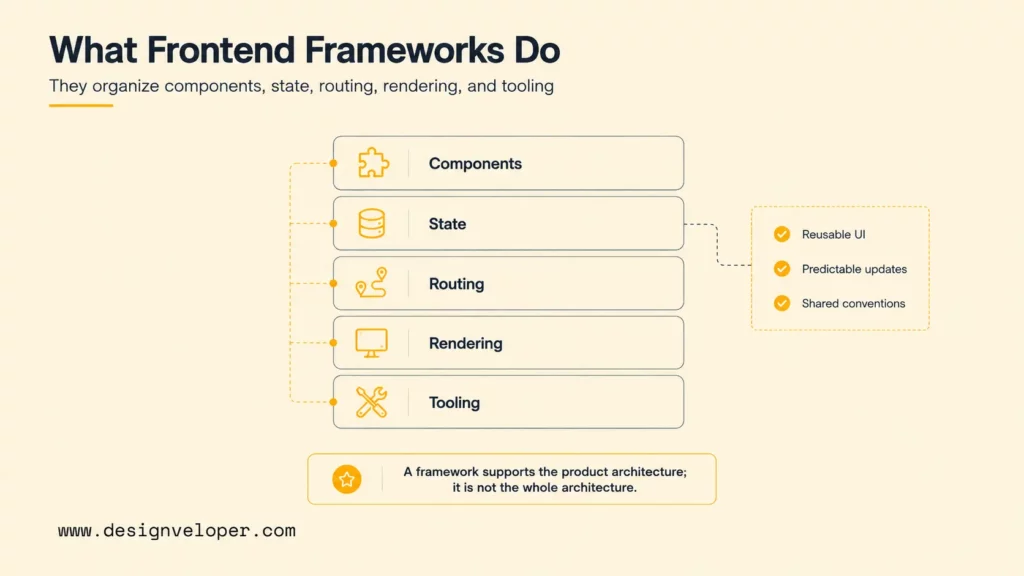
JavaScript frontend frameworks, meta-frameworks, and UI or CSS frameworks solve different layers. Teams often combine them, but substituting one category for another creates misleading comparisons.
| Type | What It Does | Examples | Best For |
|---|---|---|---|
| JavaScript frontend frameworks and UI libraries | Define components, reactivity, state updates, events, and browser rendering | React, Angular, Vue, Svelte | Interactive interfaces and application behavior |
| Meta-frameworks and application frameworks | Add routing, data loading, server rendering, static generation, build and deployment conventions | Next.js, Nuxt, Astro, Qwik City, SvelteKit | Production websites and full applications with explicit delivery models |
| UI and CSS frameworks | Provide visual primitives, utility classes, layout systems, or styled components | Bootstrap, Tailwind CSS, Material UI, Bulma | Consistent styling, responsive layout, and design-system acceleration |
A React application can use Next.js for routing and server rendering, then use Material UI or Tailwind CSS for presentation. An Angular application already receives more application structure but may still use Angular Material. A Vue application can pair Nuxt with a component system. The decision record should name each layer so the team knows which tool owns which responsibility.
CSS frameworks do not normally provide application state, API integration, route data, or rendering strategy. JavaScript frameworks do not guarantee a coherent brand system, accessible component design, or visual consistency. A component library can accelerate delivery, but teams still need design tokens, content rules, keyboard behavior, testing, and governance.
Related reading:
- Top 10 AI Code Review Tools & Best Practices For Implementation
- Prompt Engineering For Developers: A Guide To Practical Patterns
- Vibe Coding Vs Traditional Coding: Where Fast AI Coding Helps And Where It Hurts
Best Frontend Frameworks To Know
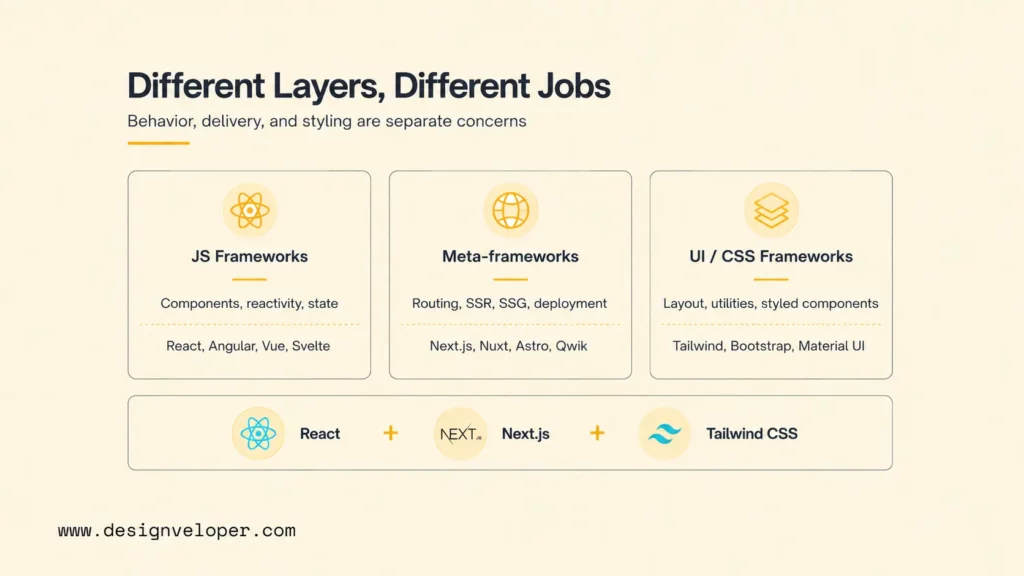
The eight options below are important because they represent different production strategies, not because every project should shortlist all eight. Official documentation should be the starting point for feature and migration decisions.
1. React For Scalable Component-Based UI
React is a JavaScript library for building user interfaces from components. It offers a large ecosystem, mature tooling, broad hiring availability, React Native alignment, and many choices for routing, data, state, styling, and testing. That flexibility suits product organizations able to establish and enforce their own architecture.
React alone does not prescribe a complete application stack. The official React guidance recommends starting new applications with a framework and identifies Next.js App Router, React Router, and Expo for different targets. This matters because a team selecting “React” must still decide rendering, routing, data loading, server boundaries, caching, forms, and deployment.
React is strong for scalable component systems, SaaS products, complex interactions, multi-platform teams, and products that need specialized ecosystem packages. The tradeoff is architectural choice overload. Without shared conventions, two React teams can produce incompatible state, data, and component patterns inside the same codebase.
2. Angular For Enterprise Web Applications
Angular is a Google-maintained web framework with components, dependency injection, routing, forms, CLI tooling, server-side rendering, static generation, hydration, signals, and DevTools. The integrated platform reduces the number of foundational choices that large teams must negotiate.
Angular works well for enterprise portals, regulated workflows, complex forms, long-lived internal applications, and organizations that prefer TypeScript-first conventions. Official routing includes guards, data resolution, lazy loading, and nested routes. Angular forms provide reactive and template-driven approaches, with reactive forms suited to scalable, testable form-heavy applications.
The tradeoff is weight in concepts and governance. Developers need familiarity with TypeScript, decorators, dependency injection, templates, signals or RxJS patterns, and Angular’s release cadence. Angular delivers the most value when the team uses its conventions consistently rather than fighting the platform.
3. Vue.js For Flexible And Developer-Friendly Projects
Vue.js is a progressive framework that can enhance static HTML, power single-page applications, render on the server, generate static sites, or integrate through Web Components. Vue Single-File Components combine template, logic, and scoped styles in a format many teams find approachable.
Vue fits small-to-medium product teams, gradual modernization, dashboards, ecommerce interfaces, and applications that want a balance between React-style flexibility and stronger default conventions. The Composition API supports reusable logic, while the wider ecosystem includes Vue Router, Pinia, Vite, and Nuxt.
The main tradeoff is ecosystem scale relative to React and organizational consistency relative to Angular. Teams should decide early how they will structure composables, state, data fetching, error handling, and server rendering. Vue’s flexibility helps adoption but still needs an application standard.
4. Svelte For Lightweight Interactive Interfaces
Svelte uses a compiler so developers write components with HTML, CSS, and JavaScript while much of the framework work is converted during the build. The result can be concise component code and less runtime machinery for many interfaces.
Svelte is attractive for interactive sites, focused applications, data experiences, teams that value compact syntax, and products that can benefit from SvelteKit’s application conventions. State of JS 2024 reported steadily increasing Svelte usage and leading positive opinion among surveyed frontend tools, while React remained far more widely used at work.
The tradeoff is a smaller hiring and package ecosystem than React. Teams should verify required grids, editors, accessibility primitives, analytics, testing integrations, and internal skills. Compiler behavior and Svelte-specific reactivity also require deliberate training and review.
5. Next.js For SEO-Friendly React Applications
Next.js is a React framework that adds file-based routing, layouts, data and server features, React Server Components, client components, prefetching, prerendering, and deployment conventions. It is a strong default when a React product needs indexable pages, full-stack routes, or mixed server and client rendering.
Next.js fits content plus application hybrids, ecommerce, SaaS, marketplaces, and product sites with personalized or authenticated areas. Rendering can be selected by route and data freshness. Server Components can keep some data and rendering work off the client, while Client Components provide browser interaction.
The tradeoff is operational complexity. Cache behavior, server and client boundaries, streaming, route invalidation, runtime compatibility, and hosting costs need explicit ownership. Next.js improves the tools available for SEO; it does not automatically create crawlable content, good metadata, fast pages, or stable canonical URLs.
6. Nuxt For Vue-Based Full-Stack Apps
Nuxt is a full-stack Vue framework with file-based routing, auto-imports, data utilities, TypeScript support, server-side rendering by default, static generation, hybrid route rules, and a Nitro server engine. It provides a production path for teams that prefer Vue components but do not want to assemble every application layer.
Nuxt works well for Vue-based ecommerce, content platforms, portals, and products combining public indexable pages with authenticated application areas. Route rules can prerender selected pages, cache APIs, redirect legacy URLs, or use different rendering behavior across the product.
The tradeoff resembles other full-stack meta-frameworks: developers must understand browser and server environments, hydration, cache invalidation, deployment presets, and Nitro behavior. A Vue team should validate the Nuxt module ecosystem and hosting target before choosing modules that become architectural dependencies.
7. Astro For Content-Heavy And Performance-Focused Websites
Astro is an application framework designed around content-focused websites and an islands architecture. Pages can ship mostly HTML while interactive components are hydrated selectively. Astro can use components from React, Vue, Svelte, and other supported ecosystems inside the same site.
Astro fits documentation, publications, marketing sites, portfolios, and ecommerce content where most of the page does not require persistent client-side application state. Content Collections, static generation, server rendering, and selective client directives help teams manage content without turning every route into a full single-page application.
The tradeoff appears when the product is an interaction-heavy application with shared client state across most of the screen. Island boundaries then require careful design, and the value of partial hydration may shrink. Teams should prototype the most stateful workflow rather than only the static homepage.
8. Qwik For Fast-Loading And Edge-Optimized Web Apps
Qwik centers resumability. Its official documentation explains that a server-rendered application serializes listeners, component boundaries, and state so the browser can resume interaction without replaying a traditional hydration process for the whole application.
Qwik is relevant for teams investigating minimal startup work, fine-grained lazy loading, edge deployment, and highly interactive experiences that must remain responsive on constrained devices. Qwik City adds routing and application conventions around Qwik components.
The tradeoff is novelty and a different mental model. Serializable closures, DOM-centric design, task behavior, and server-client execution boundaries affect how code is written. The ecosystem and hiring pool are smaller. Qwik should earn its place through a representative performance prototype and operational review.
Frontend Frameworks Comparison
The comparison summarizes the architectural center of each option. “Best for” is a starting hypothesis, not a universal verdict.
| Framework | Best For | Strengths | Main Tradeoff |
|---|---|---|---|
| React | Scalable component products and broad ecosystem needs | Adoption, packages, hiring, flexible composition | Requires application architecture choices |
| Angular | Large enterprise applications and structured teams | Integrated tooling, TypeScript, routing, forms, dependency injection | Steeper concepts and platform weight |
| Vue.js | Progressive adoption and flexible product teams | Approachable components, reactivity, strong core ecosystem | Smaller ecosystem and hiring pool than React |
| Svelte | Concise compiled UI and focused interactive products | Compact syntax, compiler model, positive developer sentiment | Smaller package and hiring ecosystem |
| Next.js | Full-stack React with mixed rendering and public pages | Routing, server features, prerendering, React integration | Cache, runtime, and server-client complexity |
| Nuxt | Full-stack Vue with hybrid rendering | SSR defaults, Nitro, route rules, Vue conventions | Server and hydration operational learning |
| Astro | Content-heavy websites with selective interaction | HTML-first output, islands, multi-framework components | Less natural for pervasive shared client state |
| Qwik | Resumable, edge-oriented interactive applications | Fine-grained lazy execution and low startup work | Newer mental model, ecosystem, and talent constraints |
State of JS 2024 found React first for professional use among its respondents, followed by Vue, Angular, and Svelte. The same survey highlighted high positive sentiment for Svelte and improving Vue retention. Survey populations are self-selected, so the results indicate ecosystem direction rather than a guaranteed hiring market or product outcome.
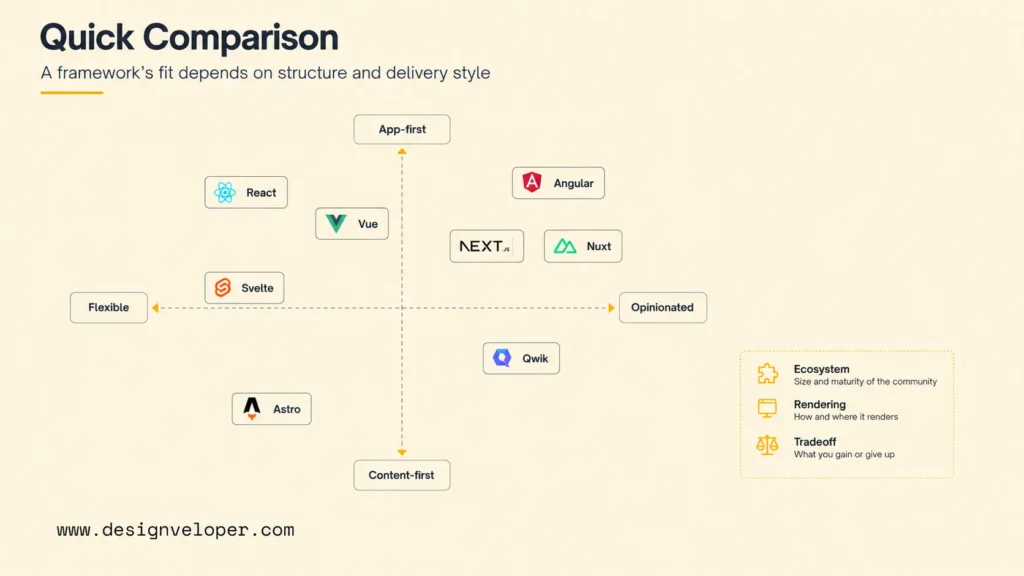
How To Choose The Right Frontend Framework
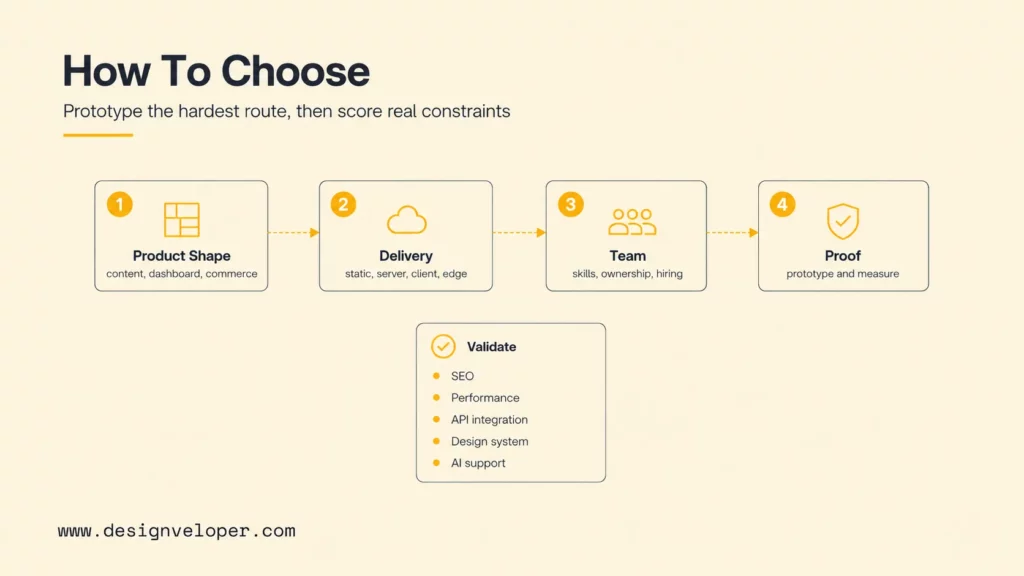
Choose with a representative workflow, not a feature checklist. Define the hardest route, data shape, interaction, device, accessibility requirement, failure mode, and deployment constraint. Then prototype that slice in two credible candidates.
- Project type: distinguish content, transaction, dashboard, internal workflow, real-time collaboration, and embedded interaction.
- SEO and rendering: define which routes need immediate HTML, personalization, streaming, static output, or client-only behavior.
- Performance and Core Web Vitals: set route budgets for JavaScript, images, fonts, LCP, INP, and CLS. Google’s current reference thresholds are 2.5 seconds, 200 milliseconds, and 0.1 at the 75th percentile.
- Team skills and hiring: assess current capability, training cost, reviewer depth, regional talent, and onboarding time.
- Ecosystem and maintenance: verify required editors, grids, charts, accessibility primitives, testing tools, release cadence, security support, and upgrade history.
- Backend and API integration: test authentication, authorization, errors, retries, streaming, uploads, real-time events, and generated clients.
- Design system and UI complexity: prototype tokens, themes, forms, overlays, keyboard behavior, localization, and accessibility.
- AI-assisted support: evaluate whether coding agents can use the current documentation and repository conventions, then require tests and human review for generated code.
Score candidates against weighted criteria, but keep the prototype decisive. A framework that wins a spreadsheet while failing the hardest workflow, deployment target, or accessibility test is not the right choice.
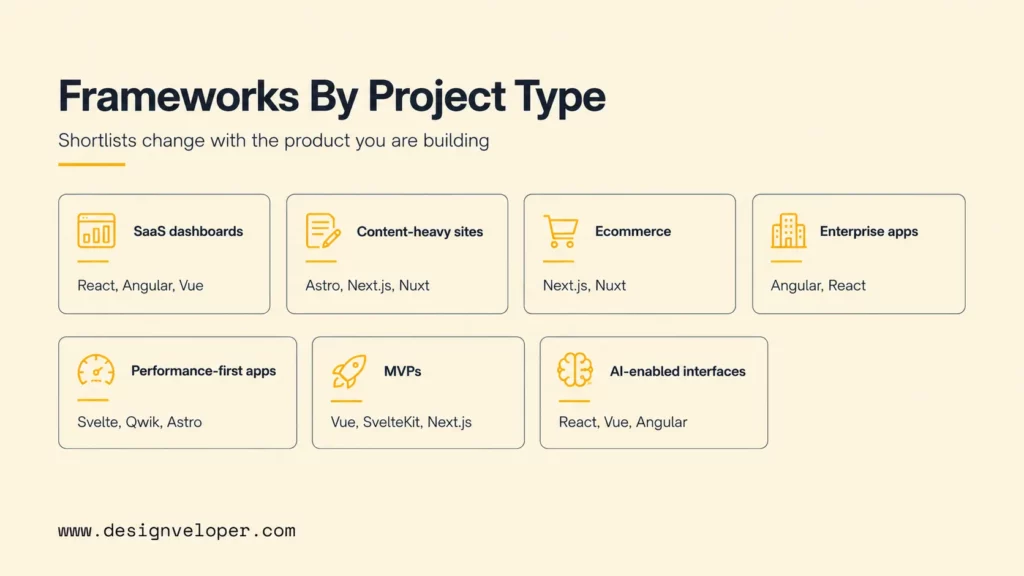
Best Frontend Frameworks By Project Type
Project type narrows the shortlist more reliably than broad popularity. The recommendations below assume the team has matching skills and validates the delivery model.
- SaaS dashboards and internal tools: React, Angular, or Vue. Angular suits standardized enterprise teams; React offers specialized ecosystem depth; Vue offers a productive middle path.
- Marketing websites and content-heavy sites: Astro, Next.js, or Nuxt. Astro fits mostly static content with islands; Next.js and Nuxt fit content connected to richer application or server needs.
- Ecommerce and marketplaces: Next.js, Nuxt, or React/Vue with a proven commerce stack. Validate catalog scale, search, personalization, cache invalidation, checkout, analytics, and CMS preview.
- Enterprise web applications: Angular or governed React. The decision depends on whether integrated platform conventions or flexible ecosystem composition better fits the organization.
- Performance-first interactive apps: Svelte, Qwik, Astro islands, or carefully optimized meta-framework routes. Measure the real interaction rather than relying on architectural marketing.
- MVPs and fast product prototypes: Vue, SvelteKit, Next.js, or Nuxt when the team already knows the stack. Existing expertise and deployability usually matter more than theoretical minimalism.
- AI-enabled product interfaces: React, Angular, Vue, Svelte, Next.js, or Nuxt can all render chat, streaming responses, review queues, and agent workflows. Prioritize streaming transport, cancellation, state recovery, permissions, observability, and human approval UX.
A strong project recommendation includes the non-framework pieces: TypeScript policy, design system, data layer, API contracts, test pyramid, observability, hosting, security, accessibility, analytics, and upgrade ownership.
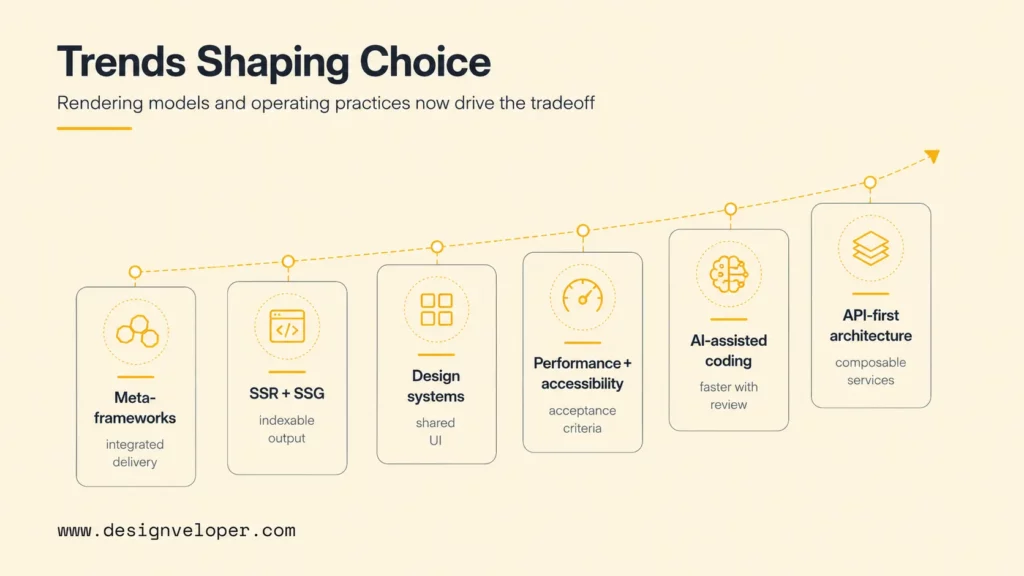
Frontend Development Trends That Affect Framework Choice
Framework choice in 2026 is increasingly a rendering and operating-model decision. Component syntax still matters, but production delivery now dominates the tradeoff.
- Meta-frameworks are common: React’s own guidance recommends frameworks for new applications, while Next.js, Nuxt, SvelteKit, Astro, and Qwik City package routing and rendering decisions.
- Server rendering and static generation support public pages: teams can select SSR, SSG, incremental or cached output, client rendering, and hybrid behavior by route. SEO still requires accessible content, correct canonicals, metadata, links, and stable status codes.
- Component-driven design systems connect design and code: tokens, accessible primitives, documentation, visual regression, and versioned components reduce inconsistent UI across products.
- Performance and accessibility are acceptance criteria: Core Web Vitals, keyboard operation, semantics, focus management, reduced motion, contrast, and screen-reader behavior need continuous testing.
- AI-assisted coding accelerates both delivery and mistakes: generated components, tests, documentation, and refactors need repository context, type checks, security review, accessibility review, and realistic evaluation cases.
- API-first and composable architecture increases integration work: headless CMSs, commerce engines, identity providers, search services, and AI APIs need consistent contracts, caching, error handling, and observability.
These trends favor teams that document boundaries. The framework should make ownership clearer: which code runs on the server, which reaches the browser, where data is cached, how components are tested, and how a route fails safely.
The winning framework is the one a team can upgrade, observe, test, and explain after the launch excitement is gone.
Framework Choices That Become Product-Ready UI
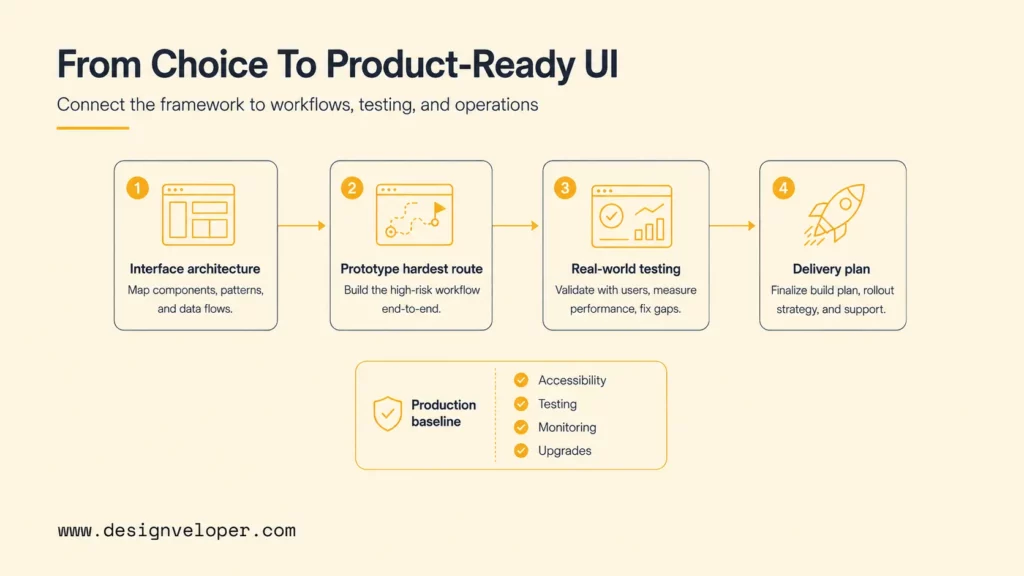
A framework becomes product-ready only when it is connected to real workflows, APIs, performance targets, accessibility, testing, deployment, and maintenance. A successful proof of concept should be treated as evidence, not production architecture.
Start with interface architecture. Define route groups, server and client boundaries, feature modules, shared components, data ownership, state lifetime, form strategy, error boundaries, permissions, and design tokens. Establish when a component belongs in the product design system and when it is local to one workflow.
Build production acceptance around user behavior. Test slow networks, low-powered devices, expired sessions, API timeouts, empty states, long translations, keyboard navigation, screen readers, interrupted uploads, duplicate submissions, and real data volume. Measure route bundles, Core Web Vitals, error rates, API latency, test duration, and build time.
A frontend framework should be tested against the hardest product route, not selected from a popularity chart. In our web development work, we prototype a representative flow that includes real API data, authentication, error states, responsive behavior, accessibility checks, and a production-like build. The result gives the team evidence about bundle cost, component boundaries, testing effort, and developer experience before the framework becomes an expensive default.
The delivery plan should include an architecture decision record, dependency policy, design-system owner, accessibility baseline, testing strategy, release process, monitoring requirements, upgrade calendar, and technical-debt budget. These artifacts turn a framework shortlist into a maintainable product roadmap instead of a one-time technology preference.
FAQs About Frontend Frameworks
What Is The Most Popular Frontend Framework?
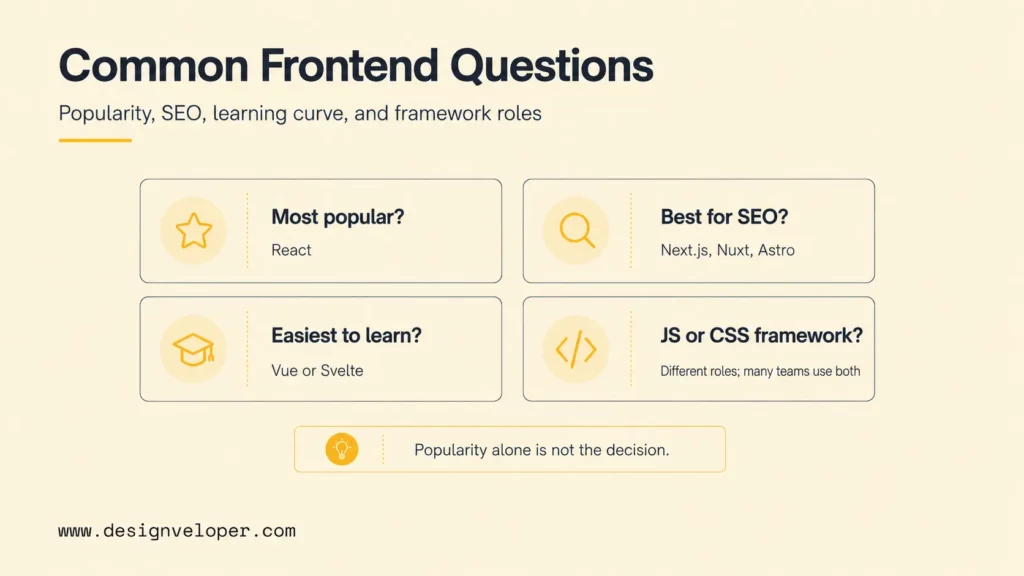
React remains the most widely used frontend UI option in major developer surveys. State of JS 2024 ranked React first for professional use among its respondents, ahead of Vue, Angular, and Svelte. Popularity is useful for ecosystem and hiring signals, but it does not prove that React’s architecture, rendering model, or operational cost fits a specific product.
Is React A Framework Or A Library?
React is officially a JavaScript library for rendering user interfaces. It provides components, hooks, and rendering APIs but does not prescribe a complete routing and data-loading architecture. The React team recommends starting new applications with a framework such as Next.js or React Router when the product needs an integrated application stack.
Which Frontend Framework Is Best For SEO?
Next.js, Nuxt, Astro, SvelteKit, Angular SSR, and Qwik City can all produce indexable HTML through server rendering or static generation. Astro is a strong content-first option; Next.js and Nuxt suit React or Vue products with mixed application needs. SEO depends on rendering accessible content, correct URLs, metadata, status codes, canonicals, links, structured data, performance, and content quality – not the framework name.
Which Frontend Framework Is Easiest To Learn?
Vue and Svelte are often approachable for developers comfortable with HTML, CSS, and JavaScript because their component formats keep those concepts visible. React has a small core but requires additional application choices. Angular teaches more concepts upfront and expects TypeScript familiarity. The easiest production framework is usually the one with strong internal mentors, conventions, examples, and review capacity.
Should I Use A JavaScript Framework Or A CSS Framework?
Use a JavaScript framework when the interface needs component behavior, state, routing, data loading, and dynamic updates. Use a CSS or UI framework when the main need is layout, styling primitives, utilities, or reusable visual components. Many products use both: Next.js with Tailwind CSS, React with Material UI, Angular with Angular Material, or Vue with a design system. Assign each layer a clear responsibility.
Also published on

Share post on










Related Articles


Future of Frontend Web Development: 2026 Guide
Future of Frontend Web Development: 2026 Guide Published August 03, 2026
Best Frontend Frameworks: 8 Options, Tradeoffs, And Tips
Best Frontend Frameworks: 8 Options, Tradeoffs, And Tips Published August 03, 2026
How to Future-Proof Your Website’s Front-End Without Constant Redesigns
How to Future-Proof Your Website’s Front-End Without Constant Redesigns Published May 23, 2025