















eCommerce App Development Guide 2026: Features, Process

More and more people are shopping online, especially through mobile phones. This encourages the growth of eCommerce applications, which are expected to reach a whopping revenue of 3.48 trillion in 2026. The figure states that this is a fertile ground for many businesses to join, which unintentionally boosts the growth of eCommerce app development.
eCommerce app development plays a crucial role today. It acts as a vital pathway for your business to conveniently connect with your customers worldwide and increase revenue streams.
This article provides a comprehensive guide, leading you through benefits, key features, and each development stage. Keep reading, and you’ll learn the knowledge necessary to embark on your own journey of eCommerce app development.
What Is eCommerce App Development?
Simply, eCommerce app development involves building mobile apps for eCommerce activities, typically selling products or providing services. These apps connect buyers and sellers online, mainly aiming to offer users a convenient and efficient shopping experience.
eCommerce apps often come with common features, like product catalogs, shopping carts, secure payment gateways, and inventory management. With so many features and regular data exchanges, they definitely need to have user-friendly interfaces and robust security.
So, do you know how many types of eCommerce there are out there? Let’s see:
| Types of App | Description | Typical Example |
| B2C (Business-to-Consumer) | Businesses sell products directly to individuals. | Adidas, Sephora, Walmart, Amazon |
| B2B (Business-to-Business) | Businesses sell products or services to other businesses. | Alibaba, Office Depot, Intel |
| D2C (Direct-to-Consumer) | Brands offer products directly to individuals without intermediaries. | Adidas, Sephora |
| C2C (Consumer-to-Consumer) | Individuals offer products directly to individuals. | Poshmark, Etsy, Facebook Marketplace |
| C2B (Consumer-to-Business) | Individuals offer services to businesses. | Freelance apps like Upwork or Fiverr |
| Marketplaces / Ecommerce Aggregators | Mobile apps gather offerings from different providers in a unified place for customers to buy or compare. | Airbnb, Uber, eBay, Google Shopping |
Recommended reading: 7 Steps of Custom eCommerce Website Development
Benefits of Building eCommerce App for Your Business
Building an eCommerce mobile app is not a fad, but a competitive edge for various businesses in today’s era. Why? Let’s dig deep into the huge benefits of eCommerce app development:
- Improve purchase frequency
Statista stated that mobile phones contributed over 70% of online orders to eCommerce websites globally as of Q3 2025. If your target audience prefers online shopping activities through mobile gadgets, you shouldn’t ignore eCommerce development on these devices.
Approaching potential consumers through m-commerce, you can increase their buying power. This is especially true if your main offerings lie in categories like FMCG (Fast Moving Consumer Goods), food & beverage, and fashion, which online shoppers tend to buy online.
- Access mobile hardware features
Do your potential consumers often scan barcodes for payments, use GPS to find the nearest stores, or use AR/VR features to try products in virtual environments? If so, building eCommerce mobile apps helps you access the inherent hardware features of a mobile phone, typically Bluetooth, GPS, or cameras.
- Build loyalty among consumers
When people tend to ‘live’ on mobile phones rather than desktops, a mobile app is considered the best vehicle to attract and retain consumers.
Push notifications to remind them about the latest discounts or their abandoned products encourage people to return to eCommerce mobile apps. Some research has shown that the open rate of this functionality on mobile phones are three or four times higher than email marketing.
- Increase loading speed & UX
A mobile app improves the user experience of your target audience. Why? It loads data much faster, as it depends on a phone’s operating system (iOS or Android) rather than a web browser whose performance is significantly impacted by internet connections.
More interestingly, some features of a mobile app can work offline, ensuring a better user experience than a mobile-based website.
FURTHER READING: |
1. ECommerce Business: Definition, Models of Transactions, and eCommerce Environment |
2. Ecommerce Website Image: 10 Tips to Optimize |
3. How to Build an eCommerce Website Fastest in 2023 |
When Should Businesses Build an eCommerce App?
Not all the time an eCommerce mobile app is required. No matter how beneficial it is, it’s still more expensive than an eCommerce website.
But what’s the best time to develop an m-commerce app? The answer depends on your brand’s popularity, budget, real customer demands, and even internal chaos.
However, if you’re in one of the use cases below, you may consider eCommerce app development:
Option 1: Build an eCommerce App After Your Website Is Live
Best for: Businesses with a live website and clear signs of growing mobile usage
Even when your target audience is mainly mobile lovers, it doesn’t mean you can ignore eCommerce website development.
A website is always the most popular way to approach your potential users through search engines. Further, it’s cheaper to build and faster to fix. Target users may know whether they should trust your brand and buy products from you through how professional and convenient your site is.
If your site is doing well – steady traffic, repeat buyers, etc. – it’s the first signal. Now, start noticing other patterns to know whether to move next to a mobile app.
Do your customers browse mostly on phones? Do they often miss promotions or good deals, as your site can’t notify them? Does your business want smoother checkouts, saved preferences, and offline access to retain consumers? If so, move to a mobile app while keeping a website to increase organic traffic and serve website lovers.
With the data collected from the website, you’ll know what truly attracts your consumers and focus on the most important features of a mobile MVP.
Option 2: Build an eCommerce App and Website at the Same Time
Best for: Well-funded startups or established companies with a mobile-first strategy
This option is quite risky for those with tight budgets. Because launching both mobile and website versions costs a fortune, even when you choose cross-platform app development instead of native apps.
But does your business model depend heavily on mobile behavior from the first day? Is your business sufficiently funded to afford both mobile and website development approaches? If so, choose this option: developing both versions at the same time.
But be aware of increased complexity and slower time-to-market, in addition to higher costs. Any small change in pricing logic, checkout flows, or something can slow your teams down.
That’s why you need a clear roadmap for development and budget distribution. Otherwise, your development costs more than what it gains.
Option 3: Hybrid Approach (PWA – Progressive Web App)
Best for: Businesses that want a website with native functionality
If your business strategy emphasizes both web development and native features, but your budget is limited, pick this final option.
A progressive web app (PWA) mainly runs on browsers. But it can access native hardware features like GPS, cameras, or offline mode if you download it to the home screen of your phone. This allows it to work like a website but behave as an app. It can load fast, work offline, and send push notifications, without depending on operating systems.
But be careful when building a PWA on iOS, as this operating system prevents it from accessing some device features. And of course, it doesn’t give full native feelings like an eCommerce mobile app. So, you can start with a website with PWA functionality, and move next to a mobile app when it’s time.
Must-have Features of an eCommerce App
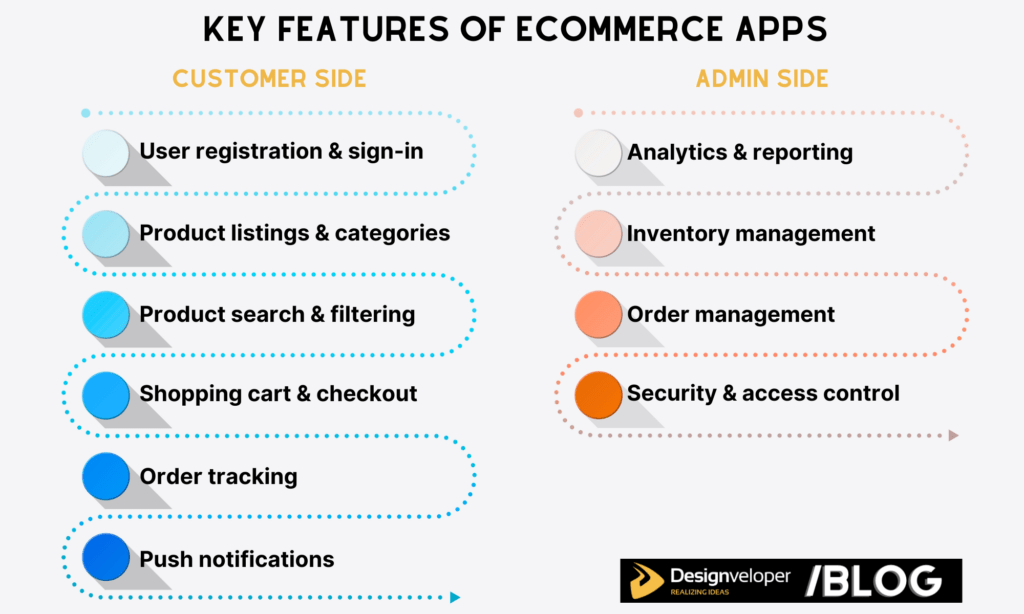
“Which features should I include in my eCommerce mobile app?” Many people ask this question, and the answer depends much on what your app mainly does. But regardless of its type and complexity, below are must-have features you couldn’t exclude:
Customer Side
In the client side where users can interact with your online store, there are some common eCommerce features:
- User Registration & Sign-In: User registration should be simple, asking for essential – but not too private – information, like an email address, a login name, or a phone number. Your mobile app should integrate social and biometric login, like Google, Apple ID, or FaceID.
- Product Listings & Categories: Your product screens should be clean and organize your products neatly to help users scroll, find, and compare what they want. The mobile app should integrate authentic images, concise descriptions, transparent pricing, clear shipping & return policies, and authentic reviews.
- Product Search & Filtering: Sometimes, users want to speed up their search by using the search bar and filters. Develop these features in a way that they can understand human languages and even misspellings instead of solely keywords. This helps consumers find exactly what they want. You can even integrate smart filters and relevant suggestions to personalize their shopping experience and increase buying likelihood.
- Shopping Cart & Checkout: The mobile phone should have the “Add To Cart” button that is big enough for a user’s thumb to tap conveniently. Besides, the checkout process should be smooth and not require consumers to fill in too many information details, which makes them worried about data privacy and prevents them from buying. The checkout should enable auto-fill, integrate many payment options, and show security cues to reduce hesitation.
- Order Tracking & Post-Purchase Support: People want to know whether their order succeeds and where their stuff is. So, your eCommerce app should display an order confirmation/thank you screen after any successful order and show users where to track their orders. Even a basic in-app support chat or FAQ makes their experience complete.
- Push Notifications: Do you want to notify consumers about the restocking of their favorite stuff, order updates, or the latest promotions? If so, integrate push notifications. But don’t overuse them, as consumers may feel annoyed and mute them without a second thought.
Admin Side
In the place where your business manages every eCommerce operation, there are some features you must integrate:
- Analytics & Reporting: Your business needs a visual dashboard to track user behavior, sales, and other metrics. This dashboard gives you actionable insights into popular products, peak times, drop-offs, and other trends to guide your decisions and strategy.
- Product Inventory Management (PIM): The PIM panel matters, as it helps non-technical teams add new products, update prices, change images, and manage variants faster.
- Order Management: This functionality integrates with shipping providers to manage order processing, cancellation, and refunding in a unified place.
- Security & Access Control: You need robust security measures and assign different permissions to the right role. So, this functionality is essential to protect eCommerce data and operations from cyberattacks.
Advanced eCommerce App Features in the AI Era

In addition to the must-haves, your eCommerce app may consider including advanced features to stay competitive and give a better experience to users.
- AI-Powered Product Recommendations: ML algorithms can notice patterns, like browsing mood, time of day, or price sensitivity, to suggest suitable products to consumers.
- Visual Search & Voice Commerce: This functionality allows users to look for what they want using their voice commands or photos. This enhances their search experience beyond text-based searches.
- Personalized Pricing & Promotions: AI uses user data (e.g., browsing behavior and location) to adjust prices and offers to individual shoppers. This feature increases conversions, loyalty, and willingness to pay.
- AI Chatbots & In-App Virtual Assistants: AI-powered chatbots reduce customer support workloads by handling common issues, explaining return & refund policies, and guiding some actions (e.g., checkout) – all done 24/7. When encountering more complex requests, they can forward them to the right human agent.
- AR Try-On & 3D Product Visualization: These features let your users interact with lifelike, 3D products in their own space, which improves conversions and minimizes returns. They prove very helpful for fashion, beauty, furniture, and luxury goods. Think of Sephora Virtual Artist, IKEA Place, and Amazon Beyond as examples.
- Predictive Analytics for Demand & Inventory: ML algorithms analyze historical data (e.g., sales or user behavior), plus market trends, to predict potential demand and adjust stock levels. This reduces stockouts and overselling, hence making your eCommerce operations more efficient and improving the user experience.
eCommerce App Development Technologies
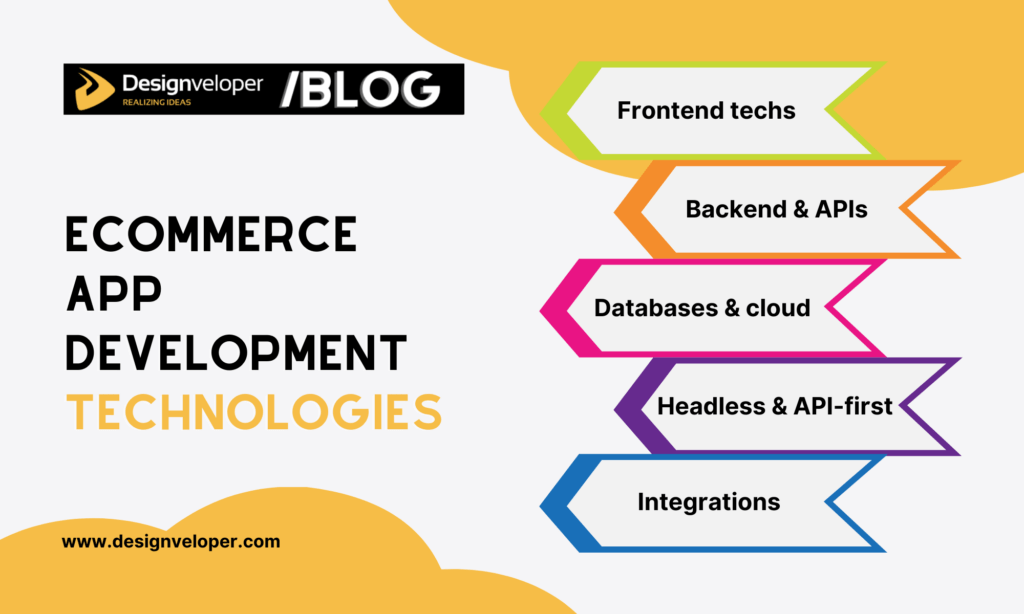
Different teams have different tech choices for eCommerce app development. What you choose often depends on operating systems, team skills, timelines, budgets, scalability, and other requirements. That said, any eCommerce app development project involves the common tech stacks as follows:
- Frontend Technologies (iOS, Android, Flutter, React Native)
Native iOS and Android apps require OS-specific technologies to ensure smooth performance. For example, Android apps are often built on Kotlin and Jetpack Compose, while iOS development requires expertise in Swift and SwiftUI.
Besides, you can consider cross-platform frameworks to build mobile apps that can perform well on both operating systems. Frameworks like Flutter and React Native help you create a shared codebase, hence saving costs and speeding up launch.
- Backend & APIs (Node.js, Java, .NET, Python)
Your development team needs a strong proficiency in Python, NodeJS, Java, .NET, and other backend technologies to handle technical work behind the scenes.
NodeJS, a JavaScript framework, supports real-time interactions and fast iterations well, while Java and .NET are ideal for large, complex apps that require stability. If you want to integrate data analytics or AI capabilities, consider Python.
- Databases & Cloud Infrastructure
Next, consider using relational or NoSQL databases to handle, store, and manage data (e.g., orders, users, or inventory) securely. You can also adopt cloud platforms like AWS, GDP, or Azure to reduce costs instead of relying on on-premises infrastructure. These cloud services can scale at a more affordable cost when your traffic increases or demands change.
- Headless & API-First Commerce Architecture
Using a headless commerce architecture allows your team to develop the frontend and the backend separately. These systems connect through APIs. This gives your team freedom to redesign one part and enable faster updates without breaking core logic.
- Third-Party Integrations (ERP, CRM, OMS)
Your eCommerce app doesn’t work alone, but connects with other services, like ERP, CRM, OMS, and payment gateways, to process and sync data. Without these integrations, your app may display mismatched inventory levels, hardly centralize orders from different sales channels, and streamline other eCommerce operations. So, building and managing clean integrations is vital to ensure smooth data exchanges between systems.
eCommerce App Development Process
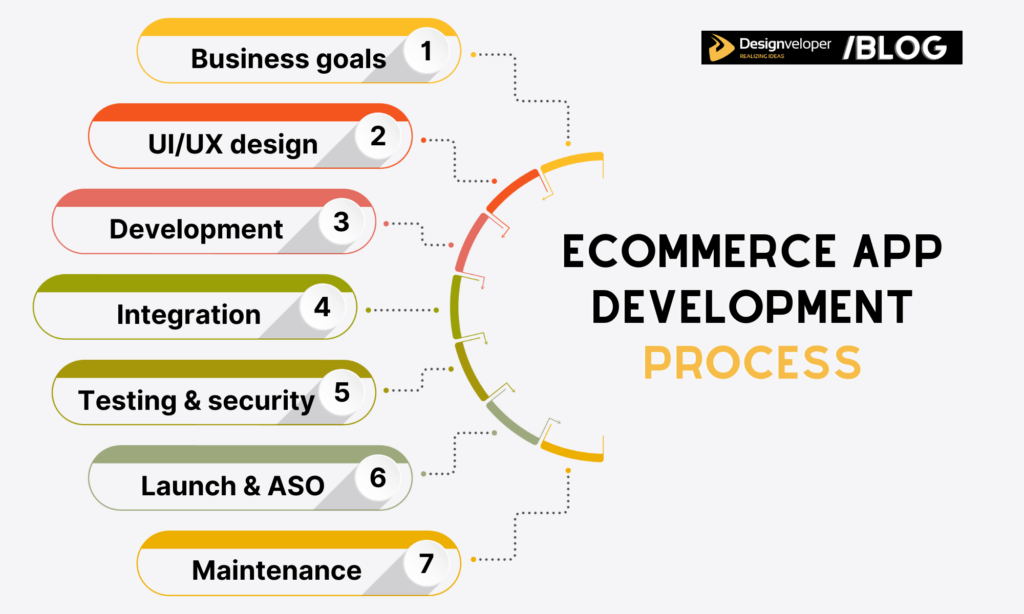
Once you understand the must-have features and core technologies of eCommerce mobile apps, we now move to the development process. Below are key steps you should consider:
Step 1: Business Goals and App Strategy
Setting clear and achievable goals for the eCommerce app is crucial. These goals must align with the overall business objectives and serve as measurable indicators of the app’s success post-launch. Conducting thorough market research may give you better insights to unveil distinctive selling points that will set your app apart in the dynamic marketplace.
Besides, clarifying app goals helps your team define the truly essential features, set a realistic timeline, and allocate resources wisely.
Step 2: UX/UI Design and User Journey Mapping
Here, designers create a wireframe and prototype with core UI elements. The design should not only align with your brand identity, but also ensure the seamless user flow throughout the app. This helps increase engagement and shopping experiences for app users.
Step 3: App Development and Feature Implementation
In this stage, your development team continues turning the static design into the dynamic user interface using frontend technologies. This involves incorporating core features, like product browsing, checkout, or order tracking. Remember that your app’s interface should have visual appeal, be intuitively navigable, and adapt seamlessly to any screen size.
Besides, your team needs to build the server-side logic and effectively manage databases. The proper setup of a backend infrastructure connects both sides efficiently and ensures efficient data flows.
Step 4: Payment, Shipping and System Integration
Next, your team needs to integrate secure payment gateways, reliable shipping solutions, and other crucial systems through APIs. Sometimes, you have to build custom APIs to connect the app with your proprietary or legacy systems.
Step 5: Testing, Security and Performance Optimization
Once development and integrations are done, QA engineers come in to conduct thorough testing in collaboration with developers and designers. Normally, this testing process includes conducting functional, usability, and compatibility tests across various devices and operating systems. This helps your team identify and resolve any possible bugs, as well as check whether the app works as intended.
Additionally, your team needs to implement robust security measures to protect user data and prevent potential security breaches. This involves adopting encryption, authentication mechanisms, and conducting regular security audits.
Also in this stage, your team focuses on performance optimization to improve the speed and responsiveness of the eCommerce app. Accordingly, you can refine the code, optimize images, and adjust server configurations to ensure fast loading times.
Step 6: App Launch and Store Optimization (ASO)
Before launching the eCommerce mobile app, you need to prepare legal and administrative documents. This helps you ensure compliance with app store policies and protect your intellectual property from any risks later.
Some mandatory documents to ensure app store compliance include Privacy Policy, Terms and Conditions (Terms of Use), and End User License Agreement (EULA). Besides, you should consider intellectual property & corporate documents (e.g., trademark registrations or NDA), business registration, tax documentation, technical & metadata documents, etc.
Once you meet app store requirements, you can send the app to app stores and wait for approval. Further, you should devise an ASO (App Store Optimization) plan to make your app more visible and accessible to target users. Accordingly, you need to:
- Optimize keywords, visuals, and metadata;
- Improve app ratings and authentic reviews;
- Keep the app regularly updated.
Step 7: Maintenance, Scaling and Feature Enhancements
Last but not least, your development must closely monitor the app’s performance and security. This entails regularly analyzing user feedback, tracking key metrics, and conducting regular security audits. These actions help you identify areas for improvement and address bugs promptly.
As the app gains popularity, you can plan to expand and enhance its infrastructure to meet the increasing demands of users.
eCommerce App Development Cost and Timeline
People are often curious about how much it costs and how long it takes to build an eCommerce mobile app. They want clear numbers for budgets and deadlines, but it’s hard to tell. It’s because the exact numbers for their projects depend on various factors – let’s say your app type, feature complexity, integrations, etc.
But there are still rough estimates for eCommerce app development costs and timeline.
| App Complexity | What It Covers | Estimated Costs | Estimated Timeline |
| Simple eCommerce app | Basic product listings, cart, checkout, and standard payments | $10,000 – $40,000 | 3 – 6 months |
| Medium-complex app | Personalized content, multiple payment options, admin dashboards, plus analytics | $40,000 – $90,000 | 6 – 9 months |
| Highly complex app | AI features, real-time inventory sync, third-party integrations, and heavy customization | $90,000 – $150,000+ | 9 – 12 months+ |
Custom vs SaaS-Based eCommerce App Development
When you decide to build an eCommerce mobile app, you may wonder whether to build a custom one or rely on SaaS platforms for development. The answer depends on your app’s complexity, customization, costs, and time-to-market.
The table below explains the differences between these two approaches:
| Aspect | Custom eCommerce App | SaaS-Based eCommerce App |
| Development Time | Longer (months) | Shorter (weeks) |
| Upfront Cost | Higher | Lower |
| Flexibility | Very high | Limited |
| Scalability | Built for growth | Platform-dependent |
| Custom Features | Fully customizable | Restricted by platform |
| Maintenance | Your responsibility | Mostly handled by the SaaS platform provider |
Custom eCommerce app development gives you complete control over design and functionality. You build exactly what your business needs, with custom features fitting every inch of your workflow. But the trade-off? Higher upfront cost and longer timelines. More importantly, you have to be responsible for the behind-the-scenes complexities yourself, from managing infrastructure to maintaining the app.
SaaS-based eCommerce app development is much faster. You start with a ready-made template and customize within limits. But the good news is, the provider handles updates and security for you, which feels comforting, especially early on. But when your business grows, this reliance may cause trouble. If the platform can’t meet your scaling requirements, your eCommerce app will generate negative ROI.
So, if you’re a startup testing ideas, SaaS is a good idea. But when your business has more complex needs or long-term plans, choose custom development instead.
Custom eCommerce App Development Services by Designveloper
Building a custom eCommerce app is rarely just about code. It’s about timing, trust, and finding a team that actually listens. That’s where Designveloper comes in and willingly helps you turn your idea into a profitable solution.
Based in Vietnam, Designveloper is a leading app and web development company with solid experience across iOS, Android, and cross-platform app development. Our highly skilled developers adopt modern and flexible tech stacks, like work with Swift, Kotlin, Flutter, or React Native to build a scalable, high-performing eCommerce app for your business.
Our custom eCommerce app development services cover the full range:
- Build from scratch;
- Modernize your legacy app;
- Integrate AI capabilities;
- Offer post-launch support and maintenance.
So, why us?
What clients often praise first is our UI/UX designs and technical excellence. Apps built by Designveloper feel unique and fit their specific use cases. Buttons respond the way users expect, while navigation feels.
Transparency is another big piece. Our process is visible, following proven Agile approaches like SCRUM or Kanban. We also have open communication and clarify communication channels to discuss with you about the project’s progress regularly and keep you updated.
Our successful projects like Aha or the Chloe Ting Hub prove our capabilities and long-term commitments in the eCommerce sector.
Do you want to build a user-centric, high-performance eCommerce app? Contact us now and let’s begin your eCommerce app development journey with the reliable partner!
Also published on

Share post on










Related Articles


What Is B2B Ecommerce? Types, Models, Platform Features, Examples
What Is B2B Ecommerce? Types, Models, Platform Features, Examples Published August 05, 2026
Cloud Ecommerce Solutions: How To Choose The Right Platform
Cloud Ecommerce Solutions: How To Choose The Right Platform Published July 15, 2026
Ecommerce Business: How To Start, Grow, And Use Technology
Ecommerce Business: How To Start, Grow, And Use Technology Published June 30, 2026