












For 2025, stacks and queues in data structures are guaranteed to play a crucial role in computer science. Both these fundamental data structures are required in order to work with data in an efficient manner. Recent studies are showing that the number of people using stacks and queues has increased by 15% in the last year alone. Their applications are so widespread in software development, operating systems and network protocols that this growth is caused.
Stacks work on Last-In-First-Out (LIFO) basis that means the last element is added is the first to be removed. Text editors offer a common example by reversing the most recent changes followed by previous ones. On the other hand, the queues follow the First In First Out (FIFO) rule, like queuing in front of a ticket queue. Task scheduling and buffering data streams are both widely used.
Recent reports reinforce the importance of these data structures with optimizing algorithms. An excellent example of this can be seen in the work of the Dronacharya College of Engineering, which found that incorporating stacks and queues in the algorithms significantly reduced processing time of complex algorithms. Moreover, expression evaluation and back tracking with stacks and queues have been pretty much documented in research papers.
In conclusion, understanding stacks and queues in data structures is essential for any computer science professional. On the whole, they maneuver through data efficiently and as such facilitate smooth and rapid operations, in the programming world.
The Importance of Stacks and Queues in Data Structures
In computer scientist theory, stacks and queues are the most basic data structures. In fact, they are very widely used in things such as managing tasks in OSes and in implementing algorithms. It is important to understand the importance of data structures to anyone who is working with data structures.

Efficiency and Performance
The most efficient way of managing data is with stacks and queues. Stacks work on a last in first out (LIFO) principle, and queues on first in first out (FIFO) principle. Quick access to the most recent or oldest data is vital to that, which is why its efficiency is so important.
Real-World Applications
Many real world applications uses stacks and queues. For example, history of visited pages in web browsers is usually managed with stacks. If you’re clicking on the back button, the most recent page is pushed off the stack. In print spooling,Print jobs are managed via queues in the order they were submitted.
Simplifying Complex Problems
Data structures are these structures which simplify the complex problems by maintaining data in a clear, organised form. there are examples for stacks such as in algorithms for parsing expression and backtracking. In breadth-first search algorithms used in graph traversal queues are needed.
Support for Modern Technologies
Stacks and queues are a major part of modern technologies. For example, in managing task in operating systems and handling request in web servers, they are extremely important. Many of the modern conveniences with modern computing wouldn’t be feasible without these data structures.
What is a Stack?
A stack is a linear data structure that follows the Last-In-First-Out (LIFO) principle. This means the last element added to the stack is the first one to be removed. Think of it like a stack of plates: you add new plates to the top and remove plates from the top as well.
Stacks are used ubiquitously in many applications including function call management in programming languages, undo mechanisms in text editors, or backtracking algorithms in both computer programming and decision trees. In order to push a function’s return address onto the stack, for example, when it’s called. At the end of the function, it will pop off the return address from the stack and continue executing from the place where it should be.

Stacks remain a core part of computer science both in their educational use and in practice as of 2025. A recent study states that to solve many algorithmic problems efficiently it is necessary to understand stacks and queues.
1. Stack operations
Fundamental data structures in computer science are stacks. It uses a LIFO (Last-In-First-Out) principle; that is, the last element added happens to be written first to the stack. This makes them very good for some data processing types.
- Push: This operation serves to put an element on to the top of the stack. For example, a stack of plates can be pushed new plate on top of the existing plates.
- Pop: The top element of the stack is removed in this operation. In the same plate analogy, taking the top plate away is called popping a plate off the stack.
- Top/Peek: The operation returns the top element of the stack, but does not remove it. It’s a view of the top plate without actually disassembling the stack.
- IsEmpty: The stack checks if empty or not. If the stack does not contain any elements, it returns true, otherwise it returns false.
- Size: The number of elements currently in the stack is returned by this operation.
2. Complexity analysis
Optimizing stacks and queues come in various applications hence it’s important to understand the complexity of both stacks and queues. A few studies proved that the time complexity in stacks and queues are relatively less (the number of basic operations such as insert and delete still run in time O(1)).
For stacks, push and pop operations are straightforward and fast. Stacks are highly efficient and are therefore applicable to situations of immediate access to the most recent data, for example, undo mechanisms in text editors. A recent report by arXiv explains the amortized complexity of stack operations does not increase even with regular push and pop.
However, queues maintain their efficiency with operations such as enqueue and dequeue having an equal O(1) time complexity. Queues are ideal therefore for service in a first come, first served (FIFO) fashion — for example, in print job scheduling. ATLAS has automated the amortized complexity of queues and has performed complexity analysis of practical applications, verifying that they are efficient in practice.
Both stacks and queues have efficient complexity on their primary operations, and are important data structures in computer science. If you want an in depth explanation on the data structures and algorithms, refer to the comprehensive data structures and algorithms study available on arXiv.
3. Stacks applications
There are a lot of useful applications of stacks. These are used in many areas, from computer science to mathematics to everyday tasks.
- Expression Evaluation: Stacks are used to evaluate arithmetic expressions. It helps the order of operation and giving correct results. For example, to evaluate expression 3 + 4 * 2 / (1 − 5), a stack can be used to control the operators and operands better.
- Function Call Management: In programming, function call is managed by stacks. On call of a function push its return address and local variables in the stack. This way, it can resume after the function execution is completed.
- Undo Mechanism in Text Editors: Lots of text editors implement the undo by using stacks. When ever you make a change to the document it pushes each change onto a stack, and the undo operation poll the last change from that stack. With this users are able to easily revert to previous versions of their work.
- Backtracking Algorithms: Stacks are crucial in backtracking algorithms like solving maze and puzzle. They track the path and allow the algorithm to backtrack (when it reaches a dead end).
- Browser History: Web browsers use stacks to manage the user’s browsing history. Each visited page is pushed onto the stack, and the back button pops the last visited page from the stack.
- Syntax Parsing: Stacks are used in syntax parsing, particularly in compilers and interpreters. They help in validating the syntax of programming languages and ensuring that the code is correctly structured.
What is a Queue?
A queue is also a linear data structure that models real-world queues by having two primary operations, namely, enqueue (we can think of that as “enter the queue”) and dequeue (we can also think of that as “delete from the queue”). This structure is named “queue” because of the fact that it resembles a real-world queue — (where people are waiting in a queue).
Every queue has a front and a back end (sometimes called ‘rear’). We insert elements through the back and remove them through the front.
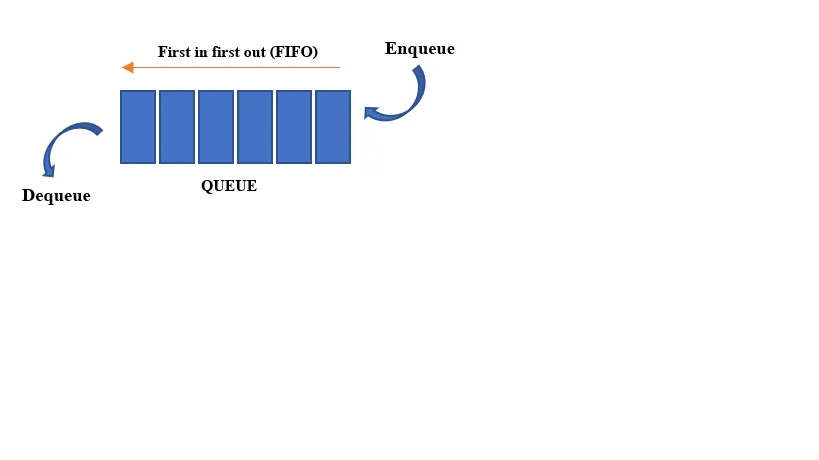
A queue is a FIFO (First In First Out — the element placed at first can be accessed at first) structure which can be commonly found in many programming languages.
1. Queue operations
First In First Out (FIFO) Queues are fundamental to computer science. Here are the key operations associated with queues:
- Enqueue: The enqueue operation puts an element into the end of the queue. It is like standing in a line where whoever is the last to stand in is the first to be served. For example, if several documents are sent to some printer (placed in the queue of documents to be printed), they will be printed in the queue it was sent.
- Dequeue: The deque operation takes off the element from the front of the queue. It’s like being in the bakery counter where the order to the first customer in line is given first. Thus, consider a task scheduler, in which oldest task is processed first.
- Peek: The peek operation lets you examine the element at the top of the queue, but not remove it. This is just useful for seeing the next item in a queue without changing the queue.
- IsEmpty: The operation isEmpty allows us to figure out if there are any elements to process.
- Size: The queue size operation returns the number of queue elements. This is good for knowing how big the queue can get, so it doesn’t overflow.
2. Complexity analysis
To optimize performance in data structures it is crucial to understand how queues are complex. Queues generally provide efficient operations but the constant time nature is a question of implementation.
- Time Complexity: Usually, queue operations take the time complexity of O(1), i.e. it takes constant time to execute. All of this holds true for it’s operations like enqueue (adds an element), dequeue (removes an element), peek (looks at the front element) for using an array or linked list implementation.
- Space Complexity: The underlying data structure defines the space complexity of a queue. For example, the space complexity for an array based queue is O(N) (where N is the number of elements in the queue). For similar reasons, a linked list based queue has a space complexity of O(N).
- Practical Examples: Imagine that a web server has requests queued at some point. Queue operations are performed in an efficient way that makes it easy for requests will be processed quickly thus reducing the wait time and improving the user experience.
- Supporting Data: The importance of optimized data structures is coming out in recent reports. For example, OpenGenus IQ’s study on the time and space complexity of queue operations.
3. Queues applications
Data structures discuss queues as an efficient approach to solve real world problems. Following First In First Out (FIFO), they work best when order matters.
- Operating Systems: In operating systems, tasks are managed by queues. The processes wait in a queue for execution to be able to share the CPU time fairly. This method avoids overload of the system and the best performance.
- Network Traffic Control: Data packets are managed by network routers with queues. During high traffic queues temporarily store data if data can’t be processed and prevent packet loss. This ensures no breaking data flow and thus helps in reducing latency.
- Print Queue Management: Queueing is used by printers to manage print jobs. A point in favor of the method is that documents are rendered in an order of submission, while engaging in a fair and productive way. The jobs processed by this system don’t conflict and get processed on time.
- Event Handling: Queues are prevalent in asynchronous event driven programming. It has a queue of events that sees them executed in order as they come. Responsive applications need this method.
- Real-Time Systems: Queues are used by real time systems, like air traffic control, for task scheduling. Critical tasks that if not processed first can disrupt system stability or safety are processed first via queues.
- Customer Service: Service requests are queued in the customer service systems. All calls or messages are resolved on first come first serve base. No one is treated differently, everyone is treated fairly and almost efficiently.
Conclusion
Understanding stacks and queues in data structures is crucial for efficient software and web development. We’ve been able to use these data structures for many projects, and achieving great results. These structures effectively help in task and data management so as to ensure smooth and flawless performance.
Also published on

Share post on








Related Articles



What Is the Internet of Behaviors (IoB)? Examples, How It Works
What Is the Internet of Behaviors (IoB)? Examples, How It Works Published December 15, 2025
Top 10 Retrieval-Augmented Generation (RAG) Examples By Industry
Top 10 Retrieval-Augmented Generation (RAG) Examples By Industry Published August 19, 2025
RAG Pipeline Diagram: A Beginner’s Guide to How It Works
RAG Pipeline Diagram: A Beginner’s Guide to How It Works Published August 18, 2025Read more topics



AI Development
AI Development

Automation Technologies & Solutions
Automation Technologies & Solutions
Back-End Development
Back-End Development

Best Companies
Best Companies

Blockchain Technology and Applications
Blockchain Technology and Applications

Business Analyst Role & Skills
Business Analyst Role & Skills

Chatbot Development
Chatbot Development

Cloud Technology Revolution
Cloud Technology Revolution

CMS Platforms Development
CMS Platforms Development

Cyber Security
Cyber Security