

















Agile frameworks like SCRUM or Kanban become increasingly popular in organizations, not only for IT teams but also for other departments. When learning about Agile, you may encounter the concept “epic.” So, what is an epic in Agile, exactly? Keep reading this guide, and you’ll find the answer!
In this article, we’ll also provide a detailed guide to help you write effective epics. Plus, you also learn about the best writing practices and success metrics to evaluate whether an epic is effective.
What Is An Epic In Agile?
In Agile, an epic is simply a large body of work that your team can’t complete within a single sprint. In other words, an epic covers a broad objective or product capability, but it’s basically too big to build all at once. So your team must break it down into smaller pieces called user stories (or tasks). Over several sprints, the team can plan, develop, and deliver these user stories incrementally until the epic is eventually completed.
For example, imagine your team is developing a new feature for a food delivery app. “Enable online ordering” might be the epic in this case, but building the entire online ordering system is not a single task. Users need to browse restaurants, add items to a cart, choose payment methods, confirm orders, and so on. Each of those becomes a user story or a task your team must complete in different sprints, while the epic ties them all together.
Agile Epic vs User Story: The Key Differences
The definition above already clarified the difference between an Agile epic and a user story. They look similar superficially. But both are different in terms of scope, purpose, and timeline. The table below explains these key differences further:
| Differences | Agile Epic | User Story |
| Scope | Focuses on a large feature or product initiative. If an item is too big for teams to complete within a single sprint, it’s an epic. | Handles one small piece of functionality and feature. |
| Purpose | Helps teams organize large product initiatives and group related work together. | Describes specific user needs (e.g., “add an item to the cart”). |
| Timeline | Often spans across various sprints because it covers multiple related stories that teams must deliver step by step. | Usually small enough to complete within a single sprint. |
How Epics Fit Into The Agile Framework
Epics are commonly used in Agile frameworks like SCRUM and Kanban to organize major product goals. They help teams see the big picture without losing track of the smaller tasks that actually move development forward.
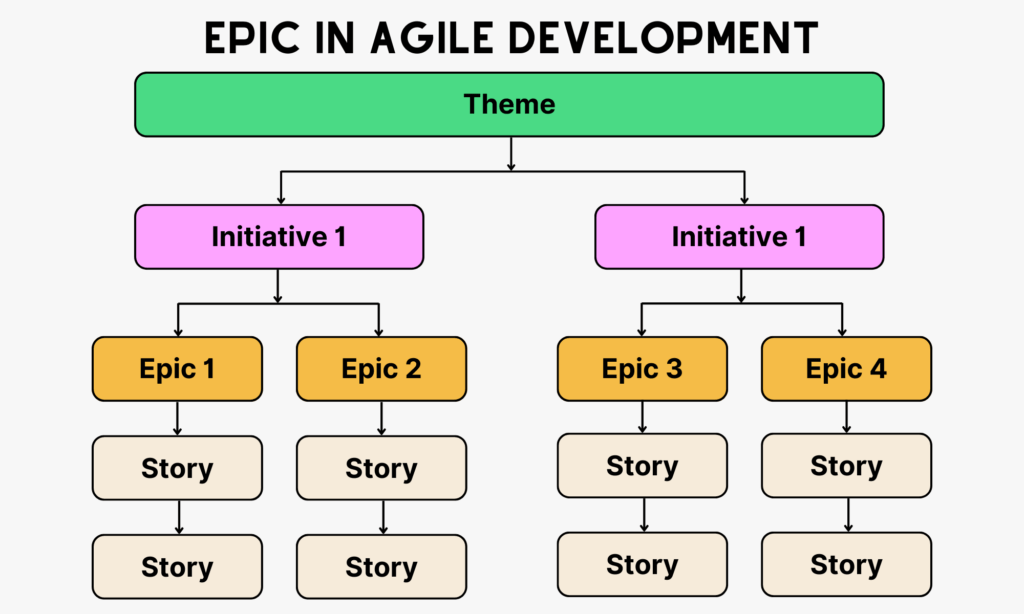
This description pinpoints the position of epics in the Agile work hierarchy: “Theme (Roadmap) → Initiative → Epic → User Story → Task”. Accordingly, during product planning, product managers or product owners define large product goals, which are then organized into epics.
Once teams define an epic, they then break it down into smaller, more manageable user stories that they can build within one sprint. This process is sometimes called “story decomposition” or “epic splitting”. Then, team members choose several stories from the backlog and commit to delivering them in the upcoming sprint. Over time, teams can add or remove user stories from the epic based on user feedback and real demands to push the epic toward completion.
Epics also play a useful role in roadmapping and progress tracking. Because they represent larger initiatives, stakeholders can quickly see how development is progressing toward large product goals. For example, a product roadmap might highlight several active epics that teams plan to deliver over a quarter.
Example Of Epic In Agile

You probably understand the theory behind Agile epics. But you may now wonder: “How does an epic actually work in a real project?” The two examples below will help you answer this question:
Example 1: User Authentication System
Imagine that you’re planning to build a user authentication system. So, the epic for this project is obviously “Developing a secure user login system.”
A secure authentication system covers many layers of functionality, but your team can’t build all of them at once. So, to make the epic more manageable, you decide to break it into smaller user stories that are usually delivered across different sprints as follows:
| User Stories | Specific User Needs |
| User Registration | “As a new user, I want to create an account with my email and password to access the platform.” |
| User Login | “As a registered user, I want to log in securely so that I can access my personal dashboard.” |
| Password Reset | “I forgot my password, so I want to reset it via email to regain access to my account.” |
| Two-Factor Authentication | “I’m aware of cybersecurity, so I want to verify my login with a one-time code to protect my account better.” |
| Session Management | “When I already log in, I want my session to expire after inactivity to avoid unauthorized access.” |
Example 2: E-Commerce Checkout Optimization
In this example, your team wants to optimize the eCommerce checkout to increase conversion rates and streamline the shopping experience. Based on this goal, the epic is “Improving the online checkout process.”
But your team can’t complete this epic within a single sprint. So, you get it split into the following user stories:
| User Stories | Specific User Needs |
| Guest Checkout Option | “I want to check out without creating an account so that I can place my order faster.” |
| Simplified Checkout Form | “I don’t want to waste time filling in too many details during checkout, so that I can complete my purchase faster.” |
| Multiple Payment Methods | “As a shopper, I want to choose between credit cards, digital wallets, or other payment options.” |
| Order Summary Page | “I want to review my order details before payment so that I can confirm everything is correct.” |
| Checkout Progress Indicator | “I want to see my progress through the checkout steps. This helps me know how close I am to finishing.” |
How To Write An Epic In Agile
You can see how epics work in real projects. But is creating an epic in Agile that easy? The answer is no, especially for new Agile practitioners.
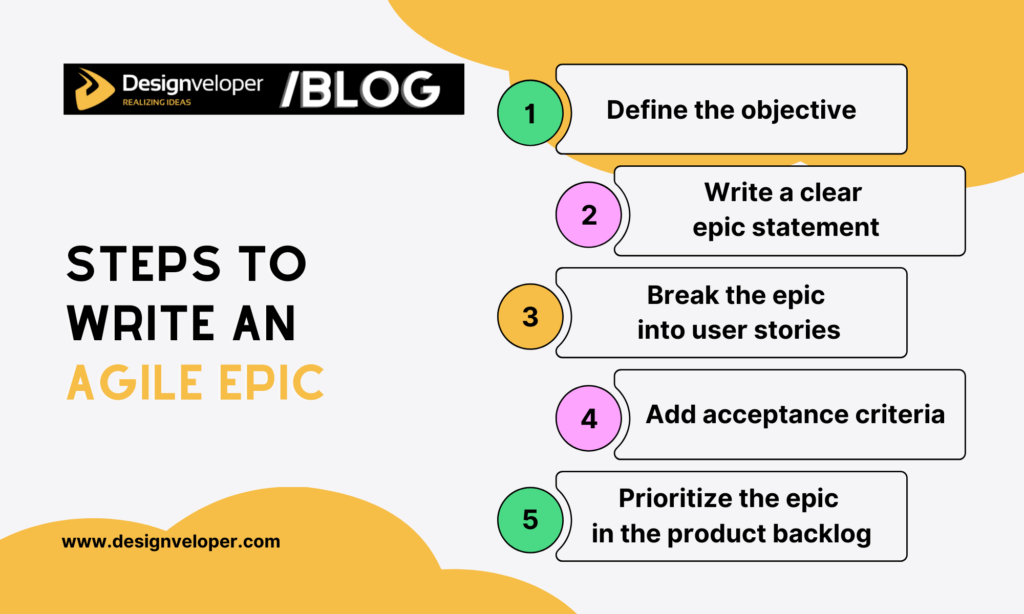
Defining the right epic is crucial, as it somehow shapes the whole roadmap of developing a product. Therefore, follow the steps below to write an epic effectively:
Step 1: Define The Objective
Many teams sometimes jump straight into building features – let’s say login pages, dashboards, and payment flows – without clearly identifying the underlying objective. It’s not a good idea, especially if you’re doing a complex project.
Before writing anything, just pause and ask yourself these guiding questions:
- What user pain point are you addressing?
- What outcome do you expect from solving it?
- How does this support the product’s long-term goals?
The answers help you identify the “why” and provide a clear direction to write the right epic. This starts by identifying either a user problem that needs solving or a business opportunity worth exploring.
For example, real users may abandon their carts during checkout, or maybe the app lacks secure authentication. Those situations naturally lead to potential epics like “Improve the checkout process” or “Implement a secure login system”.
Step 2: Write A Clear Epic Statement
Once your team already has a clear objective, write the epic statement.
The statement should describe the desired outcome, not the technical work required to achieve it. One simple way to do this is by framing the epic around user value or product capability. For example:
- Implement a secure user authentication system
- Improve the online checkout experience
- Enable users to track their delivery status in real time
Notice something about these statements: they’re broad enough for your team to explore different solutions during development.
Step 3: Break The Epic Into User Stories
When your team defines the epic, it’s time to break it down into smaller user stories that the team can complete within individual sprints. As the epic is often too large to complete at once, your team can deliver value incrementally to push the epic toward the large, ultimate goal.
In this step, your team should particularly identify key user interactions or system capabilities related to the epic. Each of these becomes a user story, which represents a small, testable piece of functionality. For example, an authentication epic might produce stories like:
- Register a new account
- Log in with email and password
- Enable two-factor authentication
- Reset forgotten passwords
Step 4: Add Acceptance Criteria
How do you know when the completion of the epic is actually considered done? It all depends on the acceptance criteria. These criteria define the conditions that the epic (or its user stories) must meet to be considered complete. In other words, they’re a shared checklist that aligns everyone on expectations.
For instance, an authentication epic might include the following acceptance criteria:
- Users can create accounts securely
- Passwords are encrypted and stored safely
- Failed login attempts trigger security protections
- Password reset emails function correctly
Step 5: Prioritize The Epic In the Product Backlog
Finally, your team needs to prioritize epics in the product backlog based on value and timing. Normally, during sprint planning, the team may come up with many epics, but not all of them are equally crucial. Imagine that your team is improving an eCommerce platform. Your backlog may contain the following epics:
- Improve checkout process
- Add product recommendation engine
- Build loyalty reward program
- Redesign user profile page
Each of these epics brings different values. So, high-value epics should be placed at the top of the backlog and scheduled for the upcoming sprints, while others may stay until the right time. To evaluate the importance and prioritization of epics, consider factors like business impact, customer demand, strategic alignment with the product roadmap, and development complexity.
Best Practices For Writing Agile Epics
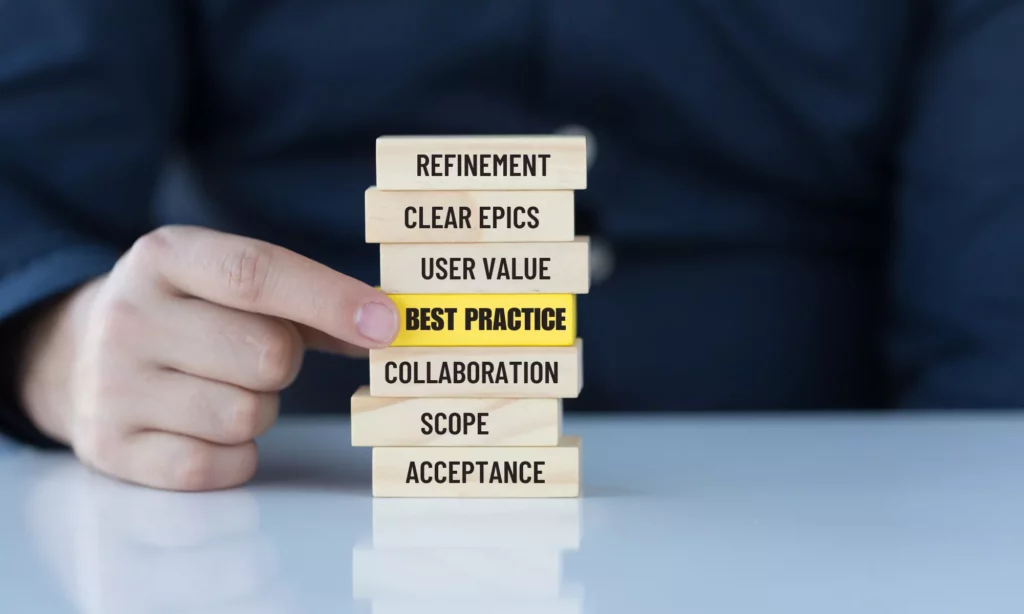
Writing an epic isn’t just about describing a big feature and dropping it into the backlog. Good epics can navigate teams on the right track. So, consider the following tips to write effective epics for Agile workflows:
- Focus on delivering user value
An epic should always deliver a meaningful outcome to users, which often handles their pain points. If an Agile epic only describes technical work without explaining why it matters, it may become difficult for teams to understand its purpose.
Therefore, try framing epics around the value they deliver. For example, instead of writing something vague like “Build new payment infrastructure,” it might be clearer to describe the benefit, such as *“Build faster and more reliable payment.”
- Avoid overly large or vague epics
Epics often represent large initiatives, but that doesn’t mean they should be enormous or unclear. If an epic spans half the product roadmap or becomes impossible to break into stories, it’s probably too big. Similarly, vague epics like “Improve the platform experience” can make your team guess what needs to be done. So, build an epic that is broad and understandable enough.
- Continuously refine epics during backlog grooming
It’s normal if you build imperfect epics for the first time. During backlog refinement (“backlog grooming”) sessions, your team should review epics to make necessary adjustments or to adjust priorities. This ongoing refinement helps align the epic with product goals and real user needs.
- Collaborate with stakeholders and development teams
Writing epics is never a single-person task. Product owners might draft the initial idea, but developers, designers, and stakeholders should provide valuable input to refine the epic. Through discussions, the whole team can discover technical constraints or user insights to write effective epics.
How To Measure The Success Of Agile Epics

You’ve done writing Agile epics. But how can you deliver them successfully? Instead of waiting until the very end of a project to see their success, your team should proactively track progress and outcomes continuously across sprints. Below are several ways to evaluate whether an epic is actually delivering what it promised:
- Tracking progress across sprints
As epics are broken down into user stories, one direct way to measure progress is by tracking how those stories move through successive sprints. Accordingly, your team can monitor story completion, sprint velocity, or epic burndown charts to see whether the work is advancing as expected. If stories tied to the epic consistently move from backlog to “done,” that’s a good sign.
- Measuring delivered value
An epic must deliver value to end-users. So one way to evaluate its success is through the outcomes those tasks produce. Your team can accordingly assess metrics, such as improved user engagement, reduced cart abandonment, faster login times, or increased customer satisfaction.
- Monitoring epic completion metrics
Another practical way to evaluate success is through how efficiently the epic is completed. This involves tracking metrics like the number of completed user stories, remaining work in the epic backlog, or the time it takes for the epic to move from planning to delivery. These metrics help your team identify bottlenecks, modify priorities, or refine the epic when development advances.
Tools And Automation For Managing Agile Epics

For small teams and projects, a spreadsheet or a simple task list can be enough to manage epics. But when projects grow, these tools become ineffective. In large-scale or complex projects, epics may cover many more user stories, which span across several sprints. This time, tracking every epic becomes harder.
That’s why many Agile teams start using project management tools to track epics and backlog items. With these tools, product owners and all team members can see how work is structured, from high-level epics to individual tasks. This saves time and makes epic management effective.
Some popular tools for managing Agile epics include:
Jira is one of the most commonly used tools in Agile development. It allows your team to create epics and link them directly to user stories and tasks. Accordingly, features like epic roadmaps, backlog management, sprint boards, and burndown charts help visualize progress and track tasks more easily.
Azure DevOps provides integrated planning and development tools for Agile teams. Particularly, its hierarchical work item structure lets your team organize work into epics, features, and user stories. The team can also use Kanban boards, sprint dashboards, and analytics reports to monitor epic progress across development cycles.
ClickUp creates a flexible workspace for managing projects and product development. It enables your team to group tasks into epics, as well as visualize them through roadmaps, timeline views, and sprint boards. Besides, with built-in workflow automation, you can automate repetitive updates.
FAQs About Agile Epics
How Should An Epic Be Written?
An Agile epic should describe a large product objective or capability. The description should focus on the outcome rather than the technical tasks required to achieve it. Besides, it should be broad enough to cover various related user stories but still clear enough for the team to understand the goal.
How Long Should An Agile Epic Last?
An Agile epic should last one to three months, equivalent to 2-6 sprints. Having said that, the exact duration can vary depending on the size and complexity of the initiative.
Can an Epic Span Multiple Sprints?
Yes. In fact, epics inherently span multiple sprints because they’re too large to be completed within a single sprint.
During each sprint, your team chooses a few stories related to the epic and implements them incrementally. Over several sprints, these completed stories gradually move the epic toward completion.
Who Writes Epics in Agile Teams?
Epics are often written by product owners or project managers, as they are responsible for defining product goals and prioritizing work in the backlog. They often collaborate with developers, designers, and other stakeholders to write epics. This ensures that the epic is clear, feasible, and aligned with both user needs and business goals.
How Many User Stories Should an Epic Contain?
There is no fixed number of user stories that an epic must contain. The number depends on the complexity of the feature or initiative being developed. Some smaller epics might include only five to ten user stories, while larger ones may involve dozens.
Also published on

Share post on










Read more topics












You may also like



What Is an Epic in Agile? How to Write It (Guide & Examples)
What Is an Epic in Agile? How to Write It (Guide & Examples) Published March 16, 2026
What Is an Agile Framework? Definition, Types and Examples
What Is an Agile Framework? Definition, Types and Examples Published March 16, 2026
Agile and DevOps: Differences and How They Interrelate
Agile and DevOps: Differences and How They Interrelate Published March 16, 2026