













Top 18 Agentic AI Companies to Watch in 2026

If you are still clarifying what agentic AI is, the short version is that it pushes enterprise AI beyond chatbots and copilots. Instead of only generating responses, these systems can plan tasks, call tools, retrieve data, reason across multiple steps, and complete workflows with limited human input.
The top agentic AI companies in 2026 include OpenAI, Anthropic, Microsoft, Google Cloud, AWS, Salesforce, IBM, SAP, ServiceNow, Palantir, Sierra, Decagon, Cognition, Harvey, Glean, Kore.ai, and Genesys. Some operate at the foundation model layer, while others focus on enterprise software, customer experience, internal workflow automation, or specialized vertical use cases.
This guide compares the leading agentic AI companies by category, strengths, and enterprise fit so you can build a more practical shortlist.
Why Agentic AI Companies Matter More in 2026
That market shift is happening quickly. Mordor Intelligence estimates the global agentic AI market will grow from USD 9.89 billion in 2026 to USD 57.42 billion by 2031, a projected 42.14% CAGR, with large enterprises leading adoption and multi-agent systems already accounting for more than half of the market in 2025.
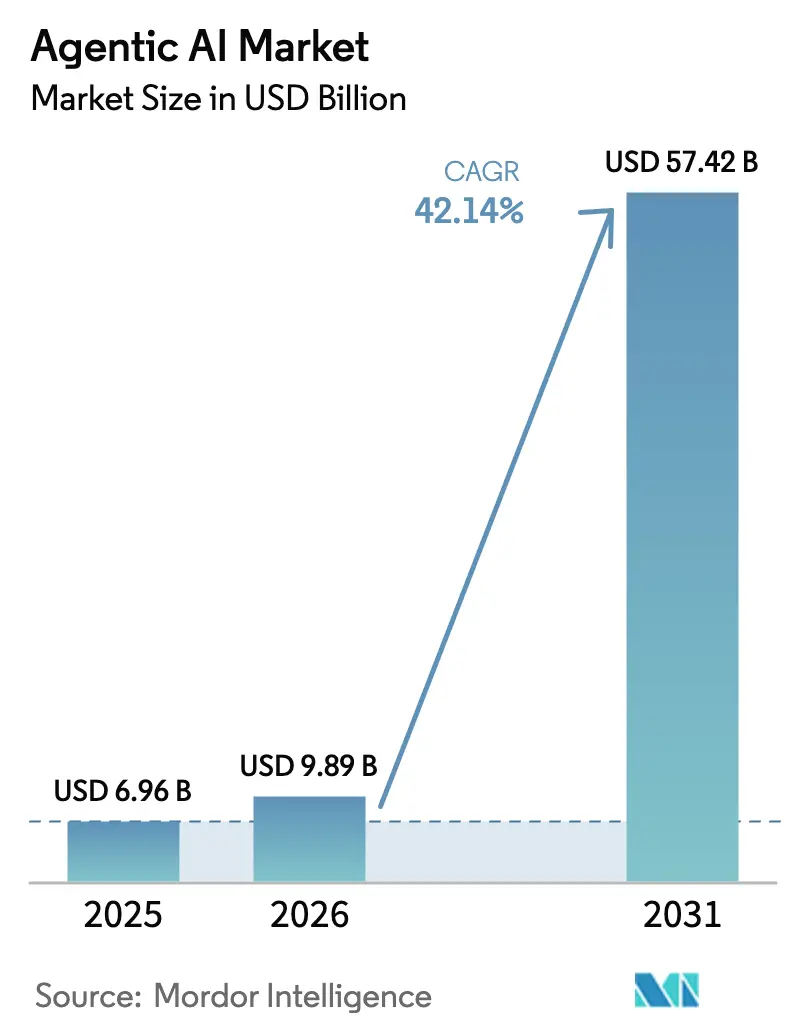
The agentic AI market is evolving because enterprises are no longer satisfied with systems that only generate content on demand. They increasingly want software that can interpret a goal, break it into steps, use tools, interact with business systems, and complete work with measurable outcomes.
That shift changes how buyers evaluate AI vendors. Model quality still matters, but it is no longer enough on its own. In production environments, the real differentiators are state management, orchestration, memory, observability, governance, and integration depth. In other words, the market is moving away from prompt quality alone and toward execution quality.
This is also why the category now spans several layers. Some companies provide the core reasoning engine. Others embed agentic behavior directly into CRM, ERP, IT, or customer support systems. A third group wins by going deep into one workflow category, such as legal work, software engineering, enterprise search, or contact center operations.
Explore more: Agentic AI Architecture: Components, Workflow, Design Patterns
Quick Comparison: Top Agentic AI Companies in 2026
| Company | Category | Latest Valuation / Market Cap | Revenue | Key Agentic Strength |
|---|---|---|---|---|
| OpenAI | Foundation model company | ~$730B private valuation | On pace for ~$25B revenue in 2026 | Strong reasoning, tool calling, developer ecosystem |
| Anthropic | Foundation model company | ~$380B private valuation | >$9B revenue run rate by early 2026; some reports put 2026 pace far higher | Reliable reasoning and governance focus |
| Google Cloud | Cloud AI company | Alphabet market cap roughly $4T+ | Alphabet FY2025 revenue: $403B; Google Cloud run rate exceeded $50B in 2025 | Search, multimodal AI, enterprise infrastructure |
| AWS | Cloud AI company | Amazon market cap roughly $2.9T | Amazon FY2025 revenue: $716.9B; AWS annualized revenue run rate: ~$142B exiting Q4 2025 | Flexible cloud-native deployment |
| Mistral AI | Model company | ~$14B private valuation | >$400M ARR reported entering 2026; targeting much higher 2026 scale | Open-weight and deployment control |
| Microsoft | Enterprise software company | Market cap roughly $3.1T | FY2025 revenue: $281.7B | Deep workplace integration |
| Salesforce | Enterprise software company | Market cap roughly $160B | FY2026 revenue: ~$41.5B | Customer-data-grounded agents |
| IBM | Enterprise AI company | Market cap roughly $210B | FY2025 revenue: $67.5B | Governance and hybrid-cloud support |
| SAP | Enterprise software company | Market cap roughly $200B | FY2025 revenue: €36.8B | Process-layer integration |
| ServiceNow | Workflow software company | Market cap roughly $90B-$95B | FY2025 revenue: $13.3B | Workflow-native automation |
| Palantir | Operational AI company | Market cap roughly $325B | FY2025 revenue: $4.5B | Data-heavy operational decision support |
| Sierra | CX agent company | $15B+ private valuation | >$150M annualized revenue run rate reported in 2026 | Omnichannel customer automation |
| Decagon | CX agent company | ~$4.5B private valuation | Revenue not fully disclosed; external estimates remain relatively early-stage | Workflow logic and service execution |
| Cognition | Engineering agent company | ~$10.2B private valuation | Revenue not publicly disclosed | Long-running coding agents |
| Harvey | Legal AI company | ~$8B private valuation | Revenue not publicly disclosed | Domain-specific legal reasoning |
| Glean | Enterprise search company | Last widely reported private valuation: $4.6B | ARR reached $100M+ publicly; outside estimates place it materially higher by 2026 | Permission-aware retrieval |
| Kore.ai | Enterprise automation company | Private; latest valuation not widely disclosed | Revenue not publicly disclosed | Orchestration plus enterprise connectors |
| Genesys | CX platform company | Private; valuation not recently updated in company disclosures | FY2026 revenue: nearly $3B; Genesys Cloud ARR: nearly $2.6B | Agentic service automation |
Note: Public-company figures use recent market-cap snapshots and latest reported annual results. Private-company figures use the latest disclosed valuation, ARR, or revenue run-rate available as of May 2026, so some numbers are approximate rather than audited.
Take a look at: Top AI Agent Companies: Industry Leaders to Watch
What Makes a Company an Agentic AI Company?
Not every AI company qualifies as an agentic AI company.
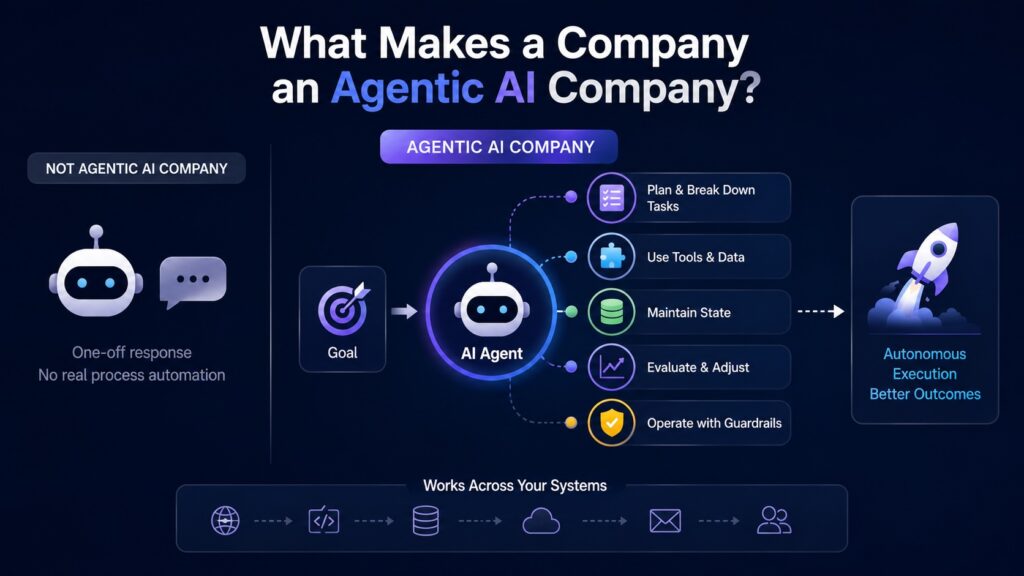
A true agentic AI company builds products or platforms that allow AI systems to pursue goals across multiple steps rather than only generating one-off responses. In practice, that usually means the system can:
- break a task into smaller actions
- call tools, APIs, or databases
- maintain state or memory across a workflow
- evaluate intermediate outputs and adjust its plan
- operate with guardrails, approvals, or governance controls
That distinction matters because buyers searching for agentic AI companies are usually not looking for generic AI vendors. They want products that can automate real business processes with a higher degree of autonomy.
Related reading:
- AI Agents vs Agentic AI: Differences From Execution to Autonomy
- 7 Key Differences Between Agentic AI vs Generative AI (GenAI)
What Enterprises Actually Need From Agentic AI
The most useful agentic AI products do more than produce answers. They help organizations move from manual orchestration to intent-based execution, where humans define goals and guardrails while the system handles more of the operational path.
For that reason, enterprises usually care about five deeper capabilities:
- Stateful execution: Can the system manage long-running, multi-step tasks instead of only responding turn by turn?
- Memory and context continuity: Can it retain relevant context across sessions, users, or channels without forcing people to restate everything?
- Tool and system access: Can it connect safely to CRMs, ERPs, knowledge bases, tickets, messaging tools, and internal databases?
- Governance and auditability: Can teams inspect what the agent did, why it acted, and where approvals or policy checks were applied?
- Operational reliability: Can it recover from errors, validate outputs, and stay useful outside a polished demo?
These requirements explain why many enterprises do not choose vendors based on raw model performance alone. They choose based on how well the product fits real workflows, data boundaries, and risk tolerance.
This one may help:
- Agentic AI in Action: 7 Real Life Use Cases and Examples
- How to Build Agentic AI: Practical Guide with Examples
To keep this list aligned with the keyword agentic AI companies, we focused on product companies that either build agentic AI platforms, embed autonomous workflows into enterprise software, or offer specialized agentic products for real business use cases.
Foundation Model and Core Platform Agentic AI Companies
These companies sit closest to the intelligence layer of the agentic AI stack. They provide the models, APIs, and orchestration capabilities that other software vendors and enterprise teams use to build autonomous systems.
Characteristics
- Large-scale reasoning models with tool-use capabilities
- API-first product design for developers and enterprise teams
- Support for structured outputs, multi-step planning, and model-driven task execution
- Strong influence over how downstream agent products are built
Role in the Ecosystem
Foundation model and core platform companies act as the base layer for the broader agentic AI market. They make it possible for enterprises, SaaS vendors, and product teams to create agents that can reason, retrieve context, call tools, and operate across workflows. In many cases, they are not the final business application. Instead, they enable the rest of the ecosystem to build on top of them.
Advantages
- Broad flexibility across industries and use cases
- Faster experimentation for custom agent development
- Strong developer ecosystems and tooling support
- High leverage for teams building proprietary agent workflows
One reason this group matters so much is that it shapes the baseline capabilities available to the rest of the market. If a foundation vendor improves tool use, structured outputs, long-context reasoning, or multi-step planning, those gains can flow into many downstream products at once.
The companies below are some of the most important players in this group today.
1. OpenAI
OpenAI remains one of the most important agentic AI companies in 2026 because it combines frontier models, tool-use capabilities, and a growing ecosystem for building autonomous workflows.
Best for: Companies building custom AI agents, copilots, and workflow automation products.
Why it stands out: OpenAI offers strong reasoning, structured outputs, tool calling, and developer tooling that make it easier to move from prototype to production.
Typical use cases: Research assistants, support automation, internal copilots, document workflows, and AI-powered operations.
2. Anthropic
Anthropic has become a leading choice for enterprises that want advanced agentic capabilities with a stronger emphasis on safety, reliability, and long-context reasoning.
Best for: Enterprises deploying AI into policy-sensitive or compliance-heavy workflows.
Why it stands out: Anthropic’s safety-first positioning makes it especially attractive for enterprise use cases where control and trust matter.
Typical use cases: Enterprise knowledge assistants, internal decision support, regulated workflows, and policy-grounded automation.
Explore more: Performance Comparison of Claude vs ChatGPT vs Gemini for Coding

3. Google Cloud
Google Cloud is a major agentic AI company because it connects advanced models, enterprise infrastructure, search capabilities, and workflow tooling into one broader platform story.
Best for: Enterprises building multimodal and data-heavy AI systems.
Why it stands out: Its combination of model capability, cloud scale, and search expertise makes it highly relevant for enterprise-grade agentic systems.
Typical use cases: Enterprise search, analytics assistants, multimodal workflows, and customer support augmentation.
4. AWS
AWS is a critical player in agentic AI because many companies need secure, flexible infrastructure for deploying agents in production rather than a single closed application layer.
Best for: Enterprises needing scalable cloud-native infrastructure for internal and operational AI agents.
Why it stands out: AWS gives organizations broad deployment flexibility and strong enterprise infrastructure depth.
Typical use cases: Internal automation, retrieval-based assistants, regulated workflows, and backend process orchestration.
5. Mistral AI
Mistral AI has emerged as an important company for businesses that want more control, open-weight model options, or stronger sovereign AI positioning.
Best for: Teams prioritizing model flexibility, deployment control, or European vendor optionality.
Why it stands out: Mistral offers a serious alternative to larger closed ecosystems while still supporting production AI ambitions.
Typical use cases: Sovereign enterprise AI, private deployments, and custom agent stacks.
Enterprise Software and Workflow Agentic AI Companies
These companies bring agentic AI directly into established business software. Instead of selling raw model access, they embed autonomous workflows into systems enterprises already use for sales, service, collaboration, operations, and internal support.
Characteristics
- Deep integration with existing enterprise systems and workflows
- Strong focus on governance, permissions, and operational control
- Productized agent experiences for business users rather than only developers
- Clear alignment with business functions such as CRM, ITSM, ERP, and employee productivity
Role in the Ecosystem
Enterprise software and workflow agent companies serve as the operational layer where agentic AI becomes useful for day-to-day business execution. They translate model capability into actions inside real systems of record, helping enterprises move from experimentation to process-level adoption.
Advantages
- Easier adoption for enterprises with existing software footprints
- Better access to operational data, workflows, and approval chains
- Stronger enterprise readiness around controls and administration
- Faster time to value for common business use cases
This group is especially important because most large enterprises do not want to assemble every agent workflow from scratch. They prefer products that already sit near core systems, permission models, and operational records, since that shortens the path from pilot to production.
The companies below are leading examples of how this group is bringing agentic AI into real business operations.
6. Microsoft
Microsoft is one of the strongest enterprise agentic AI companies because it can bring agents directly into the workplace software many businesses already rely on.
Best for: Organizations deeply invested in Microsoft 365, Teams, Azure, and enterprise identity systems.
Why it stands out: Microsoft benefits from deep enterprise distribution and strong integration across productivity and collaboration software.
Typical use cases: Employee support, internal automation, knowledge workflows, and IT help desk agents.
7. Salesforce
Salesforce is one of the clearest examples of agentic AI embedded into a business application layer, especially around CRM, service, and revenue operations.
Best for: Sales, service, and account-management teams operating inside CRM-centric environments.
Why it stands out: Salesforce can ground agents directly in customer records, workflows, and business process logic.
Typical use cases: Case resolution, sales assistance, customer support automation, and CRM workflow execution.
8. IBM
IBM remains highly relevant for agentic AI deployments in regulated environments where governance, hybrid-cloud support, and operational control matter more than hype.
Best for: Enterprises in healthcare, banking, government, and other tightly regulated sectors.
Why it stands out: IBM combines enterprise credibility with governance tooling and hybrid deployment flexibility.
Typical use cases: Compliance-aware process automation, institutional workflow orchestration, and hybrid enterprise AI.
9. SAP
SAP deserves a place on a company-first list because it is pushing agentic capabilities into core enterprise process software rather than treating AI as a side feature.
Best for: Large enterprises running finance, supply chain, procurement, and ERP-heavy workflows.
Why it stands out: SAP sits close to the systems where high-value business processes already happen.
Typical use cases: ERP workflow automation, procurement assistance, finance operations, and enterprise process agents.
10. ServiceNow
ServiceNow is increasingly important in agentic AI because its workflow-first foundation makes it well suited for autonomous actions inside enterprise service environments.
Best for: Enterprises focused on IT, HR, and internal service workflow automation.
Why it stands out: ServiceNow already owns many of the structured workflows, approval chains, and service processes where agents can create value.
Typical use cases: IT service management, employee support, ticket resolution, and workflow automation.
11. Palantir
Palantir has become a strong agentic AI company for organizations that need AI tied to operational data, sensitive systems, and high-stakes decision environments.
Best for: Complex enterprise, industrial, public sector, and defense deployments.
Why it stands out: Palantir excels where agents need access to structured operational systems and strong governance.
Typical use cases: Mission operations, industrial workflows, enterprise planning, and decision support.
Specialized Agentic AI Product Companies
These companies focus on narrower but high-value categories where agentic AI can deliver clear business outcomes. Rather than trying to serve every department, they build products for a specific domain such as customer support, software engineering, legal work, or enterprise knowledge retrieval.
Characteristics
- Domain-specific workflows and product design
- Tighter use-case focus than broad enterprise platforms
- Clearer ROI narratives tied to one business function
- Purpose-built features such as memory, orchestration, retrieval, or execution logic for a target domain
Role in the Ecosystem
Specialized agentic AI product companies convert general model intelligence into packaged business outcomes. They are often the layer that proves where agentic AI can create immediate operational value, especially when generic platforms are still too broad or too abstract for a given team.
Advantages
- Stronger fit for targeted use cases
- Faster deployment in one functional area
- Better workflow depth than general-purpose tools
- Easier measurement of business impact
This is often where the clearest ROI stories emerge. When a company focuses on one domain, it can design better memory models, workflows, escalation paths, and success metrics than a broad platform trying to serve every use case at once.
The companies below show where specialized agentic AI products are creating the clearest business value today.
12. Sierra
Sierra is one of the strongest pure-play agentic AI companies in customer experience, with a platform focused on high-scale customer-facing automation.
Best for: Enterprises looking to automate customer interactions across channels.
Why it stands out: Sierra is built around real customer operations rather than generic chatbot experiences.
Typical use cases: Omnichannel support, customer issue resolution, and service workflow automation.
13. Decagon
Decagon is a leading vertical agentic AI company for support teams that need measurable operational outcomes rather than basic conversational AI.
Best for: High-volume support organizations that need stronger resolution and deflection performance.
Why it stands out: Decagon focuses on workflow logic, memory, and customer support execution at enterprise scale.
Typical use cases: Refund handling, support triage, omnichannel service, and transactional support automation.
14. Cognition (Devin)
Cognition stands out because it applies agentic AI directly to software engineering workflows rather than customer support or office productivity.
Best for: Engineering organizations exploring autonomous coding and software task execution.
Why it stands out: Its Devin product helped define the category for long-running software engineering agents.
Typical use cases: Bug fixing, repository analysis, code changes, and engineering workflow support.
15. Harvey
Harvey is one of the clearest examples of a vertical agentic AI company succeeding through domain specialization.
Best for: Legal teams, law firms, and compliance-heavy document workflows.
Why it stands out: Harvey is designed around legal reasoning and professional service workflows rather than generic assistant use cases.
Typical use cases: Contract review, legal research, drafting support, and document analysis.
16. Glean
Glean sits at the intersection of enterprise search and agentic AI, making it highly relevant for internal knowledge workflows.
Best for: Large organizations trying to unify fragmented internal knowledge systems.
Why it stands out: Permission-aware enterprise retrieval is a critical ingredient for useful internal agents.
Typical use cases: Internal assistants, knowledge retrieval, onboarding support, and enterprise search workflows.
17. Kore.ai
Kore.ai remains a strong inclusion because it sells enterprise conversational and workflow automation capabilities as a commercial product for large organizations.
Best for: Enterprises scaling customer and employee experience automation.
Why it stands out: Kore.ai combines orchestration, enterprise connectors, and operational maturity in a way that fits large business environments.
Typical use cases: Contact center automation, employee assistance, and cross-department workflow execution.
18. Genesys
Genesys belongs on a company-focused list because it is translating agentic AI into customer experience automation for enterprises with mature support operations.
Best for: Enterprise contact centers and customer experience teams.
Why it stands out: Genesys has the operational footprint and CX depth to make agentic AI commercially relevant in service environments.
Typical use cases: Virtual agents, service automation, call deflection, and end-to-end CX workflows.
How to Evaluate Agentic AI Companies Beyond the Demo
Many agentic AI products look impressive in controlled demos. The harder question is whether they remain reliable when they are connected to real systems, incomplete data, long-running workflows, and higher-stakes business processes.
When comparing vendors, it helps to evaluate them across a more practical framework:
- Workflow depth
Some products are best at lightweight assistance. Others can manage more complex workflows with branching logic, approvals, and multi-step execution. Buyers should look closely at how much real process complexity a vendor can handle before human intervention becomes constant again.
- Memory and state management
A major divide in the market is between systems that feel stateless and systems that preserve useful context over time. Products with stronger memory design can support richer customer journeys, internal workflows, and cross-channel continuity.
- Governance and compliance readiness
As agentic AI gets closer to regulated workflows and customer-facing actions, governance becomes a buying requirement rather than a nice-to-have. Enterprises should assess approval controls, logging, policy checks, role-based access, and how easily teams can audit agent actions.
- Proximity to the end user
Not every workflow carries the same risk. Background automation in logistics or internal operations is different from direct customer-facing execution. Buyers should evaluate whether a vendor is better suited to background, mediated, or direct interaction models, and whether the product includes the right safeguards for each.
- Deployment maturity
The strongest vendors usually show more than model capability. They demonstrate error handling, observability, fallback logic, workflow diagnostics, and a clear path for scaling from pilot to sustained use.

Further reading:
FAQs about Agentic AI Companies
What is an agentic AI company?
An agentic AI company builds products or platforms that let AI systems plan, act, use tools, and complete multi-step tasks with some degree of autonomy. Unlike basic generative AI vendors, these companies focus on workflow execution rather than one-off content generation alone.
Which are the best agentic AI companies for enterprises?
The best enterprise-focused agentic AI companies in 2026 include Microsoft, Salesforce, IBM, SAP, ServiceNow, AWS, Google Cloud, Sierra, Decagon, Glean, and Kore.ai. The right choice depends on whether you need internal workflow automation, CRM-native execution, customer support agents, or regulated deployment controls.
Are OpenAI and Anthropic agentic AI companies?
Yes. Both OpenAI and Anthropic qualify because they provide the reasoning models, APIs, and supporting capabilities used to build autonomous, tool-using systems. They are especially important at the foundation model layer of the agentic AI market.
What is the difference between an agentic AI company and a generative AI company?
A generative AI company may focus mainly on producing text, images, code, or other outputs in response to prompts. An agentic AI company goes further by enabling systems to plan actions, use tools, interact with software, and complete workflows with greater autonomy.
How do I choose an agentic AI vendor?
Start with workflow fit, integration depth, governance, model flexibility, and deployment maturity. The best-looking demo is not always the best production choice, especially if the platform lacks observability, approval controls, or strong integration into your business systems.
Build Agentic AI Software With Designveloper
If you are evaluating whether to build, buy, or customize an agentic AI solution, Designveloper can help you move from experimentation to implementation. Our team builds AI-powered software, workflow automation systems, and custom digital products tailored to real business operations.
Whether you need an internal AI assistant, a customer-facing agent workflow, or a domain-specific automation product, we can help you define the right architecture and delivery path.
Contact Designveloper to discuss your agentic AI project.
Conclusion
The best agentic AI companies are not all competing in the same lane. Some build the reasoning layer that powers autonomous systems. Others turn those capabilities into enterprise workflow products, customer support platforms, or specialized vertical applications.
The deeper market shift is that agentic AI is moving from prompt-driven experimentation to execution-driven software. That changes the buying criteria. The real winners will not be defined only by model intelligence, but by their ability to manage state, memory, approvals, integrations, observability, and trust at production scale.
That is why the smartest way to evaluate this market is not to ask which company is “best” in the abstract. It is to ask which company is best for your workflow, data environment, governance needs, deployment constraints, and acceptable risk level.
If your team is exploring agentic AI for a real business use case, build your shortlist around those factors rather than brand recognition alone.
Recommended for you:
Also published on

Share post on










Related Articles


AI Chatbot Development: A Step-By-Step Guide
AI Chatbot Development: A Step-By-Step Guide Published July 15, 2026
Claude Vs ChatGPT Vs Gemini For Coding: Which AI Fits Your Workflow?
Claude Vs ChatGPT Vs Gemini For Coding: Which AI Fits Your Workflow? Published July 06, 2026
12 vLLM Alternatives for Efficient and Scalable LLM Inference
12 vLLM Alternatives for Efficient and Scalable LLM Inference Published July 06, 2026