














Machine Learning Vs AI: What’s The Difference?

The machine learning vs AI distinction is simple: AI is the broader category, and machine learning is one way to build AI systems. The practical question is not which category is better, but whether the task needs fixed rules, learned patterns, generated content, or a combination of these methods.
The distinction matters because it changes what you need to build, what data you need, and what kind of output you should expect. A fixed rule may be enough when the requirement is stable and predictable. Machine learning fits problems where historical data reveals patterns that are difficult to express as rules. Generative AI is a better fit when the system must create new text, images, audio, or code.
AI Is The Broader Field, While Machine Learning Is One Approach
AI covers the overall intelligent capability, while machine learning is one method used to build that capability. Google Cloud’s AI versus machine learning explanation describes the same parent-child relationship. That makes ML one method inside the wider AI toolbox, not a competing field.
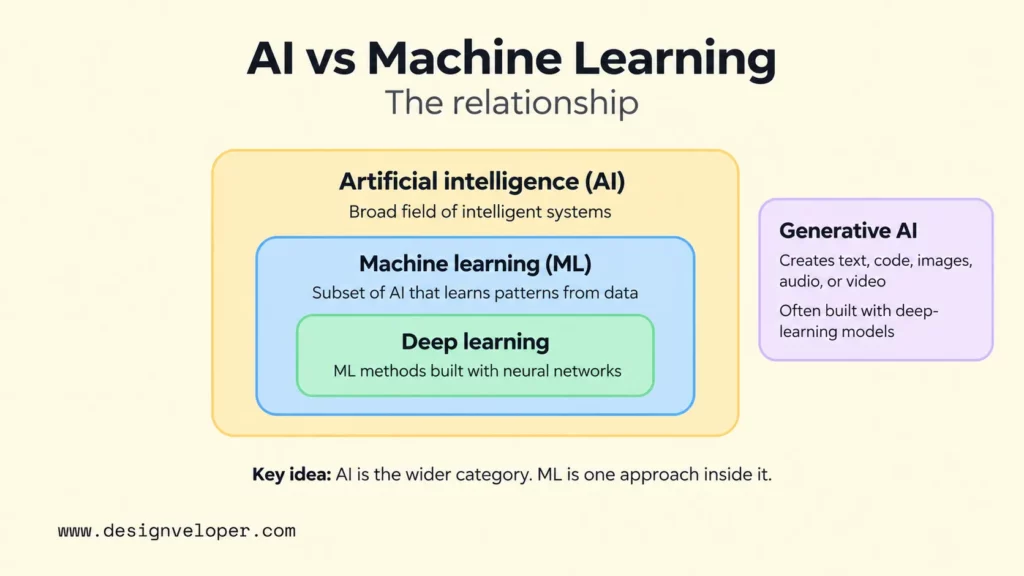
This relationship explains why the terms often overlap in products. A customer-support assistant can be called an AI system because it understands requests and helps complete a task. Inside that system, a machine-learning model may classify the request, a language model may draft a reply, and fixed business rules may decide when a human must approve the result. AI describes the whole intelligent function; ML describes a learning-based component or method.
| Dimension | Artificial intelligence | Machine learning |
|---|---|---|
| Scope | Broad field covering systems that perform intelligent tasks. | Subset of AI focused on learning patterns from data. |
| Main goal | Perform or support tasks such as reasoning, planning, recognition, interaction, or decision-making. | Build a model that generalizes learned patterns to new inputs. |
| How decisions are made | May use rules, search, optimization, planning, trained models, or combinations of these methods. | Uses a fitted model whose parameters or structure reflect patterns learned from data or feedback. |
| Dependence on data | Varies by approach; some rule-based AI does not require model training. | Requires training data, examples, observations, or feedback appropriate to the learning method. |
| Typical outputs | Actions, plans, decisions, recommendations, conversations, or generated content. | Predictions, classifications, scores, clusters, rankings, or learned representations. |
| Common examples | Expert systems, planning systems, AI assistants, robotics, and AI applications that combine several methods. | Fraud scoring, recommendation models, demand forecasts, image classifiers, and speech models. |
The table simplifies the relationship for comparison. In practice, many AI applications combine machine-learning models with rules, interfaces, permissions, and human review.
Machine Learning Vs AI: The Key Differences
Scope And Purpose
The simplest difference is purpose versus method. AI is defined by the intelligent task the overall system is meant to perform. Machine learning is defined by the fact that a model learns patterns from data rather than having every decision rule written directly by a programmer.
That means an AI project can include ML without being only an ML project. A product-recommendation feature, for example, may use an ML model to rank items. The AI application still needs product data, business constraints, user controls, and software that turns the ranking into a usable experience.
Rules, Algorithms, And Learning From Data
AI can follow explicit rules, while machine learning derives useful decision behavior from data. IBM’s reasoning in AI overview describes rule-based expert systems that use if-then rules. A simple example is an expert system that routes a loan application to manual review when a known policy condition is met. The system can apply encoded knowledge without training a predictive model.
Machine learning is useful when the decision boundary is too complex to express as a stable set of rules. Instead of writing thousands of conditions for suspicious transactions, a team can train a model on relevant historical signals and known outcomes. The model then estimates whether a new transaction resembles patterns associated with fraud. Rules can still sit around that score to block, approve, or escalate cases.
Training And Data Requirements
An AI system does not always need model training, but a machine-learning model does. Training means fitting or updating model parameters from data or feedback. A company can also use a pretrained model through an API, so it may not train the model itself even though the model is still the result of machine learning.
For teams building their own model, useful data matters more than collecting data without a clear target. The data must represent the task, and the team needs a way to evaluate whether the model works on new cases. Our guide to training an AI model starts with the same decision: define the task and evidence for success before deciding whether training is necessary.
Predictions, Decisions, And Generated Content
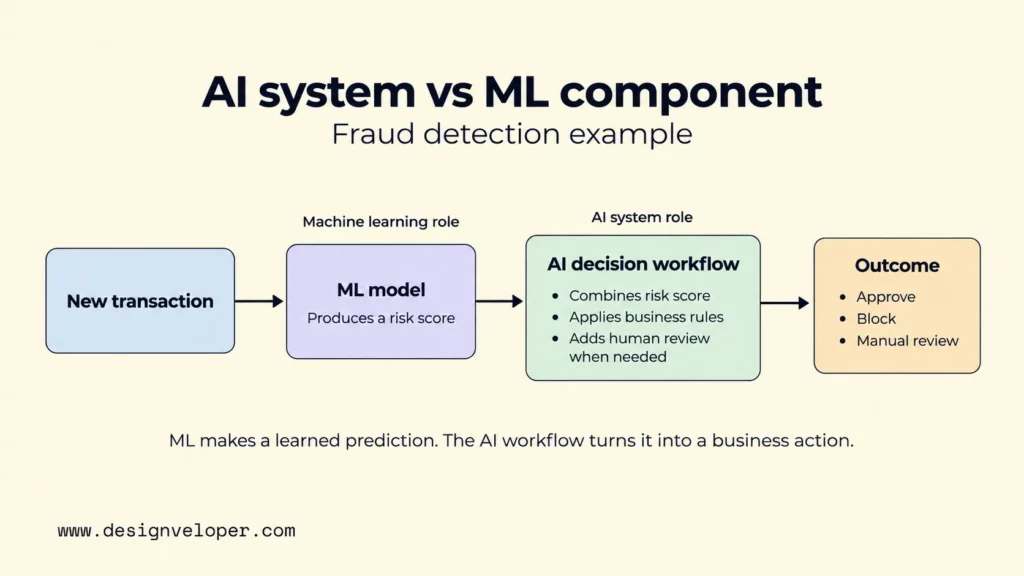
Machine-learning models usually produce learned estimates or representations, while an AI application turns one or more model outputs into something useful for a person or workflow. A fraud model may output a risk score. The surrounding AI-enabled workflow can combine that score with business rules, account context, and a reviewer before deciding what happens to the transaction.
Generated content adds another layer. A generative model predicts and constructs new output such as text, code, images, or audio from patterns learned during training. The broader AI product determines how prompts are formed, what context the model receives, which tools it can use, and when the output needs verification.
AI And Machine Learning In Real-World Applications
The clearest way to compare AI vs machine learning is to look at the same business problem at two levels. AI describes the end-to-end capability or workflow. Machine learning describes the part that learns from examples, signals, or feedback.
| Scenario | AI system role | Machine-learning role |
|---|---|---|
| Customer-support routing | Understands a request, applies service rules, routes the ticket, and may draft a response. | Classifies intent, topic, sentiment, or urgency from historical examples. |
| Fraud or anomaly detection | Combines risk signals, policies, alerts, and human review into a decision workflow. | Learns patterns associated with normal or suspicious behavior and produces a score or classification. |
| Product recommendations | Chooses how personalized suggestions appear and applies availability or business constraints. | Learns affinities from behavior, item features, or similar users and ranks likely matches. |
| Voice assistants and chatbots | Manages conversation, retrieves information, calls tools, and returns an answer or action. | Powers tasks such as speech recognition, language understanding, ranking, and response generation. |
| Image recognition | Uses recognized objects or visual features to support a task such as quality control or document processing. | Trains a vision model to classify, detect, segment, or represent visual content. |
| Content generation | Defines the user workflow, context, permissions, review process, and downstream action. | Uses a generative model, usually based on deep learning, to create or transform content. |
Fraud detection shows why the two labels should not be treated as substitutes. A model can identify patterns, while a production fraud workflow may also need thresholds, case handling, feedback, and auditability. Our guide to fraud detection with machine learning goes deeper into the model-building side of that workflow.
Rule-based AI also remains useful when knowledge can be expressed explicitly. An expert system can apply predefined eligibility or troubleshooting rules without learning from historical data. That is enough to show that not every AI system must use machine learning, even though learning-based methods power many current AI products.
Where Deep Learning And Generative AI Fit
Deep learning sits inside machine learning, which sits inside AI: AI → machine learning → deep learning. IBM’s AI, machine learning, and deep learning comparison describes the same hierarchy. Deep learning uses multi-layer neural networks to learn complex patterns and is especially important for language, vision, speech, and other high-dimensional data.
If you need the technical relationship in more detail, our guide to what deep learning is explains how neural networks fit under ML. The key point for this comparison is that deep learning is a type of machine learning, not a separate alternative to AI.
Current generative AI systems commonly rely on deep-learning models. However, generative AI is not interchangeable with machine learning as a whole. Machine learning also includes non-generative tasks such as classification, forecasting, anomaly detection, and ranking.
Generative AI is better understood by what it produces. It creates or transforms content such as text, code, images, audio, or video. Our guide to what generative AI is covers the output-focused category and its business uses. The relationship is easier to remember this way. ML describes how a model learns. Deep learning describes a family of ML methods. Generative AI describes systems designed to create new output.
Choosing The Right Approach For A Product Or Workflow
Choose the approach from the problem, not from the label “AI.” Start with the output you need. Then check how predictable the rules are, what data exists, and what happens if the system is wrong. That usually leads to one of four practical choices.
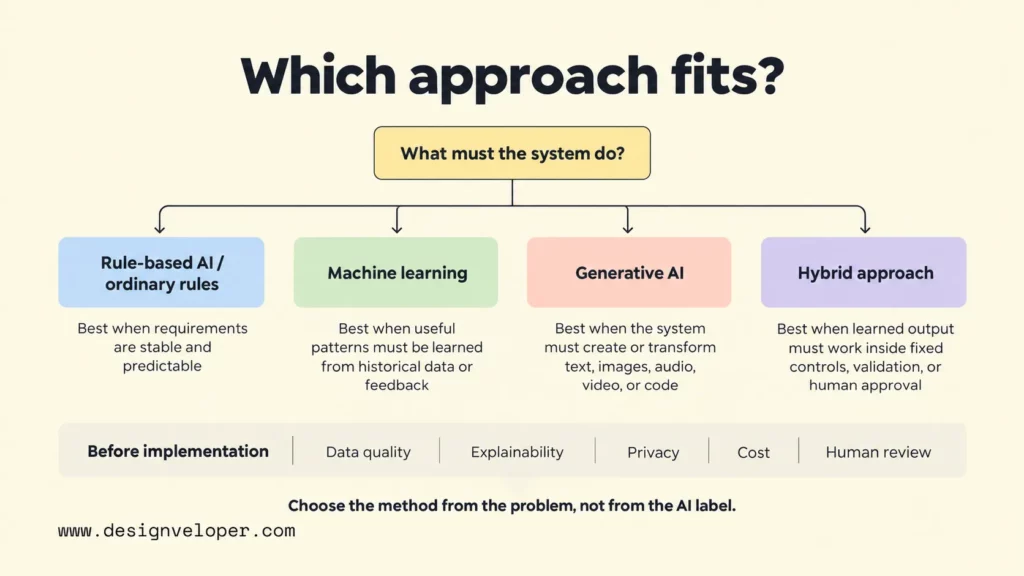
- Use ordinary rules or rule-based AI when requirements are stable and predictable. A deterministic rule is easier to test and explain when the same input should always lead to the same action.
- Use machine learning when useful patterns must be learned from historical data or feedback. This fits prediction, classification, ranking, anomaly detection, and other tasks where hard-coded rules become brittle or incomplete.
- Use generative AI when the system must create or transform text, images, audio, video, or code. Add grounding, evaluation, and review when incorrect output can create business or user harm.
- Use a hybrid when the workflow needs both flexible models and fixed controls. A common pattern is ML or generative output inside deterministic permissions, thresholds, validation, and human approval.
Before implementation, check data quality, explainability, privacy, cost, latency, and the level of human review the workflow needs. The best technical method can still be the wrong product choice if the organization cannot supply reliable data, explain high-impact decisions, protect sensitive information, or afford the operating cost.
A useful implementation checkpoint is to separate what should stay deterministic from what should come from a learned model. Also mark where people must review the result. That boundary makes later architecture and evaluation decisions much clearer.
FAQs About Machine Learning Vs AI
Are Machine Learning And AI The Same?
No. Machine learning is a subset of artificial intelligence. AI covers the broader goal of systems performing intelligent tasks, while ML specifically uses algorithms and data to learn patterns that can be applied to new inputs.
Is ChatGPT AI Or Machine Learning?
ChatGPT is an AI service powered by machine-learning models. “AI” describes the product and capability; machine learning describes how the underlying models learn patterns and generate outputs. OpenAI’s explanation of how ChatGPT and its foundation models are developed describes both levels.
Should I Learn AI Or Machine Learning First?
Start with the core AI concepts that explain rules, search, machine learning, and generative systems. Then study machine learning in more depth if you want to build or evaluate learning-based models. This order gives you the broader map before you specialize in model training and evaluation. If you want a coding-first route after that, our guide to AI with Python maps common AI paths to practical projects.
If your goal is product management or business adoption rather than model engineering, you do not need to master every ML algorithm first. Learn how to frame the task, judge data quality, understand model limits, measure output quality, and decide where human review belongs.
Which AI Systems Do Not Use Machine Learning?
Rule-based expert systems are the clearest example. They use human-written knowledge and if-then logic instead of learning a predictive model from training data. Search, planning, and symbolic reasoning systems can also be built without ML. In practice, many modern AI products are hybrid systems that combine learned models with deterministic rules and software components.
If your team needs help turning the chosen approach into software, our AI development services can support AI software development, generative AI, and chatbot integration. Start by bringing three boundaries into the discussion: what must stay deterministic, what can come from a learned model, and where people must review the result.
Also published on

Share post on









Related Articles


AI Chatbot Integration: A Practical Guide to Connecting Your Systems
AI Chatbot Integration: A Practical Guide to Connecting Your Systems Published September 29, 2026
How To Build A RAG Chatbot: Steps, Code & Best Practices
How To Build A RAG Chatbot: Steps, Code & Best Practices Published September 29, 2026
What Is An LLM Agent? How It Works, Architecture, And Examples
What Is An LLM Agent? How It Works, Architecture, And Examples Published September 29, 2026