















IoT Firmware Development: Everything You Need to Know in 2026
April 09, 2025

Looking at your smartwatch or smart thermostat, have you ever wondered why it’s that “intelligent”? How can the device collect changes (e.g., activity levels or temperature) through sensors and send the data to its face display or certain smartphone applications (e.g., iPhone’s Heart)? Is that because of the hardware behind the scenes? No, it’s all thanks to firmware, an integral part of the IoT system we often overlook. So, what exactly is IoT firmware, and how does the IoT firmware development process take place? Let’s find out the answers to these questions in today’s article!
Understanding IoT Firmware
In the first section, we’ll explain the definition of IoT firmware, its crucial role in today’s context, and its visible difference from software.
What is IoT Firmware?
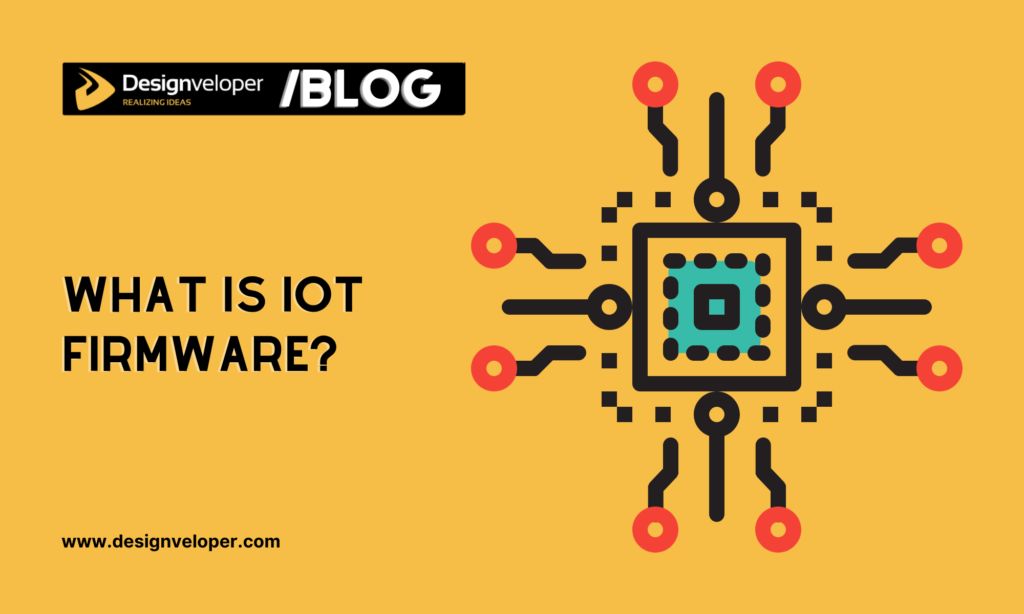
Every IoT device has the specialized software attached to its hardware to command what the hardware needs to do. This software is actually the code or a set of instructions that allows the device to implement specific actions (e.g., triggering sensors to collect environmental changes, processing Bluetooth connectivity, or monitoring the device’s display). So now, can you guess what that specialized software is? Yes, it’s “IoT firmware,” exactly.
How is IoT Firmware Different From Software?
The definition that “IoT firmware is the specialized software” makes many people suppose these two terms are similar. But in fact, they have visible differences.
Firmware is known as the “low-level” or “hard” software that directly manages the device’s hardware. It’s less regularly updated by end users. The core missions of IoT firmware often include:
- Controlling sensors (e.g., temperature sensors, motion sensors, or proximity sensors) to collect and transfer data.
- Support connectivity protocols (e.g., WiFi or Bluetooth) to ease communication between IoT devices and high-level software.
- Managing the display hardware (like your smartwatch’s display screen).
- Automatically performing some actions (e.g., enabling autonomous vehicles to react to road obstacles in real-time or triggering smart irrigation systems to irrigate fields based on sensor data).
Software, on the other hand, is what you can see on the iPhone and Apple Watch’s screens below.
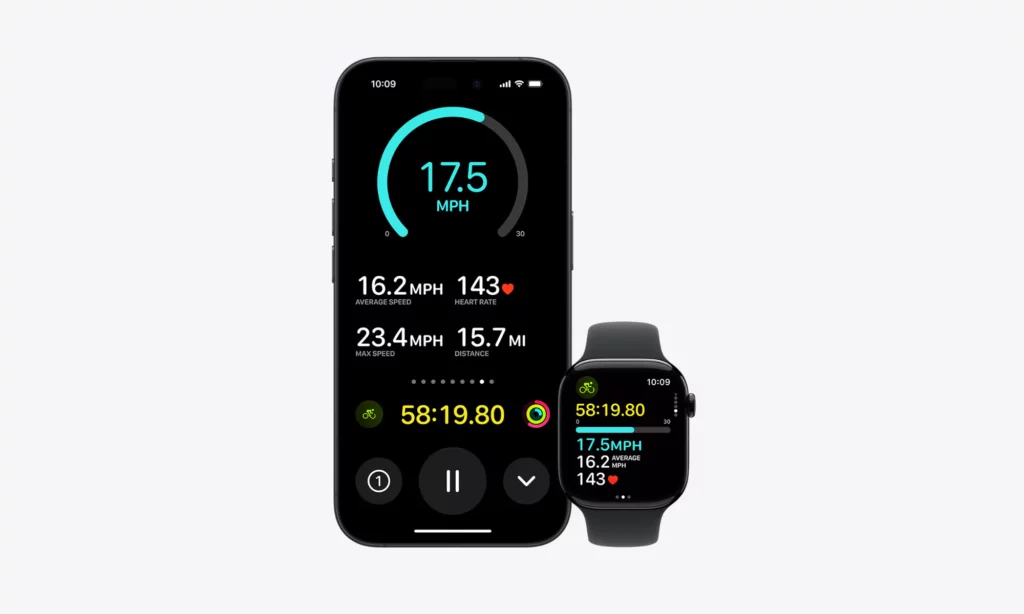
These applications often operate on top of the firmware and the operating system. They directly interact with users and can be easily installed, updated, or uninstalled. Some common software applications include messaging apps, fitness tracking apps, and many more.
The Important Role of Firmware in IoT
Firmware plays an indispensable part in the IoT system. It defines a device’s core functionality, supports its security, and ensures its reliability.
Particularly, firmware turns hardware capabilities into usable functions by processing the low-level interactions between sensors, actuators, and communication modules. Without proper firmware, a thermostat, for example, is no longer “smart.” In other words, it can’t monitor temperature sensor readings, display real-time data, and activate heating/cooling functions based on sensor signals.
Further, IoT firmware ensures IoT devices and software on them will operate continuously in a reliable manner. It does so by handling errors, optimizing resources, and keeping connections stable. This is especially important for some specific IoT devices (like industrial robotics or medical devices), for which failures can result in serious consequences.
Finally, IoT firmware acts as a crucial security layer. Secure firmware integrates the best security measures (like encryption, secure boot, or authentication) to protect your device and data from cyber threats. Especially, many IoT firmware systems now can implement Over-The-Air (OTA) updates to promptly respond to any new vulnerability.
4 Key Things to Know Before Developing IoT Firmware
Understanding the importance of firmware in the IoT context, various companies are paying more attention to how to develop IoT firmware effectively for their IoT devices. Before jumping into the detailed steps of IoT firmware development, you need to consider the following factors:
1. Hardware Foundations for IoT Firmware
We all know that IoT firmware directly resides in a device’s hardware. So, without a solid understanding of the device’s hardware components (e.g., sensors or peripherals) and resource constraints, you struggle to create firmware that manages the device’s performance effectively. Here’s what you need to know about hardware foundations for IoT firmware:
Microcontroller Selection
When it comes to microcontrollers (MCUs), we often think about them as the brains of IoT devices. They’re small, self-contained computer chips where IoT firmware is directly embedded. There are many common microcontroller types to choose from. They include the ARM Cortex-M Series, ESP32, Microchip PIC MCUs, Texas Instruments MSP430, and many more.
To select appropriate microcontrollers, you should consider different factors (like memory, processing power, and peripherals) based on your IoT needs. For example, if you want IoT devices to have real-time or complex data processing, consider powerful microcontrollers.
Memory Management
Next, consider memory capabilities like RAM, Flash, and EEPROM (Electrically Erasable Programmable Read-Only Memory). RAM is used to store variables and runtime data, while Flash helps store the firmware code and constant data. EEPROM, another non-volatile memory, is utilized to store and retain small, crucial data, even when the device loses power.
Further, to optimize memory usage, you should consider using suitable data structures, writing efficient code, leveraging memory pooling, minimizing global variables, and automatically freeing up memory space that isn’t in use.
Optimal Power Consumption
You should consider strategies to optimize IoT firmware’s power consumption. They include choosing low-power microcontrollers, using sleep modes (e.g., standby or deep sleep), disabling clocks to unused peripherals, utilizing low-power communication protocols (e.g., BLE), and only activating sensors when they’re needed.
Besides, you can develop IoT firmware that reacts to events instead of repeatedly tracking the status of sensors. For instance, rather than reading a temperature sensor’s value every 10 milliseconds, the firmware can be active only when the sensor detects overheating signals. This helps save power consumption and processing resources.
Sensor Integration & Data Collection
IoT firmware should be designed to connect with different types of sensors to collect necessary data. This involves leveraging suitable communication protocols (e.g., UART, I2C, or analog inputs). Further, your device’s firmware needs essential capabilities to acquire and pre-process data from sensors. These capabilities may include filtering, checking, converting, and combining sensor readings.
Real-Time Operating Systems (RTOS)
There are several IoT use cases (e.g., industrial automation or medical devices) that require real-time data manipulation. In these cases, using RTOS options like FreeRTOS, RTX, or Zephyr helps handle crucial tasks in real-time, control firmware resources effectively, and promote modularity for easier development or updates.
2. Programming Languages and Software Tools
Once you’ve had a good preparation for hardware foundations, it’s time to consider programming languages and software tools for IoT firmware development. Let’s take a detailed look!
Programming Languages
There are different programming languages you should consider in developing IoT firmware. They include C, C++, MicroPython, Rust, and more. The choice of programming languages depends much on your hardware’s resource constraints and IoT needs.
Normally, C and C++ are known for their fine-grained memory management and wide support for different microcontroller architectures. Meanwhile, MicroPython is suitable if you require rapid prototyping and ease of development rather than optimal performance. But if your devices prioritize reliable and secure performance, leverage Rust to develop IoT firmware.
Software Tools
Next, you need different software tools to build IoT firmware. They include:
- Integrated Development Environments (IDEs): IDEs are software applications that provide the necessary tools for software and firmware development. Normally, IDEs like Eclipse and Visual Studio Code (VS Code) are installed with specific plugins to facilitate the development process. For example, if you work with ESP32 projects to develop IoT firmware on Espressif’s hardware microcontrollers, VS Code requires the Espressif IDF plugin to integrate the ESP-IDF (Espressif IoT Development Framework) into the editor. This offers specialized features (e.g., code completion, project management, or debugging) to facilitate the development process of ESP32 projects.
- Firmware Development Kits (FDKs): FDKs provide pre-built components, well-tested libraries, and debugging tools to accelerate development, simplify debugging, and enhance code quality. You can leverage FDKs offered by microcontroller vendors. For example, for the ESP32 projects we mentioned, you can utilize the ESP-IDF v4.x framework, coupled with the AWS IoT SDK component for ESP boards and the ESP Utility Tool, to support IoT firmware development. Besides, open-source FDKs like Arduino or PlatformIO are available for community-driven projects.
- Compilers, Debuggers, and Profiling Tools: Compilers are used to convert source code into machine code that microcontrollers can execute. GCC (GNU Compiler Collection) is a common compiler for embedded systems. Meanwhile, debuggers like GDB, JTAG, or SWD help developers spot and fix errors in code. You can also use profiling tools (e.g., Valgrind) to analyze how your code performs, hence discovering bottlenecks and optimizing memory usage.
3. Communication Protocols
Like humans using languages to communicate with others, IoT devices also leverage communication protocols to interact. As already mentioned, IoT firmware is responsible for handling such connectivity. So, before IoT firmware development, it’s crucial to choose and implement communication protocols that align with your IoT requirements. Below are some common protocols you may consider:
| Communication Protocols | Description | Ideal for |
| MQTT (Message Queuing Telemetry Transport) | – A lightweight publish/subscribe messaging protocol.- Works over TCP/IP.- Commonly used to monitor devices and transfer sensor data. | – Unreliable networks- Resource-constrained devices |
| CoAP (Constrained Application Protocol) | – A specialized web transfer protocol for constrained devices.- Uses UDP.- Developed to be similar to HTTP but has lower overhead.- Widely utilized in machine-to-machine (M2M) communication | – Lossy and low-power networks |
| BLE (Bluetooth Low Energy) | – A low-power technology for wireless communication- Often seen in wearables, health monitoring, and smart home devices. | – Short-range interactions in battery-powered devices |
| Zigbee | – A low-power, mesh network protocol.- Commonly used in industrial control and home automation. | – Large networks with multiple devices |
| LoRaWAN (Long-Range Wide Area Network) | – A low-power, long-range technology for wireless communication.- Widely leveraged in asset tracking, smart agriculture, and smart city applications. | – Long-distance communication- Low data rates |
| Cellular IoT | NB-IoT (Narrowband-IoT)- Developed for low-power, low-bandwidth applications.- Often used in environmental sensors and smart meters. | – Applications where infrequent data transmission is needed. |
| LTE-M (Long-Term Evolution for Machines)- Supports higher data rates than NB-IoT.- Commonly utilized in connected vehicles and asset tracking. | – Applications where data is sent more frequently. |
4. Security and Reliability in IoT Firmware
When developing IoT firmware, you should keep the two factors “Security” and “Reliability” in mind. Without considering these factors, IoT firmware is prone to common vulnerabilities like injection attacks or buffer overflows. As a result, bad guys can exploit these weaknesses to gain control of your IoT devices and steal sensitive data. Not to mention that insecure IoT firmware makes your company easily violate specific industry standards and regulations about data privacy and security. Therefore, before IoT firmware development, you should consider appropriate security strategies to ensure firmware safety and avoid any violations.
These security strategies should include:
- Secure Coding, Testing & Debugging: Implement secure coding practices to avoid common vulnerabilities. In addition to the testing and debugging tools mentioned above, you should adopt appropriate techniques for firmware security. They include unit testing, integration testing, system testing, Hardware-in-the-Loop (HIL) testing, and more.
- Secure Communication Channels: Implement secure communication between devices, cloud servers, and other systems. Also, adopt secure key management practices and establish secure boot processes to prevent firmware tampering.
- Security Best Measures & Compliance: Include the security best practices like strong passwords, encryption protocols (AES, TLS/SSL), and robust authentication mechanisms (tokens, certificates) to protect your data in transit and at rest. Besides, comply with industry-specific security standards (ISO 27001, NIST) and regulations (HIPAA, GDPR).
- Over-the-Air (OTA) Updates: Implement secure OTA updates by utilizing secure communication protocols (e.g., HTTPS) to deliver firmware updates as well as validating whether these updates are authentic. Also, adopt strong error-handling mechanisms to stop bad updates from ruining IoT devices. Additionally, use code signing to avoid malicious updates on these devices.
8 Key Steps of IoT Firmware Development
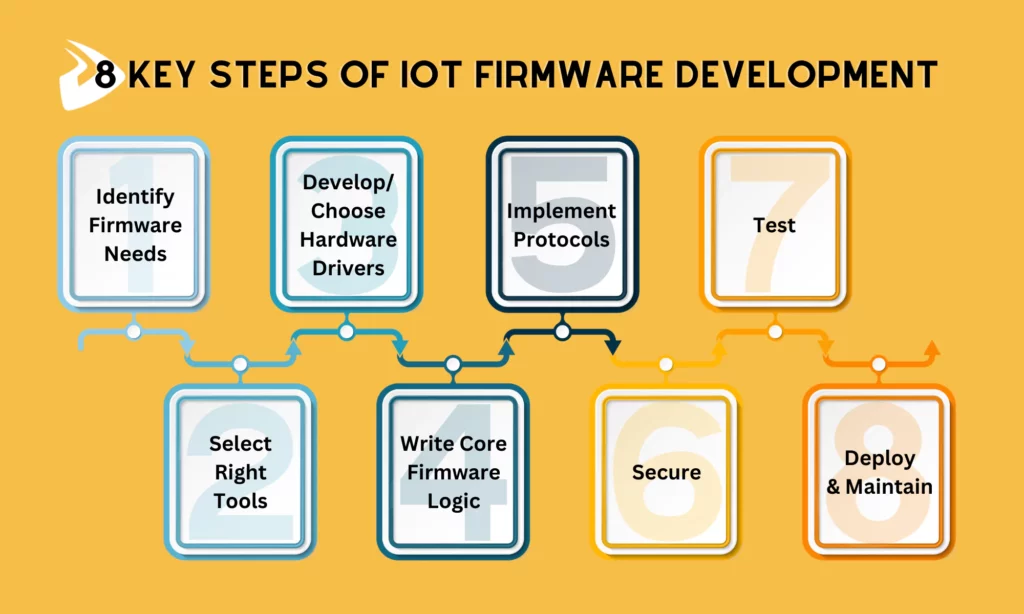
Developing firmware is like creating a brain for IoT devices to make them intelligent. Whether you’re going to build a simple smart home device or a complex industrial IoT solution, follow the key steps to develop IoT firmware effectively:
Step 1: Identify Your Firmware Requirements
Before starting the development process, you need to define clearly which main tasks IoT firmware should accomplish. For example, you want to build a smart agriculture device that can measure environmental conditions (e.g., temperature or moisture), transfer data to an app, and even automatically monitor a sprinkler.
Besides, you should ask relevant questions about other capabilities, including:
- How will your device communicate (e.g., Bluetooth, Wi-Fi, or cellular connectivity)? This question helps you select the right communication protocols for your device.
- What security measures will your device need (e.g., strong passwords or encryption)?
- Does your device have any limitations (e.g., limited memory or processing power)? IoT devices like smartwatches definitely have less memory capacity than big ones like industrial robotics. Understanding your device’s limits helps you make clear plans for them.
Answering those questions, you can easily draw a simple diagram that illustrates how your device’s components interact and deliver data.
Step 2: Select the Right Development Tools
Choosing the right tools will ensure the effective and seamless development process of IoT firmware. There are many options out there, depending on your IoT device’s hardware components. These tools include an Integrated Development Environment (IDE), a Firmware Development Kit, a compiler (for translating your instructions into a language your device may understand), etc. Additionally, if you want your device to perform real-time tasks (in case of industrial equipment, for example), consider a Real-Time Operating System (RTOS). You may go back to our second tip in the previous section to see which software tools and programming languages you need.
Step 3: Develop/Choose Hardware Drivers
IoT firmware is in charge of managing your device’s physical components (e.g., sensors or LEDs). Therefore, it needs device drivers, which are specialized software programs, to communicate seamlessly with those hardware components. For example, IoT firmware requires a temperature sensor driver to detect temperature changes.
If your IoT device uses specialized or unique hardware that isn’t widely supported, you may have to write drivers from scratch. Otherwise, you can leverage external drivers provided by microcontroller vendors or sensor and component manufacturers. For example, if you integrate an ESP32 microcontroller, its provider, Espressif offers the ESP-IDF that covers a wide range of drivers for the ESP32’s built-in peripherals. Meanwhile, the manufacturer of Bosch BMP280 (a pressure sensor) also offers driver libraries to ease the process of reading sensor data.
Today, various microcontroller vendors offer Hardware Abstraction Layers (HALs). HALs enable you to write firmware that can be portable between different microcontrollers of the same provider without much modification.
Step 4: Write Core Firmware Logic
Now, it’s time for the actual IoT firmware development to happen. Here, you need to use programming languages (like C, C++, or MicroPython) to write code or instructions for your device to perform core functions. These functions include reading data from sensors, processing the data, monitoring actuators (i.e., to turn on/off a motor), and interacting with the Internet or other devices.
Here, you can leverage pre-written code libraries for common tasks, which facilitates your firmware development. Further, you can integrate machine learning algorithms to ease the process of handling data, responding to events, and making automated decisions. This is extremely beneficial in complex IoT applications like industrial automation or robotics. Additionally, you can also leverage effective programming techniques and tools to improve performance and power consumption.
Step 5: Implement Communication Protocols
Now, give your IoT device a voice by choosing suitable communication protocols for it. The wrong choice of languages makes your IoT devices struggle to send and receive data. You can look back to our third tip in the previous section to see which communication protocols are well-suited for your IoT use cases.
Further, use libraries like MQTT libraries (e.g., Eclipse Paho) or IwIP (for TCP/IP networking) to facilitate development. These libraries offer essential features to process data transfer, ensure encryption, and manage errors, hence reducing the amount of code needed to implement communication protocols. Accordingly, you need to incorporate these libraries into your firmware and configure them based on your needs.
Step 6: Secure IoT Firmware
Next, consider protecting your IoT firmware, device, and data with the best security measures like strong passwords, encryption, secure storage, and authentication mechanisms. All these measures ensure data security during transmission and at rest by only allowing authorized users or devices to access it and preventing cyberattacks.
If you struggle with IoT firmware security, don’t hesitate to contact Designveloper! With over a decade of experience in IoT and cybersecurity services, we’re committed to supporting you in safeguarding IoT firmware and data effectively. Whether you need a variety of testing procedures, security threat models, customized security training programs, or compliance consultancy, we cover it all. Get in touch with us and receive free estimates!
Step 7: Test Carefully
Once your IoT firmware is developed and equipped with security features, it’s time to test it to detect any bugs before they cause real-world troubles. You can leverage testing tools and techniques (e.g., unit testing or edge-case testing) to check whether the firmware operates correctly in all situations. If anything wrong happens, use debugging tools to fix it.
Step 8: Deploy and Maintain IoT Firmware
Now, you’re done with testing and debugging. It’s time to install the firmware on your IoT device. But the IoT firmware development process doesn’t end here. To ensure its reliable performance in the long term, leverage bootloaders to allow for OTA updates and conduct logging and error reporting to constantly track your device’s performance.
Final Thoughts
After this article, we expect you already have a solid understanding of IoT firmware, from its definition to its development process. The process of building IoT firmware may vary depending on your specific requirements. Have you any interesting experiences about IoT firmware development to share with us? Discuss further on our Facebook, X, and LinkedIn! Also don’t forget to subscribe to our blog to receive informative articles about relevant topics!
Also published on

Share post on









Read more topics









You may also like


IoT Software Development: A Complete Beginner’s Guide for 2026
IoT Software Development: A Complete Beginner’s Guide for 2026 Published April 29, 2025
IoT in Smart Cities: 10 Transformative Technologies Reshaping Urban Life
IoT in Smart Cities: 10 Transformative Technologies Reshaping Urban Life Published April 22, 2025
Core Technology of IoT: What Businesses Need to Know in 2026
Core Technology of IoT: What Businesses Need to Know in 2026 Published April 21, 2025