












What Is IoT Data Analytics? Types, Use Cases, And Implementation

IoT data analytics is the process of turning data from connected devices and sensors into useful insights or automated actions. It helps teams understand what is happening, explain why it happened, predict what may happen next, and decide what to do about it.
The practical value comes from connecting analytics to a real operating decision. A factory may track machine temperature and vibration to spot abnormal behavior before a failure. A logistics team may combine location and condition data to find delays or protect sensitive goods. The same pattern applies across many IoT systems. Collect the right signals, process them reliably, and analyze them for a defined purpose. Then send the result to people or systems that can act.
What Is IoT Data Analytics?
IoT data analytics converts raw telemetry from connected equipment into information that can support a decision or trigger a response. The Internet of Things supplies the data through sensors and connected devices. Analytics gives that data context, such as whether a reading is normal, what changed, and whether action is needed.
If you need the device-and-connectivity foundation first, our guide to the Internet of Things explains how connected objects, sensors, and networks exchange data. IoT data analytics starts after those devices begin producing useful signals, although collection quality and connectivity still shape the results.
Consider a motor with temperature and vibration sensors. Individual readings do not tell a maintenance team much on their own. A gateway can collect and normalize them, an edge or cloud service can process them, and storage can preserve the time series for comparison. Analytics can then detect a sharp change, compare it with historical behavior, estimate whether the pattern suggests a developing fault, and send an alert to a maintenance system.
This makes IoT data management part of the analytics problem rather than a separate afterthought. If timestamps are inconsistent, sensors drift, packets arrive late, or the system loses context about which asset produced a reading, even a strong model can produce a weak result. Reliable analysis begins with data that has a clear source, time, unit, and business meaning.
Four Types Of IoT Data Analytics
The four common types of IoT analytics answer different questions: what happened, why it happened, what is likely to happen, and what should be done. They are not maturity levels that every project must climb in order. A simple descriptive alert may be more useful than a predictive model if the business only needs fast visibility. The table uses the motor example as an illustrative scenario.
| Type | Key question | Typical output | IoT example |
|---|---|---|---|
| Descriptive | What happened? | Status, trend, count, or summary | A dashboard shows that motor temperature exceeded its normal range three times today. |
| Diagnostic | Why did it happen? | Possible cause, correlation, or root-cause evidence | Temperature spikes appear after vibration rises and cooling airflow falls. |
| Predictive | What is likely to happen? | Forecast, probability, risk score, or anomaly prediction | A model estimates that the motor has an elevated risk of failure during the next operating period. |
| Prescriptive | What should be done? | Recommended action or optimized decision | The system recommends inspecting the motor during the next planned stop instead of waiting for a breakdown. |
IBM’s predictive analytics guidance describes predictive analysis as using historical data with statistical modeling, data mining, and machine learning to estimate future outcomes. IBM also distinguishes descriptive, diagnostic, predictive, and prescriptive analytics by the questions they answer.
For an IoT project, choose the type from the decision you need to support. If operators only need to know that a freezer is above a safe threshold, descriptive or rule-based analysis may be enough. If the goal is to schedule maintenance before a likely failure, predictive analytics becomes relevant. Prescriptive analysis adds value only when the organization can define acceptable actions, constraints, and consequences.
How IoT Data Analytics Works
IoT data analytics works as a pipeline from sensing to action. The exact technologies vary, but a useful architecture must collect data, prepare it, store or stream it, analyze it, and deliver the result to a person or system.
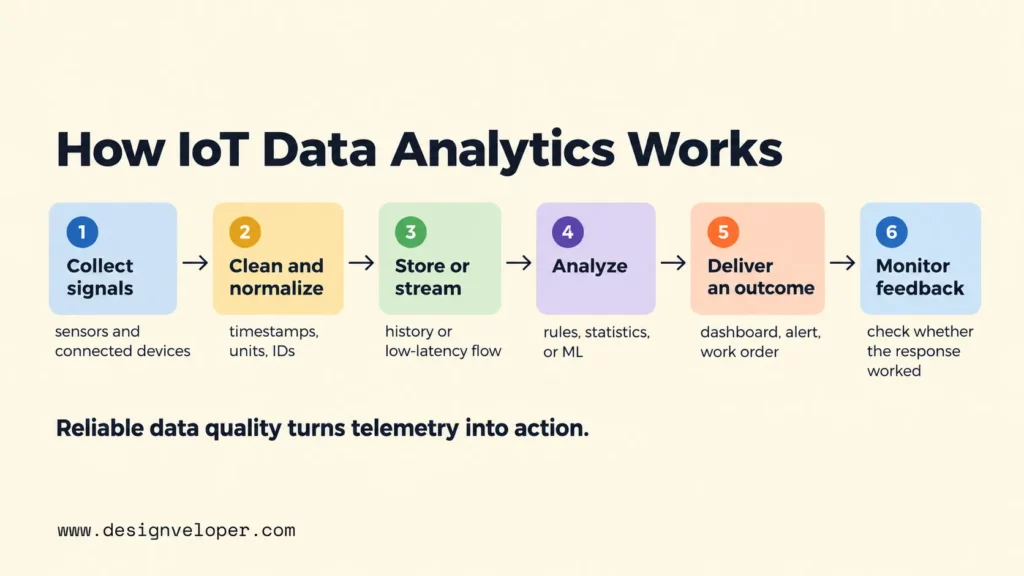
- Collect the signals that matter. Sensors, controllers, vehicles, wearables, and other connected systems produce readings or events. A gateway may aggregate several devices before the data moves farther through the system.
- Process and normalize the data. The pipeline checks timestamps, units, formats, missing values, and device identifiers. Some work can happen close to the device. AWS IoT Greengrass documentation describes local processing that can respond to events and continue operating with intermittent connectivity.
- Store or stream the data for its purpose. Historical analysis needs durable, protected records with suitable access and retention controls. Real-time data analytics may instead prioritize a low-latency stream, while still retaining selected data for later analysis. Time-series storage is common because many sensor readings are meaningful in relation to time.
- Apply the right analytical method. Rules can detect threshold breaches. Statistical methods can reveal trends and correlations. Machine learning can classify patterns or detect anomalies when the problem and data justify the added complexity.
- Deliver an outcome. The result can appear in a dashboard, create an alert, open a work order, or trigger a bounded automated control. Feed the outcome back into monitoring so the team can judge whether the response worked. AWS IoT Core rules, for example, can filter device messages and route them to other services or actions.
Microsoft’s IoT architecture guidance presents a similar flow through sensing, networking, ingestion, processing, and application or presentation layers. That separation is useful because each layer has a different failure mode. A good model cannot fix a sensor that measures the wrong variable, and a good dashboard cannot recover readings that were lost before ingestion.
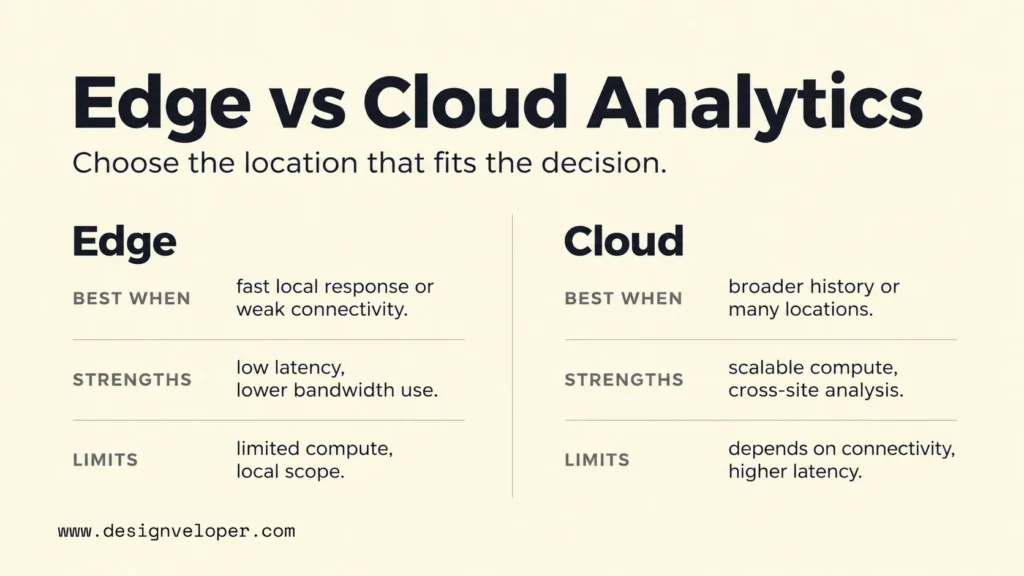
Our IoT infrastructure guide gives more detail on the sensing, network, processing, and application layers. For analytics planning, the important lesson is to decide where each task belongs. Edge analytics fits work that needs a fast local response or must tolerate weak connectivity. Cloud analytics fits workloads that need broader history, larger computing resources, or data from many locations.
IoT Data Analytics Use Cases
IoT data analytics is most useful when a physical process produces signals that can change a real decision. Common use cases include maintenance, asset tracking, condition monitoring, resource optimization, and remote monitoring.
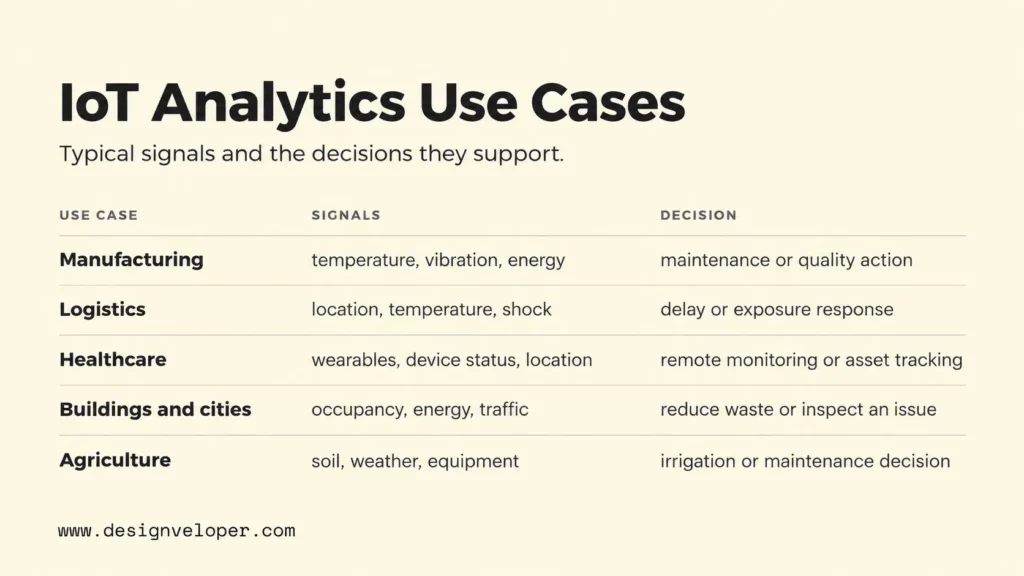
- Smart manufacturing and Industrial IoT: teams can analyze equipment temperature, vibration, or energy data to monitor condition, check quality, or plan maintenance. Cisco describes Industrial IoT as connected devices, sensors, applications, and networking that collect and analyze operational data. Its Industrial IoT overview also identifies predictive maintenance and real-time operational data as common applications. Our guide to Industrial Internet of Things covers the broader factory context.
- Logistics and supply chains: location, temperature, shock, vehicle, and route data can support asset tracking, condition monitoring, route decisions, and maintenance planning. Our article on IoT in supply chain operations explores those connected logistics patterns.
- Healthcare: connected medical devices and wearables can support remote monitoring, while location technologies can help track equipment. These systems need stronger controls around privacy, safety, access, and data quality because a bad reading can affect a high-stakes decision. Our guide to IoT in healthcare provides more application context.
- Smart buildings and cities: organizations can analyze energy, occupancy, traffic, waste, and infrastructure data to detect unusual conditions and adjust operations. The value depends on a clear operational objective, such as reducing energy waste or prioritizing an inspection, rather than collecting data simply because sensors are available.
- Agriculture: soil moisture, weather, irrigation, equipment, and livestock data can support irrigation timing, condition monitoring, and resource planning. The useful output should be tied to a controllable decision, such as when to irrigate or which asset needs attention.
Predictive maintenance shows how the whole workflow comes together. A sensor records machine temperature and vibration. A gateway moves or filters the readings. Time-series storage preserves the history. An anomaly model compares new behavior with learned or defined patterns. If risk rises past an agreed threshold, the system sends a maintenance alert. AWS documents this pattern in IoT SiteWise anomaly detection, where models use industrial time-series data to identify abnormal equipment behavior and potential failures.
Business Benefits And Challenges Of IoT Data Analytics
The business case for IoT data analytics comes from changing an outcome, not from producing more dashboards. When analytics helps a team detect a problem sooner, reduce unnecessary work, use resources better, or make a faster decision, it can improve operations. The same system can fail to create value if the data is unreliable or nobody owns the action that follows the insight.
Operational benefits
In manufacturing, predictive maintenance can shift some work from emergency repair to planned inspection. That can reduce avoidable disruption and maintenance cost when the model is accurate enough and the maintenance team can act on the warning. Sensor-based monitoring can also support quality and safety by exposing abnormal conditions sooner.
The same decision-first logic applies in other settings. In logistics, better location and condition visibility can help teams investigate delays or product exposure earlier. In buildings, combining occupancy and energy data can help operators find waste that a monthly utility total would hide. These benefits depend on a clear response path, not only on collecting more telemetry.
Practical limits
The challenges start with data quality and interoperability. Different devices may report different units, timestamps, identifiers, or sampling rates. Networks may be unreliable. Devices may be replaced or recalibrated. If those changes are not tracked, the analytics layer can mistake a data problem for a real-world event.
Scale also changes the design. More devices mean more messages, storage, processing, monitoring, and operating cost. That does not mean every reading must be sent to the cloud. Filtering or aggregating at the edge can be useful when raw data is repetitive, bandwidth is limited, or the local process needs a fast response.
Security and privacy must be designed across the system, from device identity to stored data and user access. NIST’s 2026 IoT cybersecurity guidance focuses on cybersecurity activities and capabilities that help customers manage IoT product risk. That guidance is aimed at IoT product manufacturers, not analytics pipelines. In an analytics implementation, the same risk-management principle means protecting ingestion, storage, APIs, models, dashboards, and automated actions.
Model accuracy is another practical limit. Predictive maintenance is not the same as detecting any unusual reading. A model can drift when operating conditions change, and false alerts can make users stop trusting it. Track model performance, alert quality, and the business outcome together. If a simple threshold performs well enough, adding machine learning may create more maintenance work than value.
How To Implement IoT Data Analytics
Implement IoT data analytics by starting with one measurable operating goal and building the smallest reliable data path that can support it. Architecture and tools should follow the decision, latency, scale, security, and data requirements of that use case.
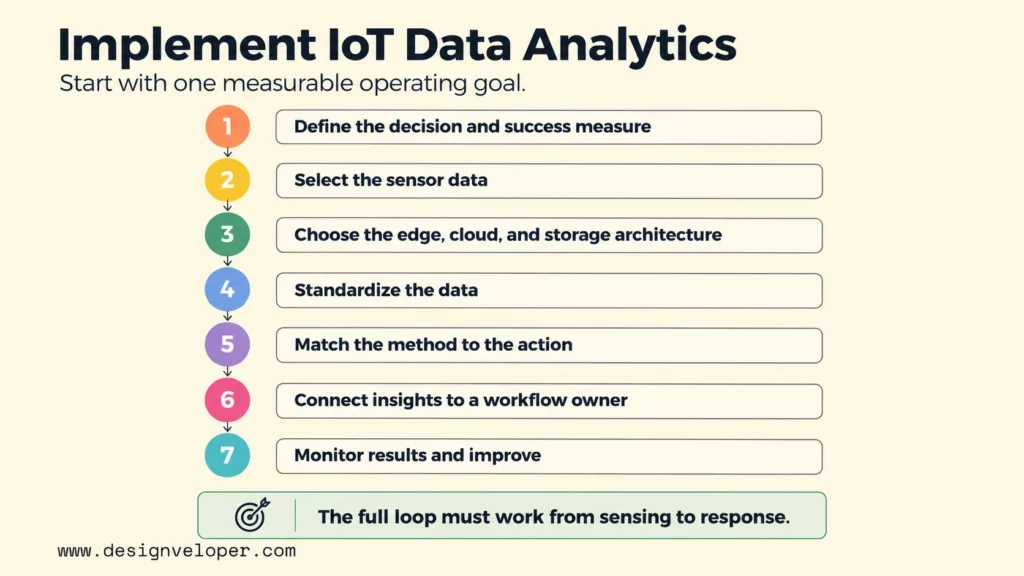
- Define the decision and success measure. State what should change if the analysis works. For predictive maintenance, that could be detecting credible failure risk early enough to schedule an inspection. Pair the goal with operational measures such as alert precision, avoided unplanned stoppages, or maintenance lead time.
- Select the sensor data that can explain the problem. Choose variables because they have a plausible relationship to the target condition. For a rotating machine, temperature and vibration may be useful. Also record asset IDs, units, timestamps, sampling rates, and operating context so the readings remain interpretable.
- Choose the edge, cloud, storage, and analytics architecture. Put low-latency or offline work close to the device when needed. Use centralized services when the analysis needs longer history or data from many assets. If platform selection is part of the project, our comparison of IoT cloud platforms can help you compare ingestion, storage, analytics, device management, and scalability.
- Standardize data before modeling. Define device protocols, payload fields, units, timestamp rules, metadata, and quality checks. Preserve raw data when it has audit or retraining value, but do not keep every signal forever without a retention reason.
- Match the analysis method to the action. Use real-time rules for immediate threshold decisions, batch analysis for periodic summaries, predictive models for future risk, and prescriptive methods only when the system can evaluate feasible actions and constraints. Test the simplest method that can meet the goal before adding complexity.
- Connect insights to a workflow. Decide who receives an alert, what information they need, how they confirm it, and what action follows. Automated controls need explicit safety boundaries and fallback behavior. A prediction without an owner and response path is only an observation.
- Monitor the system after launch. Track missing data, sensor drift, processing delays, storage cost, model quality, security events, alert outcomes, and the original business measure. Retrain or revise models when the environment changes. Remove signals or processing steps that add cost without improving the decision.
A pilot should prove the full loop, not only the model. In the machine example, success means the data path works from end to end. The analysis must identify a useful condition, reach the right person, and leave enough time for maintenance to respond. Once that loop is stable, the team has evidence for scaling to more assets or adding more advanced analytics.
FAQs About IoT Data Analytics
What Is The Difference Between IoT And IoT Data Analytics?
IoT is the broader system of connected physical devices, sensors, networks, software, and services that exchange data. IoT data analytics is the part that processes and examines that data to produce an insight, prediction, recommendation, or automated response. You can have connected devices without advanced analytics, but analytics is what turns their telemetry into a decision-support asset.
What Data Sources Are Used In IoT Analytics?
IoT analytics can use sensor readings, device logs, location data, equipment states, actuator events, images, environmental measurements, and gateway or network events. It can also combine IoT data with business context such as maintenance history, asset records, schedules, or weather. The useful set depends on the question. More sources do not automatically create a better model.
Is IoT Data Analytics The Same As Predictive Maintenance?
No. Predictive maintenance is one use case for IoT data analytics. IoT analytics also supports descriptive monitoring, diagnostics, quality control, asset tracking, energy optimization, remote patient monitoring, traffic analysis, and many other decisions. Predictive maintenance specifically uses condition and historical data to estimate failure risk or maintenance need before a breakdown.
What Tools Are Used For IoT Data Analytics?
Most IoT analytics stacks use several tool categories rather than one product. They may include device connectivity or gateways, message brokers, stream processors, time-series or object storage, query engines, machine learning services, dashboards, and alerting systems. An IoT analytics platform may bundle several of these functions, while a complete production stack can still combine specialized services. The Azure and AWS examples described earlier show how functions can be split across a stack. Choose tools from the workload requirements, not from a feature checklist alone.
Also published on

Share post on









Related Articles


Data And AI Strategy: A Practical Roadmap For Business Growth
Data And AI Strategy: A Practical Roadmap For Business Growth Published October 14, 2026
What Is IoT Data Analytics? Types, Use Cases, And Implementation
What Is IoT Data Analytics? Types, Use Cases, And Implementation Published September 25, 2026
Data-Driven Decision-Making: 7 Steps And Real-World Examples
Data-Driven Decision-Making: 7 Steps And Real-World Examples Published September 16, 2026