















10 Leading Data Analytics Companies in 2026

Have you ever wondered how data analytics companies are shaping our world? In today’s digital age, every click, every view, and even every purchase is collected and transformed into data. Data analytics companies are the wizards who turn this vast amount of data into meaningful insights.
These companies play a crucial role in helping businesses make informed decisions, predict trends, and improve services. Whether you’re a business owner looking for a data analytics service, a job seeker eyeing the industry, or simply someone curious about the field, this article is for you.
We’ll start by breaking down the basics of data analytics – what it is and how it works. Then, we’ll take you on a tour of the top 10 leading data analytics companies. And finally, we’ll explore the benefits of working with or at these companies.
So, are you ready to explore this realm? Let’s get started!
What is Data Analytics?
Data analytics is a comprehensive field that involves the systematic computational analysis of data.
Businesses often use data analytics to analyze and interpret complex data sets. Accordingly, they can identify trends, patterns, and relationships that can be used to drive strategic business decisions.
However, handling vast amounts of data from diverse sources can be daunting. This is where data analytics companies come into play, providing specialized tools and expertise to help businesses unlock the value of their data.
How Does Data Analytics Work?
Data analytics works by using specialized systems and software that integrate machine learning algorithms, automation, and other capabilities. This process includes the following steps:
Data Acquisition: To answer specific business questions, you need to acquire data from various sources for analysis by using code like Sequel or Python. These sources could be databases, files, external feeds, user submissions, or even social media. Meanwhile, the data could be structured or unstructured and in different formats.
Data Preparation: Not all data you collect can be used for analytics. Therefore, you need to clean and transform the data into a format that can be analyzed. This involves dealing with missing or inconsistent data and combining different data sets to create a cohesive data source.
Data Exploration: This stage involves using statistical techniques to extract valuable insights from the data. As such, analysts explore the data to understand its underlying structure and distribution and identify any outliers or anomalies.
Data Modeling: Mathematical models are applied to the data to identify patterns and relationships. These models can be descriptive, predicting the past; predictive, forecasting the future; or prescriptive, suggesting actions.
Communication of Insights: The final stage refers to visualizing the data and communicating the findings in an understandable and actionable manner to stakeholders. This could involve creating dashboards, reports, or presentations.
Each of these stages requires specific tools and techniques. So, data analytics companies often provide platforms or services that encompass these stages. This, accordingly, helps businesses make data-driven decisions with ease.
FURTHER READING: |
1. 10 AI Data Analytics Tools Transforming the Industry |
2. What is Healthcare Data Analytics? A Detailed Guide |
3. Data Analyst vs Business Analyst: A Comparative Guide for Beginners |
4 Types of Data Analytics
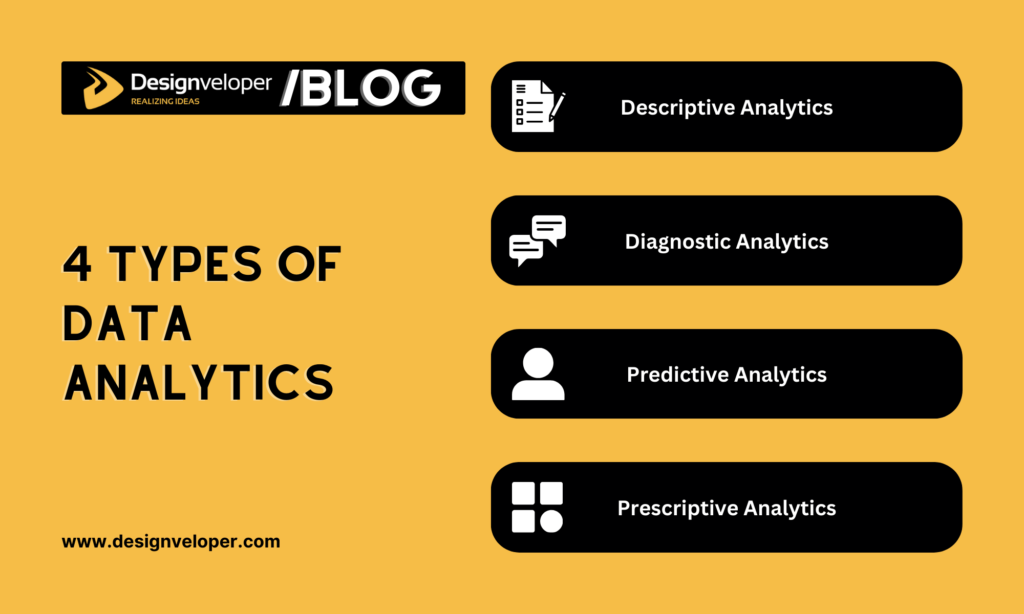
Data analytics can be categorized into four main types, each with its own focus and use cases:
Descriptive Analytics: This type of analytics answers, “What happened?” It involves analyzing historical data to understand changes that have occurred in a business. For example, a retail company might use descriptive analytics to understand the total sales, customer visits, and product performance in the past year.
Diagnostic Analytics: This one helps resolve the question, “Why did it happen?” This involves more detailed data exploration and drill-down techniques to understand the root cause of a particular outcome. For instance, if a company’s sales dropped in the last quarter, diagnostic analytics could be used to find out why that happened.
Predictive Analytics: Predictive analytics uses statistical models and forecasting techniques to answer the question, “What could happen in the future?” For example, an insurance company might use predictive analytics to calculate the likelihood of a claim being fraudulent.
Prescriptive Analytics: To understand “What should we do?”, this type of data analytics uses simulation and optimization algorithms to deliver possible solutions. For instance, an airline might use prescriptive analytics to set ticket prices, balancing the need to fill seats with the goal of maximizing revenue.
Each of these types of data analytics plays a crucial role in business decision-making, and they are often used in combination to provide comprehensive insights. For example, a data analytics company might use descriptive and diagnostic analytics to understand a client’s current situation, then apply predictive and prescriptive analytics to recommend actions for the future.
Benefits of Working With or At Data Analytics Companies
In our data-centric world, data analytics serves as the backbone of decision-making and strategic planning. However, to harness the true power of data, sophisticated data analytics software is indispensable. This is where data analytics companies shine – they are the architects of these powerful tools.
Whether you’re in a partnership with such a company or are a part of its workforce, the opportunities and benefits are profound. Now, let’s delve deeper into the myriad advantages that await in the realm of data analytics.
Benefits of Working With Data Analytics Companies
Valued at USD 61.44 billion in 2023, the global data analytics market is expected to expand at a CAGR of 25.20% from 2023 to 2033. This growth is fueled by the continuous demand for digital transformation based on data analytics and the increasing use of data analytics tools for forecasting.
This projection signifies a growing demand for data analytics tools in the future, paving the way for data analytics companies to expand. Consequently, the demand to collaborate with data analytics companies for more effective digital transformation and superior forecasting models is on the rise.
Here are some benefits you may obtain from working with data analytics companies:
Access to Expertise and Advanced Tools
Data analytics companies are staffed with experts who have a deep understanding of data, its intricacies, and how to extract meaningful insights from it. They also have access to advanced analytical tools that can handle large volumes of data, making it easier for businesses to understand their data landscape.
Faster and More Efficient Data Analysis
With their expertise and advanced tools, data analytics companies can analyze data much faster and more efficiently than a business could on its own. This allows businesses to quickly gain insights from their data and make informed decisions.
Data-Driven Decision-Making Leading to Better Outcomes
Working with data analytics companies enables businesses to make decisions based on data, rather than intuition or guesswork. This leads to better outcomes, as decisions are grounded in facts and trends identified from the data.
Benefits of Working For Data Analytics Companies
Is working for data analytics companies promising? Absolutely. According to The Future of Jobs Report 2023 by the World Economic Forum, roles in data analytics such as data analysts, data scientists, and business intelligence specialists are the fastest-growing jobs in the future. Working in the realm of data analytics, you can receive the following benefits:
Lucrative Career Opportunities with High Demand
The demand for data analytics skills is high, and it’s only going to increase as more businesses recognize the value of data-driven decision-making. This makes data analytics a lucrative career field with plenty of opportunities for growth.
Opportunity to Work with Cutting-Edge Technology
Data analytics companies are at the forefront of technology. Working at such a company gives you the opportunity to work with the latest tools and technologies in the field of data analytics.
Be at the Forefront of Data-Driven Innovation
Data is the new oil, and data analytics companies are the ones drilling for it. Working at a data analytics company puts you at the forefront of data-driven innovation, giving you the chance to make a real impact in the field.
Top 10 Leading Data Analytics Companies
You’ve understood what data analytics is and the reasons why data analytics companies are important for businesses and individuals alike. So now, it’s time to know who the key players in this field are.
These companies are not only leading in terms of technology and innovation, but they also offer great opportunities for those interested in working in this dynamic field. Let’s take a look at the top 10 leading data analytics companies.
1. Accenture
No. of Employees: 734,000 people across 120+ countries
Pay Range for Data Analytics Roles: USD 82K – 125K per year
Achievements:
- Leader and Star Performer in the 2022 Everest Group PEAK Matrix Assessment for Data & Analytics Services
- Leader in the 2022 Gartner’s Magic Quadrant for Data and Analytics Service Providers
Accenture, a global leader in professional services, empowers a myriad of organizations to fortify their digital backbone, streamline operations, boost revenue growth, and elevate citizen services.
Its suite of analytics services and solutions offers a wide range of capabilities. They entail Data Transformation, AI Solutions, Generative AI, AIP+, Accenture SynOps, and Business Process Services. These services are instrumental in redefining business performance and delivering enduring value through intelligent operations.
Accenture’s service suite offers:
- Data Discovery and Augmentation: They provide a comprehensive view of your customers by enhancing your assets with third-party data and predictive analytics.
- Data Management: Beyond data analytics, they offer various capabilities to manage data in compliance with regulations.
- Data Democratization: They tailor user-friendly tools to enable employees to harness data and embark on the journey to AI.
- Industrialized Solutions: They provide ready-to-use analytics and AI solutions for common challenges, as well as bespoke solutions for more specific needs.
Given these remarkable achievements and contributions, Accenture has rightfully earned its place as one of the premier data analytics companies to collaborate with or work for.
2. Tableau
No. of Employees: 4,181
Pay Range for Data Analytics Roles: USD 94,141 per year
Achievements:
- The 2023 Readers’ & Editors’ Choice Awards by Datanami for the “Best Big Data Product: Business Intelligence and Data Visualization.”
- Leader in Gartner’s Magic Quadrant for Analytics & BI Platforms for its vision and execution.
Tableau is a pioneer in data visualization. Particularly, it crafts an AI-powered business intelligence platform that illuminates the understanding of data. With a mission to make data analysis universally accessible, Tableau is dedicated to helping people comprehend their data, irrespective of their technical proficiency.
Tableau’s product suite comprises Tableau Prep, Tableau Desktop, Tableau Server, Tableau Cloud, and Tableau Mobile.
This suite offers a wealth of capabilities catering to users across the spectrum of technical expertise. From straightforward metrics to sophisticated analytic techniques, Tableau provides a versatile interface for data exploration, equipped with the analytical depth required by data scientists. Also, they offer potent data visualization tools to design interactive, real-time dashboards and reports.
Here are some outstanding features of this product suite:
- VizQL: A patented technology that converts drag-and-drop actions into data queries.
- R and Python Integration: Conducts advanced, quantitative analyses and effortlessly share visual results.
- Instant Geocoding: Facilitates automatic map creation with a single click.
- Show Me: Recommends the optimal visualizations for your data.
- Tableau Pulse and Einstein Copilot: Accelerate decision-making, eliminate repetitive tasks, and enable intelligent analytics.
3. Sisense
No. of Employees: 600
Pay Range: USD 159,832 per year
Achievements:
- G2 Industry Leader for Embedded Business Intelligence (BI) Platforms in Fall 2023
Sisense stands at the forefront of business intelligence and data analytics. It offers a platform that demystifies complex data and converts it into actionable insights. Not only powerful, but the platform is also secure for sensitive data thanks to robust features for data security and governance. Further, it’s designed to scale with the needs of organizations.
This BI platform contains some key features as follows:
- Data Analysis: Sisense boasts a robust analytics engine that allows users to create complex queries and calculations to unearth insights from their data. They can execute ad-hoc analytics and custom dashboards or reports.
- Visualization: The platform provides a variety of visualization options, including charts, graphs, and interactive dashboards. Users can create visually engaging and interactive reports to effectively present their findings.
- Embedded Analytics: Sisense can be integrated into other apps and platforms. This enables businesses to embed AI-powered analytics with pro-code, low-code, and no-code capabilities directly into their products or services. This feature is especially beneficial for software companies and organizations that aim to provide data-driven insights to their users.
- AI and Machine Learning: The platform provides AI/ML capabilities to perform data forecasting and predictive analytics.
4. IBM
No. of Employees: 282,200
Pay Range for Data Analytics Roles: USD 86K – 135K per year
Achievements:
- Leader in The Forrester Wave: Data Management for Analytics in 2023
- Leader in The Forrester Wave: Enterprise Data Fabric in 2022.
IBM is a multinational technology titan. It offers an extensive array of data analytics services to help clients harness their data, derive insights, make informed decisions, and fuel growth.
These services include:
- Business Analytics Software: Their business analytics offer the flexibility to make confident data-driven decisions backed by real-time insights, business analytics tools, forecasts, data analytics, and BI tools to enhance profitability and drive results across key metrics.
- Data Science and Analytics: This service provides automated, supported analytic capabilities to streamline workflows, eliminate costly errors, and save time for data scientists, data analysts, and line of business owners.
- Text Analytics: By investing in text analytics, businesses can enable their experts to focus more on creating value for their stakeholders and less on cumbersome business processes.
Regardless of the services you choose, you may receive standout features of IBM solutions:
- Data Fabric Access: Simplify raw data access for self-service, while ensuring governance and privacy.
- End-to-End Data Management: Improve cost performance and productivity with unparalleled scale and resiliency.
- Outcome Prediction: Allow users to conduct AI-driven data analytics to forecast possible outcomes.
- Customized CRM Experiences: Strengthen customer relationships through any channel with more precise and concise responses to inquiries in any language.
All these contributions turn them into one of the most sought-after data analytics companies to work with/for.
5. Oracle
No. of Employees: 164,000
Pay Range for Data Analytics Roles: USD 103K – 138K per year
Achievements:
- Leader in The Forrester Wave: Augmented Business Intelligence Platforms in 2023
- Visionary for ability to execute and completeness of vision in the 2023 Gartner’s Magic Quadrant for Analytics and Business Intelligence Platforms
- Leader in the 2022 Nucleus Embedded Analytics Value Matrix
Oracle, a multinational computer technology giant, excels in the development and marketing of database software, cloud-engineered systems, and enterprise software products.
Like other data analytics companies, they also offer a fully integrated suite of data analytics services, including:
- Oracle Analytics Platform: This platform has ready-to-use services for diverse workloads and data. Embedded with machine learning, Oracle Analytics empowers different stakeholders to access and process relevant data, evaluate predictions, and make swift, accurate decisions.
- Oracle Analytics Mobile App: The app analyzes data interests and patterns of each employee to provide real-time alerts and intelligent recommendations. Further, its natural language processing tech allows employees to request data by voice and listen to the answers for their requirements.
- Oracle Fusion Data Intelligence Platform: This platform gathers business data, ready-to-use analytics, and prebuilt AI/ML models to deliver innovative apps with deeper insights. This accelerates the decision-making process into actionable results.
6. Infosys
No. of Employees: 335,186
Pay Range for Data Analytics Roles: USD 83K – 111K per year
Achievements:
- Top 3 Global IT Services Brands by Brand Finance in 2024
- Global Top Employer 2024
As the global leader in digital and consulting services, Infosys boasts 40+ years of experience in helping different businesses manage their systems and operations.
Powered by cloud and AI, their range of data analytics and GenAI services unlock new business possibilities. Accordingly, they offer:
- Autonomous Data & AI Estate: This fully managed service uses AI to manage, govern, and transform a client’s data and AI landscape. Accordingly, it reduces the total cost of ownership by up to 45% while ensuring security, compliance, and SLA compliance.
- AI-Powered Business: This solution allows AI and Cognitive decisions across business functions, processes, human interfaces, and machines. This, hence, makes businesses more autonomous and accelerates business growth.
- New Growth Engines: This Data and AI-powered digital service enables businesses to servitize their data and insights, implement a Business Intelligence strategy, develop sustainable ecosystems, deliver smart offerings, and build safe marketplaces for cooperation.
7. Splunk
No. of Employees: 8,000
Pay Range for Data Analytics Roles: USD 111K – 172K per year
Achievements:
- Leader in the 2022 Gartner’s Magic Quadrant for Security Information and Event Management
- Leader in 2022 IDC MarketScape for SIEM
- Winner in the 2024 Campus Forward Award for Excellence in Early Career Hiring
- 2023 Best Workplaces in Technology by Fortune
Founded in 2003, Splunk has carved a niche for itself in the realm of data analytics companies. Accordingly, numerous global organizations with complex systems go to Splunk to keep their systems secure and work seamlessly with massive data.
Splunk’s unified platform, powered by Splunk AI, entails two solutions:
- Splunk Cloud: Allows for petabyte-scale data analytics.
- Splunk Enterprise: Enables you to turn data into action in your private cloud or on your premises.
These flexible platforms allow you to access and search data from any source and across any device. Also, you can share data-driven insights across departments and eliminate data silos in your business to work smarter with different user groups.
The unified platform integrates:
- Security Solutions: Such measures as Splunk Attack Analyzer or Splunk Security Essentials protect business data and boost security operations while implementing advanced analytics and automated responses. For this reason, Splunk can improve alert fidelity by two folds.
- Full-stack Visibility: This Splunk platform offers full-stack visibility regardless of your business’s scale. With only one full-stack, OpenTelemetry-native solution integrated into the Splunk platform, your business can handle problems in seconds.
- AI and Embedded Capabilities: These features enhance productivity, threat prevention, and incident responses.
8. Teradata
No. of Employees: 6,500
Pay Range for Data Analytics Roles: USD 79K – 118K per year
Achievements:
- #1 by Gartner for Logical Data Warehouse and Traditional Data Warehouse
- Leader in the Forrester’s Data Management for Analytics Evaluation
- Major Player in the 2020 IDC MarketScape: Cloud Data Platform Vendor Assessment
Established in 1979, Teradata specializes in cloud database solutions, analytics software, and a range of related products and services. The company’s core offerings entail business analytics, cloud-based products, and expert consulting services.
Teradata VantageCloud, their flagship multi-cloud data platform, empowers businesses with robust analytics, real-time data intelligence, and seamless integration with familiar BI and AI/ML services.
This innovative software accelerates business innovation by effortlessly unifying and harmonizing disparate data sources. It also consistently transforms data into actionable insights thanks to ClearScape Analytics, the most powerful AI-integrated capability.
Like other best data analytics companies in this list, Teradata also builds a safe and scalable environment to implement the most important business workloads and perform complex analytics at a fast speed.
9. SAS Institute
No. of Employees: 12,170
Pay Range for Data Analytics Roles: USD 84K – 131K per year
Achievements:
- Top ranking in Corporate Equality Index in 2023 by Human Rights Campaign Foundation
- Winner in the 2023 Customer Innovation Platinum Awards of Boomi North America
SAS Institute is a US-based multinational company that is known for AI & data analytics software. The company creates, manages, and licenses a suite of data analytics solutions, also referred to as SAS (Statistical Analytical System).
This software suite serves a multitude of purposes, including data processing, data mining, report writing, statistical analysis, market modeling, software development, and data warehousing.
Through cutting-edge AI and analytics capabilities, SAS empowers businesses to leverage the most sophisticated analytics, business intelligence, data management, and AI solutions to tackle their most challenging business problems.
Today, SAS continues to expand its product portfolio with innovative tools such as SAS Viya and SAS Visual Analytics. This ensures its competitiveness in the data science and business intelligence markets.
10. InData Labs
No. of Employees: 80+ data scientists, engineers, and consultants across the U.S. and Europe
Pay Range for Data Analytics Roles: USD 55K – 105K per year
Achievements:
- Recognized by Clutch and GoodFirms as a Top AI & Big Data Company
- Certified AWS Partner
- Delivered over 150 successful data-driven solutions for global clients across fintech, manufacturing, digital health, E-commerce, and logistics.
InData Labs is a leading data science and AI development company that helps businesses extract actionable insights, automate processes, and innovate through intelligent analytics and machine learning solutions.
Its deep expertise in custom AI development, Big data and analytics, predictive modeling, and NLP enables businesses to enhance decision-making, optimize operations, and build scalable data infrastructures.
InData Labs’ service suite includes:
- AI Software Development: Full-cycle development of AI-powered web and mobile apps and SaaS platforms.
- Generative AI and ChatGPT Integration: Delivering generative AI solutions, including ChatGPT integration and custom LLM training for customer support automation, AI agents, and intelligent virtual assistants, and domain-specific conversational interfaces tailored to business needs.
- Predictive Analytics & Forecasting: Tailored models for sales prediction, customer churn, demand planning, and fraud detection.
- Natural Language Processing (NLP): Custom solutions for sentiment analysis, document classification, chatbots, and LLM-powered tools.
- MLOps & Model Lifecycle Management: Deployment, monitoring, and continuous improvement of ML models with automated pipelines, versioning, CI/CD, and performance tracking to ensure production-grade scalability, reliability, and governance.
- Big Data & Cloud Infrastructure: End-to-end cloud data pipeline architecture, ETL automation, and real-time analytics dashboards.
Given its technical specialization, proven success across industries, and commitment to custom, scalable solutions, InData Labs stands out as a trusted partner for organizations looking to drive growth through data analytics and AI.
11. MicroStrategy

No. of Employees: 1,934
Pay Range for Data Analytics Roles: USD 87K – 126K per year
Achievements:
- Customers’ Choice Award in Gartner’s 2023 Peer Insights
- #1 in Portfolio Capabilities according to BARC Score in 2023
- #1 in 2023 Gartner’s Critical Capabilities for Analytics and Business Intelligence Platforms
MicroStrategy Incorporated is a U.S.-based enterprise specializing in business intelligence, mobile software, and cloud services.
The company is renowned for offering potent enterprise-grade analytics and mobile platforms through licensing agreements and cloud-based subscriptions. These solutions empower both individuals and businesses to enhance productivity, efficiency, and customer retention.
In October 2023, the company unveiled MicroStrategy AI, a novel addition to its AI/BI platform. This innovative product enables organizations to seamlessly integrate transformative AI experiences into their applications and products, all based on trusted data.
Three standout features of MicroStrategy AI include:
- Auto: This is an integrated virtual AI assistant. Auto revolutionizes the way users interact with and understand their data by analyzing data through a natural language interface in an intuitive chatbot. It can answer business queries, automate the creation of dashboards or applications, and craft and optimize free-form SQL queries. Moreover, Auto is versatile enough to be embedded in any application and supports all languages.
- Auto Dashboard: This tool aids in the AI-powered design and deployment of visualizations, dashboards, reports, or entire apps.
- Auto SQL: This tool is designed for architects. It enables them to automatically generate precise and efficient SQL queries to answer business questions.
Conclusion
Data is the gold of the digital age, and data analytics companies are good partners who help your business uncover hidden insights behind data. By partnering with data analytics, you can unlock valuable insights that can transform your business or future. So, are you ready to be a part of the data revolution? Dive deeper into the world of analytics companies and discover the possibilities!
Also published on

Share post on










Related Articles


What Is IoT Data Analytics? Types, Use Cases, And Implementation
What Is IoT Data Analytics? Types, Use Cases, And Implementation Published September 25, 2026
Data-Driven Decision-Making: 7 Steps And Real-World Examples
Data-Driven Decision-Making: 7 Steps And Real-World Examples Published September 16, 2026
RAG Pipeline Diagram: Components, Workflow, And Production Design
RAG Pipeline Diagram: Components, Workflow, And Production Design Published August 21, 2026