

















Agile is one of the most common development approaches in recent years. Along with its growing popularity is the rise of Agile teams. But setting up the right Agile team structure to successfully deliver products is not that easy. That’s why this article provides essentials around this topic, especially for those beginning to build their own Agile team.
Here, in this article, we’ll walk you through common team structures, explain key roles and responsibilities, and break down the core characteristics of high-performing Agile teams. Along the way, we’ll also show you how Agile teams work in practice, how you might build one from scratch (or fix a struggling one), and how all of this compares to traditional development setups.
Ready? Let’s get into it!
What is an Agile Team?
An Agile team is basically a small, cross-functional group of people who work together to deliver value in short, iterative cycles.
The team works based on the Agile philosophy: staying flexible to respond promptly to changes and deliver value faster. More particularly, the Agile team continuously plans, builds, and tests small increments of product pieces, adjusting direction or work to meet evolving demands.
In Agile teams, there are no rigid roles and long handoffs. Instead, they tend to share ownership, collaborate closely, and create a feedback loop to improve products and the development process.
Today, Agile teams don’t always follow frameworks and practices strictly like you might’ve seen before. Accordingly, many organizations are moving away from rigid frameworks toward a broader Agile mindset.
Besides, Agile is not exclusively adopted in IT, but spans across departments. According to the 18th State of Agile Report, 41% of surveyed organizations have increased their investment in enterprise-level Agile scaling. This shift also boosts the ecosystem around Agile, with enterprise planning tools reaching roughly $634 million in 2026, led by companies like Atlassian, Microsoft, PlanView, and Broadcom.
Key Characteristics of an Agile Team

Agile teams may look a bit different in practices, depending on project requirements and business goals. But there are a few core characteristics you might often see in any Agile team:
- Cross-functional
Agile teams bring together people with different skill sets, including developers, designers, testers, business analysts, project managers, and many more. They work closely to deliver working product increments without relying too much on external teams.
- Self-organizing
Instead of being micromanaged, Agile teams decide how to approach their work on their own. They plan, estimate, and distribute tasks collectively. This doesn’t mean there’s no structure, but in Agile, control is more shared than imposed.
- Customer-focused
Everything an Agile team does is tied, directly or indirectly, to user value. Accordingly, the team doesn’t build features because it wants, but because those features can solve the real problems of end-users. Using user reactions collected during feedback loops, the team can enhance the product to deliver the value it once promised.
- High collaboration
In Agile, communication is constant, from daily check-ins to retrospectives. By depending more on real-time interactions rather than documentation, Agile teams can stay aligned and keep the work on the right track.
- Continuous improvement
Agile teams don’t build a product and let go. Instead, they regularly reflect on what’s working and what isn’t, then adjust their priorities and even workflows. This helps them constantly improve the product and meet changing customer demands.
What is The Structure of an Agile Team?
Typically, an Agile team includes 5 to 9 members. This size is often considered the “sweet spot,” which is small enough to stay flexible but large enough to cover the necessary skills.
That said, this number isn’t set in stone. Team size can vary depending on factors like product complexity, required skill sets, and even organizational constraints.
For example, a highly specialized product might need a slightly larger team, while a simpler project could run just fine with fewer people. Still, if Agile teams grow too big, communication tends to get messy. So organizations often split them into smaller units.
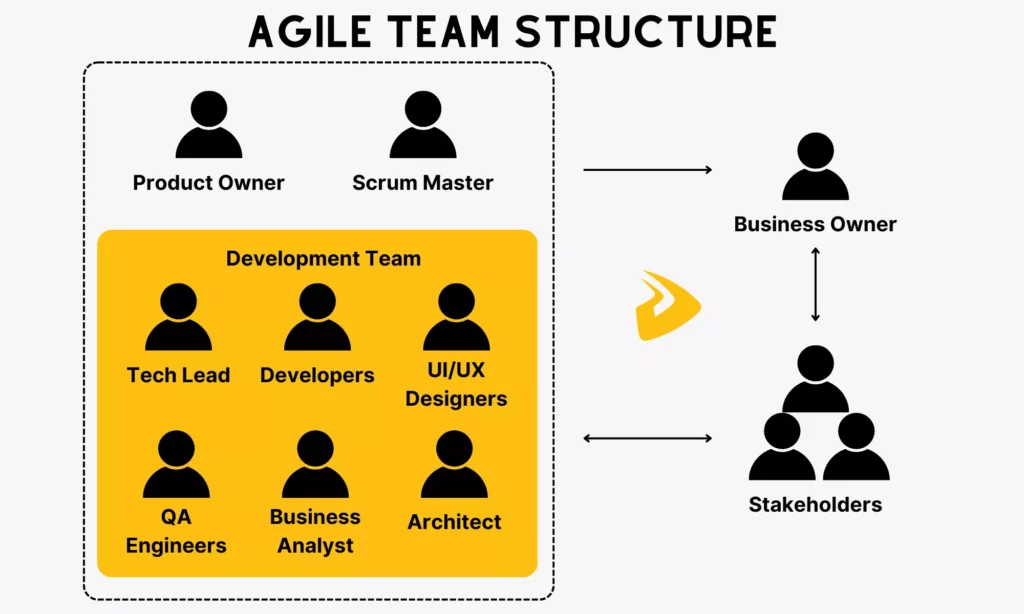
In terms of structure, most Agile teams are built around a few key roles working closely together. A common setup includes a Product Owner who defines priorities, a Scrum Master (or Agile Coach) who supports the process, and a group of developers or specialists who actually build the product. In larger organizations or more complex projects, many Agile teams are often set up and work together on a single program or product line.
Common Agile Team Structures
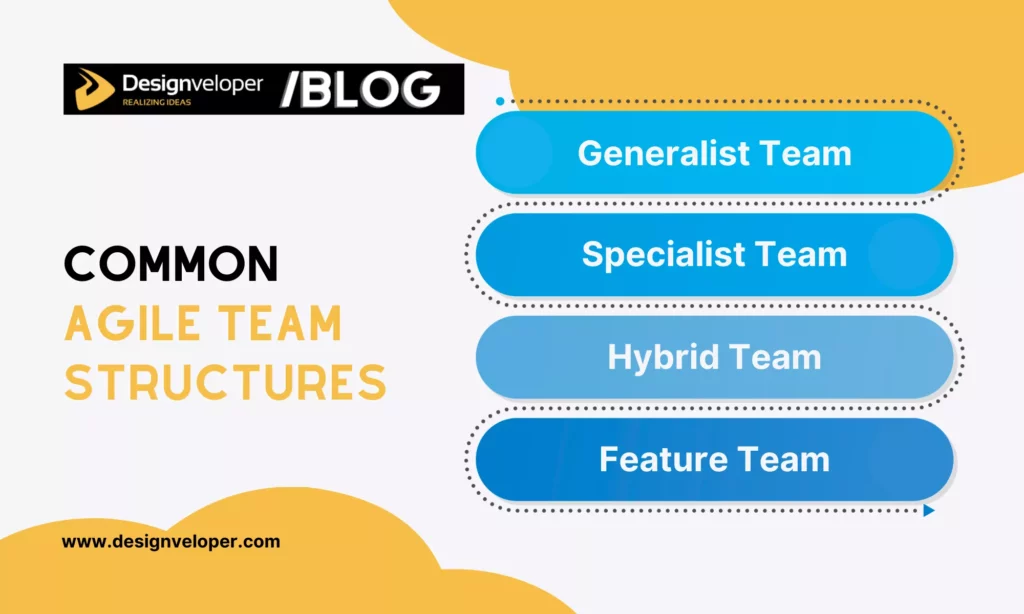
You’ve understood what the typical structure of Agile teams is. But in reality, an Agile team structure can appear in different shapes, adapting to different projects, goals, and constraints. Understanding these variations can help you form a structure that aligns with your specific use cases.
Generalist Team
A generalist team includes members with broad, overlapping skill sets rather than deep specialization. Accordingly, everyone can handle various types of tasks, from development and design to testing. This enables them to deliver features end-to-end collaboratively and flexibly jump into projects whenever needed to keep progress steady.
So, generalist teams often work best for smaller projects or startups that prioritize adaptability. But for more complex projects that require deep expertise, this Agile team structure is not the best choice.
Specialist Team
A specialist team is, of course, opposite to a generalist team. It’s made up of individuals with deep expertise in specific areas, like backend development, QA, or UX design. Each person goes deep on their domain, which can improve technical quality and efficiency, especially for complex systems.
This Agile team structure best fits large-scale or highly technical projects. But it requires more dependencies between roles. So, if the team doesn’t handle coordination carefully, it can slow development down.
Hybrid Team
A hybrid team blends the two approaches. Particularly, some members are specialists, while others have broader, cross-functional abilities. This creates a balance: teams get the technical depth they need without losing too much flexibility.
Hybrid teams are quite common, especially in growing organizations that need both efficiency and adaptability. But managing these teams is also challenging, because they may struggle with role clarity or uneven workload distribution.
Feature Team
A feature team is organized to deliver complete features. Instead of focusing on specific functions, the team needs all the skills to take a feature from idea to deployment. This reduces handoffs and makes the feature highly user-focused.
Feature teams are ideal for product-driven companies that prioritize continuous delivery and customer value. However, it can require significant coordination and, sometimes, there’s an overlap in skills across team members.
Agile Team Roles and Responsibilities

As we’ve seen, Agile teams can be structured in different ways. And depending on project requirements and frameworks, roles in Agile can shift. That said, most teams still grow around a few core ones:
Product Owner
The Product Owner is responsible for maximizing the value of the product. In particular, they connect stakeholders and the team, ensuring the right things get built at the right time.
Key responsibilities:
- Define and prioritize the product backlog
- Translate business needs into clear requirements
- Communicate the product vision to the team
- Gather and incorporate stakeholder and customer feedback
- Make decisions on scope and priorities
Alternative titles: Product Manager, Business Owner, or sometimes just “Product Lead” in less formal setups.
Scrum Master
The Scrum Master plays a crucial role if your team adopts the Scrum framework. They support the team by ensuring the whole team follows Agile practices and removing obstacles that slow the team down.
Key responsibilities:
- Facilitate Agile events (daily stand-ups, sprint planning, retrospectives)
- Remove blockers that affect team progress
- Coach the team on Agile principles and practices
- Protect the team from external disruptions
- Improve team processes over time
Alternative titles: Agile Coach, Iteration Manager, or Delivery Lead (depending on the framework).
Development Team
The Development Team includes all the people who build and deliver the product. Despite the name, it includes not just developers but also designers, testers, and other specialists, depending on project scope and requirements.
Below are the key responsibilities of a typical development team:
- Developers:
- Design, build, and test product features
- Collaborate to deliver working increments each sprint
- Estimate and plan their own work
- Maintain code quality and technical standards
- Continuously improve technical practices
- UX/UI Designers: Design user flows, interfaces, and overall user experience to ensure the product is intuitive and engaging
- Testers (QA Engineers): Validate functionality, identify bugs, and ensure the product meets quality standards before release
Supporting Roles (Optional)
Beyond those core roles, an Agile team can include the following additional roles to support the development work. These roles are often introduced when projects become more complex or require specific expertise.
- Business Analysts: Help refine requirements and bridge business–technical gaps. For example, at Designveloper, our BAs often gather requirements from clients or conduct further research to better understand user needs. Further, they support QA and testing processes and help with creating documentation and training materials.
- DevOps Engineers: Manage deployment pipelines and infrastructure. In companies like Designveloper, DevOps engineers particularly help build and maintain end-to-end CI/CD pipelines, implement GitOps workflows, write automation scripts, and operate AWS environments.
- System Architects: Define the overall system architecture, ensure scalability, and guide technical decisions across teams.
- Support/Service Engineers: Handle production issues, monitor system performance, and ensure smooth operation after deployment.
- Cybersecurity Specialists: Identify vulnerabilities, implement security measures, and ensure compliance with security standards.
How Agile Teams Work
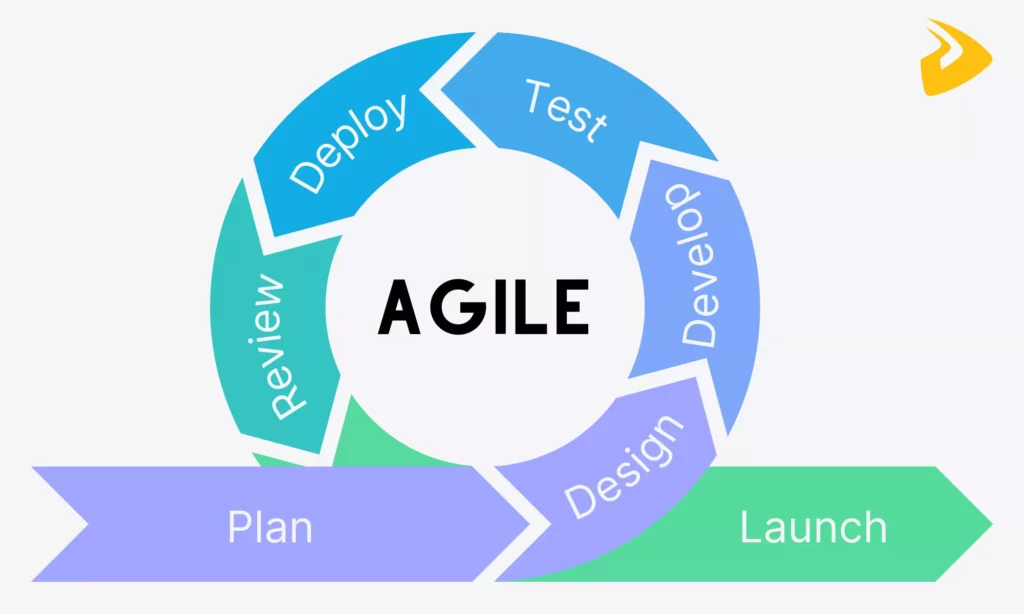
You’ve already learned about what roles a typical Agile team covers. But how do those people actually work together day by day to deliver real value to end users? This section will provide a sequence of events that Agile teams often follow to stay aligned:
This is where each iteration (or sprint) begins.
The team meets to decide what work they can actually complete in the upcoming sprint, based on priorities set by the Product Owner. In other words, they discuss and prioritize tasks that they can complete within a single sprint. At Designveloper, our team members are encouraged to adopt estimation techniques like t-shirt sizing or story points to estimate what they can or can’t do.
Finally, the team commits to a set of items and forms a shared understanding of what they need to deliver at the end of each sprint.
- Daily stand-ups
These are often short, focused check-ins that last around 15 minutes daily. During stand-ups, each team member shares what they worked on, what they’re doing next, and whether anything is blocking their progress. Through this sharing, everyone can stay aligned and spot issues early before they become bigger problems.
- Review & retrospective
At the end of the sprint, teams often hold two key sessions. In the review, they present completed work to stakeholders, gather feedback, and validate whether the product is going in the right direction. Then, teams have the retrospective to reflect on what went well, what didn’t, and what they could improve. Through those small reflections, people can continuously improve the development work and the product over time.
Agile Team Vs Traditional Team: Key Differences
With all the crucial information mentioned above, you now may understand how an Agile team truly looks and works. But many of you may wonder: How do Agile teams differ from traditional teams? The answer lies in the following comparison table:
| Aspect | Agile Team | Traditional Team |
| Planning & Flexibility | Iterative planning with room to adapt when priorities change | Detailed upfront planning with limited flexibility once started |
| Structure & Leadership | Flat, self-organizing teams with shared responsibility | Hierarchical structure with clear top-down management |
| Delivery | Incremental delivery in short cycles (sprints) | A finished product delivery at the end of the project |
| Collaboration & Communication | Continuous, informal communication (daily stand-ups, quick syncs) | More formal communication, often through documentation and reports |
| Customer Involvement | High involvement with regular feedback loops | Limited involvement, mostly at the beginning and end |
| Testing | Ongoing testing throughout development | Testing happens after development is completed |
| Risk Management | Risks identified and addressed early through iterations | Risks often discovered later in the process |
| Best for | Dynamic projects with evolving requirements | Stable projects with well-defined scope |
How to Build a High-Performing Agile Team
- Clear roles
- Communication
- Tools
- Continuous improvement
Despite enormous benefits, Agile frameworks themselves can’t guarantee success without having a good strategy to build a high-performing Agile team. That team doesn’t follow frameworks strictly but focuses on the crucial factors as follows to operate effectively:
- Clear roles
Even in flexible environments, clarity is important. That means everyone should understand their responsibilities, for example, who owns the backlog, who facilitates the process, and who builds and tests the product. Even in generalist teams, members also need to know who does what to avoid collisions and conflicts. Without clear roles, things can get messy fast.
- Communication
Communication takes place often in Agile, so it’s no wonder that knowing how to communicate well is important. High-performing Agile teams often communicate openly and frequently. This doesn’t mean they have to hold meetings all the time for sharing and discussions. But teams need to deliver honest feedback and be open about struggles or new ideas. Smooth communication can prevent bigger misunderstandings later on.
- Tools
The right tools don’t make a team Agile, but they make collaboration easier. Accordingly, tools for backlog management, task tracking, and communication help teams stay aligned, especially in distributed environments. Still, it’s important not to overcomplicate things; too many tools can actually slow teams down.
- Continuous improvement
Strong Agile teams regularly review how they work and look for ways to improve. So, consider Agile events like reviews and retrospectives as a good chance to reflect on past work, adjust processes, fix issues, and experiment with better approaches. Over time, these small changes add up and make your team operate better.
When Should You Use an Agile Team?

Many people think that Agile fits everywhere. But in reality, whether it works effectively depends a lot on project types, industry, and even company culture.
So, when does Agile work best? Here are several scenarios where you should adopt this approach:
- Software development & SaaS products that often face evolving requirements and prioritize fast delivery
- Startups and innovation-driven teams that want to test ideas quickly
- Marketing and creative projects that benefit from rapid iteration and constant feedback
- Product development environments where continuous user input defines the roadmap
- Industries undergoing digital transformation, like fintech, eCommerce, or health tech
But Agile may not be ideal when:
- Requirements are fixed and unlikely to change (such as in well-defined infrastructure projects)
- Strict regulatory or compliance constraints exist. Those constraints require heavy documentation and approvals, which may not be suitable for Agile.
- Stakeholders expect detailed upfront planning and fixed timelines
- Projects are small and simple. In these projects, requirements may rarely evolve or become complex, so investing in Agile may not be unnecessary.
FAQs About Agile Teams Structure
Can Agile Have a Core Central Coordinating Team?
Yes, usually in larger organizations. Individual Agile teams are typically self-organizing, as mentioned earlier. But how can a company manage a large-scale, complex project involving various Agile teams? A central coordinating group (sometimes called a program team or Agile leadership team) is the answer in this case.
Accordingly, they help align multiple teams around shared goals. They don’t control day-to-day work but provide guidance, resolve cross-team dependencies, and keep things moving in the same direction.
Who Makes Up an Agile Team?
An Agile team usually includes a Product Owner, a Scrum Master (or similar role), and a Development Team made up of developers, testers, designers, and other specialists. Depending on the setup, you might also see supporting roles like architects or DevOps engineers. The exact mix can vary, but an Agile team must cover all the necessary skills to deliver real value.
What is The Quality of an Agile Team in SAFe?
In SAFe (Scaled Agile Framework), one key quality of Agile teams is the ability to collaborate effectively while staying aligned with broader organizational goals. These teams are not just cross-functional and self-organizing. They also have to operate within a larger system and coordinate with other teams to deliver value at scale.
How Many People Are in an Agile Team?
Most Agile teams have around 5 to 9 members to balance between flexibility and capability. Of course, this number can vary depending on project complexity and available skills.
What Skills Are Needed in an Agile Team?
Agile teams need a mix of technical and soft skills. On the technical side, development, testing, design, and maybe DevOps are crucial. Meanwhile, soft skills needed are usually communication, collaboration, adaptability, and problem-solving.
Can Agile Teams Work Remotely?
Yes, and many Agile teams work quite effectively in distributed environments. With the right tools and communication habits, remote Agile teams can collaborate as well as co-located ones. That said, it does require a bit more intentional effort to manage remote Agile teams and ensure no one feels out of the loop.
Also published on

Share post on










Read more topics










You may also like



What Is An Agile Team? Structure, Roles & Responsibilities
What Is An Agile Team? Structure, Roles & Responsibilities Published March 19, 2026
What Is Agile Project Management? Benefits & Best Practices
What Is Agile Project Management? Benefits & Best Practices Published March 18, 2026
User Stories Examples & Template For Agile Development
User Stories Examples & Template For Agile Development Published March 18, 2026