












Make Enterprise Agent Handoffs Auditable With AI Data Lineage

AI data lineage makes enterprise agent handoffs auditable when it connects source records to agent decisions, permissions, approvals, and final actions. Each link must identify the data version, acting agent, and tool call. A reviewer can then trace an ERP update back through the workflow without guessing what happened between systems.
In its broader sense, AI data lineage maps data from its source through transformations to the model, application, or AI output that uses it. This guide focuses on the runtime part: which records an agent retrieved, how agents and tools handed them off, and which approved business action followed. Training and evaluation data lineage belongs to the wider model lifecycle. A data catalog or an agent activity log alone cannot establish both source history and authorization.
Distinguish Data Provenance From Agent Lineage
Data lineage maps the path from a data source through transformations to its destination. Data provenance looks more closely at the origin and history of a particular record or value. Agent lineage, or agent execution history, records which agents and tools used that record, what they did, and under which authority. These views answer different audit questions. Stable source and event identifiers connect them to the same business action.
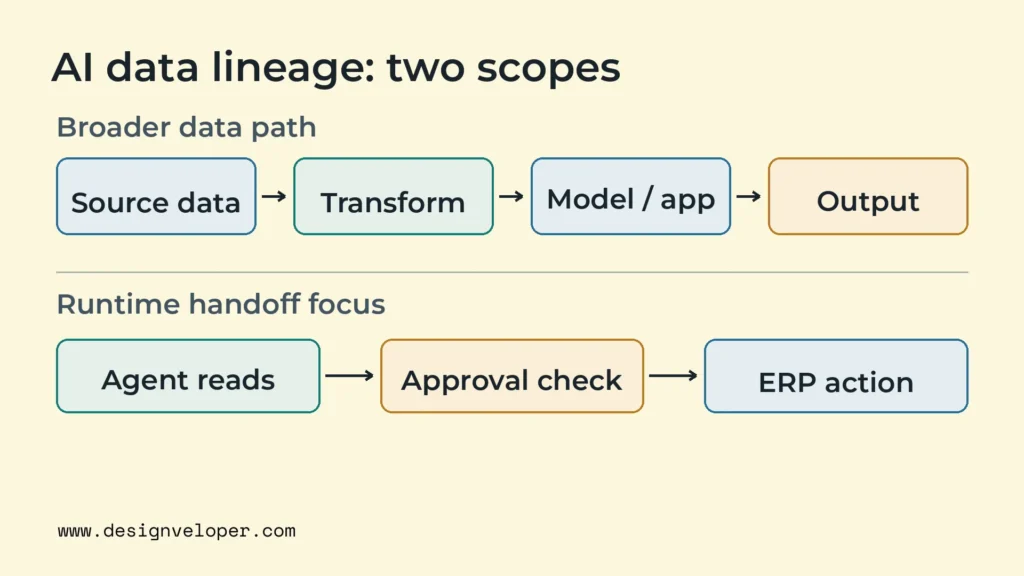
Consider an invoice amount. Its provenance identifies the original invoice, its version, and any correction to the recorded value. Its data lineage shows how extraction and later transformations moved the value into the matching process. These records help a reviewer check whether the amount came from the right source and how it changed. Google Cloud’s data lineage documentation describes how supported data assets and transformations can be inspected through lineage views. This is useful evidence about data movement, but it is not a complete record of an agent’s authority to change an ERP entry.
Agent lineage answers a different question: which agent received that amount, what task it performed, which tool it called, and whether the action was allowed. The term is useful here for the history of an agent workflow; it is not a claim that every platform defines a separate standard called AI agent lineage. Our guide to AI agent orchestration and handoffs explains why task routing, bounded tools, and review points matter when several agents cooperate.
The connection matters when an outcome is challenged. A trace might show that a matching agent passed a value to the next step, yet reveal nothing about the invoice version it read. A data lineage record might show an invoice transformation, yet reveal nothing about who authorized an ERP write. The W3C PROV ontology offers a useful conceptual foundation by distinguishing entities, activities, and responsible agents. The practical design task is to preserve those relationships across application boundaries.
Map Each Data Handoff From Source To Action
Map each handoff as a linked event, not just a row in a general activity log. Give every source object, transformation, agent message, proposed tool call, and resulting action an identifier that the next record can reference. Record when it occurred and who owns that stage.
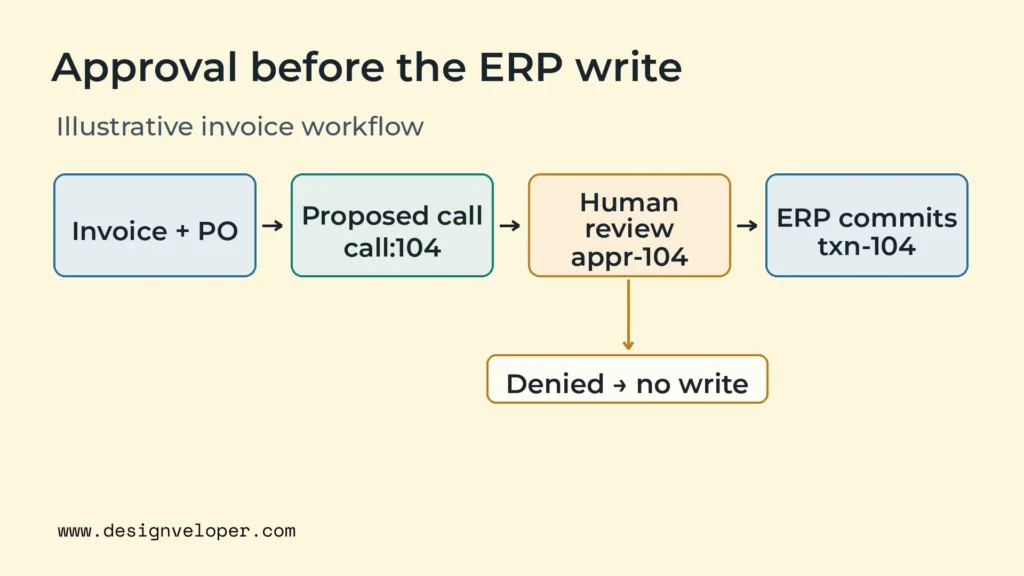
Consider this illustrative procurement workflow. One agent extracts values from an invoice. A second agent compares those values with a purchase order. A finance employee then approves the proposed ERP update. The identifiers and UTC times below are fictional, but they show what a reviewer would need to retrieve.
| Stage | Recorded evidence | Stable reference and UTC time | Accountable owner |
|---|---|---|---|
| Source and version | Invoice document, version 3 | src:inv-104:v3; 09:00 | Accounts payable |
| Retrieved or transformed data | Extracted invoice fields; parent source reference | extract:104:v1; 09:01 | Document agent owner |
| Agent handoff | Extracted fields sent to purchase-order matching agent | handoff:104; 09:02 | Matching agent owner |
| Tool call | ERP update request prepared; execution pending approval | call:104; 09:04 | ERP integration owner |
| Downstream action | Approval authorizes call:104; ERP transaction references that approval | appr-104; 09:05 / txn-104; 09:06 | Finance approver; ERP integration owner |
AI data lineage becomes audit evidence only when its references resolve to actual records. The handoff must point to the extracted fields, and the tool request must point to the matching decision. In the example, appr-104 authorizes call:104, and the committed ERP transaction txn-104 refers back to appr-104. Use a consistent workflow or correlation ID across systems, while keeping a separate identifier for each event.
Use event time, not the order in which a logging service receives records, to reconstruct the sequence. A retried message may arrive late. Store both the time the action happened and the time its record was collected, especially across separate systems. The ERP service must check a valid approval before committing the update. A later log entry cannot authorize an earlier write.
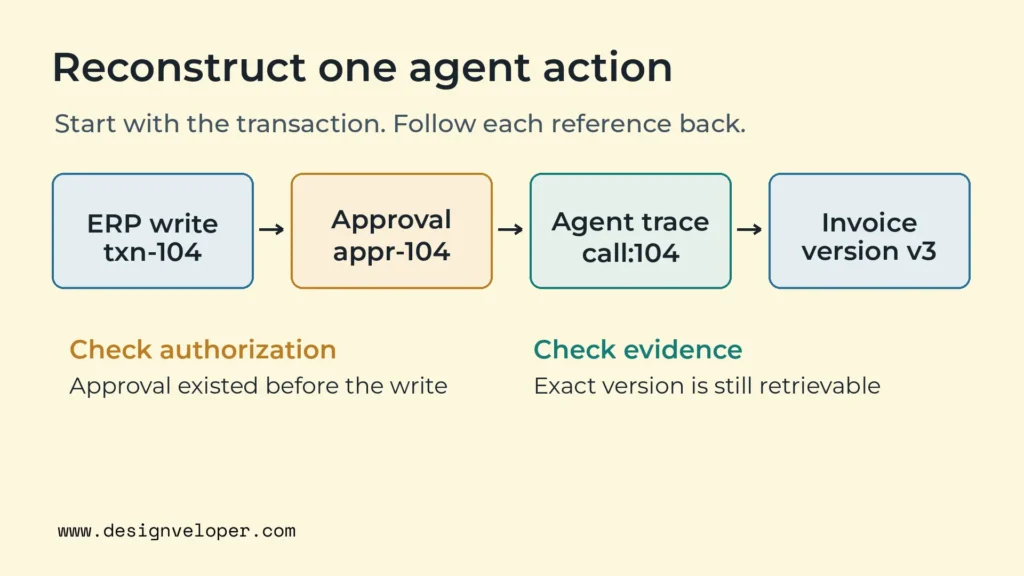
Record versions at the point of use. If the invoice changes after extraction, a link to the current document is not enough to reproduce the earlier decision. Preserve a versioned object reference or a governed snapshot, and record the transformation that created each derived value. For retrieval-based applications, our guide to building a RAG chatbot explains why document chunks, retrieval settings, and source freshness affect the context an AI system receives.
Choose the level of detail according to the possible harm. A table-level dependency may be enough to investigate a broken reporting pipeline. An invoice payment decision may need the exact document version, selected fields, match result, and authorized write. The OpenLineage object model documents jobs, runs, input datasets, and output datasets. Its event structure can inform the data part of a record, but a team still needs application-level events for approval and business actions.
Carry Permissions And Human Approval Through Every Handoff
Each handoff should carry evidence of who requested access, what they were allowed to do, which policy applied, and whether the request was approved or denied. A successful tool call alone cannot prove that the agent had the right authority at that time.
Give each agent a distinct service identity and a narrow access scope. The invoice-reading agent may need permission to read documents, not permission to post payments. The matching agent may need purchase-order read access, not the ability to modify supplier bank details. Our AI agent governance guide explains how owners, tool limits, and approval gates work together to keep those boundaries clear.
At each access attempt, record the acting identity, target resource, requested operation, access scope, policy version, decision, and event time. Keep denied attempts as well as allowed ones. For example, if the invoice agent requests an ERP write and policy blocks it, that denial is evidence that a control was exercised. Do not overwrite the denied event when the workflow later succeeds through an approved route.
Human approval needs its own durable record. In the illustrative procurement case, the matching agent prepares an update and marks it as pending. The finance approver reviews the invoice and purchase-order evidence, then approves a specific request. The ERP integration should verify that this approval still applies to that request before writing. Record the approver’s identity, decision, time, request ID, and any conditions or expiration.
Approval status must remain explicit: pending, approved, rejected, expired, or revoked, as the workflow requires. A message saying that someone approved the task is not the same as a checked authorization event. If the proposed amount or destination changes, require a fresh approval under the applicable policy. A later reviewer should be able to distinguish the agent’s recommendation from the person’s decision and the ERP system’s actual result.
The Agent Governance Toolkit’s provenance model illustrates fields for agent identity, source classification, transformations, policy decisions, and audit links. It is a useful schema reference, not proof that a complete cross-agent provenance chain is available out of the box. Its implementation-status table lists provenance-chain tracking with parent IDs as planned, while audit trail integration is shipped. A defined schema is not a working chain across agents. Design that join and verify that your chosen tools actually emit the required events.
Link Agent Traces To Governed Data Records
Connect execution traces to governed source records with shared identifiers. A trace shows the sequence of agent steps, while the governed record establishes the source, version, classification, and access context behind a step. Together, they let a reviewer reconstruct both behavior and evidence.
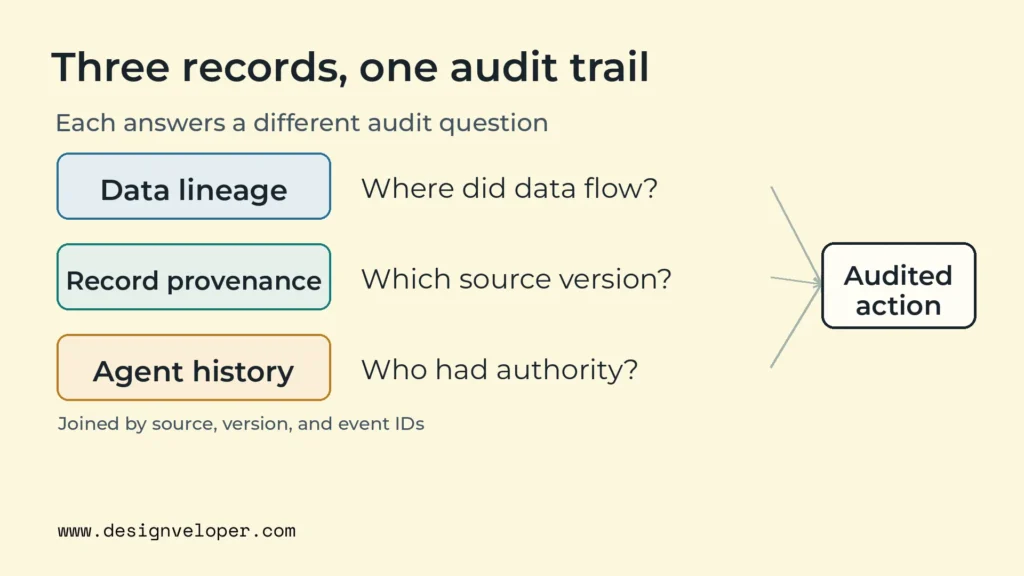
In a tracing system, a trace represents one request or workflow run, and spans represent steps inside it. Record the trace ID on the business event. On the retrieval or tool span, add the source version reference, handoff ID, policy decision ID, and resulting transaction ID where relevant. The MLflow tracing documentation distinguishes traces from ordinary experiment runs and describes automatic and manual instrumentation. Tracing a function does not automatically establish that its data source or approval was valid.
Versions help explain why two runs produced different outcomes. Record the prompt revision, model identifier, tool or application build, and retrieval configuration when each can affect the decision. A name such as latest is not a reproducible version reference. Our LLM deployment pipeline guide explains how versioned prompts, model settings, and retrieval indexes support testing and rollback. Link those release references to the action trace rather than relying on today’s deployment settings.
Trace storage creates a second data-governance problem when inputs contain invoices, employee details, or credentials. Prefer access-controlled pointers to the source record over copying full documents into every span. If auditors need the original content, provide an authorized way to retrieve the correct historical version. Keep sensitive payloads out of routine logs, define retention rules, and protect the evidence store against unauthorized changes. A content hash may help detect a changed file, but it cannot prove that the original information was correct.
Existing data tools can help with parts of this design. Amazon DataZone lineage documentation describes dataset and job-run relationships, including authorization for lineage events. Google Cloud also documents a data lineage MCP server that agents can query using defined roles; the remote feature is marked Preview. Neither capability should be mistaken for proof that a particular ERP change passed an organization’s approval rules. That last link must be created and tested inside the business workflow.
Start With One High-Risk Workflow And Expand
Start with one consequential workflow and prove that an independent reviewer can reconstruct a single action from its sources to its outcome. Do not begin by trying to catalog every agent in the organization. The first implementation should expose missing evidence while the workflow and its owners are still manageable.
- Select the decision. Choose a process with real consequences, such as an invoice update that requires approval. Name the business owner, the systems involved, and the action that must never happen without authorization.
- Define the record contract. Agree on source and version references, event IDs, parent links, timestamps, agent identities, policy decisions, approval states, and the final transaction reference. Assign an owner to each event.
- Instrument the joins. Capture events where data is read, transformed, handed off, checked, and written. Propagate correlation IDs across services. Verify that failed calls and denied access attempts are recorded, not just successful steps.
- Test the reconstruction. Give a reviewer the ERP transaction ID and ask them to find the exact source version, agent trace, permissions, approval, and result. Repeat the test with a denied write, a changed invoice, and an expired approval.
- Expand only after the evidence holds. Fix gaps, confirm record retention and reviewer access, and assign support ownership. Reuse the tested event contract for a second workflow, adjusting fields only when its risks require it.
Make the acceptance test binary where possible. Can a reviewer retrieve the source as it existed at decision time? Can they tell whether approval preceded the write? And finally, can they identify a denied request and the control that stopped it? Record the answers and the missing links. A dashboard that looks complete is not sufficient if a reviewer still needs to ask an engineer what happened.
Our AI business process automation guide recommends clarifying the process and its human checkpoints before adding automation. Applied to lineage, that means agreeing on the invoice owner, the approval rule, and the exact point where an ERP write is permitted. These decisions determine which records the pilot must capture. Once reviewers can follow a complete action and its exceptions, the same method can support broader agent workflow governance without assuming that more logging alone creates accountability.
If your team is preparing an agent workflow that reads governed data and updates existing systems, our AI development services cover custom AI software and integrations. Before discussing a build, document the source-to-action map, required approval gate, and one transaction reviewers must be able to reconstruct. These details help define the integration work without assuming that platform logging is enough.
Also published on

Share post on










Related Articles


Make Enterprise Agent Handoffs Auditable With AI Data Lineage
Make Enterprise Agent Handoffs Auditable With AI Data Lineage Published November 16, 2026
Top 10 Retrieval-Augmented Generation (RAG) Examples By Industry
Top 10 Retrieval-Augmented Generation (RAG) Examples By Industry Published October 28, 2026
Data And AI Strategy: A Practical Roadmap For Business Growth
Data And AI Strategy: A Practical Roadmap For Business Growth Published October 14, 2026