











AI Implementation Roadmap For SMEs: From Pilot To Business Value

An AI implementation roadmap for SMEs is a practical plan for choosing one business problem, testing a suitable AI solution, and expanding only after a pilot proves its value. Start with a repeatable workflow and a measurable baseline. Then check your data and risks, choose the simplest workable solution, test it with staff, and use the results to decide whether to scale, revise, or stop.
The roadmap should protect a small team’s time as well as its budget. It does not require a custom model or a company-wide rollout. Each stage needs an owner, evidence, and a clear decision before more money or responsibility is committed.
Prioritize AI Use Cases For SME Business Goals
Choose the first AI use case by its business result, not by how impressive the technology looks. Find a task that repeats often, has a clear owner, and causes a problem you can measure. A support manager might want to reduce the time spent sorting incoming requests. A finance lead might want fewer invoice fields entered by hand.
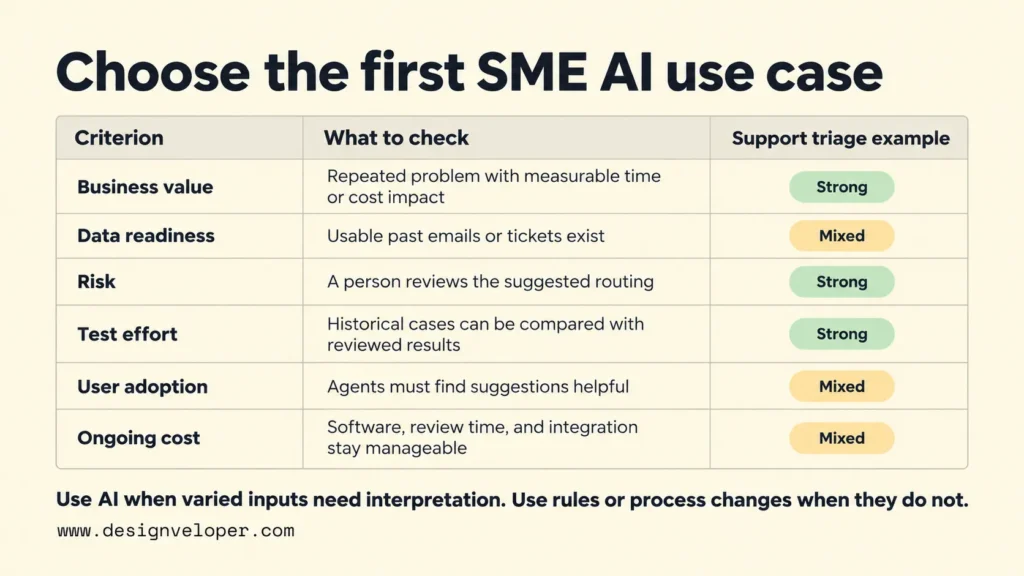
Before proposing AI, ask whether a process change, a simple rule, or a feature in existing software can solve the problem. Rules are often enough when every request follows the same format. AI becomes more useful when someone must interpret varied emails, documents, or questions. Our guide to AI automation explains that distinction and why people still need to handle sensitive decisions and exceptions.
Compare a short list of possible workflows using six questions. Is the potential benefit meaningful? Is the data ready? What could go wrong? How hard is a useful test? Will staff adopt the change? Can the business afford to run it after launch? Use a simple strong, mixed, or weak rating for each answer. Do not add the ratings into a supposedly precise score when the evidence is still uncertain.
Consider an illustrative pilot in which AI reads support emails and suggests a category, but a staff member approves the routing. Its initial assessment could look like this:
| Criterion | Illustrative fit | Reason to test |
|---|---|---|
| Business value | Strong | Incoming messages take staff time to sort, and handling time can be measured. |
| Data readiness | Mixed | Past tickets exist, but categories and labels may be inconsistent. |
| Risk | Strong for a supervised pilot | A person checks the routing; urgent or sensitive requests never receive automatic final decisions. |
| Test effort | Strong | The team can compare suggested categories with reviewed historical tickets. |
| User adoption | Mixed | Agents must find the suggestions useful rather than spend extra time correcting them. |
| Ongoing cost | Mixed | Software fees, review time, and help-desk integration remain to be estimated. |
That pilot is more promising than its ratings alone suggest because mistakes can be caught before they reach customers. Invoice extraction may also save time, but payment approval should remain separate from field extraction. Internal knowledge search can be a useful first test when documents are current and access permissions are sound. The right choice depends on the SME’s own workflow, not a universal ranking of AI use cases for SMEs.
Assess SME Readiness Before Choosing A Solution
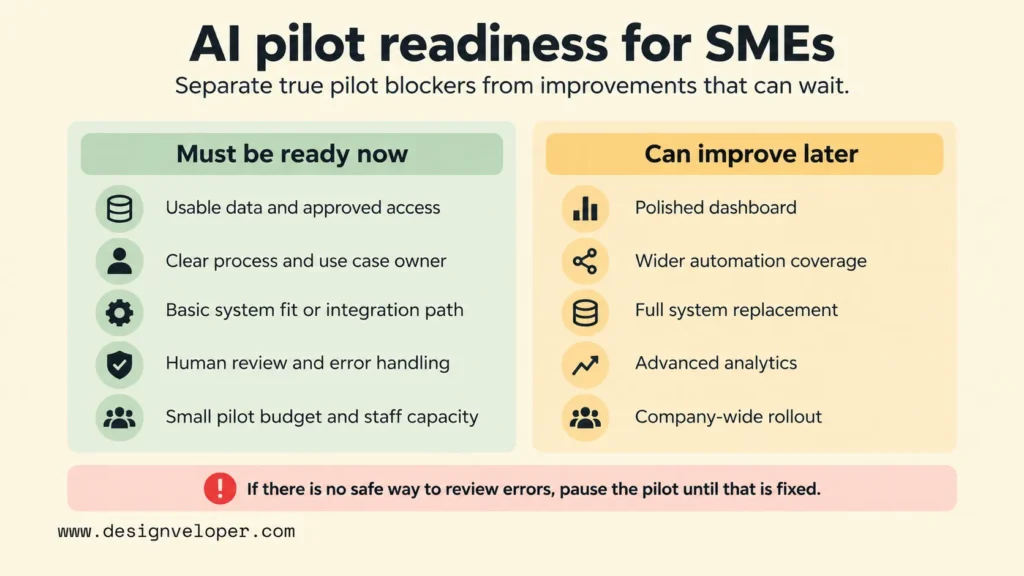
An SME is ready for a pilot when it can supply usable information, assign responsible people, and test the work without exposing the business to unacceptable harm. Readiness is not the same as having a large technical team. It means the minimum conditions for a reliable experiment are in place.
Start with a sample of real inputs. Check whether customer requests, invoices, or reference documents are complete, current, and available for the proposed purpose. Ask who may see them and whether a vendor is allowed to process them. A knowledge assistant cannot give dependable answers if it searches outdated policies or reveals files that some employees should not access.
Next, check the work around the data. Can the current help desk or accounting system connect to the proposed tool? Does the process have clear steps, or does each employee handle it differently? Who can answer staff questions, review errors, and approve a pilot budget? Our business process automation guide explains why redesigning a weak workflow matters more than placing AI on top of it.
The OECD’s 2025 report on AI adoption by SMEs identifies connectivity, data and computing resources, skills, and finance as important conditions for adoption. It also describes different needs among firms with different levels of digital maturity. This is a reason to assess your own constraints rather than copy a larger company’s implementation plan.
Separate pilot blockers from later improvements. No lawful route to the needed data, no accountable reviewer, or no safe way to handle errors should stop the test until fixed. A polished dashboard, a complete system replacement, or automation of every exception can wait. If the core process is too inconsistent to measure, standardize a small part of it first and reassess whether AI is still needed.
Follow A Five-Phase AI Implementation Roadmap For SMEs
Use five phases to turn an idea into a decision supported by evidence. Each phase produces a small deliverable and ends with a question the owner must answer. The sequence prevents a successful demonstration from being mistaken for a solution that employees can use safely every day.
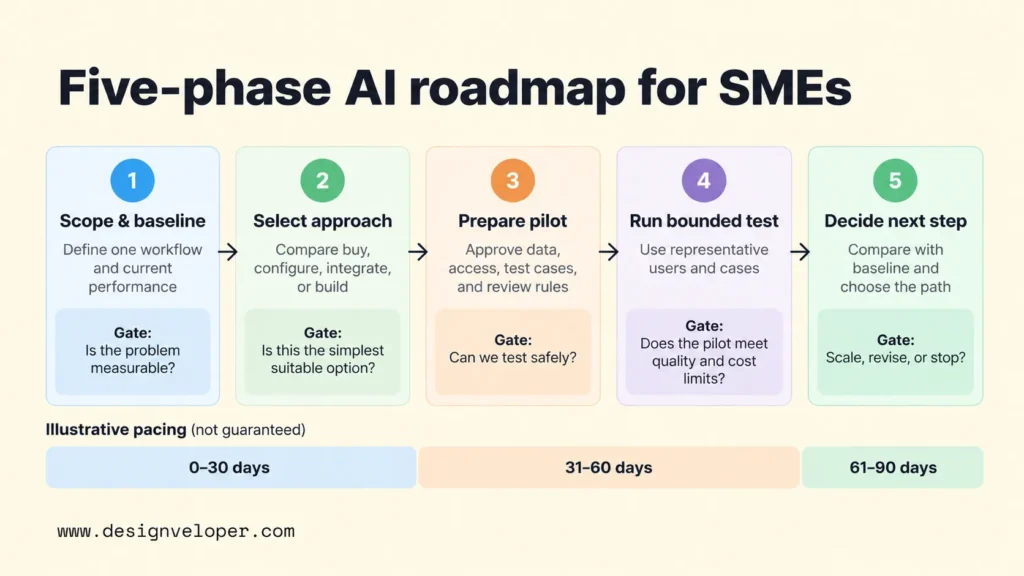
| Phase | Owner | Deliverable | Decision gate |
|---|---|---|---|
| 1. Scope and baseline | Workflow owner | One defined task, current performance, target, and excluded cases | Is the problem measurable and worth testing? |
| 2. Select the approach | Business owner with technical adviser | Comparison of existing software, configured AI, integration, and custom build | Is the chosen option simpler and more suitable than the alternatives? |
| 3. Prepare the pilot | Technical lead and data owner | Approved data access, test cases, review rules, and fallback process | Can the team test safely with usable data and a named reviewer? |
| 4. Run a bounded test | Pilot owner and participating staff | Recorded results from normal, difficult, and failure cases | Does the pilot meet its quality, safety, adoption, and cost limits? |
| 5. Decide and plan | Business sponsor | Comparison with the baseline and a scale, revise, or stop decision | Is there enough evidence and capacity to operate the next release? |
In phase one, define exactly what enters and leaves the process. For support triage, the input might be an incoming email and the output a proposed queue. Track current sorting time and incorrect assignments before introducing AI. Exclude complaints requiring legal review or other high-impact judgment from the first test. Without a clear boundary, a pilot can appear successful by handling only easy cases.
Phase two is a solution decision, not a model contest. Buy when an existing product already fits the task and its security and data terms are acceptable. Configure a built-in feature when the workflow is close to standard. Integrate services when the business needs data to move between tools. Build a custom application only when its extra control or workflow fit justifies the cost of development and support.
Compare ownership and recurring costs before choosing. A hosted AI service may avoid model infrastructure, but someone still owns access rules, application changes, and output review. In our AI development cost guide, we separate initial build costs from recurring usage, integration, monitoring, and maintenance. Ask any vendor to make those assumptions explicit in its estimate.
Phase three prepares a small, representative test set. Include ordinary inputs, incomplete records, ambiguous requests, and cases the system must refuse or escalate. Give the pilot only the access it needs. Set who can approve an AI suggestion, where mistakes will be logged, and how staff will finish the work manually if the tool fails.
Phase four puts the proposed workflow in front of the people who will use it. Start with a limited group and supervised outputs. Record not only successful answers but also corrections, missed cases, time spent reviewing, and incidents. A test on convenient examples alone cannot show whether the workflow will hold up in daily use.
In phase five, compare the pilot with the baseline and the agreed limits. Scale if the improvement is worthwhile and the team can support it. Revise if a specific problem seems fixable and another test can settle it. Stop if the costs exceed the gains or a material risk cannot be controlled. A decision to stop protects the business from further investment in a weak use case.
Set Proportionate AI Governance And Human Oversight
SME AI governance should give every use case an owner, clear limits, and a way to correct or stop unsafe behavior. It should not require a large committee for a low-risk drafting assistant. The more harm a mistake could cause, the stronger the approval and monitoring controls should be.
Start with a one-page operating record. Name the accountable business owner and the person who reviews outputs. State which data the tool may receive, which actions it may take, and which tasks remain human decisions. Record the vendor’s data-handling terms, retention settings, security responsibilities, and exit options before connecting company information.
Human oversight must be specific enough to use. A staff member can approve a ticket category before routing, while a finance manager must approve any payment. Set an escalation route for incorrect or sensitive results. Keep a manual fallback for outages and a way to suspend the tool if it starts causing harm. A reviewer who cannot see the evidence behind an action may only add delay, not effective control.
The US NIST AI Risk Management Framework provides voluntary guidance for managing AI risks. Its Govern, Map, Measure, and Manage functions help organizations assign responsibility, understand context, assess risks, and respond. NIST AI RMF 1.0 was released in 2023 and is being revised; it is not a substitute for laws or sector-specific duties that apply to the business.
For a document summarizer used on public information, sample review and basic access rules may be enough. For a tool that changes customer accounts, recommends credit decisions, or handles medical information, the consequences are different. Such uses may require more testing, stronger human authority, and legal review before deployment. Our enterprise AI governance framework guide gives a fuller view of roles and controls; a small company should adopt only the parts its risks justify.
Measure Pilot Value Before Scaling AI
Scale an SME AI pilot only when it improves a meaningful business measure without creating unacceptable errors or operating costs. A fast demonstration is not evidence of business value. Decide in advance which result would justify continued investment and who has authority to make that decision.
Record the baseline and target for one primary measure. For support triage, this could be the time from ticket arrival to correct assignment. Track it over a period that reflects ordinary workload. Use the same definition during the pilot, and note changes in volume or case difficulty. If the team starts counting only easy tickets, the before-and-after comparison is misleading.
Pair the business outcome with evidence of quality. Measure the share of tickets assigned to the right queue, the number requiring correction, and whether urgent cases reach a person promptly. Observe staff adoption as well: a tool that saves seconds per message but needs frequent corrections may increase total work. Review any harmful failures separately instead of hiding them inside a good average.
Include the full cost of running the workflow. Add subscription or model charges, integration upkeep, time spent checking outputs, staff training, support, and security work. For an illustrative calculation, suppose the new process saves 12 staff hours in one period. If review and correction take 10 hours, the net saving is only two hours before other expenses. These are example figures, not observed SME results.
Agree on a review cycle and thresholds before the test starts. A pilot owner might review errors weekly and bring a final recommendation to the sponsor after enough representative cases have accumulated. Proceed only if the target outcome is met, key failure limits hold, and total cost remains acceptable. If the data is too sparse, extend the test rather than declaring success. If a serious risk appears, pause the workflow even if its average performance looks good.
Roll Out AI Without Overloading A Small Team
Roll out a proven AI workflow gradually, with training and ongoing ownership built into normal work. Keep the first release narrow enough that employees can report mistakes and return to the old process when needed. An SME does not gain capacity by introducing a tool that no one has time to maintain.
Train the people who use the system on three things: what the AI is allowed to do, how to check its work, and when to escalate. Show them real examples from the pilot rather than only ideal demonstrations. Update the written procedure so staff know which steps have changed and who approves the final outcome.
Give one person responsibility for reviewing performance after launch. That owner should check errors, usage, cost, vendor changes, and feedback at a frequency suitable for the workflow. A second person can handle technical fixes, but the business owner still decides whether the process is delivering value. Our guide to AI model monitoring explains how to distinguish a working technical service from a system that still produces useful business outcomes.
Expand only after the first workflow remains dependable under normal conditions. More users, more data, or an additional department can introduce new permissions and failure cases. Treat each change as a small release with its own checks. If the next workflow needs a different data source or approval rule, reassess its readiness instead of assuming the first pilot proves it will work.
When existing products cannot meet the required workflow or integration needs, our AI development services offer a route to a tailored solution. Before asking any delivery partner to build one, bring a defined process, a baseline, approved data boundaries, and a clear success gate. That brief makes it easier to judge whether custom work would create enough value to justify its ongoing ownership.
Also published on

Share post on










Related Articles



On-Device AI For Mobile Apps And When A Hybrid Setup Fits Best
On-Device AI For Mobile Apps And When A Hybrid Setup Fits Best Published October 23, 2026
How To Make The Build Vs Buy Software Decision With Confidence
How To Make The Build Vs Buy Software Decision With Confidence Published October 23, 2026
AI Implementation Roadmap For SMEs: From Pilot To Business Value
AI Implementation Roadmap For SMEs: From Pilot To Business Value Published October 23, 2026