















Development Team Extension: When It Fits And How To Make It Work

Development team extension adds external engineers to an existing in-house team when it needs more capacity or specialist skills. It fits ongoing work when your engineering lead can set priorities, review code, and help new contributors learn the product. Without that internal support, adding developers may create more coordination work rather than solve the problem; a provider-led project may fit better.
What Is Development Team Extension?
Development team extension is an engagement model in which external developers join an existing in-house engineering team. They use its agreed backlog, tools, and delivery process, while the client’s engineers usually direct their day-to-day work. The actual split of responsibilities depends on the contract. You may also see the terms software development team extension or extended development team for this arrangement.
In a common arrangement, your engineering lead approves technical decisions and decides when code can ship. The provider recruits the developers and may handle employment contracts, payroll, and replacements. These are typical duties, not fixed rules. The agreement must say who employs each person, who resolves daily blockers, and who is responsible if a deliverable fails acceptance.
For example, a company with an established checkout platform might add a senior backend engineer for an ongoing payments roadmap. That engineer joins planning meetings, uses the company’s repository, and submits code for the same reviews as internal staff. The client still decides which changes are safe to release. For a related explanation of adding outside specialists under internal direction, see our guide to IT staff augmentation for growing companies.
This integration is what matters most. Calling several people an extended team does not show whether they will stay assigned to your product, who can replace them, or how their work will be accepted. Those details must be settled before work starts.
How Development Team Extension Differs From Staff Augmentation, Dedicated Teams, And Outsourcing
Team extension and staff augmentation often describe almost the same working arrangement: outside specialists join a team the client already leads. A dedicated team usually offers a more stable group, sometimes with its own lead. Project outsourcing usually asks the provider to deliver an agreed result. Providers do not use these labels consistently, so the table describes typical arrangements rather than fixed industry definitions.
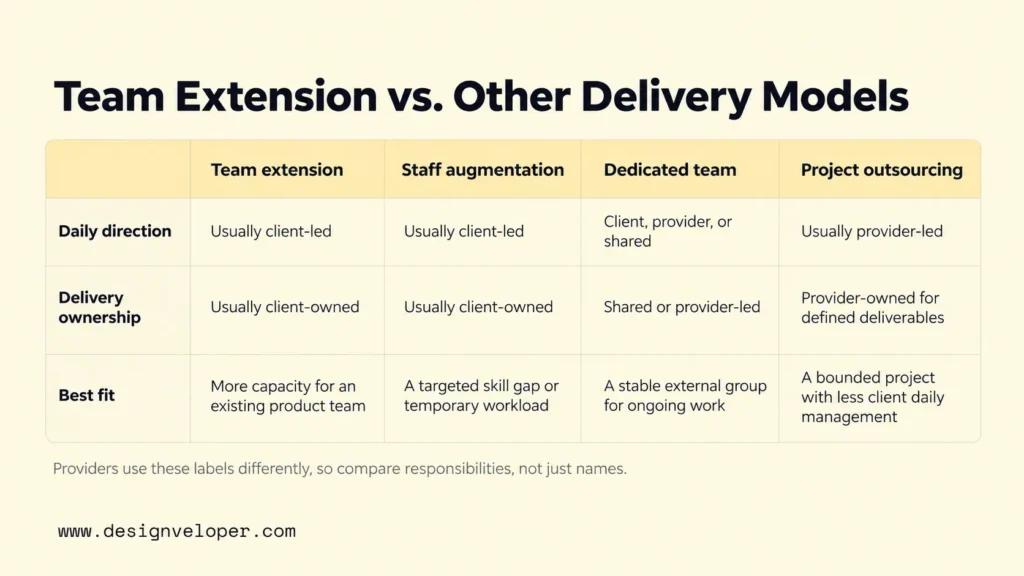
| Model | Staffing unit | Who directs daily work | Delivery ownership | Engagement scope | Best-fit situation |
|---|---|---|---|---|---|
| Development team extension | Named developers embedded with an existing team | Usually the client’s engineering lead | Usually the client, unless the contract assigns specific outcomes | Continuing work on a shared product backlog | More capacity with internal technical leadership |
| Staff augmentation | Individual specialists or roles | Usually the client | Usually the client | A skill gap or flexible staffing need | Targeted expertise or a temporary workload increase |
| Dedicated team | A stable group, sometimes with a provider lead | Client, provider, or both as agreed | Shared or provider-led for an agreed workstream | Ongoing product or workstream | Continuity when a whole group is needed |
| Project outsourcing | Provider-organized delivery team | Usually the provider | Provider for defined deliverables, subject to contract | Agreed scope and acceptance criteria | A bounded project with less client-led daily management |
Look first at who can change priorities, approve architecture, accept releases, and remove a developer from the assignment. If you must supply all those decisions, the proposal behaves like team extension even if the vendor calls it a dedicated team. Our overview of software development outsourcing models explains how staffing and delivery contracts can create different duties.
Also separate employment from delivery control. An engineer can be employed by the provider while taking daily direction from your team. Conversely, a provider may run development while you retain product ownership and final acceptance. Ask each bidder to mark these responsibilities in writing; a marketing label cannot answer them.
When To Extend Your Development Team
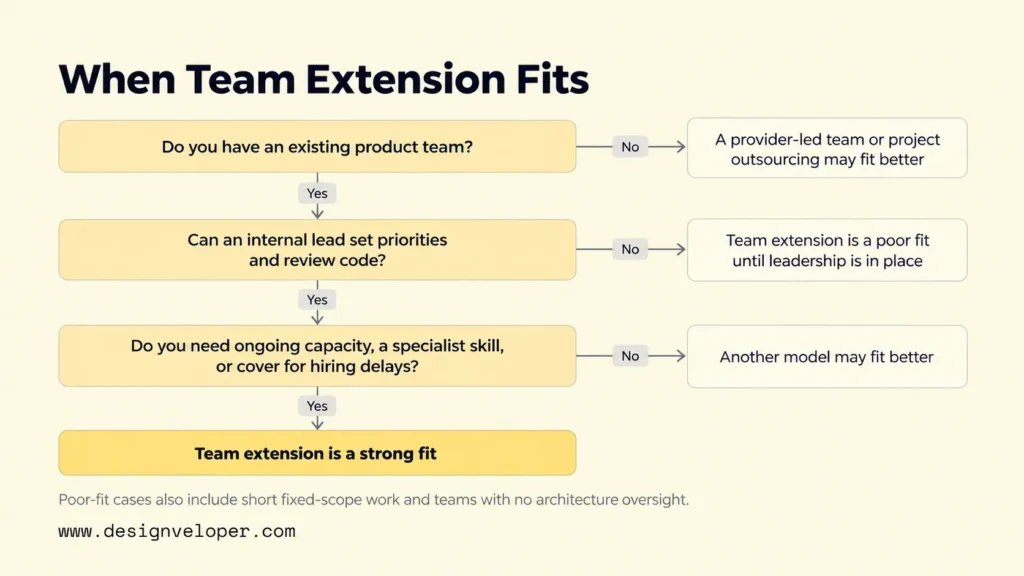
Extend your team when the work belongs to an existing product and you already have someone who can guide outside engineers. Strong candidates include an ongoing roadmap, a specialist gap, and hiring delays that would otherwise leave planned work unfinished. The key condition is available internal leadership, not merely a shortage of developers.
Ongoing roadmap work benefits from shared context. If your product changes every sprint, an embedded engineer can learn its code and decisions over time. That makes recurring feature work more suitable than a one-off assignment with little need for product knowledge. A named developer and clear notice periods also make that continuity easier to protect.
A specific skill gap can justify a smaller extension. Suppose the core team can own a cloud migration but lacks experience with deployment automation. An external specialist could build that pipeline with an internal engineer, document it, and transfer its maintenance. In this case, the goal is not simply extra output. It is to close the immediate gap without leaving a system that only the external specialist understands.
Hiring delays create another reasonable use case, but the timing must account for onboarding. If interviews for a permanent role are still underway, compare the expected time to recruit with the time required to select, onboard, and support an external developer. A short contract is useful only if the person can complete meaningful work before the engagement ends.
The model is a poor fit when nobody inside the company can review code or resolve architecture questions. It is also weak for a short, fixed-scope deliverable that a provider could own from start to acceptance. In either case, compare an accountable delivery partner rather than buying additional people you cannot manage. For a longer workstream that needs its own group, our offshore dedicated development team guide explains the continuity and management trade-offs.
One useful readiness test is to ask your engineering lead to name the first two tasks, the reviewer for each, and the person who can resolve blockers. If these names and tasks are unclear, improve the working setup before adding capacity. More engineers will otherwise wait for the same decisions that slow the current team.
What Does Development Team Extension Cost?
Development team extension costs depend on the roles you need, where the developers work, how long they are assigned, and what the provider includes in its fee. There is no useful universal hourly rate. A quote for a senior security engineer cannot be compared fairly with a quote for a junior application developer, especially when the two fees cover different services.
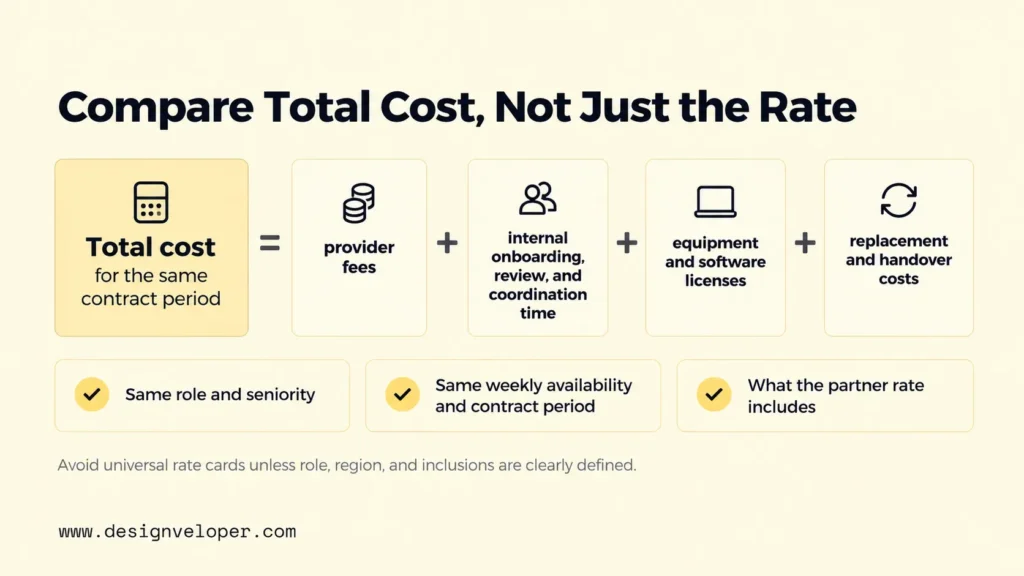
Start with a like-for-like proposal for the same role, experience level, weekly availability, and contract period. Then ask what happens during holidays, sickness, replacement, and early termination. A low headline rate can leave you paying separately for recruiting, equipment, or time when a new person is still learning the system.
| Cost factor | Why it changes the cost | What to request from a partner |
|---|---|---|
| Role and seniority | Specialist skills and experience change the proposed fee. | Named role, skill expectations, screening method, and seniority definition |
| Location and overlap | Markets differ, and required meeting hours may limit staffing options. | Work location, agreed overlap hours, and holiday calendar |
| Engagement length | Minimum terms and notice rules affect how much capacity you must buy. | Minimum commitment, renewal terms, and exit notice |
| Rate inclusions | Recruiting, management, equipment, and replacement may be bundled or extra. | Itemized inclusions, exclusions, and additional charges |
| Client-side effort | Onboarding, reviews, coordination, and handover consume internal time. | Expected client responsibilities and a handover plan |
For a sound total-cost comparison, start with the provider’s fees for the same contract period. Estimate the hours your team will spend on onboarding, code reviews, and coordination. Multiply those hours by a consistent internal hourly cost, then add equipment, software licenses, and expected replacement or handover costs. State your assumptions so you can compare proposals on the same basis rather than judging the invoice alone.
For example, two partners might quote the same monthly fee for an engineer. One includes replacement and equipment, while the other charges for both. The second proposal may cost more even before you consider its notice period. Compare a defined operating period and all included services, not the quoted rate alone. Our broader guide to software development cost factors can help separate the cost of people from the cost of the work being delivered.
How To Choose A Development Team Extension Partner
Choose a partner by checking whether its developers can join your workflow and remain accountable under clear terms. The sales presentation matters less than how candidates are assessed, how changes are handled, and what happens when someone leaves. Ask for written evidence and specific contract answers before choosing on price.
Technical screening should resemble the work the person will do. Ask who evaluates applicants, whether you can interview the proposed developer, and how you can assess a relevant code sample or architecture discussion. A general programming test says less about fit than an exercise tied to your actual stack. Do not give candidates confidential production code simply to make the exercise realistic.
Retention and replacement terms protect the knowledge you invest in onboarding. Ask whether the people are assigned exclusively to your work, what notice applies to a change, and whether a replacement must pass your interview. The contract should also say who pays for overlap and knowledge transfer. If the partner cannot keep the same people, a well-defined handover is the next-best protection.
Communication should be tested before the start date. Confirm the working language, decision-making channels, time-zone overlap, escalation contact, and expected response time for blockers. Request a short example of a weekly status update. The point is to learn whether an external engineer can get a timely answer from the right person, not to add meetings for their own sake.
Security and intellectual property need separate written treatment. Agree on confidentiality, the ownership or assignment of work product, permitted tools, access removal, and incident reporting. Ask how the provider protects development environments and manages access. The NIST Secure Software Development Framework is a useful reference for discussing secure development practices, but it does not replace legal review of your contract or your own security checks.
References are most useful when they match the proposed engagement. Ask for a relevant public case study or a reference who can discuss developer continuity, review quality, and communication. Also test contract flexibility: whether you can add a specialist, reduce capacity, or end the assignment under stated notice rules. For a related but different purchase, our guide to choosing a dedicated development team helps assess provider fit when you may need a whole group rather than embedded individuals.
Finally, request a one-page responsibility agreement. It should name who assigns tasks, approves designs, reviews code, controls deployment, accepts deliverables, and manages staff changes. If two parties both assume the other owns one of these duties, that gap is likely to matter more than a small difference in the hourly fee.
How To Integrate Extended Developers Into Your Existing Team
Integrate extended developers as contributors to the same product, not as a separate queue of outsourced tickets. Give them a named internal contact, a small first assignment, and access only to the systems they need. The first sprint should prove that tasks can move from understanding to reviewed code without confusing ownership.
Before the start date, prepare a short guide to the product’s purpose, key services, local setup, test process, and coding standards. Include current architecture decisions and known risks, not just a repository link. An internal developer should walk through the first task and explain why it matters. That conversation can uncover missing documentation before it blocks a larger piece of work.
Make access specific and reviewable. Use individual accounts, least-privilege permissions, and an agreed process for granting and removing access. Protect the main branch with reviews and appropriate checks. GitHub’s CODEOWNERS documentation explains one way to request reviews from the right maintainers; repository owners can also require those approvals when the setting is available.
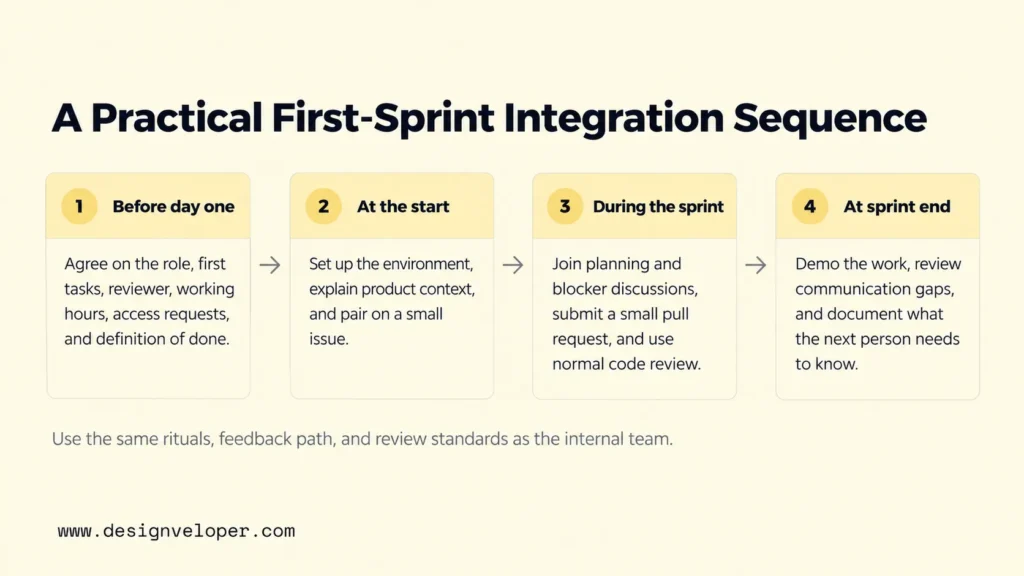
A short first-sprint sequence keeps onboarding practical:
- Before day one: Agree on the role, first tasks, reviewer, working hours, access requests, and definition of done.
- At the start: Set up the development environment, review product context, and pair on a small issue.
- During the sprint: Join the team’s planning and blocker discussions, submit a small pull request, and receive normal code review.
- At sprint end: Demonstrate completed work, check access and communication gaps, and document what the next person would need to know.
Use the existing team rituals rather than creating a second process. An outside developer should have the same route to ask questions, raise risks, and get feedback as an internal colleague. Agree on a daily overlap window for decisions that cannot wait. When time zones barely overlap, write task context and acceptance criteria clearly enough for work to continue asynchronously.
Keep knowledge transfer continuous. Require short notes for important design decisions, internal review of risky changes, and shared ownership of critical areas. A handover document written only in the final week is too late to fix undocumented assumptions. Review collaboration after the first sprint, then decide whether to increase scope, change support, or stop the engagement.
Before contacting a provider, prepare a short brief with the missing skills, expected assignment length, available internal lead, first deliverable, and security boundaries. We recommend asking every bidder to return both a staffing proposal and a responsibility split, so you can compare real working models. If you want to discuss how that choice fits an existing product, our software development services page describes the broader development work we support. Use the first sprint to judge whether the proposed partnership actually fits your team.
Also published on

Share post on










Related Articles



Development Team Extension: When It Fits And How To Make It Work
Development Team Extension: When It Fits And How To Make It Work Published October 22, 2026
Offshore Dedicated Development Team: How To Hire And Manage One
Offshore Dedicated Development Team: How To Hire And Manage One Published October 12, 2026