












AI’s Impact on Employment and Careers in Technology

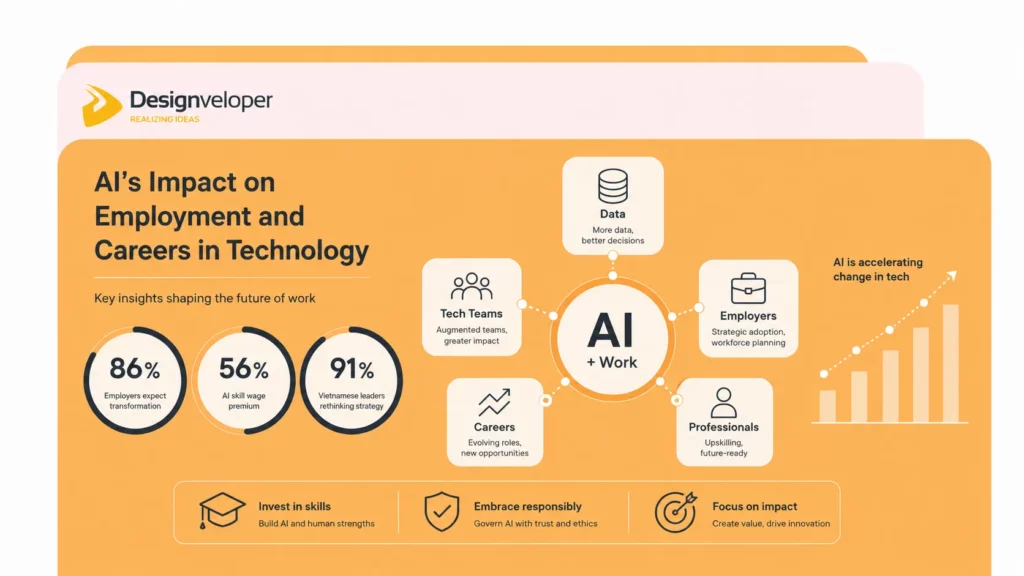
AI is no longer a side topic in technology work. It now shapes how companies hire, how developers build, how managers structure teams, and how workers plan their careers. The core point of this report is simple. AI is not removing the need for human talent in technology. It is changing where that talent creates value.
Routine work is being compressed. Higher value work is becoming more important. This includes architecture, product thinking, security, data quality, testing, governance, communication, and business judgment. The real AI Impact on technology careers is not simple job loss. It is a shift in tasks, skills, and career ladders.
From a Designveloper writer’s view, the strongest technology firms will not win by cutting people first. They will win by redesigning work first. AI should remove low value repetition, then help teams move human talent toward better products, stronger delivery, tighter security, faster iteration, and clearer customer outcomes. Firms that treat AI only as a headcount tool may gain short term savings. But they risk weakening their talent pipeline, product quality, and long term adaptability.
This article explains that shift through several key areas:
- The latest labor market data
The report reviews findings from WEF, ILO, IMF, PwC, Microsoft, LinkedIn, Anthropic, GitHub, and Stack Overflow. - How AI changes technology teams
It looks at coding, testing, debugging, documentation, support knowledge, product discovery, and software delivery. - What AI means for careers, wages, and hiring
It explains wage premiums for AI skills, faster skill turnover, pressure on junior roles, and rising demand for AI aware specialists. - What employers should do now
It recommends workflow redesign, upskilling, stronger review systems, junior talent development, and skills first hiring. - What technology professionals should do now
It argues that workers should build an “AI plus” profile by combining AI literacy with architecture, security, analytics, domain knowledge, UX, or product judgment. - What remains uncertain
The article notes that global studies use different methods, and that early career pressure cannot be blamed on AI alone. The better reading is careful, not alarmist.
What the latest data says
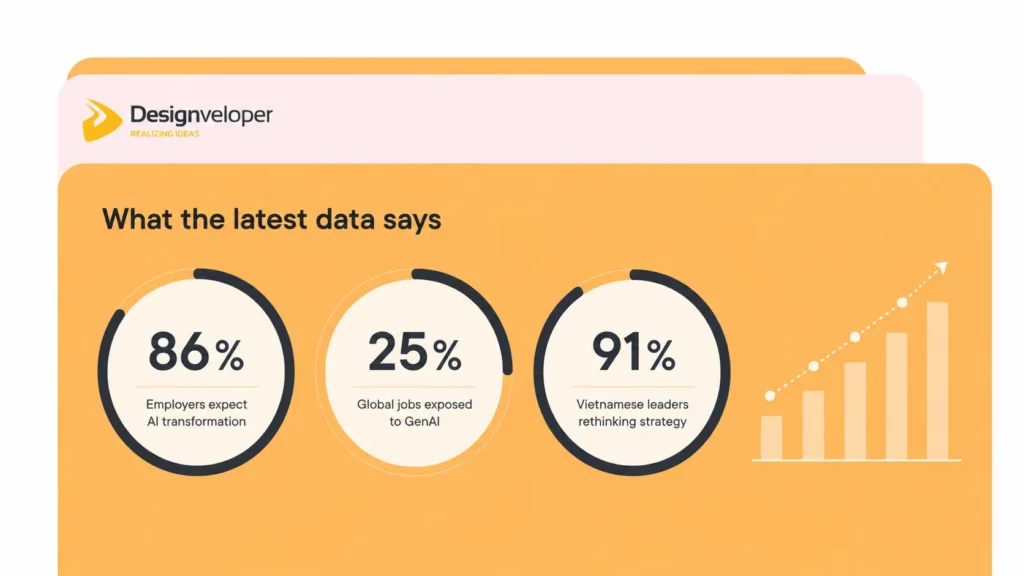
A strong starting point comes from the World Economic Forum’s 2025 research base. Its Future of Jobs work gathered views from more than 1,000 large employers that together represent over 14 million workers across 22 industry clusters and 55 economies. That is important because it captures what employers expect to do, not just what workers fear they might do. The survey found that 86% of employers expect AI and information-processing technologies to transform their business by 2030. It also identified Big Data Specialists, FinTech Engineers, AI and Machine Learning Specialists, and Software and Applications Developers among the fastest-growing roles by percentage.
That finding matters for technology careers because it tells us two things at once. First, AI will sit inside most future software and digital workflows. Second, demand will keep rising for builders who can design, deploy, and manage those workflows. In other words, AI pushes parts of coding toward automation while lifting the need for more advanced engineering, data, and systems roles. The labor market therefore becomes more polarized inside technology itself. The market rewards depth, ownership, and integration. It discounts repetitive execution.
The International Labour Organization adds another useful layer. Its May 2025 update says one in four workers worldwide are in occupations with some degree of exposure to generative AI. It also says 25% of global employment sits in potentially exposed occupations, and that share rises to 34% in high-income countries. Yet the ILO does not frame this mainly as redundancy. It says most jobs will be transformed rather than eliminated because human input remains necessary. The same study also notes higher exposure in media-, software-, and finance-related occupations.
The International Monetary Fund uses a broader method and reaches a broader estimate. IMF work says nearly 40% of global jobs are exposed to AI-driven change, with about 60% of jobs in advanced economies affected, 40% in emerging markets, and 26% in low-income countries. That looks higher than the ILO result, but the difference is methodological, not contradictory. The ILO focuses more tightly on occupational exposure to GenAI tasks. The IMF frames AI exposure more broadly across the labor market. Put simply, both sources point in the same direction. Knowledge work, especially digital and cognitive work, will feel AI early and deeply.
One of the most important current signals comes from PwC. Its 2025 Global AI Jobs Barometer says AI-exposed industries saw revenue per employee rise 27%, versus 9% in less exposed industries. It also says wages in the most AI-exposed industries are rising more than twice as fast as in the least exposed ones, and that workers with advanced AI skills earned a 56% wage premium in 2024, up from 25% the previous year. On top of that, the skills sought by employers are changing 66% faster in highly exposed jobs. Those numbers show that AI is not only a cost story. It is already a value and pay story.
That same PwC research carries a message many firms still miss. It found that job availability grew 38% even in roles more exposed to AI, though growth was slower than in less exposed occupations. This means exposure does not equal disappearance. A better reading is that AI changes the composition of those jobs, the speed of skill turnover, and the reward for people who can work with the tools well. So the real labor market risk may not be “no jobs.” It may be “jobs still exist, but your old skill mix no longer qualifies you for them.”
The latest workplace surveys reinforce that view. Microsoft and LinkedIn found in 2024 that 75% of global knowledge workers already used AI at work, 78% of AI users brought their own AI tools to work, 79% of leaders said AI adoption was necessary to stay competitive, and 66% of leaders would not hire someone without AI skills. In 2025, Microsoft’s Work Trend research found that 82% of leaders saw that year as pivotal for rethinking strategy and operations, 81% expected agents to be integrated into AI strategy within 12 to 18 months, and 24% said AI had already been deployed organization-wide.
The Vietnam-specific picture adds urgency for companies based in Southeast Asia. Microsoft Vietnam’s 2025 Work Trend release says 91% of Vietnamese leaders saw the year as a crucial moment to rethink business strategy and operations. It also says 95% expected to use digital labor to expand workforce capacity within 12 to 18 months, 65% said their organizations were already using agents to fully automate some workflows or processes, and 91% were considering hiring for new AI-related roles. For a company operating out of Ho Chi Minh City in Vietnam, those numbers matter. They show that the local market is not waiting on this shift. It is already in it.
How AI is changing work inside technology teams
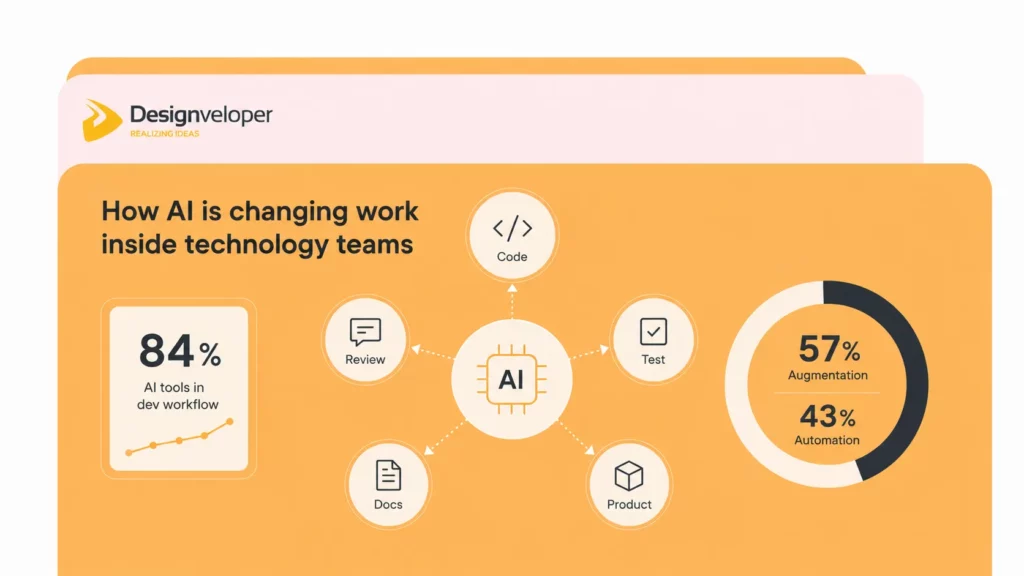
The biggest mistake in public debate is thinking that AI affects technology work only through coding speed. Coding speed matters. But it is only one layer. AI now changes how teams write code, review pull requests, produce documentation, debug errors, draft user stories, design test cases, create analytics dashboards, manage support knowledge, and even structure product discovery. Technology careers now shift because the whole delivery system is changing, not just the text editor.
Anthropic gives perhaps the clearest task-level view. Its early Economic Index work found AI use concentrated in software development and technical writing, with use leaning more toward augmentation than pure automation in the 2025 release, at 57% versus 43%. The same work said over one-third of occupations saw AI used in at least a quarter of their associated tasks, while only about 4% saw AI used across three-quarters of tasks. That is an important shape. It shows AI spreads widely but unevenly. It reaches many jobs, but it does not absorb all of them.
Anthropic’s later geography report adds a second key point. It says software development remained the most common Claude use case in every country it tracked. That matters because it reveals where AI demand actually lives right now. The center of gravity is not abstract theory. It is code, software workflows, and knowledge work tied to building digital products. For technology professionals, that means AI literacy is no longer a nice extra. It is becoming part of the baseline environment of the profession itself.
A more detailed Anthropic coding study from April 2025 sharpens the picture further. It found that 79% of Claude Code conversations were classified as automation, versus 21% augmentation, while standard Claude.ai coding interactions were less automated. It also found that web-development languages such as JavaScript and HTML were especially common in the dataset, and that UI/UX component development and web and mobile app work ranked among the top use cases. Anthropic explicitly suggested that jobs centered on simple apps and user interfaces may face earlier disruption than work focused on deeper back-end, architecture, or system responsibility.
This does not mean front-end work disappears. It means commodity front-end work becomes cheaper and faster to produce. The same will likely happen to routine testing, simple documentation, low-level refactoring, and first-draft content. Humans still matter in these workflows, but their comparative advantage moves upward. They win through design judgment, product context, system coherence, accessibility, performance, privacy, security, brand sense, and customer empathy. A developer who can only produce interface code now competes with a machine-assisted workflow. A developer who can align interface behavior with business logic, analytics, user behavior, and trust standards still has strong leverage.
The developer community itself now confirms this shift. AI tools are now part of everyday software development. Developers use them to write drafts, suggest tests, generate code, and speed up documentation. However, adoption does not mean full trust.
The stronger pattern is that AI changes the role of software teams. Instead of only producing code, engineers and technical leaders now spend more effort reviewing outputs, setting constraints, checking architecture fit, and making sure AI-generated work is safe for production.
| Theme | What the Data Says | What It Means | Practical Impact on Teams |
|---|---|---|---|
| AI adoption is mainstream | Stack Overflow’s 2025 Developer Survey says 84% of respondents are using or planning to use AI tools in development, while 51% of professional developers use AI tools daily. | AI is no longer a side experiment. It has become a normal part of the software development workflow. | Teams should assume that developers will use AI tools and create clear standards for when and how to use them. |
| Trust remains limited | The same survey says 66% of developers are frustrated by AI outputs that are “almost right.” It also shows that more developers distrust AI accuracy than trust it, at 46% versus 33%. | AI can support developers, but it cannot replace human judgment. The main issue is not whether AI can generate output, but whether that output is reliable. | Human review, testing, code review, and technical validation remain central to production work. |
| AI helps with first drafts | AI can produce a draft, propose tests, generate an endpoint, create a migration, or build a UI component. | AI is useful for speeding up early execution and reducing repetitive work. | Developers can move faster on routine tasks, but they still need to check whether the result fits the product, architecture, and business context. |
| AI fails in expensive areas | AI often struggles with edge cases, architecture fit, compliance needs, data assumptions, observability, maintainability, security gaps, and product nuance. | The most costly problems appear after code generation, especially when systems move toward production. | Teams need stronger review processes, security checks, QA coverage, and governance around AI-assisted work. |
| The value of human expertise increases | AI increases the value of people who can review and govern systems, not just generate outputs. | The work shifts from simple production to evaluation, validation, and system-level thinking. | Senior engineers, architects, QA leaders, product managers, and security specialists become more important in AI-enabled delivery. |
| Open-source developers are also adopting AI | GitHub’s 2024 report says 73% of open-source respondents use AI tools for coding or documentation. | AI adoption is not limited to enterprise teams. It is also changing open-source development and documentation workflows. | Developer communities need clearer norms around AI-generated code, contribution quality, and documentation reliability. |
| Generative AI projects are growing quickly | GitHub reported 70,000 new public generative AI projects started in 2024 and close to 150,000 total public generative AI projects after 98% year-over-year growth. | AI is becoming a major category of software creation, not only a tool inside existing workflows. | Engineering teams need new skills in AI system design, evaluation, integration, monitoring, and user safety. |
| Productivity gains change how time is used | GitHub says AI coding tools can improve developer productivity by up to 55%. | The main effect is not that engineers disappear. Instead, saved time can move toward system design, collaboration, and learning. | Teams should use AI productivity gains to improve planning, architecture, documentation, and product quality. |
| Engineers are moving up the stack | AI shifts value from raw code production toward orchestration, review, and decision-making. | Developers must become better at defining constraints, structuring prompts, setting evaluation criteria, and validating outputs. | Junior developers need to learn verification, debugging, testing, and system thinking earlier in their careers. |
| AI features increase product complexity | AI-enabled products need stronger guardrails, telemetry, responsibility models, and workflow design. | AI does not remove product complexity. In many cases, it adds new risks and new responsibilities. | Teams must design AI features with clear ownership, monitoring, escalation paths, and quality controls from the start. |
What this means for careers, wages, and hiring
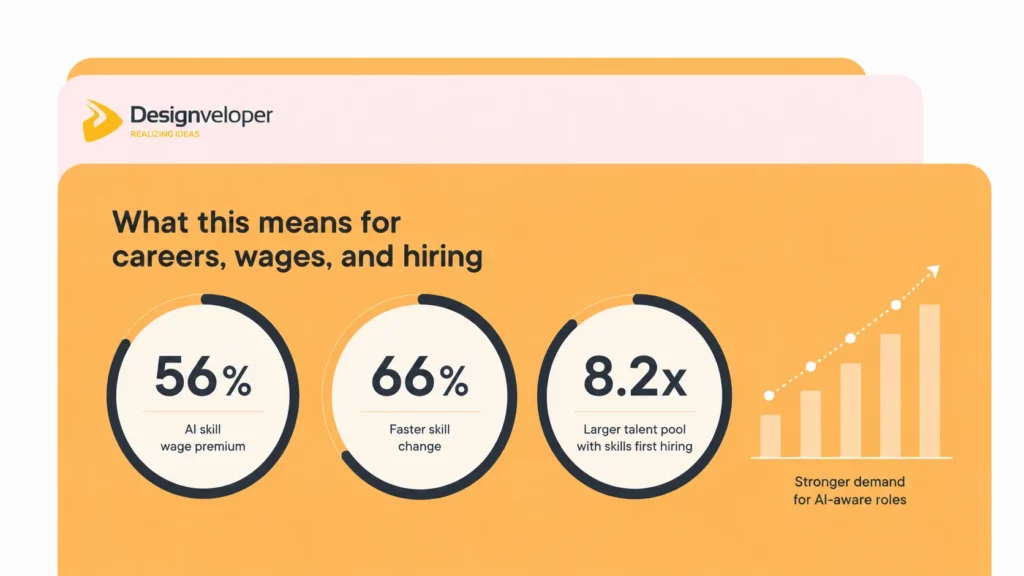
The first major career effect is wage separation. PwC’s 2025 work says workers with advanced AI skills earned a 56% wage premium in 2024, up from 25% the year before. It also says wages in the most AI-exposed industries rose more than twice as fast as in the least exposed industries. In plain language, the market already pays extra for people who can create commercial value with AI. That is not a future claim. It is a present one.
The second effect is faster skill turnover inside the same job title. A “software engineer” title in 2023 already means something different in 2026. A “product manager” title in 2026 now often includes AI tooling judgment, experimentation literacy, and workflow automation awareness. A “QA engineer” who cannot design assisted test flows will likely lose ground against one who can. PwC says skills are changing 66% faster in highly exposed jobs. So the real career threat is not only replacement. It is skill obsolescence inside apparently stable job titles.
The third effect is a tougher early-career ladder in some parts of tech. The evidence here needs care. It is too early to make a universal claim that AI alone is collapsing junior tech hiring. But the directional signs are real. Indeed Hiring Lab reported in July 2025 that early-career and junior tech titles in the United States were down 34% versus pre-pandemic levels, while senior and manager-level tech roles were down 19%. LinkedIn’s 2026 software engineer talent landscape also said the absence of a rebound in entry-level software engineer hiring by the end of 2025 was concerning, while warning that the data was not enough to prove AI was the cause. That is the sober reading. The junior ladder is under pressure, but causation remains mixed.
Even so, the mechanism is easy to understand. Entry-level roles historically carry a larger share of repetitive, well-bounded tasks: boilerplate coding, documentation drafts, low-risk bug fixes, test scaffolding, and routine support. Those are exactly the tasks that current AI tools handle well enough to compress demand. When a senior engineer can complete part of that work faster with AI, some firms choose not to open another junior seat. That does not kill the profession. But it can narrow the old apprenticeship model.
This means the entry-level value proposition must change. Junior professionals now need to show more than willingness and hustle. They need proof that they can work inside AI-augmented systems without lowering quality. They need to demonstrate stronger debugging, stronger context gathering, better documentation judgment, and better collaboration with senior reviewers. A good junior developer in 2026 is not the person who writes the most raw code. It is the person who can turn AI output into reliable production work under supervision.
The fourth effect is stronger demand for specialist and cross-functional roles. The World Economic Forum highlights AI and machine learning specialists, software developers, and big data specialists among the fastest-growing roles. BLS says overall computer and information technology occupations will grow faster than average from 2024 to 2034, with around 317,700 openings each year on average. It also projects 15% growth for software developers, QA analysts, and testers from 2024 to 2034, and 34% growth for data scientists over the same period. These are not signs of a shrinking digital workforce. They are signs of a workforce whose center of demand is shifting toward more data-rich, AI-aware, and systems-heavy work.

The fifth effect is stronger emphasis on skills-first hiring. LinkedIn’s 2025 skills-based hiring research says applying a skills-first approach to AI roles can expand the talent pipeline 8.2 times globally, which is 34% higher than the increase for non-AI jobs. This matters because hiring based only on pedigree will become less effective as the market changes faster. Firms will need practical signal. They will need portfolios, shipped work, evaluation skill, model judgment, and domain relevance. Degrees and brand-name employers will still matter, but measurable capability will matter more.
The sixth effect is a wider gap between workers who only use AI and workers who can supervise it. Microsoft’s 2025 Work Trend work describes the rise of hybrid teams of humans and agents. It says 82% of leaders think this is a pivotal year to rethink operations, 81% expect agents in AI strategy within 12 to 18 months, and 82% are confident digital labor will expand workforce capacity in that same window. In the Vietnam release, Microsoft says leaders expect teams to train and manage agents over the next five years, and that many organizations are already automating parts of customer service, marketing, and product development. These are early signs of a new management layer: people who direct, audit, and improve AI-enabled workflows.
This is why career advice built for the old software market is now less reliable. “Learn to code” is still useful, but it is no longer enough by itself. The better advice is “learn to solve and own outcomes.” Coding remains essential. Yet code alone is becoming a lower share of the total value stack in many roles. The higher share now lives in architecture, business flow understanding, data modeling, testing strategy, security review, product sense, and operational ownership. That is the real AI impact on long-term technology careers.
What employers and leaders should do now
The first step is to redesign workflows before redesigning headcount. PwC’s productivity and wage data shows where value is appearing. Microsoft’s 2025 research shows that leaders are already moving toward hybrid human-agent teams. Both signals support the same strategy. Start by mapping high-volume, repeatable work inside engineering, QA, support, product operations, documentation, and analytics. Then decide which parts AI can draft, which parts humans must review, and which parts must stay fully human because of trust, legal, or product-risk reasons. That workflow map should come before any staffing decision.
The second step is to treat upskilling as a core business function, not an HR side task. If skills in AI-exposed jobs are changing 66% faster, then annual training cycles are too slow. Employers need live skilling systems. These should include AI tool training, evaluation training, secure-use rules, prompt and workflow design, and strong review habits. The biggest risk is not that people refuse to use AI. Microsoft’s 2024 report already showed employees were using AI even without formal plans. The bigger risk is that they use it badly, invisibly, and without governance.
The third step is to strengthen human review, not weaken it. Stack Overflow’s 2025 survey shows mainstream AI use, but also high frustration and distrust around accuracy. That means quality systems matter more, not less. Firms should improve code review standards, strengthen testing gates, formalize security checks, and define what counts as acceptable AI assistance at each stage of delivery. AI can raise throughput. It can also raise the volume of plausible errors. Leadership needs to prepare for both effects.
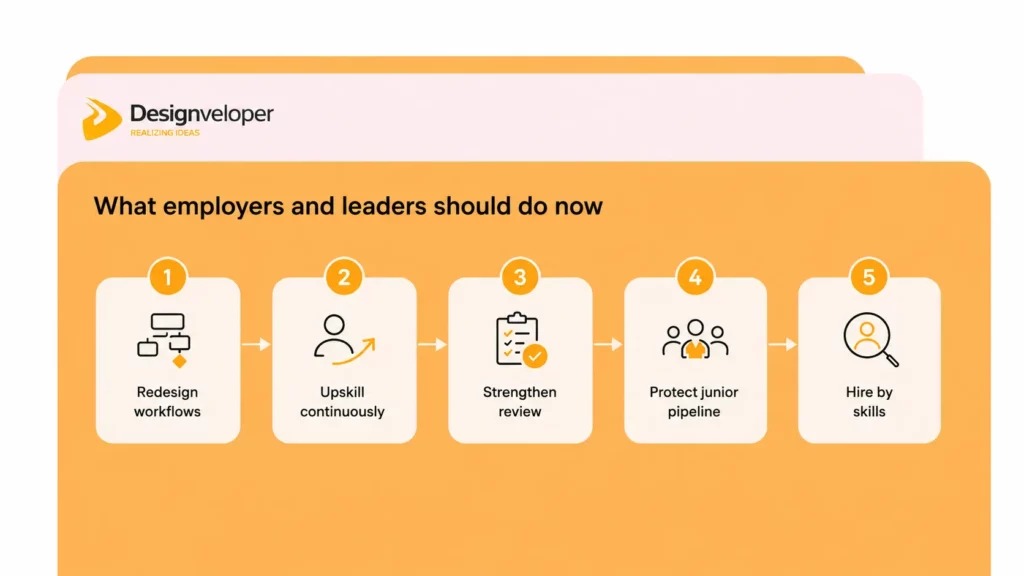
The fourth step is to protect the future talent pipeline. The early-career bottleneck is becoming a strategic issue. If too much entry-level work disappears without new apprenticeship models, firms will create their own future shortage of mid-level and senior talent. Employers should therefore redesign junior roles rather than abandon them. Give junior staff AI-assisted tasks with strong oversight. Ask them to evaluate outputs, document tradeoffs, write tests, reproduce bugs, trace data issues, monitor performance, and learn product flows. In the AI era, apprenticeship should teach judgment earlier.
The fifth step is to hire more on demonstrated skill and less on narrow credential filters. LinkedIn’s skills-based hiring work says the talent pool for AI roles expands dramatically under a skills-first approach. This matters because the market for practical AI builders will stay tight. Companies that only search for perfect pedigrees will move slowly. Companies that can evaluate real project work, portfolio evidence, product reasoning, and delivery maturity will hire faster and often better.
The sixth step is to choose AI partners with full-stack delivery depth. This is where companies like Designveloper can matter. AI features do not live alone. They live inside apps, services, workflows, integrations, and support systems. A firm that can connect AI software development to web, mobile, UI/UX, security, testing, and maintenance will likely deliver more lasting value than a provider that only builds prototypes. In practice, buyers should ask for concrete project proofs, delivery process detail, security standards, post-launch support plans, and case studies tied to real business outcomes.
What technology professionals should do now
The first move is to stop defining yourself too narrowly. If your entire professional identity rests on one task that AI can draft, you are exposed. If your identity rests on owning outcomes, reducing risk, and improving systems, you are far more resilient. That means a developer should think beyond writing code. A product manager should think beyond writing tickets. A designer should think beyond static screens. A QA professional should think beyond manual test execution. The labor market is rewarding people who can connect tools to outcomes.
The second move is to build an “AI plus” profile. The “plus” matters more than the AI. AI alone will not differentiate you for long. Many people will have basic tool familiarity. The stronger profile is AI plus architecture, AI plus security, AI plus healthcare knowledge, AI plus fintech logic, AI plus analytics, AI plus platform reliability, or AI plus UX. Designveloper’s own portfolio illustrates this principle well. Song Nhi mixes AI with personal finance workflows. Lumin mixes document tooling with collaboration, signing, and enterprise trust. ODC mixes software delivery with healthcare operations. Context raises value.
The third move is to learn evaluation, not just generation. Employers now know that anyone can produce a draft with modern tools. The harder skill is checking whether that draft is correct, secure, maintainable, fair, and commercially useful. Stack Overflow’s distrust numbers, Anthropic’s task-level results, and GitHub’s productivity research all point to the same lesson. High-value professionals do not just ask the model for output. They know how to inspect, test, improve, and reject it when needed.
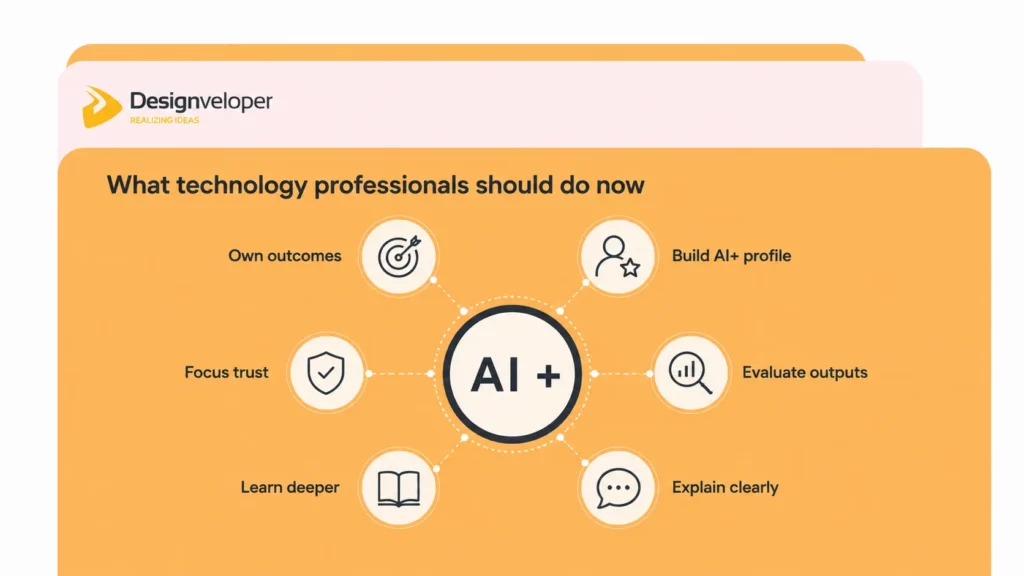
The fourth move is to develop explanation power. AI can write. But people still need professionals who can explain why a system works, where it can fail, why a tradeoff was chosen, what risk remains, and what the business should do next. This is why communication stays important in a technical labor market. It is also why firms continue to value product-savvy engineers and technically fluent managers. The workers who can translate between AI systems and business reality will remain hard to replace.
The fifth move is to use AI to learn faster, but not to outsource understanding. GitHub says developers often use the time saved by AI tools for system design, collaboration, and learning new skills. That is the right pattern. If you use AI to avoid thinking, your skill base will decay. If you use AI to compress setup work and free time for deeper learning, your market value can rise. The difference lies in intent. Use the tools to accelerate the path to expertise, not to imitate expertise you do not yet have.
The sixth move is to watch where trust bottlenecks remain. Security, privacy, architecture, compliance, observability, data quality, and customer communication still carry heavy human accountability. Designveloper’s own service mix reflects this priority with cybersecurity consulting, threat modeling, secure coding training, AI software services, and custom product delivery under one roof. For professionals, that is a clue. Careers that sit close to trust, safety, and integration may gain strength as AI spreads.
The seventh move is to build proof, not only knowledge. In the next hiring cycle, portfolios may matter more than ever. Show an AI-assisted test workflow. Show a secure chatbot integration. Show a document analysis feature. Show a prompt-evaluation framework. Show a dashboard that turns model output into business action. Show a small app where the logic, review, and monitoring are clearly yours. The market is moving toward evidence of capability. It is not moving toward faith in resumes alone.
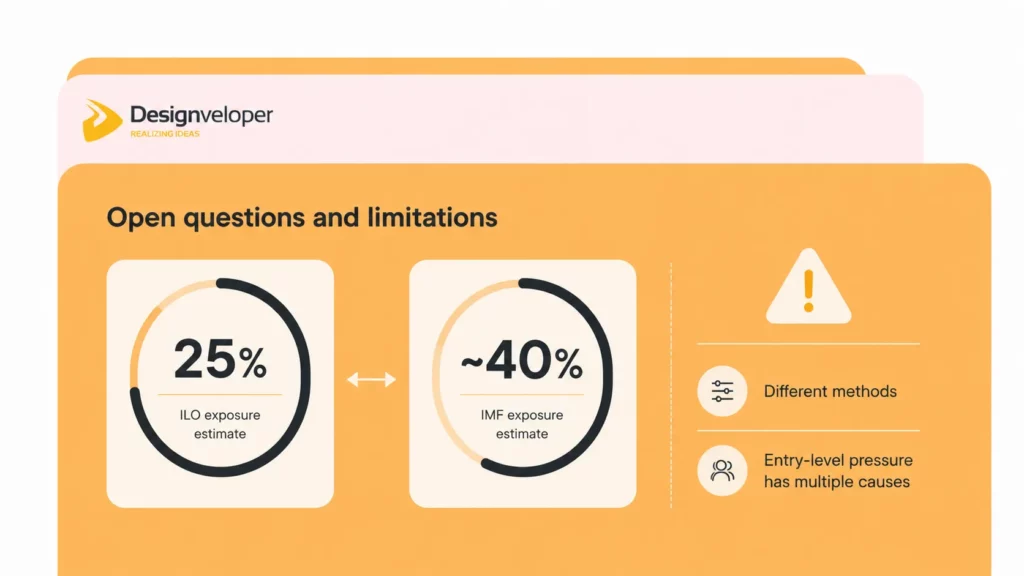
Open questions and limitations
A couple limits matter. First, global institutions use different methods. The ILO’s 25% exposure figure and the IMF’s roughly 40% exposure figure are not direct contradictions, but they are not interchangeable either. They measure different layers of the same transition. Readers should treat them as directional indicators of large-scale change, not as one uniform probability of job loss.
Second, entry-level pressure is real, but causation is still not final. Recent labor-market sources show weaker early-career tech hiring and a lack of rebound in entry-level software roles, yet they also warn that macro conditions and the post-pandemic hiring reset still shape the data. So it is fair to say AI is part of the pressure. It is not yet fair to say AI alone explains the entire pattern.
The final conclusion remains firm. AI will keep changing employment and careers in technology. But the winners will not be the firms that simply reduce labor fastest, or the workers who merely “use AI” the most. The winners will be the firms that redesign work well, and the professionals who move toward judgment, systems thinking, domain depth, assurance, and accountable delivery. That is where durable value is moving. For Designveloper, this is not only a topic to write about. It is a market to build for. The company’s mix of AI services, custom software delivery, security capability, and cross-industry product work puts it in a credible position to help clients navigate the shift, and to keep evolving its own talent model as the AI impact grows across the technology labor market.
Appendix: Source links
- World Economic Forum. “Future of Jobs Report 2025: 78 Million New Job Opportunities by 2030, but Urgent Upskilling Needed to Prepare Workforces.” https://www.weforum.org/press/2025/01/future-of-jobs-report-2025-78-million-new-job-opportunities-by-2030-but-urgent-upskilling-needed-to-prepare-workforces/
- World Economic Forum. “The Future of Jobs Report 2025.” https://www.weforum.org/publications/the-future-of-jobs-report-2025/
- World Economic Forum. “The Future of Jobs Report 2025: Jobs Outlook.” https://www.weforum.org/publications/the-future-of-jobs-report-2025/in-full/2-jobs-outlook/
- International Labour Organization. “One in Four Jobs at Risk of Being Transformed by GenAI, New ILO–NASK Global Index Shows.” https://www.ilo.org/resource/news/one-four-jobs-risk-being-transformed-genai-new-ilo%E2%80%93nask-global-index-shows
- International Labour Organization. “Generative AI and Jobs: 2025 Update.” https://www.ilo.org/publications/generative-ai-and-jobs-2025-update
- International Monetary Fund. “AI Will Transform the Global Economy. Let’s Make Sure It Benefits Humanity.” https://www.imf.org/en/blogs/articles/2024/01/14/ai-will-transform-the-global-economy-lets-make-sure-it-benefits-humanity
- PwC. “2025 AI Jobs Barometer.” https://www.pwc.com/us/en/tech-effect/ai-analytics/ai-jobs-barometer.html
- PwC. “AI Linked to a Fourfold Increase in Productivity Growth.” https://www.pwc.com/gx/en/news-room/press-releases/2025/ai-linked-to-a-fourfold-increase-in-productivity-growth.html
- Anthropic. “The Impact of AI on Software Development.” https://www.anthropic.com/news/impact-software-development
- Anthropic. “The Anthropic Economic Index.” https://www.anthropic.com/news/the-anthropic-economic-index
- Anthropic. “The Anthropic Economic Index: Geography.” https://www.anthropic.com/research/economic-index-geography
- LinkedIn Economic Graph. “Skills Based Hiring: March 2025.” https://economicgraph.linkedin.com/content/dam/me/economicgraph/en-us/PDF/skills-based-hiring-march-2025.pdf
- Microsoft WorkLab. “AI at Work Is Here. Now Comes the Hard Part.” https://www.microsoft.com/en-us/worklab/work-trend-index/ai-at-work-is-here-now-comes-the-hard-part
- Microsoft WorkLab. “2025: The Year the Frontier Firm Is Born.” https://www.microsoft.com/en-us/worklab/work-trend-index/2025-the-year-the-frontier-firm-is-born
- Microsoft Vietnam News Center. “Báo cáo Chỉ số Xu hướng Công việc năm 2025: Sự ra đời của doanh nghiệp tiên phong.” https://news.microsoft.com/vi-vn/2025/06/12/bao-cao-chi-so-xu-huong-cong-viec-nam-2025-su-ra-doi-cua-doanh-nghiep-tien-phong/
- Stack Overflow. “AI | 2025 Stack Overflow Developer Survey.” https://survey.stackoverflow.co/2025/ai
- Stack Overflow. “2025 Stack Overflow Developer Survey.” https://survey.stackoverflow.co/2025/
- GitHub Blog. “Octoverse: AI Leads Python to Top Language as the Number of Global Developers Surges.” https://github.blog/news-insights/octoverse/octoverse-2024/
- GitHub Blog. “How Developers Spend the Time They Save Thanks to AI Coding Tools.” https://github.blog/ai-and-ml/generative-ai/how-developers-spend-the-time-they-save-thanks-to-ai-coding-tools/
- Indeed Hiring Lab. “Experience Requirements Have Tightened Amid the Tech Hiring Freeze.” https://www.hiringlab.org/2025/07/30/experience-requirements-have-tightened-amid-the-tech-hiring-freeze/
- Designveloper. “Official Website.” https://www.designveloper.com/
- Designveloper. “Services.” https://www.designveloper.com/services/
- Designveloper. “AI Development Services.” https://www.designveloper.com/services/ai-development-services/
- Designveloper. “Software Development Services.” https://www.designveloper.com/services/software-development-services/
- Designveloper. “AI Business Process Automation.” https://www.designveloper.com/blog/ai-business-process-automation/
- Designveloper. “Software Development Outsourcing.” https://www.designveloper.com/blog/software-development-outsourcing/
- Designveloper. “Careers.” https://www.designveloper.com/careers/
- Designveloper. “Financial Web Development Company in Vietnam.” https://www.designveloper.com/blog/financial-web-development-company-in-vietnam/
Also published on

Share post on










Related Articles


AI’s Impact on Employment and Careers in Technology
AI’s Impact on Employment and Careers in Technology Published April 28, 2026Read more topics