

10 Best Providers of IoT Solutions to Consider in 2026

IoT (Internet of Things) solutions have become an integral part of our life. According to one research study, the global IoT value will reach $1.06 trillion by 2025, dominated by Industrial IoT (IIoT). This figure is unsurprisingly estimated to grow in subsequent years, with a 10.17% CAGR (2025-2029) as a result of the transformative benefits IoT brings. It makes physical devices become smart and interact with digital software to exchange data. Based on meaningful insights derived from the data, your business can improve decision-making, operational efficiency, and business outcomes.
For these reasons, more and more companies are looking for robust, efficient IoT solutions to optimize their workflows. But what types of IoT solutions are available in today’s market? Which provider should you consider partnering with? Let’s find them out in our article!
What Types of IoT Solutions are Available in Today’s Market?
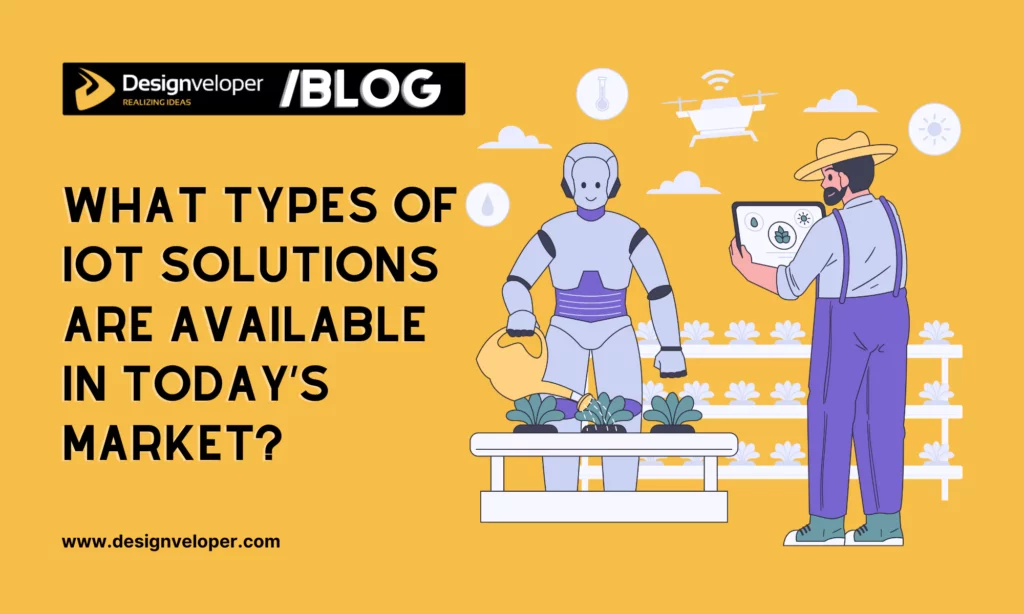
IoT solutions involve hardware, software, and services that use IoT technology to address specific problems. There are various IoT solutions like ATSAC out there, each of which serves different purposes. So, they fall into different categories based on industries and offerings:
By Industries
IoT is widely adopted across industries as follows:
1. Industrial
Industrial IoT solutions combine connected devices and sensors with cloud services to enhance industrial operations, productivity, and workplace safety. They span different sectors, from manufacturing and oil & gas to automotive and agriculture. In recent years, its global market has been growing significantly, exceeding a staggering value of $275 billion in 2025. This is an inevitable result of the increasing demand for automation, asset monitoring, predictive maintenance, and quality control.
Best IIoT providers: PTC, Schneider Electric, SYSTEMA, Siemens, Arm
2. Infrastructure
Infrastructure IoT solutions focus on keeping infrastructure systems secure, efficient, and sustainable. Some common applications include smart cities, smart transportation, environmental monitoring, smart energy grids, and structural health monitoring.
For example, ATSAC (Advanced Transportation System and Coordination) is a comprehensive IoT solution Los Angeles has implemented to enhance traffic flows and reduce congestion. The system includes over 26K vehicle detectors and over 590 CCTV cameras to automatically monitor real-time traffic, adjust signal timing based on traffic conditions, and support public transportation.
Best infrastructure IoT providers: Breeze Technologies, Belitsoft, IKE Smart City, Cavnue
3. Consumer
IoT has a wide application in different aspects of everyday life. One typical example is wearables like smartwatches or fitness trackers that continuously track your activity levels, vital signs (e.g., heart rate), and sleep patterns. They then can deliver this data to a healthcare provider’s application for doctors to monitor your health conditions, make prompt diagnoses, and offer care better.
Beyond this application, consumer IoT is commonly seen in smart homes and connected cars. For example, smart thermostats can automatically adjust temperature to optimize energy utilization while connected cars like the BMW 7 Series can automatically track real-time traffic and choose the best route.
Best consumer IoT providers: Google, Amazon, Samsung Electronics, Rachio
4. Commercial
Commercial IoT involves using IoT technology in many commercial segments to optimize processes, increase customer satisfaction, and generate new revenue streams. Several popular use cases of commercial IoT include retail stores, hospitality, healthcare facilities, and office buildings. For instance, retailers like Amazon or Home Depot use IoT and other advanced technologies to manage inventory levels, analyze customer behaviors, and personalize ads on smart displays.
Best commercial IoT providers: Sensormatic Solutions, Philips Healthcare, Bosch Sensortec, Johnson Controls
By Offerings
IoT vendors now provide different solutions for your business problems. These solutions can be hardware, software, and end-to-end IoT services.
1. Only Hardware
Several providers focus on physical components forming an IoT system. These components include smart devices, sensors, and gateways for data collection and transmission.
Best IoT providers: Texas Instruments, Davis Instruments, Bosch Sensortec, NXP Semiconductors
2. Only Software
Various providers specialize in offering or developing software applications or platforms to monitor, analyze, and visualize IoT data. These platforms often integrate powerful capabilities like data ingestion, device management, application development, or real-time visualization and reporting.
Best IoT providers: Designveloper, AWS IoT, PTC, Bechtle
3. End-to-End IoT Solutions
Many providers give their clients a complete solution of hardware, software, and services to handle the entire IoT problem, from device connectivity to data analytics and visualization.
Best IoT providers: Chamberlain Group, Johnson Controls, ABB, Schneider Electric
10 Best Providers of IoT Solutions to Consider in 2025
You’ve understood the different IoT solutions available in today’s market. Now, let’s look at our top list of IoT solution providers in 2025.
1. Designveloper
- Founded in: 2013
- Headquarters: Ho Chi Minh City, Vietnam
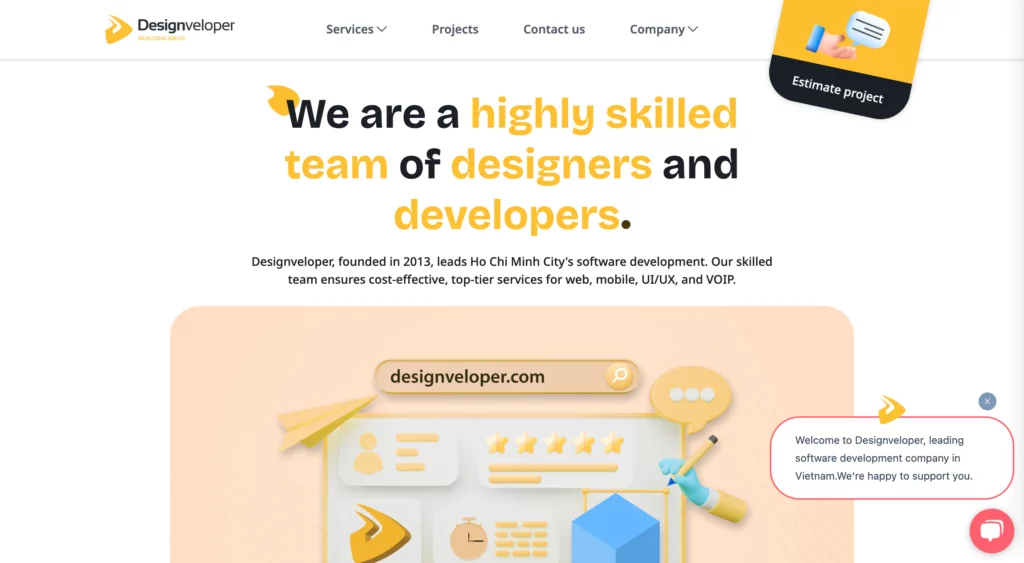
Designveloper is one of Vietnam’s leading software developers. We mainly focus on building custom, scalable digital solutions for clients across industries like healthcare, finance, or manufacturing. These solutions include bespoke enterprise software, websites, mobile applications, and consulting services. Integrating technologies like AWS or AI, we help you create comprehensive IoT-based systems for secure data ingestion, processing, storage, and advanced analytics.
As for the proven track record, we successfully implemented over 100 projects. One of them is ODC, a France-based telehealth platform connecting doctors and patients. The platform has powerful tools (like e-prescription or online booking) as well as integrates existing networks and IoT devices to monitor patients remotely in real-time.
Further, our IoT-based solutions meet international standards and industrial regulations like GDPR or HIPAA. We also leverage different security best practices to ensure secure data in transit and at rest. These practices range from encryption and access control to source code management centralized on client servers.
2. Texas Instruments
- Founded in: 1930
- Headquarters: Dallas, Texas
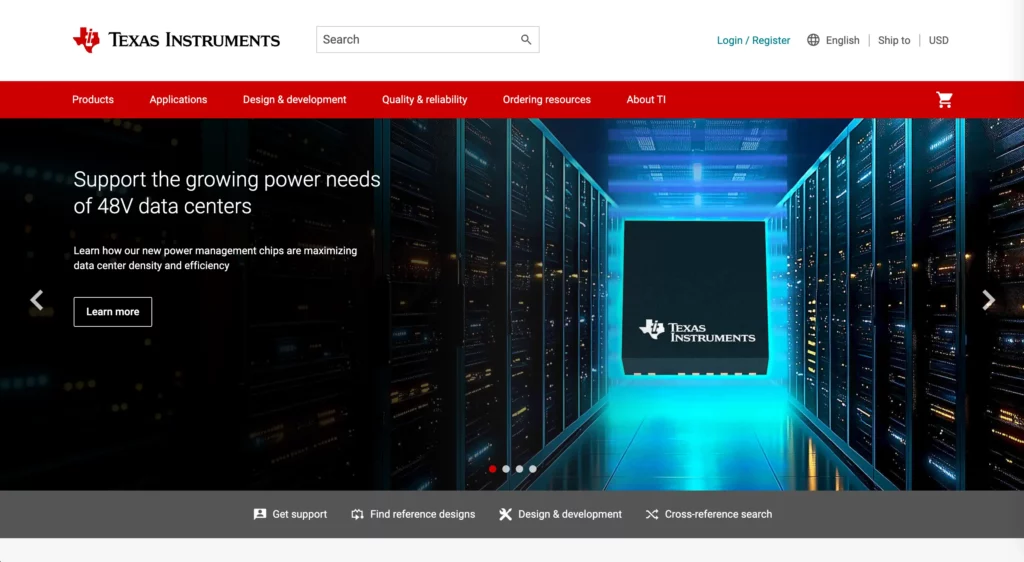
Texas Instruments is a global semiconductor manufacturer that specializes in analog and embedded processing chips. Its diverse portfolio of over 80,000 products help clients optimize power, acquire and deliver data precisely, and control smart devices efficiently. These products use cutting-edge core technologies like wired and wireless connectivity, motor control, processing (i.e., microcontrollers), sensing, or industrial communication.
Besides making your devices smarter, these products ensure security compliance with functional safety standards like ISO 26262 and IEC 61508. Further, they help you create secure end devices that adhere to regulations, such as US CISA, Europe CRA, UN R155, or ISO/SAR 21434.
Their products are widely adopted across industries, particularly:
| Industry | Typical Products |
| Manufacturing | Flow & pressure sensorsWirelessly connected LED lighting & energy management. |
| Automotive | Navigation, Bluetooth hands-free & audio, Wi-FiKeyless entry, interior lighting, mirror control, sensors |
| Fitness & Healthcare | Informed workouts with activity & performance measurementSafe independent living with fall detection, medication monitoring |
| Homes | Security & safety system, sensorsSmart home energy gateway, thermostats, sensors |
3. Davis Instruments
- Founded in: 1963
- Headquarters: Hayward, California
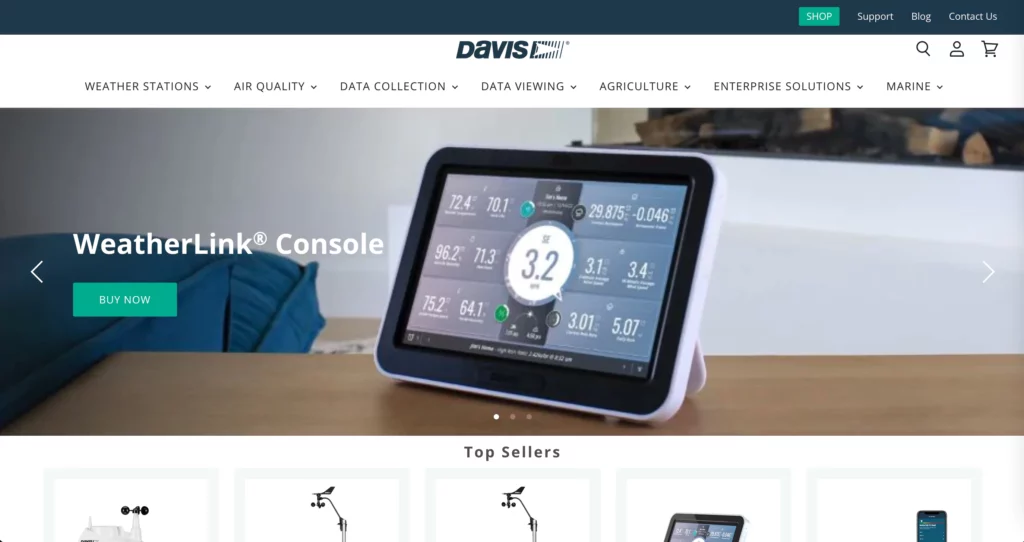
If you’re looking for excellent products to track weather and environmental conditions, Davis Instruments is a worth-considering option. The company specializes in designing and producing precision weather, outdoor, and marine equipment that measures parameters (e.g., temperature, wind, pressure, or barometric pressure).
Apart from these physical devices, Davis Instruments provides data viewing products, including WeatherLink Console, WeatherLink website, and WeatherLink mobile apps for iOS and Android. These products have a customizable, interactive dashboard to view current and historical data, track daily weather patterns, and send automated alerts about environmental changes.
Additionally, Davis Instruments partners with AEM to provide comprehensive enterprise solutions for monitoring severe weather risks like lightning, wildfire, flood, and storm.
4. Thales Group
- Founded in: 1968
- Headquarters: Paris, France
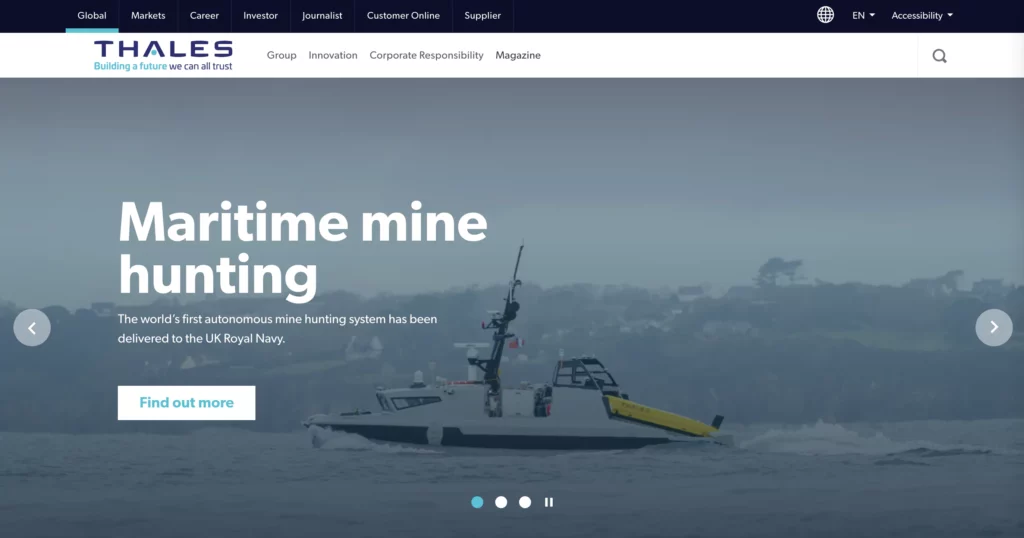
Thales Group is a multinational corporation that invests deeply in advanced technologies like AI, Big Data, and quantum to build comprehensive solutions for space and aerospace, defense, and cybersecurity. In terms of IoT, Thales Group’s IoT Suite addresses the common challenges its clients often face when building and deploying cellular IoT devices. Accordingly, Thales IoT Suite simplifies and secures IoT connectivity during three following phases:
- Build: The company offers a diverse range of advanced eSIM and iSIM that can endure extreme conditions.
- Run: Thales Group offers services including Thales eSIM Subscription Management or Thales Instant Connect to monitor eSIM profiles remotely and enable immediate connectivity after manufacturing.
- Protect: The company helps secure IoT devices against cyber threats with solutions like eSE (embedded Secure Elements), HSM (Hardware Security Modules, Trusted Key Manager, and IoT SAFE. These security solutions ensure compliance with stringent regulations in many industries.
5. Telit Cinterion
- Founded in: 1986
- Headquarters: Irvine, California
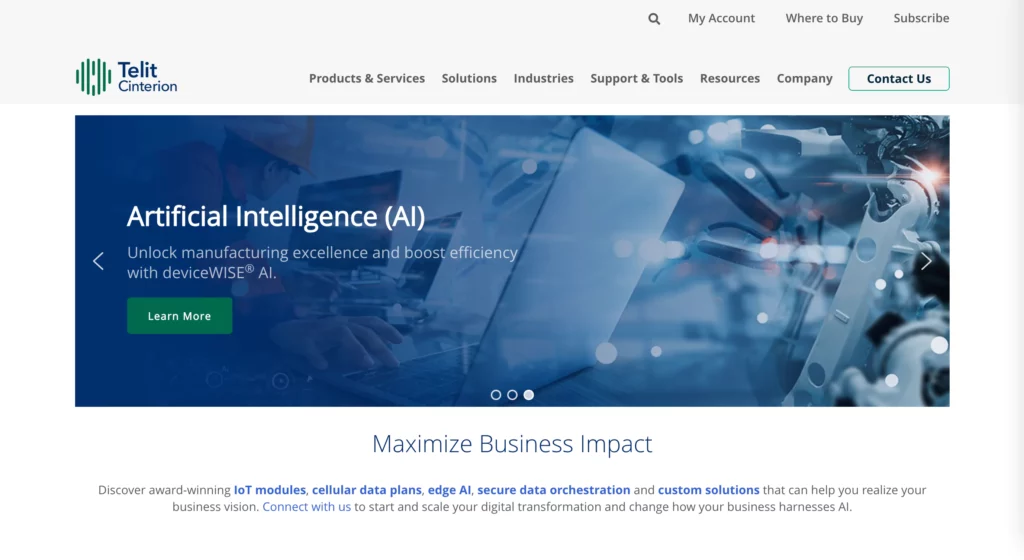
As a global engineering corporation, Telit Cinterion has offered enterprise-grade IoT solutions that meet strict environmental requirements and industry standards. Its diverse portfolio of products is widely adopted across sectors like micromobility, retail, smart buildings, healthcare, or construction. These products encompass:
- Modules: Telit Conterion provides a variety of certified modules like Cellular 5G, Smart Modules, or NExT Modules to securely connect any IoT devices.
- Connectivity: Telit Cinterion’s NExT, a secure mobile network, allows for seamless device management and improved turnkey connectivity. The network integrates powerful capabilities (e.g., remote eSIM provisioning, connectivity management, and embedded connectivity) to deploy and control all your cellular IoT devices from a unified platform.
- Platforms: Telit Cinterion offers different IoT platforms for mission-critical deployments. Typically, deviceWISE EDGE integrates your factory equipment and applications without custom code, while deviceWISE CLOUD helps manage and speed up IIoT deployments from a single platform. Also, you can leverage deviceWISE VIEW to collect and visualize data, along with AI capabilities to improve product inspection and quality.
Apart from these core offerings, Telit provides custom IoT solutions, from hardware design and mechanical development to firmware and software customization.
6. Bechtle
- Founded in: 1983
- Headquarters: Neckarsulm, German
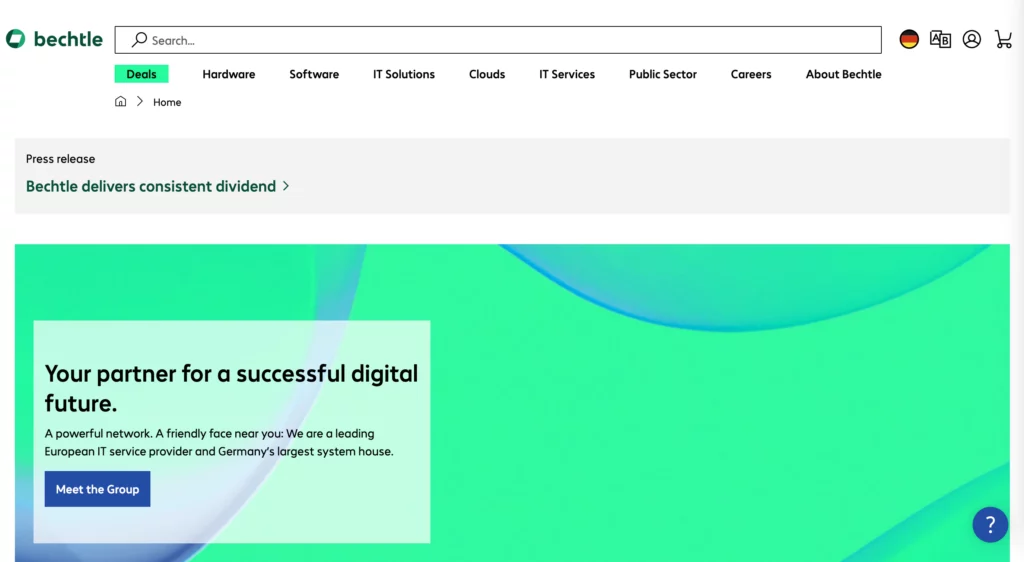
Bechtle is one of Europe’s leading IT service providers. They build scalable, efficient IT architectures that cover on-premises and multi-cloud solutions, AI, and security. With a focus on integrated decentralization, their managed services help build comprehensive IT strategies to digitize your workplace and business processes.
Bechtle has extensive IoT expertise and experience, coupled with a strong partner network, to provide a comprehensive IoT solution. The company offers the following IoT services:
- IoT Networks: Their experts excel at assessing your IoT network to find the best technology for it (like 5G, UWC, or LoRaWAN). Further, they configure a customized, easily-integrated network and monitor IoT devices to ensure smooth performance and connectivity.
- IoT Platforms: Bechtle’s existing IoT platforms integrate data ingestion, database integration, visualization tools, and other powerful capabilities to ease your IoT deployment. Besides, the company is an authorized reseller of various platforms, hence helping you find a suitable one for your specific needs.
- IoT Services: Bechtle provides a wide range of IoT services to configure, scale, and deploy your IoT system. Their services cover consulting on the best networks and infrastructure, configuring device parameters, monitoring and updating your system, etc. Plus, their Bechtle Device-as-a-Service model handles the procurement, logistics, and management of your IoT hardware. So, you don’t need to directly buy and monitor sensors.
- IoT Security: Bechtle helps secure edge gateways and cloud infrastructure from cyberattacks.
7. Chamberlain Group
- Founded in: 1954
- Headquarters: Illinois, US
Are you looking for a reliable, experienced IoT provider who changes the way you access, manage, and secure facilities? If yes, don’t ignore Chamberlain Group.
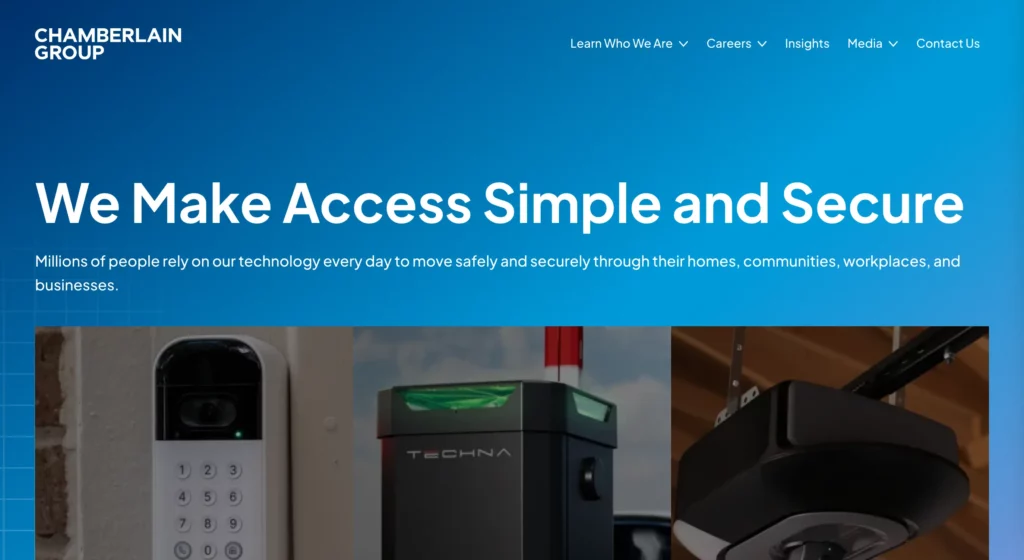
The corporation excels at developing and engineering building automation systems, including hardware and software. These offerings not only provide different levels of security but also enable you to see what’s happening in your facilities (i.e., home, office buildings, or factories). Let’s take a quick look at Chamberlain Group’s offerings:
- Physical devices (e.g., security cameras, garage keypad, commercial door operators, or garage control).
- myQ Smart Home App offers real-time insights into your garage doors, schedules operating times of doors, and securely shares access with other authorized users. Other platforms of Chamberlain Group use myQ smart technology to enhance facility security and access. Typically, In-Garage Delivery uses this tech to get packages delivered safely to your garage, while LiftMaster’s Smart Access Ecosystem depends on this tech to completely control your home’s main entry points.
- myQ Facility helps facility managers visually monitor door and dock spaces in real-time. Further, it can analyze the activity of commercial doors, gates, or docks and generate custom reports.
- myQ Community enables you to manage all access points of various property types like schools or apartments from a unified place. It integrates powerful capabilities like 24/7 video monitoring or people-flow management to easily track suspects and enhance safety.
- myQ Connected Garage allows you to manage your home and garage securely from your vehicle.
8. Johnson Controls
- Founded in: 1885
- Headquarters: Milwaukee, Wisconsin, US
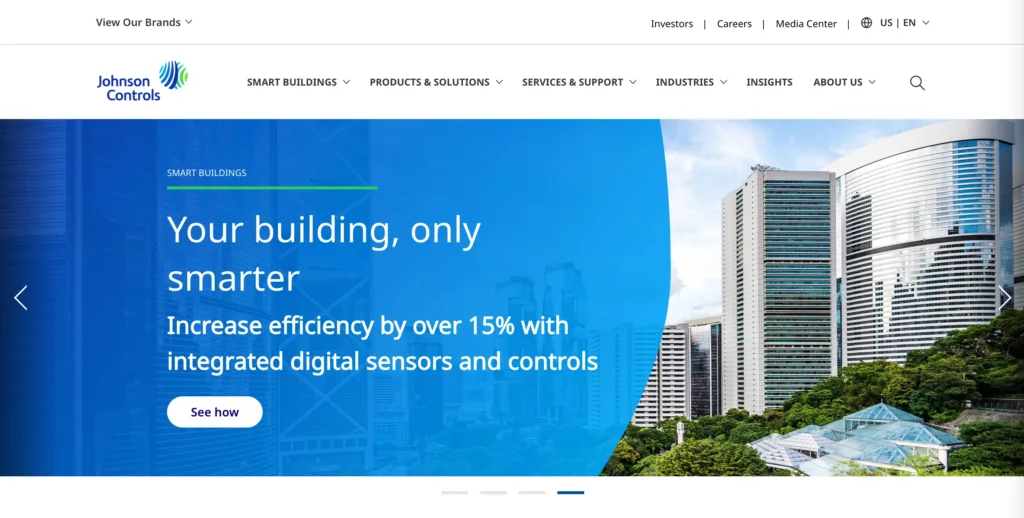
Johnson Controls is one of the world’s leading smart building providers with nearly 140 years of experience. The company offers award-winning digital techs and services through the OpenBlue platform to help its clients deeply understand their facility’s health, performance, and sustainability.
Johnson Controls provides both hardware and software IoT solutions for smart buildings. It has a diverse portfolio of hardware products like HVAC equipment (e.g., rooftop units and air handling), HVAC controls (e.g., valves and actuators), fire detection devices (e.g., sensors and control units), or security systems. These physical products are connected with platforms like Facility Explorer, EasyIO, or Metasys to manage and secure your building automatically in one place.
Beyond these offerings, Johnson Controls provides renewable and energy-efficient solutions to optimize costs and reduce carbon consumption. The company also offers retail solutions like Sensormatic IQ or Inventory Intelligence for seamless retail management and increased shopper engagement.
9. Silicon Labs
- Founded in: 1996
- Headquarters: Texas, US
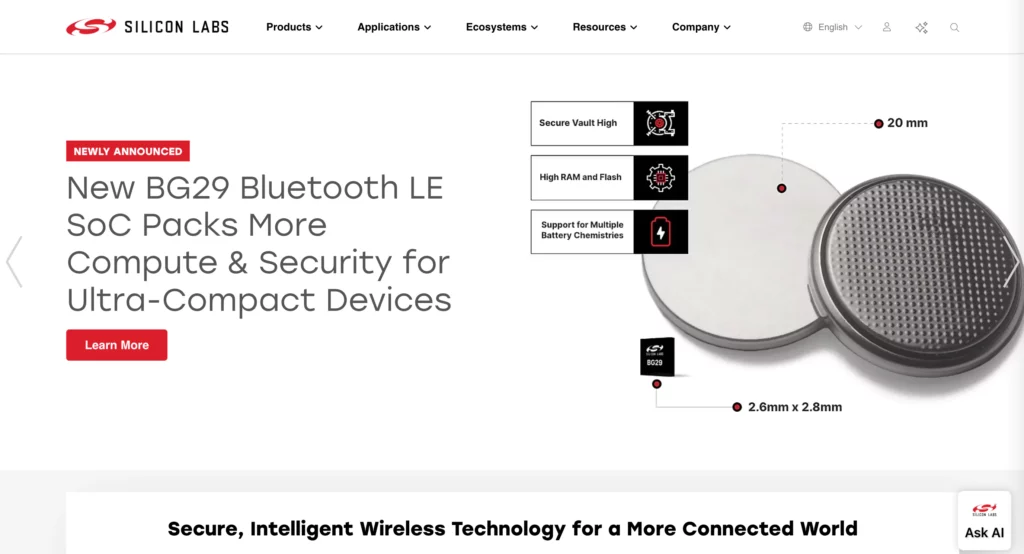
Silicon Labs specializes in providing low-power wireless connectivity. Its trusted leading IoT platform helps you build secure, smart connected devices like security cameras or smart locks.
With a robust partner network like Amazon or Google, Silicon Labs offers hardware components, software solutions, intuitive development tools, and dedicated ecosystem support to build advanced applications for smart homes, smart cities, factories, healthcare providers, and retailers.
Their offerings, accordingly, cover:
- Wireless Hardware: Silicon Labs helps build and deploy wireless chips for the IoT with common protocols like Amazon Sidewalk, Bluetooth, or Matter.
- Non-Wireless Development Tools: The company has a broad portfolio of non-wireless development tools. They include ultra-low power microcontrollers (MCUs), sensors, smart interface controller ICs, and power management devices.
- Services: Silicon Labs offers comprehensive services (e.g., Custom Part Manufacturing Service) for faster time-to-market.
- Security: The company offers security training programs and Secure Vault™, an industry-leading set of security features, to address IoT threats quickly.
Coupled with these offerings, the company uses different protocols, standards, and technologies to create comprehensive IoT solutions. For example, Channel Sounding measures accurate distance for context-aware and smart systems, while Energy Harvesting helps reduce energy consumption and ensure cost savings.
10. Schneider Electric
- Founded in: 1836
- Headquarters: Rueil-Malmaison, France
Schneider Electric is the world’s technology leader in automation and digital transformation. The company has deep expertise in smart industries, future-proof data centers, smart buildings, and resilient infrastructure.
They offer EcoStruxure™, a single, IoT-based system, which integrates various powerful capabilities to ensure your business’s efficiency, safety, and connectivity. Typically, the platform uses Embedded Connectivity & Intelligence to perform native analytics and make control decisions, or Smart Operations to develop applications like monitoring and visualization.
This platform is also deployed in the following validated architectures:
- Building: EcoStruxure™ Building integrates modern IP-based controls and analytics to manage your systems seamlessly and discover energy efficiency.
- Power: EcoStruxure™ Power digitizes and simplifies power distribution systems.
- Data Center: EcoStruxure™ IT helps plan and design optimal data centers, monitor hybrid IT environments, and modernize your legacy data centers.
- Plant and Machine: Schneider Electric offers IIoT solutions to automate manufacturing processes, optimize supply chain, and monitor equipment. These solutions reduce carbon footprint, save costs and energy, and ensure workforce safety.
- Grid: EcoStruxure™ Grid manages electricity demand and supply, maximizing grid efficiency for electrical distribution utilities and ensuring regulatory compliance.
5 Steps to Build Your Custom IoT Solution
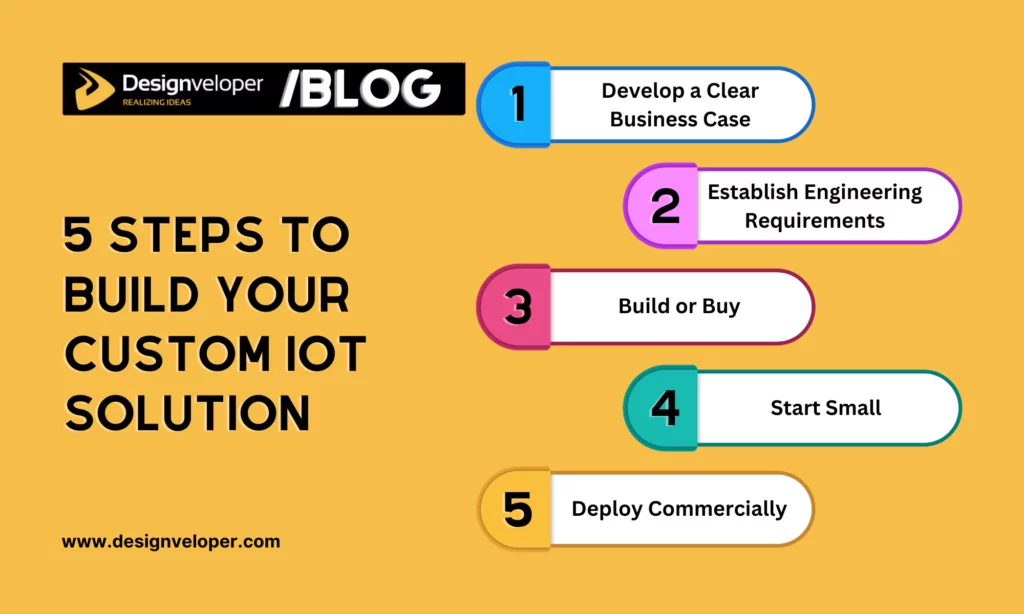
Each company faces different business problems like high equipment downtime or frequent delays in shipment. In such a case, the company needs to strategically build a custom IoT solution to these problems. So, in this section, we’ll detail the key steps your business should follow to tailor an IoT solution effectively:
Step 1: Develop a Clear Business Case
Which problems do IoT projects help your business address? This question lays a foundation for your IoT development journey. However, not all companies can give a clear purpose and objective for IoT usage. Sometimes, they look for an IoT solution because of external pressures (like intense competition), without understanding its full potential for their business performance. Therefore, creating a reliable business case is a must before you jump into any IoT project.
But a clear business case isn’t enough. There are various challenges associated with IoT projects you must anticipate to avoid frustration.
1. IoT development can last longer than expected due to technical issues (like infrastructure compatibility) or business issues (like lack of stakeholder buy-in).
Takeaways: Calculate possible costs and ROI for your IoT deployment and plans for unexpected events like project delays.
2. Embracing IoT projects means changing the way your business works. This change covers new business models, new project management methodologies, and cross-department collaboration.
Takeaways: Acquire senior management’s approval for IoT deployments. Also, engage different departments in IoT projects right from business case development to get them used to new cross-department workings and project management methods like Agile or Lean.
3. It’s crucial to consider whether your team has the necessary skills and experience with IoT integration. These skills may relate to cloud architecture, data analytics, communication protocols (e.g., MQTT), etc.
Takeaways: Identify and fill IoT skill gaps if you want to build an internal team for your IoT project. In doing so, focus on training and upskilling the workforce about IoT-unique technologies. Further, collaborate with reliable providers who have deep expertise in IoT and similar experience in your business domain.
Step 2: Establish Engineering Requirements
After having a clear objective and double-checking the business case, you then use them to define engineering requirements for the IoT solution. Whether you decide to build the solution internally or outsource your project, this step is crucial to identify which components and functionalities your IoT system should have. Accordingly, ask these questions:
- Which smart devices will offer the data your business needs? (e.g., smartwatches, factory equipment, or drones)
- What types of data should your business collect? (e.g., health data, temperature readings, or wind speed)
- What analytical techniques and tools help turn raw data into actionable insights? (e.g., descriptive or predictive)
- Which business systems need to be connected? (e.g., CRM or EHR)
- What services does the IoT system provide? (e.g., predicting equipment breakdown or analyzing a customer’s in-store journey)
Then, make a rough draft of your IoT architecture based on its five layers. At each layer, ask more detailed questions. For example, ask: “How much data do IoT devices produce, in which form, and how fast will it be extracted for analysis?” for the Processing Layer. These questions help you determine your choice of storage solutions (e.g., cloud or edge), data processing capabilities, and communication protocols. Consult IoT experts if your in-house team doesn’t have sufficient hardware and software skills related to IoT to handle those engineering requirements.
Step 3: Build or Buy
Do you plan to customize an IoT system internally from scratch, outsource the project to third-party providers, or use existing solutions like AWS IoT? Regardless of your choice, defining all the necessary engineering requirements helps identify the most critical components of your IoT solution. To select appropriate vendors, consider the following things:
- Offerings & Capabilities: As mentioned, IoT vendors can provide hardware components (e.g., gateways or semiconductors), software, or end-to-end IoT services. Consider their offerings carefully and compare which capabilities they offer. These capabilities can be visualization, enterprise system integration, storage/database, connectivity network, edge analytics, etc. Plus, identify whether their offerings come with customization options to meet your specific needs.
- Security & Scalability: Opt for the IoT providers who offer the security best measures to safeguard your data in transit and at rest. Their offerings also need to comply with specific industry standards to avoid data breaches or penalties. Further, when your IoT system grows, all the components, from hardware to software, must scale accordingly. So, work with those providing scalability capabilities to ensure your solution’s future growth.
- Pricing Models: Consider your budget constraints and compare the pricing plans of different IoT vendors to choose the suitable ones. Don’t forget to calculate costs associated with support, maintenance, and customization in the long term.
- Partner Network: This refers to collaboration between cloud platforms, hardware manufacturers, communication vendors, and other stakeholders. If a vendor has a robust, diverse partner network, they ensure their offerings integrate seamlessly. This both minimizes the risk of incompatibility and speeds up IoT deployments.
Step 4: Start Small
Upon completing the IoT solution, you need to validate its feasibility by experimenting on a small number of the most important scenarios for your company. Once you’ve verified the solution, you can continue to develop additional functionalities and deploy the IoT system in the broader organization. Also in this phase, you should provide necessary training to employees to use the systems and prepare for any changes required by the new business process.
Step 5: Implement Commercial Deployment
In this phase, your IoT solution is deployed to a wide range of smart devices. This is also when you need to focus on managing the overall IoT system and involve employees in widely leveraging it in their daily tasks. Besides, continuous monitoring is crucial to ensure the seamless working of the solution and new business processes.
Conclusion
This article has given you a detailed view of available IoT solutions in today’s market. These solutions cover hardware, software, or end-to-end IoT services that help businesses address certain issues. With our list of 10 best IoT solution providers and a step-by-step guide, you can build a custom IoT system to streamline your workflows, boost productivity, and bring the best business results.
Wanna help with IoT solution development? Partnering with Designveloper, you’ll reach the full potential of the IoT technology. For more interesting topics about IoT, don’t forget to follow us on Facebook, X, and LinkedIn!
Also published on

Share post on










Related Articles


IoT Software Development: A Complete Beginner’s Guide for 2026
IoT Software Development: A Complete Beginner’s Guide for 2026 Published April 29, 2025
IoT in Smart Cities: 10 Transformative Technologies Reshaping Urban Life
IoT in Smart Cities: 10 Transformative Technologies Reshaping Urban Life Published April 22, 2025
Core Technology of IoT: What Businesses Need to Know in 2026
Core Technology of IoT: What Businesses Need to Know in 2026 Published April 21, 2025