









IoT Cloud Architecture: Layers, Data Flow, And Design Decisions

IoT cloud architecture is the blueprint for how connected devices send data through gateways or networks to edge and cloud services, and how applications turn that data into actions. A useful design also defines how commands travel back, how devices are secured, and what happens when a connection fails.
For most teams, the main decision is not whether to use a cloud. It is which work must happen near the device and which work benefits from shared cloud services. That choice shapes response time, operating cost, reliability, and the work needed to manage a growing fleet.
What Is IoT Cloud Architecture?
IoT cloud architecture describes the roles, connections, and rules that make an Internet of Things (IoT) system work as a whole. It covers physical devices, any local gateways, message ingestion, processing, storage, applications, and the control path back to equipment. Security and device management apply across these parts rather than sitting at the end of the data path.
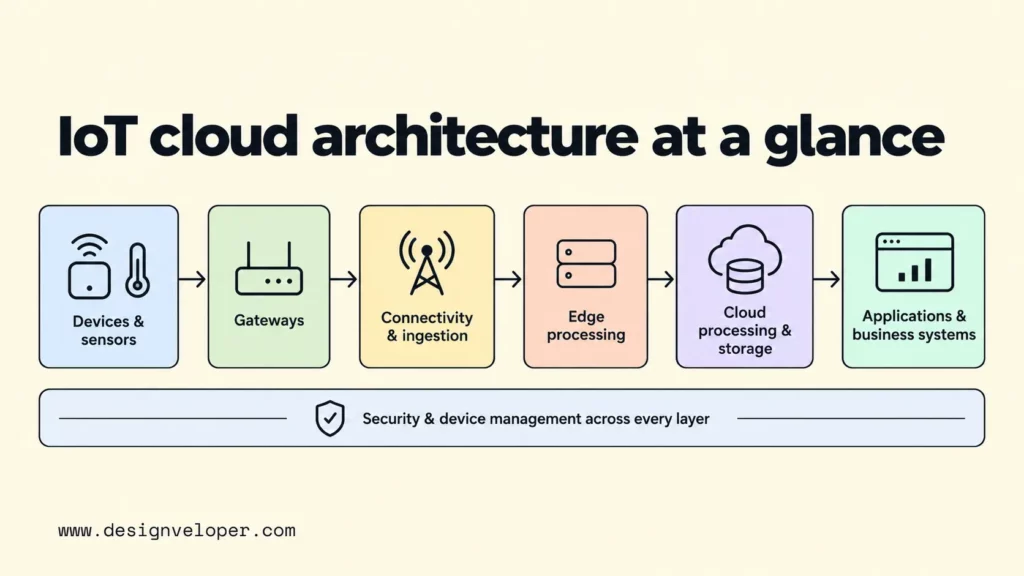
An architecture is different from an IoT cloud platform. The architecture states what the system needs and how its parts interact. A platform supplies some of those functions, such as an MQTT message endpoint, device identity, or update management. Google Cloud’s IoT platform architecture guidance makes this distinction concrete: a full platform can provide fleet services that a standalone message broker does not. For a separate look at products rather than system design, see our comparison of IoT cloud platforms.
There is no single mandatory count of IoT architecture layers. Some explanations group the system into perception, network, processing, application, and business layers. Others separate the edge, cloud, and management functions differently. For design work, explicit responsibilities and interfaces matter more than the number of boxes in a diagram. A device that connects directly to the cloud may not need a separate gateway, for example.
IoT Architecture Layers And Core Components
The core components follow the path from a physical reading to a business response. Each boundary needs a clear owner and a defined way to exchange data. Otherwise, a working sensor can still produce missing, late, or unusable information.
Devices And Gateways
Devices measure conditions or act on instructions. A sensor might measure temperature or vibration. A controller can read that signal and operate equipment, while an actuator makes a physical change such as opening a valve. These roles may share one piece of hardware, but the design should identify what each device can measure or control.
A gateway connects local equipment to the next part of the system when direct cloud access is unsuitable. It can translate a factory protocol into a cloud-friendly message, combine readings, filter unneeded events, or store them briefly during an outage. A gateway may also authenticate downstream devices, but that is an implementation choice, not a guarantee. Microsoft’s IoT Edge gateway documentation describes different gateway patterns, including protocol translation.
Connectivity And Data Ingestion
Connectivity determines how readings reach a trusted ingestion service. A short-range, battery-powered sensor may use Bluetooth Low Energy or another local radio link to reach a gateway. A fixed machine may use a wired industrial network. A remote device might use cellular connectivity. The choice depends on distance, power supply, payload size, available bandwidth, acceptable delay, and the likelihood of disconnection.
The protocol used on a local link is not necessarily the one used to send messages to the cloud. A gateway might read a machine through OPC UA, then publish a normalized event through MQTT over a protected network connection. The receiving service must verify who may connect and what that identity may publish. AWS documents how its IoT Core message broker and rules engine separate message receipt from downstream routing.
Before implementation, define a shared event format. Include the device identifier, event time, measured value, unit, and a way to identify repeated messages when needed. A temperature reading without its unit or timestamp can reach storage successfully and still mislead an application. Consistent schemas make data from different device models easier to compare.
Edge And Cloud Processing
Edge processing handles work close to the equipment when waiting for a cloud round trip is too slow or too risky. An on-site service can remove noise, calculate short-window summaries, detect a local threshold, or keep an operator display working without internet access. The edge still needs computing capacity, software updates, and local monitoring.
Cloud processing is better suited to work that benefits from larger data sets or shared infrastructure. It can compare readings across sites, store long histories, and run scheduled or streaming analysis. Microsoft describes both cloud-connected and edge-connected IoT patterns, including systems that use both. The key is to assign a processing task where its timing and connectivity needs can be met.
Local processing does not automatically make a system safe. A critical machine stop must be handled by a suitable local control system with its own verified safeguards. Cloud analytics can recommend maintenance or change a noncritical setting, but it should not become the only route for a safety-critical response.
Storage, Applications, And Enterprise Integration
Storage should match how the data will be used. Recent operational readings may need quick access for live dashboards and alerts. Historical readings may belong in a time-series store or another system suited to trends and reporting. Retention rules should reflect the actual decision, audit, or analysis need. Keeping every raw event indefinitely can increase cost without improving the result.
An application turns stored or incoming data into a useful response. It might show that a pump is running unusually hot, alert an engineer, and record whether someone acknowledged the warning. An application programming interface (API) can pass an approved event to an enterprise resource planning (ERP) system or a computerized maintenance management system (CMMS). Those links should carry enough device and event context for the receiving team to act.
The analytics method should follow the decision. A simple threshold may be enough for an urgent maintenance warning. Trend analysis may help identify a slow change over weeks. Our guide to IoT data analytics explains how these methods differ and why an insight needs a practical response path.
IoT Data Flow From Devices To Cloud And Back
IoT data flow has two directions: telemetry travels from equipment toward applications, while approved commands or settings can travel back. A complete design must show both. Receiving a reading does not prove that a device can safely receive and carry out an instruction.
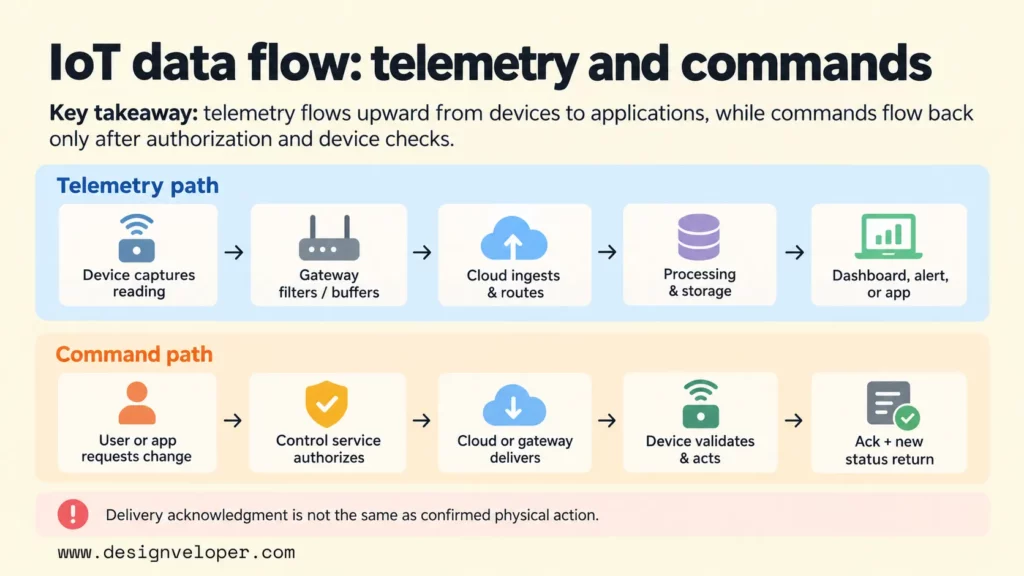
On the upward path, a device records an event with its identity and measurement time. If a gateway is present, it can check the local sender, translate the payload, and filter or buffer events. A cloud ingestion endpoint authenticates the connecting client and checks its permissions. A message broker or routing service then sends accepted events to processing and storage. An alert or dashboard consumes the resulting information.
The return path begins with an authorized user or application requesting a change. A control service checks the request and directs it to the correct device or gateway. The receiving system checks whether the command is valid in its current state, applies it when allowed, and reports success, failure, or the new state. An acknowledgment that a message arrived is not the same as proof that the physical action happened. For important commands, record both outcomes separately.
Disconnections complicate both paths. The gateway may queue telemetry and send it when a connection returns, but delayed data must retain its original timestamp. Applications must also handle duplicates and out-of-order events. The MQTT 5.0 standard defines at-least-once delivery for QoS 1; applications still need a strategy for repeated events. Commands require stricter rules because replaying an old instruction may be unsafe. Use expiry, state checks, and command identifiers where appropriate.
Cloud, Edge Computing, And Hybrid IoT Architecture Models
Choose a cloud-centric model when work can tolerate network delay, an edge-first model when the site must respond locally, and a hybrid model when both needs are important. These labels describe where processing happens. They do not dictate a specific vendor or require every device to connect through the same network.
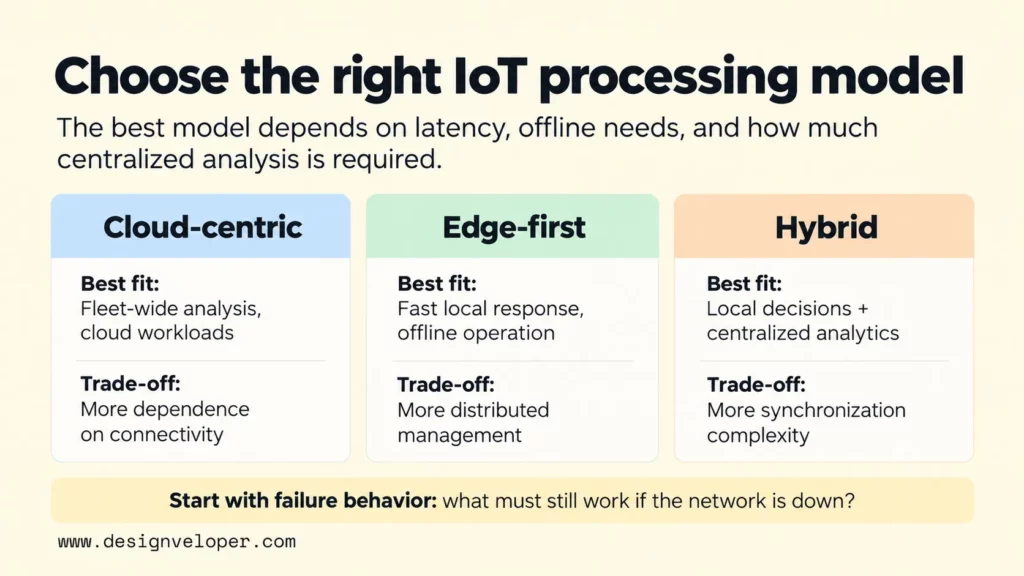
| Model | Best Fit | Main Trade-Off |
|---|---|---|
| Cloud-Centric | Fleet-wide analysis and workloads that tolerate network latency | Greater dependence on connectivity and data transfer |
| Edge-First | Fast local response or operation during connectivity loss | More constrained resources and distributed-device management |
| Hybrid | Local decisions combined with centralized analytics and fleet management | More synchronization and operational complexity |
A cloud-centric design can keep business logic in one place. That can simplify shared reporting, but it leaves time-sensitive operations exposed to network interruptions. Edge-first processing avoids the cloud round trip for selected decisions. In return, teams must deploy and maintain software across more locations. A hybrid setup adds a way to compare sites while local processes continue, but requires clear rules for synchronization.
Use failure behavior to settle a close choice. Ask what the device must do after five minutes without internet, not only how quickly it responds on a good day. Then ask which information still needs to reach a central system and when. An architecture that passes a speed test but loses necessary events during an outage has not met its operating requirement.
IoT Cloud Architecture Example: Factory Condition Monitoring
Consider an illustrative factory that wants to detect unusual machine conditions before a planned maintenance window. Each machine has vibration and temperature sensors. A nearby gateway reads the signals, checks their timestamps, and attaches a stable machine identifier. This is an example of a possible design, not a reported Designveloper project or a measured performance result.
The gateway calculates a simple rolling summary and flags values outside a site-defined rule. It can notify an on-site operator even when the internet is unavailable. It also forwards selected readings and alerts to the cloud when connected. The cloud stores the history and compares recent behavior with earlier readings. If a review rule is met, an application prepares a maintenance alert with the affected machine, time, values, and supporting trend.
A CMMS integration can turn the confirmed alert into a work request rather than leaving it on a dashboard. An engineer still needs enough context to decide whether to inspect, monitor, or schedule maintenance. For related factory systems and their constraints, our industrial Internet of Things overview explains the relationship between connected equipment, operational systems, and people.
Suppose connectivity fails for an hour. The gateway keeps only as much data as its tested local storage can hold, maintains the permitted on-site warning behavior, and marks events with their original times. After reconnection, it uploads the backlog in manageable batches. The cloud then removes repeated events before updating trends. If the buffer fills, the system needs a documented policy for which data to keep and how to report the gap.
The example also shows where control belongs. A maintenance alert can reach the cloud and create a work request. A safety stop, if needed, belongs to a separately assessed local control system. The architecture should not depend on a delayed analytics message to protect a worker or machine.
IoT Device Management, Security, And Reliability In Production
A production-ready IoT cloud architecture needs more than a successful data demo. Teams must prove that devices can join securely, survive expected failures, stay maintainable, and produce useful information at the required scale. The following deployment checks turn those goals into testable questions.
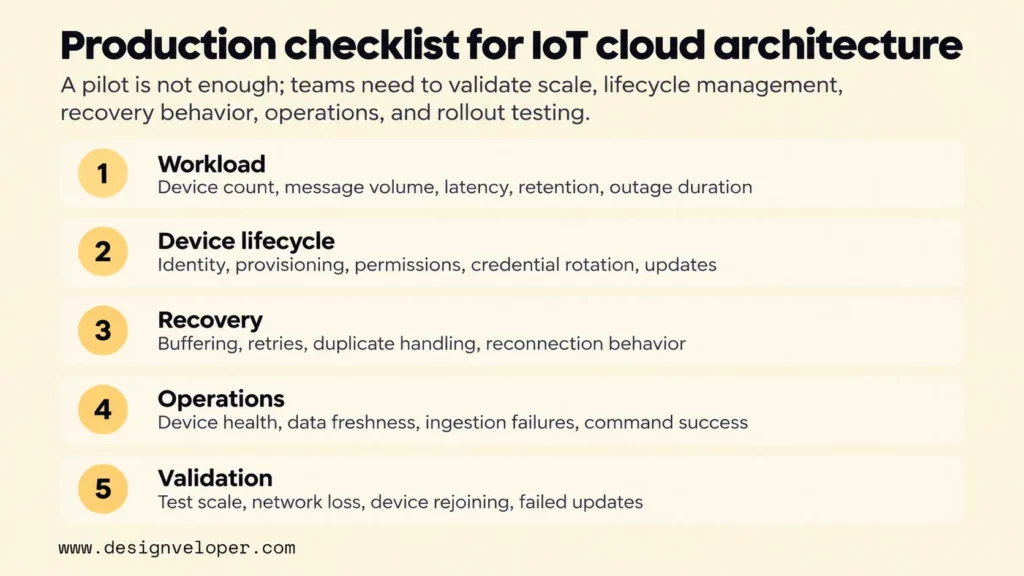
- Size the workload. Record the expected device count, messages per device, payload size, busiest reporting period, response-time target, retention period, and longest expected outage. Test peak traffic and backlog recovery, not just average traffic. These inputs help estimate network use, processing capacity, and storage.
- Plan the device lifecycle. Give each device a unique identity and an approved provisioning process. Limit permissions to the messages and actions it needs. Define how credentials are rotated or revoked, how firmware is updated or rolled back, and how a retired device loses access.
- Design recovery behavior. Set buffer limits, retry rules, message identifiers, reconnection behavior, and time synchronization. Decide how an application treats late readings and duplicates. A network retry should not silently run the same physical command twice.
- Monitor operations. Track device connectivity and health, age of the newest reading, ingestion failures, queue lag, rejected authentication, update outcomes, and command completion. Route alerts to someone who can distinguish a failed device from a failed data path.
- Validate before rollout. Simulate power loss, network loss, device rejoining, high message volume, expired credentials, and a failed firmware update. Test local safe-state behavior with the responsible engineering team. Document what must be fixed before expanding the fleet.
Security has to span the device, gateway, network, and cloud. The NIST IoT device cybersecurity baseline offers a starting point for identifying device capabilities that support common security controls. It is not a certification that a particular deployment is secure. Our guide to IoT security risks also covers practical issues such as weak credentials, updates, and network exposure.
Before approving a design, trace one normal reading, one failed reading, and one command from start to finish. For each, identify where it is checked, stored, retried, observed, and acted on. This small exercise often reveals missing responsibilities faster than choosing more cloud services.
If your team needs a custom device-to-cloud integration or application, we can discuss the interfaces and acceptance tests before development begins. Start with the device types, the business action each reading should support, and the required offline behavior. Our custom software development services provide a route to discuss an application or integration scope without assuming a ready-made IoT solution or claiming an unverified IoT project.
Also published on

Share post on









Related Articles


IoT Cloud Architecture: Layers, Data Flow, And Design Decisions
IoT Cloud Architecture: Layers, Data Flow, And Design Decisions Published October 20, 2026